You are having your wildest expectations met with your software, with thousands of users signing up for it and data flowing seamlessly. Then an official notice arrives stating that your platform fails to meet the personal data protection law.
Well, when it comes to Saudi Arabia’s digital transformation under Vision 2030, data is now the main part of the economy. You cannot just settle on finding a mobile app development company in Saudi Arabia and launch your product.
There, you need a partner who treats compliance as a core architecture requirement to make your final product aligned with compliance.
Why is compliance the new basic foundation for success?
Saudi Arabia’s digital ecosystem is going under a renaissance. Under the vision of 2030, the kingdom is constantly evolving into a global tech hub where data is the foundational bedrock of the modern economy.
When the environment is this competitive, software no longer just flashes the features or sleeps on interfaces; they have to be rooted in trust and legal integrity.
For years, many corporate leadership teams saw government regulations as a final problem and like a checkbox to be ticked before the launch.
But, with this year, the afterthought approach is a costly mistake that can lead to massive delays in projects and still keep your product vulnerable to security gaps.
Understanding the PDPL and National Cybersecurity Standards of Saudi Arabia
In the Kingdom, the complete regulatory system is governed by two main watchdogs: the Saudi Data and Artificial Intelligence Authority, or SDAIA, and the National Cybersecurity Authority, or NCA.
While SDAIA focuses on the Personal Data Protection Law, or PDPL, making sure about the privacy and rights of individuals, the NCA builds a foundation for essential cybersecurity controls, or ECC. It gives the base level national security rules for government entities and their important suppliers.
Now, to build a platform that thrives, you must understand that these rules are not suggestions; they are actually some key legal instruments. For example, one important pillar of these regulations is data residency.
Generally, personal data collected from Saudi residents should be stored and processed within the Kingdom, with cross-border transfers only available under strict conditions and regulatory approvals.
Understanding the data
Not all data is treated equally under the PDPL. The law defines “personal data” as any information that can identify an individual directly, like their name or phone number using linked databases.
There is also a special category in it which is sensitive data that consists of health records, genetic data, biometric identifiers, and religious beliefs that asks for more stringent safeguards.
For complex projects like ERP software development, where a system might handle everything from employee payroll to sensitive financial records, the architecture must be built to isolate these high-stakes categories.
All unauthorized access to sensitive data can lead to immediate legal action and severe damage to the reputation.
The cost of not complying with the given standards
There is a huge cost of not complying earlier because the kingdom has introduced a penalty framework that is designed to ensure absolute accountability. Violations of the PDPL are not mere slaps on the wrist but can trigger the following.
- Direct Fines: Up to SAR 5 million for just one violation that can also reach to double if you perform these offenses on repetition.
- Criminal Liability: If one discloses or transfers sensitive data on intention that the law can detain them for imprisonment for up to two years.
- Business impact: Serious cases can take the form of suspension of business licenses too or the complete shutdown of a digital service.
| Regulation | Key Focus | Responsibility |
| PDPL | Data Privacy & Rights | Protects |
| NCA ECC | Cybersecurity Baseline | Ensures national security and infrastructure integrity |
| SAMA Framework | Banking & FinTech | Mandatory for any platform handling financial transactions |
Once you weave the rules into the initial blueprint, you can make sure that your platforms are not just functional but legally bulletproof in the eyes of Saudi authorities.
Building the blueprint to satisfy design and data residency for Saudi Arabia
Now here is the main part that you cannot skip if you are ready to prepare your blueprint that satisfies the data protection laws in Saudi Arabia.
The principle of privacy by design
A compliant framework starts long before the first line of code is written, as it begins with the privacy-by-design philosophy. This means adding data protection into every phase of your software development life cycle in place of trying to bolt it in as a final step.
In the Saudi context, this architectural blueprint is defined by how you handle the movement, storage, and access of citizen information.
Sovereign Infrastructure with the Data Residency Rule
One of the most defining features of Saudi law is the data localization requirement. Under the PDPL, personal data collected from Saudi residents must normally be stored and processed on the servers that are located within the Kingdom.
While cross-border transfers are allowed, in specific cases like fulfilling a contract or with explicit regulatory approval from SDAIA, the best practice for most organizations is to utilize Saudi-based cloud regions to minimize legal complexity.
For complex projects like ERP software development, this residency rule is paramount. Because an ERO system serves as the central nervous system of a business and holds everything, this massive data repository staying within national borders is the safest way to maintain long-term compliance.
Technical Pillars of a Compliance Architecture
To meet the key standards of both the PDPL and the NCAs’ Essential Cybersecurity Controls, or ECC, your technical teams must focus on these given design points.
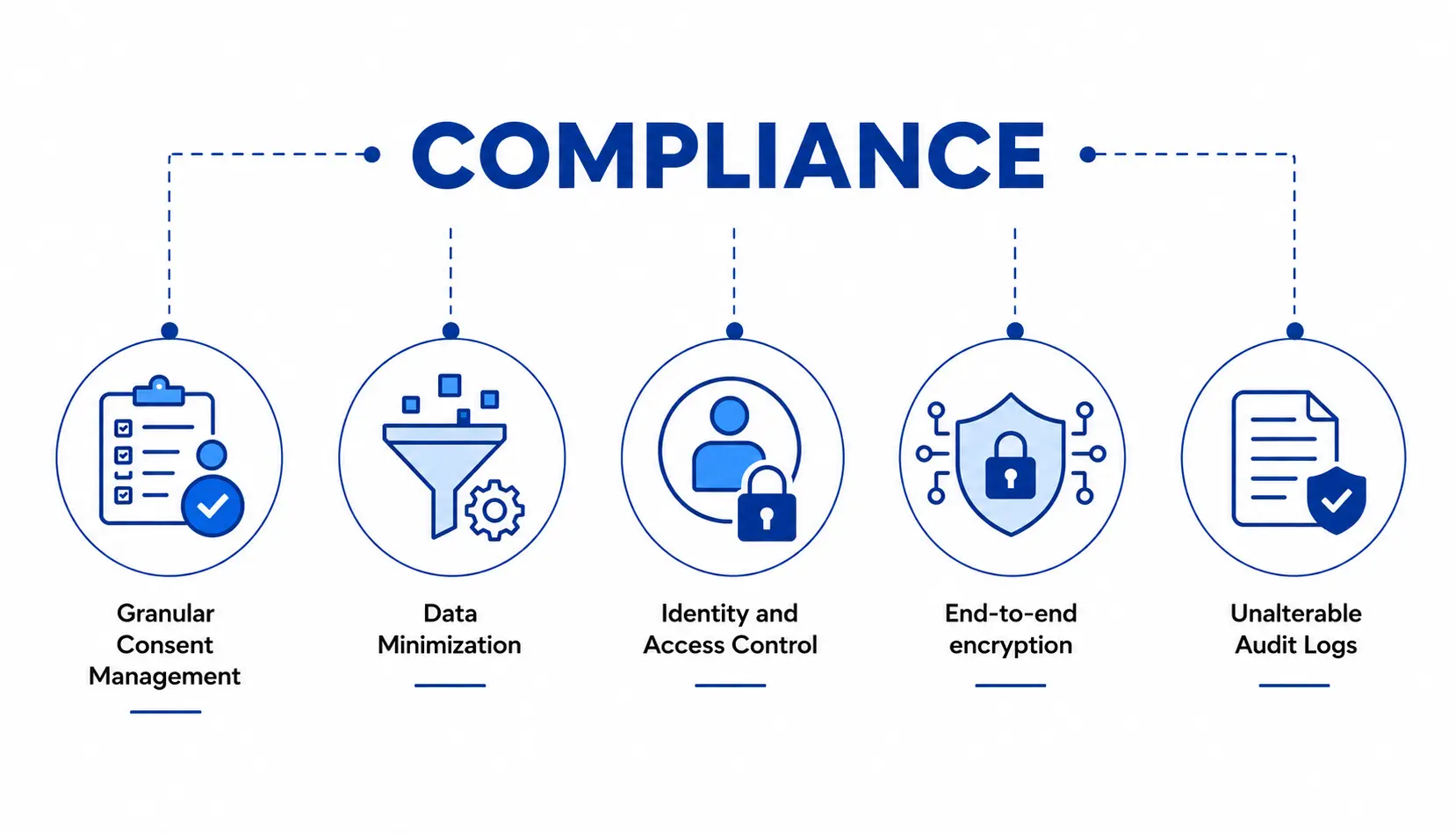
Granular Consent Management
Your UI/UX must feature clear screens that are friendly to users where individuals can quickly grant consent without having to read lengthy documentation. But, prechecked boxes are a direct violation, and consent must be explicit, documented, and just as easy to withdraw as it was to give.
Data Minimization
Only collect what is strictly important for a defined business purpose. If a feature does not truly need a user’s birthday or location to function, the system should not request it.
Identity and Access Control
Both the administrative as well as user accounts must use multi-factor authentication or MFA, and role-based access controls or RBAC. With it, a product makes sure that even within a business, sensitive data is only visible to those whose roles mainly require it in place of being visible to everyone.
End-to-end encryption
Data should not only be encrypted at rest or when stored on a disk but also during the transit while it moves across the internet using industry standard protocols.
Unalterable Audit Logs
Systems must maintain permanent, safe logs of all administrative actions and system calls. These digital paper trails are important for future government audits or when investigating a given security incident.
When you follow these blueprint requirements, you make sure that your platform satisfies multiple state demands at the same time, thus lowering the need for expensive structural changes once the product is live.
How should you weave Saudi Arabian compliance into the CI/CD pipeline?
From the technical point of view there are a few things that you or your technical partner should keep in mind.
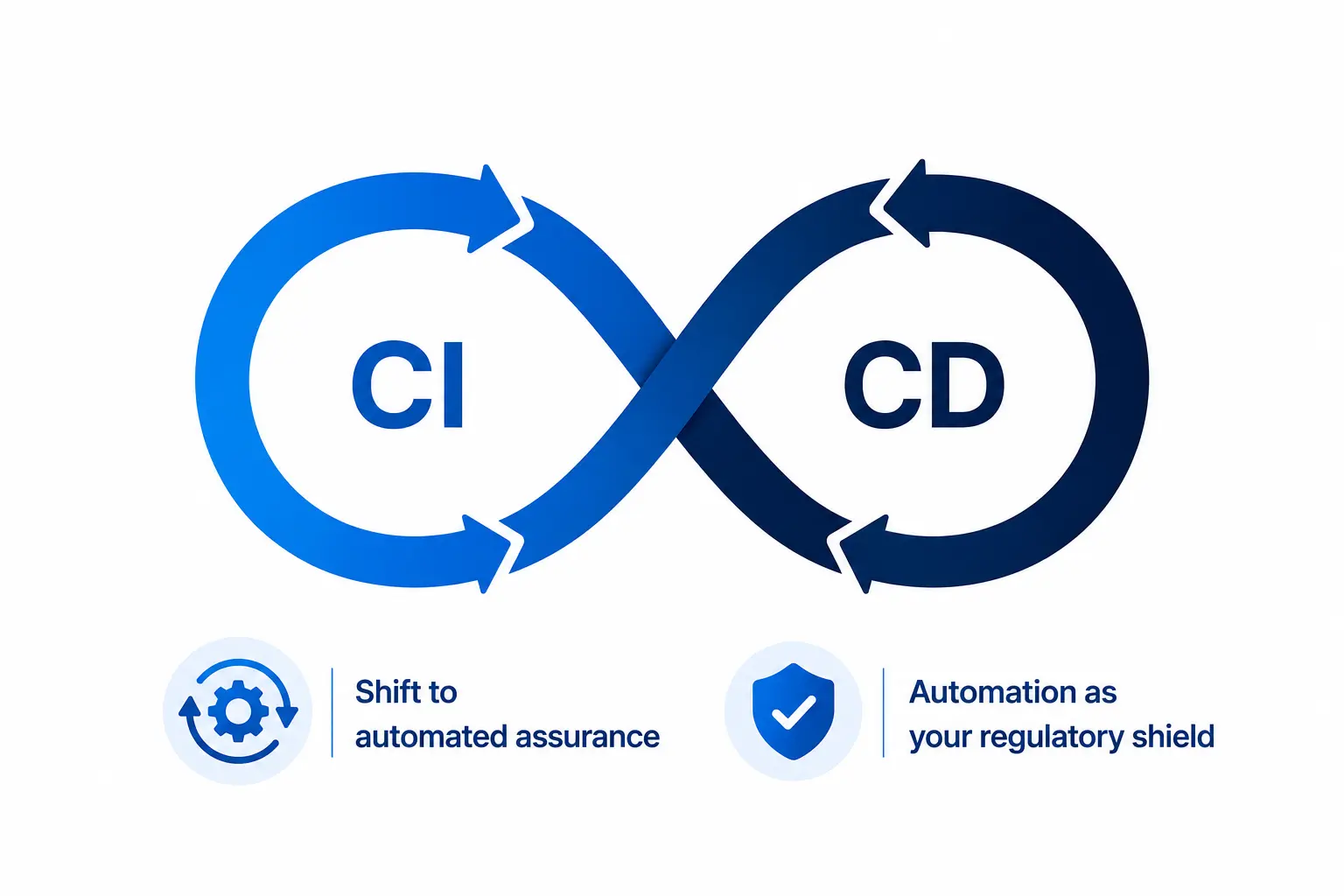
Shift to automated assurance
In the traditional software world, security was mostly a gate at the end of the journey, a final, often painful, manual audit before a product went live. In the modern Saudi digital ecosystem, this model is obsolete.
Leading development teams now adopt DevSecOps, a methodology where security and compliance checks are automated in the entire development lifecycle. In place of waiting for the end of the project, compliance is connected into every sprint and release cycle.
Automation as your regulatory shield
To stay ahead of evolving threats and strict regulatory timelines, your continuous integration and continuous deployment or CI/CD pipeline must act as an automated filter.
Modern workflows now run given software tools automatically to verify every code update before it ever touches a production server.
Key practices in the compliance pipeline include the following:
- Static and Runtime Testing or SAST/DAST that automatically scans the source code and runs applications for risks before you deploy it on the final platforms.
- Software Composition Analysis or SCA identifies third party components of libraries that are not secure and could compromise your data integrity.
- Infrastructure as code scans your cloud configurations and container setups to find out if they meet national security baselines before they are provisioned.
Maintaining the digital paper trail
Regulatory oversight does not end at launch; it is a continuous process of tracking and refinement. This is where robust compliance guidelines are more than important for your engineering team.
With an established clear internal manual for securing code on the basis of international standards like OWASP and local NCA controls, developers can make sure that every system call is logged and every administrative change is tracked in an unalterable audit file.
The 72-hour commitment
Finally, your pipeline must support an incident response plan. Under the PDPL, if a data breach occurs that could harm individuals, the Saudi Data and AI Authority, or SDAIA, must be notified within 72 hours.
A compliance developer’s journey consists of building the internal alerts and monitoring tools important to detect, contain, and report these incidents within that tight legal window.
Once you automate these defenses, you move from a reactive posture to a proactive one, thus shipping corporate software with total confidence.
Real-world lessons to dodge the compliance challenges in Saudi Arabia
Many businesses fail not because their technology is weak but because they treat regulatory rules as a final checkbox exercise in place of a technical roadmap. There are several mistakes that are consistently responsible for derailing the product launches in the kingdom.
One of the most common errors is choosing the cloud host before confirming data residency rules. This mistake mostly leads to forced infrastructure changes and expensive migration delays when companies realize their chosen provider does not meet Saudi localization standards.
Normally, viewing the PDPL as a legal paperwork task in place of an architectural requirement results in faulty data-gathering methods that are illegal under the law.
| Common Corporate Mistake | Direct Commercial Impact | How To Prevent It |
| Choosing cloud hosts before residency checks | Forced infrastructure changes & high operating costs | Map out data locations before signing contracts |
| Viewing PDPL as simple paperwork | Illegal file-handling & faulty data methods | Code consent tools directly into the app layout |
| Postponing security testing | Costly system rewrites post-launch | Use automated deployment and DevSecOps pipelines |
| Neglecting employee access controls | Credential abuse & security breaches | Implement MFA and RBAC from day one |
Furthermore, neglecting the use of secure third-party components or failing to maintain a record of processing activities or RoPA are major roadblocks that trigger enforcement actions from SDAIA.
Treating compliance as a one-time event in place of an ongoing process is perhaps the most dangerous trap of all. By internalizing robust compliance guidelines as part of your daily engineering culture, you make sure that security is built in, not bolted on, shielding your business from penalties of up to SAR 5 million.
Partner with NetSet: Your gateway to a Saudi Compliant Product
As Saudi Arabia continues to make its digital framework stronger, you have to stay ahead of the PDPL and NCA standards without any option. Our team at NetSet Software can help you transform these complex legal demands into integrated digital assets.
We have architected a number of future-ready ecosystems that respect Saudi residency rules and user rights from the first line of code. And, if you are also planning to build a platform that complies with Saudi guidelines, let’s build a lasting trust and total compliance product for you.

FAQs
Does the PDPL apply to small startups or only large corporations?
The law is something that all the entities whether they are public or private, and small or large, need to take care of when they process personal data of individuals who live in Saudi Arabia.
What will be the penalty if a business fails to comply with standards in Saudi Arabia?
In case a business fails to comply, they have to pay fines that can even touch SAR 5 million and if any entity discloses sensitive data intentionally, serious penalties like imprisonment for up to two years can take place.
Is Saudi cloud hosting mandatory for every application?
While residency rules favor local storage, your hosting location depends on your given industry and target users. However, storing personal data with the kingdom is the safest way to ensure compliance.
How quickly must we report a data breach to the authorities?
Under the PDPL, businesses are generally required to notify the Saudi Data and AI Authority or SDAIA within 72 hours of finding a leak that could harm individuals.
Can we add compliance features after our software has already launched?
Yes, but this is going to be one costly mistake that can end with 30 times more expenditure just to fix the issues once the product is already launched.