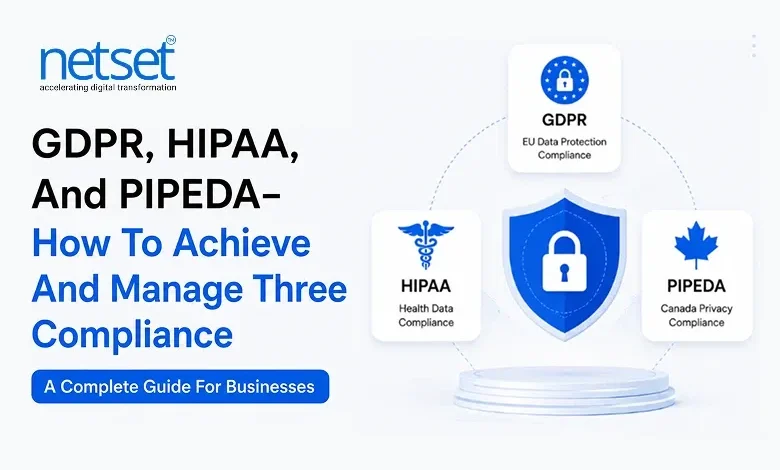
When digital economies grow, there come the data privacy concerns and the organizations to monitor those concerns.
A lot of businesses work across the borders, and for them, mishandling the information leads to huge financial penalties that have reached billions globally in recent years and a loss of consumer trust.
But the three organizations that monitor digital privacy today act as a guide, especially for health and wellness applications.
To comply with them is no longer an option today, because they are a baseline for any company that values reputation and global market access.
Getting to know the big three regulations—HIPAA, GDPR, and PIPEDA
To manage compliance in the most effective manner, you first have to understand the rules from the main moderators and there are three of them that you have to focus on.
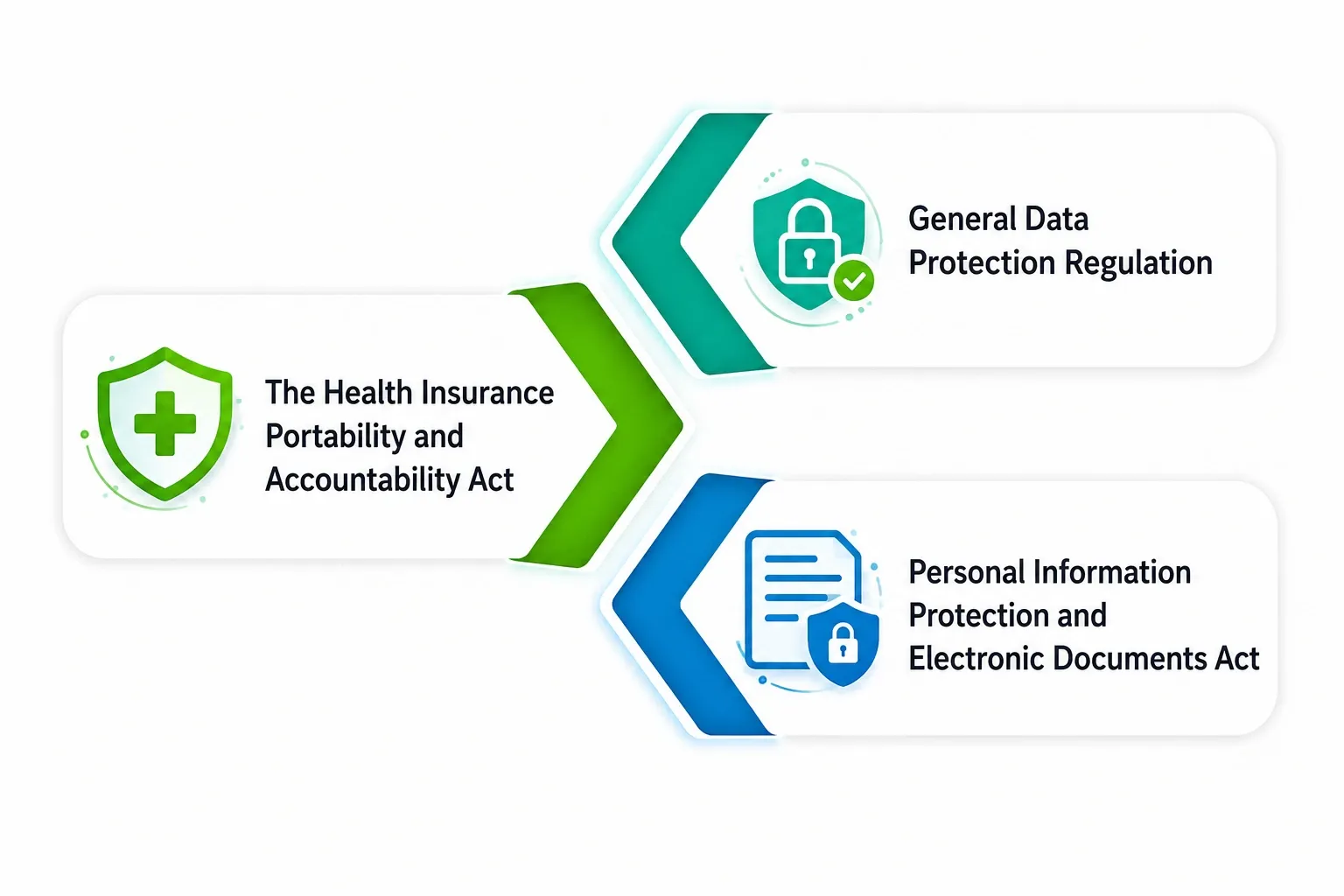
The Health Insurance Portability and Accountability Act
If you are confused by the name, you might be knowing this with the acronym HIPAA, a US federal law built mainly to protect health information or the PHI. It applies to covered entities like:
- healthcare providers
- business associates who are the third-party vendors handling PHI on their behalf
- HIPAA compliance application development providers partnering with these associates.
They must adhere to the privacy rule, which sets the national standards for protecting medical records and the security rule, which focuses on electronic safeguards like encryption and firewalls, which is really mandatory.
General Data Protection Regulation
Across the Atlantic, GDPR provides a detailed set of guidelines for any entity processing the personal data of EU residents, no matter where the business is actually located. They are not tied to any given sector like HIPAA but cover everything from names and email addresses to biometric identifiers across every industry.
It demands a clear lawful basis for processing and strict consent protocols and gives individuals notable rights, like the right to have their data deleted (the right to be forgotten).
Personal Information Protection and Electronic Documents Act
Finally, Canada’s PIPEDA takes care of how privacy sector businesses collect, use, and disclose personal information at the time of commercial activities. PIPEDA is built on 10 Fair Information Principles that include accountability, identifying purposes, and getting meaningful consent.
While it applies to most Canadian businesses, the organizations must also be aware of provincial laws like those in Alberta, British Columbia, or Quebec, and if provincial laws are “substantially similar” to PIPEDA, then businesses in those provinces follow the provincial law instead of PIPEDA.
All these data privacy regulators are a global standard for data protection and every business has to understand their jurisdictions and the types of data they cover. It is usually the first step to create that unified strategy which can satisfy the US, EU, and Canadian regulators, all at the same time.
The similarities between HIPAA, GDPR, and PIPEDA laws
All of these are different jurisdictions but share a common DNA that is about protection of privacy for users.
Main idea is similar
It is the idea that you should only collect the information when it’s necessary for your goal and the purpose limitation that makes sure that data is not used for anything other than its original intended purpose.
Privacy by design is the core
Another shared pillar is the concept of privacy by design, which guides that security should not be an afterthought but must be built into your systems from day one. This consists of implementing strong technical safeguards, like the encryption for data both at rest and in transit.
For those who build modern health and wellness applications, this connection is actually a benefit. It’s because you build a high-standard, unified security architecture that you can mostly use to satisfy all the major requirements from these three regulations.
Where do the HIPAA, GDPR, and PIPEDA rules clash?
With the similarities comes a friction point where these laws feel different, notably asking businesses to have different, jurisdiction-specific controls.
The Explicit Consent
With GDPR, if you want to process someone’s sensitive personal data (like health information), you need their explicit, detailed, and freely given consent. It has to be very clear and specific.
Under HIPAA, healthcare providers do not need that same kind of explicit consent for everyday operations. They are allowed to use and share health information for treatment, payment, and healthcare operations automatically.
However, for uses that go beyond those, like marketing or research, HIPAA requires separate patient authorization.
The Breach Notification Timelines
Now these timelines also vary widely because under the GDPR, you must notify the given authority within 72 hours of finding a breach. But in HIPAA, you have to notify within 60 days and PIPEDA requires it as soon as feasible.
The Right to be Forgotten
Further, the GDPR’s right to be forgotten can directly conflict with HIPAA and PIPEDA, which mandate that medical records should not be retained for given periods, like up to six years.
Finding these legal traps is where expert AI app development services in India become invaluable, as it helps you build modular consent flows and data routing logic that automatically adjust on the basis of where your user is located.
The 3-step bundle plan to reach HIPAA, GDPR, and PIPEDA compliance
Now, building a robust compliance program should not be overhelping, especially if you have a structured roadmap and if you don’t have one, then follow the below.
The first steps
You have to start with conducting a thorough information audit and data mapping exercise to find exactly
- What personal data do you process?
- Where is it stored?
- Who has access to it?
Under the GDPR, for example, you must stay prepared to show this list of processing activities to regulators with details to show why you collect the data and how long you plan to keep it.
The second steps
Once you understand data flow, you have to perform unified risk assessments, specifically a HIPAA security risk analysis and a GDPR data protection impact assessment, or DPIA. It is basically done to find and mitigate the potential risks before they take the form of a breach.
Here don’t forget the transparency as it is an important pillar to take care of where you must provide clear and easy-to-understand information in your privacy policy about:
- your data processing
- the legal basis for your activities
- how users can use their rights, like asking for a copy of their data or deletion.
This transparency is important if you want meaningful consent under PIPEDA and build long term trust with your users.
The Final Steps
At the end, ensure that your relationships with third-party vendors are governed by strong contracts like data processing agreements or DPAs for the EU and Business Associate Agreements or BAAs for the US to ensure they handle data with the same level of care you do.
For organizations, especially those building digital products with mobile app development services in India, these steps will help them to prepare their infrastructure to satisfy the international regulators from day one.
How to stay compliant with HIPAA, GDPR, and PIPEDA for the long term?
You also have to understand that compliance is not a one time project but a constant program that asks for dedicated oversight and constant improvement.
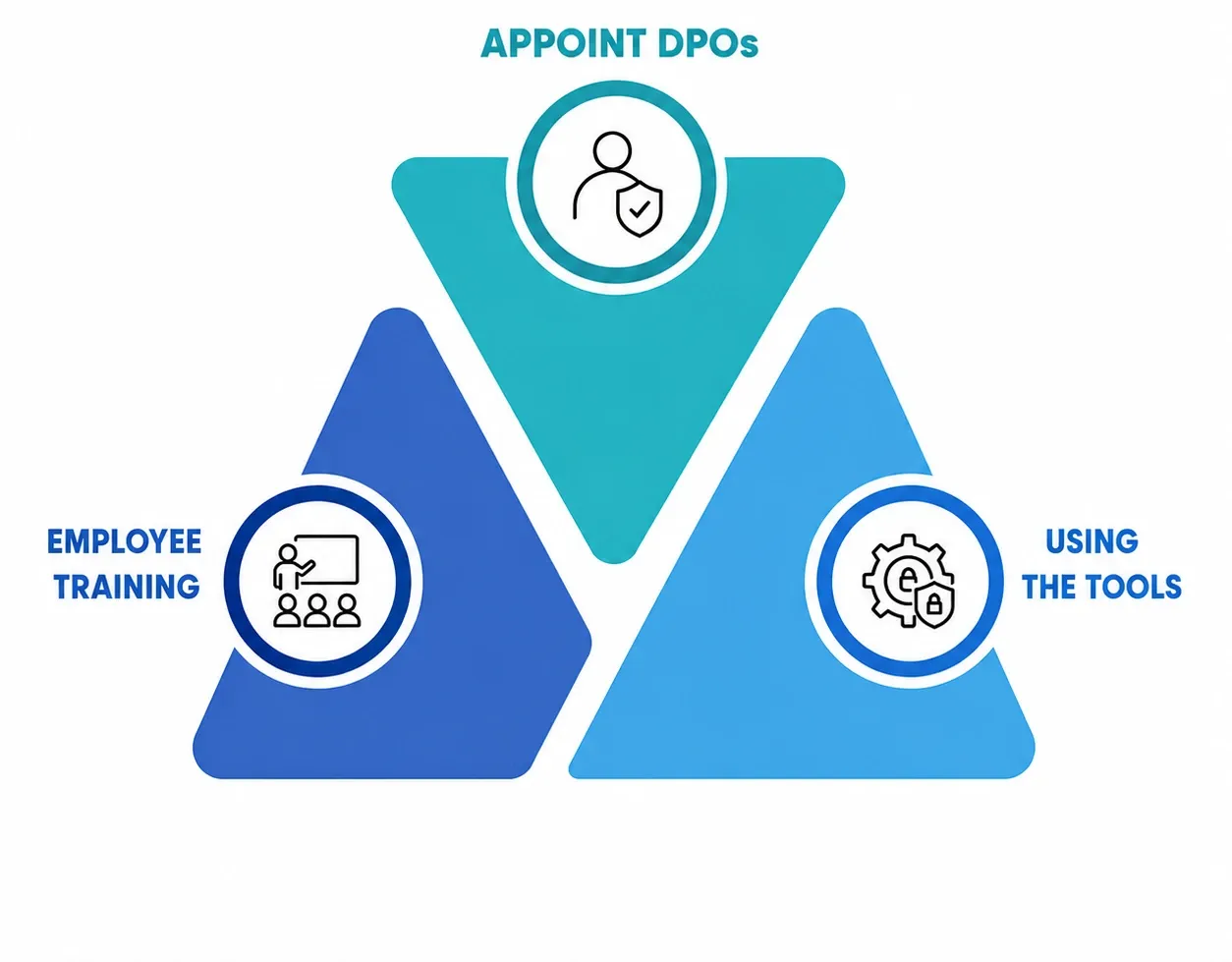
Appoint DPOs
An important part of this is appointing the right personnel, like a data protection officer for HIPAA, who are empowered to monitor your adherence to the law and evaluate the effectiveness of your policies. These officers play an important role in making sure that privacy by design remains a core part of every new feature or service you launch.
Employee Training
Time to time training for employees is really important for all three frameworks so that every team member understands their role in protecting sensitive information and knows how to follow your security procedures.
Using the Tools
To manage this complex workload efficiently, many businesses move away from manual tracking, which is often error-prone, towards compliance management solutions. These tools provide real-time risk monitoring and automated evidence collection that make it much easier to stay audit-ready at the time of custom mobile app development projects in India.
All these habits in your daily operations will help you transform data protection from a regulatory burden to a reliable business asset.
Your Partner for Data Protection Requirements—NetSet Software
Management of overlapping requirements of HIPAA, GDPR, and PIPEDA is for sure a complex task, but it should not be seen as a regulatory burden. In place of it, integrated compliance serves as a powerful competitive differentiator that proves to your global users that you value their privacy as much as they do.
At NetSet Software, that’s what we help you achieve because we understand this ecosystem is more than just a checklist. Our expert team has hands-on experience in privacy impact assessments and deep PHI risk analysis so that your organizations stay ahead of all the evolving risks.
Your requirements can be anything from handling sensitivity across US, EU and Canada to integrating compliance modules in your mobile app where NetSet delivers you that exact security culture and win the long term trust of your clients.
FAQs
What makes GDPR, PIPEDA and HIPPA different from each other?
HIPAA protects information within the healthcare system, GDPR covers all personal data in every sector, and PIPEDA, regulates private sector businesses who handle personal information for commercial activities.
Is encryption required for all three regulations?
All these three focus on safeguarding data where encryption is just one of the methods to achieve those regulations. Under HIPAA’s Security Rule, for instance, you must implement appropriate technical safeguards to make sure of the confidentiality of electronic protected health information.
Do I need a Business Associate Agreement (BAA) if I’m in Canada?
Canadian healthcare organizations can get legal protection by signing a BAA with U.S.-based service providers. However, generally, BAAs are not signed between two Canadian companies, and some major service providers may refuse to enter into these specific agreements.
What happens if I have a data breach in more than one country?
You must meet the specific notification timelines for each jurisdiction. GDPR requires notifying authorities within 72 hours, while HIPAA generally allows up to 60 days, and PIPEDA requires reporting “as soon as possible” after they find a sensitive data compromise.
Can a third-party service “certify” me as compliant?
Be cautious because there are no official compliance certification programs confirmed by regulatory bodies for PIPEDA or HIPAA. While some third parties offer certifications, they do not prevent a regulatory body from finding a violation later because compliance is an ongoing responsibility of the organization, not a one-time badge.