For decades, software engineering has been about building logic step by step, writing lines of code, and going with debugging sessions.
But the picture of software creation is completely different, where AI development service providers are going with an AI engineering approach. In place of developers manually coding every function, intelligent models now act as co-engineers, where they understand the intent and generate solutions on the basis of that.
This AI-first development approach transforms engineers from coders into orchestrators who are there to guide the learning, adaptation, and innovation much faster than traditional methods ever could.
The new architectural layers stack of AI-first applications
When it comes to AI-first engineering, it is not just about replacing the code with models; it is more about reshaping the very way developers work with their stacks.
In place of a linear pipeline of outputs, the new architecture feels alive where it mixes reasoning, memory, and symbolic rules into systems that adapt in real time.
The core infrastructure (brain, memory, and orchestration)
At the foundation lies the “brain” that is the large language model that interprets intent and generates responses. But brains alone are not enough. They need memory to recall context across sessions and orchestration layers to coordinate multiple agents working together.
Think of it as a digital nervous system where the model provides intelligence, the memory ensures continuity, and the orchestration acts like a conductor, thus keeping every component in sync
This triad forms the beating heart of AI software development company workflows.
Data integration to prepare information and system logic
AI systems thrive on data but raw information is of no use which is why there requires a layer that can clean, structure, and mix data with system logic.
It is also where APIs, databases, and knowledge graphs work together in the model so that outputs are grounded with the best of reality. For businesses like Retail, this means AI does not just guess customer preferences; it connects to inventory, pricing, and transaction histories to deliver actionable insights.
In this manner, artificial intelligence for solutions for retail businesses and other information-driven industries becomes practical and not just theoretical.
Neurosymbolic logic to combine creative AI with rigid rules
Finally, the stack introduces neurosymbolic logic, which is a fusion of generative creativity with rule-based accuracy. Models can imagine possibilities, but symbolic rules apply boundaries.
When they are used together, they create systems that are both flexible, reliable, and capable in terms of innovation while respecting compliance and business constraints. This balance is what makes AI’s first development truly transformational.
The engineering practices for AI-first development engineers
Traditional software engineering gets good at determinism, where the same input always produces the same output. But in AI-first development, unpredictability is part of the design. Models generate responses that vary on the basis of the context and prompt engineers to rethink their practices. In place of rigid scripts, they now manage prompts, ground outputs in real-time data and build guardrails to deliver reliability.
Prefer Reading: AI Prompt Engineering for Beginners to Experts: A Complete Guide
Prompt management to treat prompts as production code assets.
Prompts are no longer throwaway test stringers but are important assets. Engineers version them, test them, and refine them just like source code.
This discipline makes sure that prompts remain consistent across the environments, which reduces the risk of unexpected behavior.
Advanced RAG patterns that ground systems in real-time data
Retrieval-augmented generation or RAG, has become a key element when it comes to AI development services.
Again this is because the models connect with live databases, APIs, and knowledge graphs so that engineers are not stuck in constant complexities and can better focus on outputs.
This practice is really important for industries like finance or healthcare, where accuracy comes with the most critical consequences for the customers as well as businesses.
Customization strategies to balance in-context learning and fine-tuning
Developers face a choice where either they can adapt models on the fly within context learning or fine-tune them for long-term specialization. The balance depends on the use case.
Like retail businesses benefit from in-context customization for customer interactions, compliance systems do require finely tuned accuracy.
Model evaluation to test and guardrail unpredictable software
To test AI systems, it has to be more than just pass or fail because the focus remains on monitoring ranges of acceptable behavior. For that, engineers have to design guardrails, bias checks, and fallback mechanisms to catch if there are any fallbacks. This delivers that even when outputs are different, they remain safe, ethical, and aligned with business goals.
In short, engineering for non-deterministic DOE means using unpredictability while building a structure that keeps it useful, reliable, and safe. This is where a custom AI development company proves its value by turning uncertainty into innovation.
The upgraded flow picture and how AI changes the daily life of a developer?
If we mention AI in front of engineering, it does not just change the complete architecture but sort of changes the rhythm of a developer’s day.
What once stuck around writing and debugging code now feels like orchestrating intelligent companions and management of ever changing pipelines.
Developers are no longer just builders but are conductors of multi-agent systems and guardians of AI models in production.
Autonomous companions as coding assistants and multi-agent teams
Imagine that your development team does not have to start their morning with a blank editor, rather they can quickly consult an AI companion who already knows the backlog, style, and your overall project’s context.
These assistants are capable of suggesting code, flag potential bugs, and even generate documentation in real time.
But the best part is that now the AI systems work in multi agent teams, that is, the clusters of AI models partner together just like human colleagues.
Here one agent might be handling testing, another is optimizing performance, and a third manages integration. The developers step into the role of supervisors where in place of micromanaging every line of code, these AI agents just need guidance over a set.
This whole system boosts productivity while frees up engineers to focus on creative problem solving.
LLMOps and CI/CD to rebuild deployment pipelines for AI models
When you consider the deployment pipeline, they too look very different for AI first world which is not like traditional CI/CD that focused on deterministic code releases. The new pipelines account for model updates, prompt changes and data refresh cycles.
This is where LLMOps (operations for large language models) come into play.
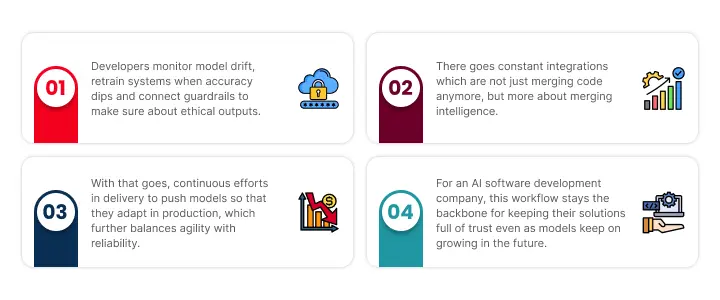
- Developers monitor model drift, retrain systems when accuracy dips and connect guardrails to make sure about ethical outputs.
- There goes constant integrations which are not just merging code anymore, but more about merging intelligence.
- With that goes, continuous efforts in delivery to push models so that they adapt in production, which further balances agility with reliability.
- For an AI software development company, this workflow stays the backbone for keeping their solutions full of trust even as models keep on growing in the future.
In short, the daily life of developers shifts from just writing the static code to managing the problem solving elements and AI-first workflows are further advancing engineering to bring a better mix of creativity, supervision, and operational excellence.
Hurdles and outlook to manage current risks and future trends
There is no doubt, AI-first engineering is great but it does come with its own challenges that developers and businesses must understand carefully.
Do not just see these hurdles as technical because they touch cost, speed, and security, which are the very foundation of product development.
Operational obstacles (cost, latency, and security risks)
High costs because training and running large models require notable computational resources that make budgets a constant problem.
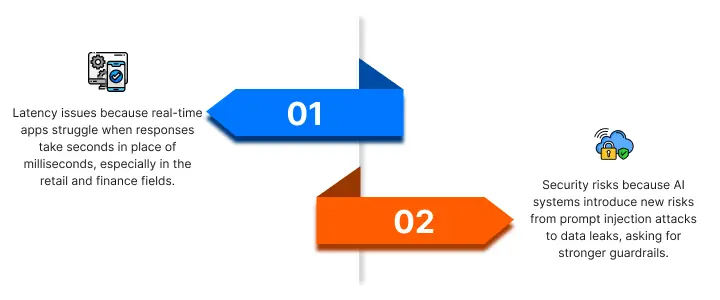
- Latency issues because real-time apps struggle when responses take seconds in place of milliseconds, especially in the retail and finance fields.
- Security risks because AI systems introduce new risks from prompt injection attacks to data leaks, asking for stronger guardrails.
The road ahead with evolving legalities and the new developer identity
Looking forward, there is no denial that the world will have a strong impact from law just like technology. There are new laws introduced by the government on a regular basis to handle AI ethics, data privacy and accountability which will create the need to redefine the functions of business.
At the same time, developers are no longer just coders but the modern engineer who works as a strategist that balances creativity with compliance and guides intelligent systems in place of micromanaging them.
For a custom AI development company or the ones into tech, this shift means they have to build products that are not just technically sound but fits in terms of cultural and regulatory ecosystem.
Partner with NetSet Software: Your trusted AI-first engineering agency
The promises of AI-first engineering become real when businesses partner with experts who know how to translate vision into execution.
NetSet Software, a trusted AI software development company, does not just deliver models but designs workflows, integrates data, and builds guardrails that make AI reliable in production. Businesses from every industry can turn artificial intelligence for solutions into custom experiences with predictive analytics that drive growth.
Our custom AI development company, not just delivers you modern tech but makes sure that your product takes benefit from AI in order to stay smooth, scalable fastest, and never break on future-proof grounds.
FAQs
How is AI‑first architecture different from standard API integration?
Unlike traditional APIs that simply fetch and return data, AI‑First architecture introduces reasoning layers, memory, and orchestration. This allows systems to interpret context, adapt outputs, and evolve with usage, which makes them far more dynamic than static pipelines.
How do you test software when outputs are stochastic and unpredictable?
Testing AI systems is not about passing or failing. Engineers monitor ranges of acceptable behavior, using bias detection, fallback mechanisms, and guardrails to make sure that outputs remain safe and useful even when they vary. It is a shift from strict validation to continuous observation.
When should businesses choose RAG over fine‑tuning?
Retrieval‑Augmented Generation or RAG, is best when real‑time accuracy is critical, grounding models in live data. Fine‑tuning works better for custom tasks that require consistency, such as compliance workflows. A custom AI development company often helps organizations decide which approach fits their goals.
What impact do multi-agent systems have on developer roles?
Multi‑agent systems transform developers into orchestrators. Instead of writing every line of code, engineers supervise intelligent agents that handle testing, optimization, and integration. This evolution boosts the overall creativity and strategic oversight when the development is AI‑first development.
What new security risks come when a business goes for AI-first ecosystems?
AI introduces risks like prompt injection, adversarial inputs, and data leakage which is why you need protecting systems layered with defenses, proactive monitoring, and continuous updates. For the security part, you need an experienced AI software development company so that these risks are managed effectively while keeping innovation secure.