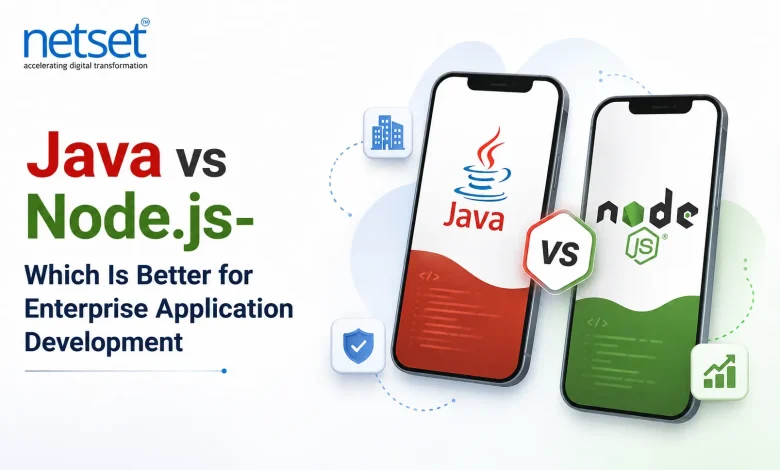
Ask any tech startup or an established enterprise; the weightage of deciding which tech stack to use has always been a key element. It helps fund how fast your company can grow, how secure your data will be, and how much the software will cost over many years.
For more than 10 years Java has served as the stable workhorse for large corporations but with that, Node.js has also come out as. A powerful modern challenger that promises speed and agility.
Now, which one should you pick? This is what this blog solves for you with the ultimate modern Java vs Node.js difference.
Understanding the Two Tycoons- Java and Node.js
Since the mid 1990’s, Java has been there and it is one of those languages that never really left the spotlight due to its object oriented and mature ecosystem trusted by dedicated developers everywhere. What makes it stand out is its famous write once and run anywhere principle which in simple terms means that if you write a program in java, you do not have to worry about rewriting it for every device as long as the device has a virtual machine, it just works.
That reliability is why most of the well known companies still depend on Java in order to run their most critical back systems. It is not flashy but it is solid, proven and quietly powering some of the biggest businesses in the world.
Node.js uses a single threaded event loop and you can think of it as a replacement of multiple workers with one extremely fast receptionist taking care of thousands of quick requests in a row. It never stops to wait for information to load which makes Node.js perfect for I/O heavy tasks where the application constantly sends and receives small bits of data like a real time chap app or a streaming service.
Scalability difference between Java and Node.js
To scale means to make your application bigger to handle more users. Java is the traditional leader in vertical scaling. This involves making a single server more powerful by adding more memory or processing power. It handled huge enterprise workloads reliably within a stable and centralized environment.
Now coming to Node.js, it is built for horizontal scaling so in place of depending on one big engine, you can add smaller engines that work together. This approach is perfect for microservices, where a large application is broken into separate parts that can later scale as per requirements separately. If your goal is a lightweight, distributed system that works seamlessly on the cloud, you will need to hire node.js developers and go for this flexible architecture offered by Node.js.
| Feature | Java | Node.js |
| Best For | Large systems, complex math | Real-time apps, APIs |
| Architecture | Multi-threaded | Single-threaded event loop |
| Scalability | Strong vertical scaling | Excellent horizontal scaling |
| Performance | Strong for heavy CPU tasks | Fast for data streaming (I/O) |
Security and compliance difference between Java and Node.js
When it is about industries like fintech and healthcare, security is not something that you can ignore and Java is gold standard in it because it comes with built in security features and a strict structure that catches errors while the code is being written. You can easily keep compliance and regulations like HIPPA or SOC 2 when you use the Java programming language.
Node.js is secure too but it demands more vigilance from developers. Since it relies on a huge ecosystem of code packages known as NPM even small vulnerabilities in those packages can create risks if not carefully managed.
While these packages save time, teams must carefully check each one for given risks or vulnerabilities. Businesses that focus on ironclad protection for sensitive transactions typically hire Java developers to ensure long-term availability and safety.
Development speed & maintenance difference between Java and Node.js
Time to market is a major factor for modern businesses and when it comes to Node.js, it lets teams use a single language (JavaScript) for both the front and back of a website. This can lower initial development time by up to 20%, and with such level of speed, startups can launch new product fast.

But when you zoom out and look at the long run, the story changes which is why the cost of building and maintaining software over time gets an important thing to consider just like speed or any other element.
Java goes with a strict rule set, and that is what makes it easy to manage on the large and complex level system which reaches the time line window from 5 to 10 year period. This catches bugs early and makes sure that code written years ago still works smoothly today.
For making things smoother, opt to partner with a professional Java development company who can further help you build a strong system that stands the test of time.
When to choose Java vs. Node.js?
To pick between both of these master class technologies, you really have to decide on the nature of your project in place of going with your instinct about which is better theoretically.

Go for Java if your project consists of:
- Core banking or financial trading platforms.
- Complex business logic and heavy data processing.
- Systems that must integrate with older, existing corporate software.
- Large-scale applications that need decades of support.
Go for Node.js if your project involves:
- Features doing real time elements like instant messaging, gaming, or live notifications.
- Suits for high-speed APIs and lightweight microservices.
- Internet of Things, or IOT, devices and data streaming.
- Fast moving projects where you need to launch a version one as soon as possible.
Final suggestion- consult with an expert partner
The choice between Java and Node.js goes down to strategic investment in your company’s future. With a professional partner, you can book a consultation and get the strategic as well as technical clarity to achieve successful digital transformation.
NetSet Software is recognized globally from leading directories like Top developers, Good firms, Trust pilot, Up work and more holds global certifications to safeguard client’s data. In simple terms, our specialized teams maintain key standards and bring years of experience to guide you the right tech stack between Java and Node.js for your project.
FAQs
Is Node.js safe enough for banking or healthcare apps?
Yes, but it requires proactive management so developers have to carefully compare third party libraries in the NVP ecosystem to avoid risks. Java is usually the preferred one in these sectors because of its mature, built in security frameworks that makes compliance easier.
Will Java get obsolete in the coming few years or will it still be used?
No, Java remains the backbone of the enterprise world that powers the 90% of Fortune 500 systems and it is taking the stage further with its new features like virtual threads built to handle modern web demands more efficiently.
Is it possible that I can use both Java and Node.js at the same time for my project?
To get the best of both (stability plus speed) world a lot of modern projects go for polyglot architecture that uses Java for core, heavy duty processing and Node.js for real time layers like APIs or live camera facing features.
Which is better for a microservices architecture?
Node.js gets a little more points when it comes to microservices because it is lightweight and starts up very fast but Java frameworks like Spring Boot aer also robust, scalable microservices in large businesses.
Which technology is cheaper to deploy and manage?
Node.js mostly has a lower upfront cost due to faster development speed. But Java gives 15% lower cost over a 5 year period because its strict structure makes long term maintenance easy and less prone to errors.