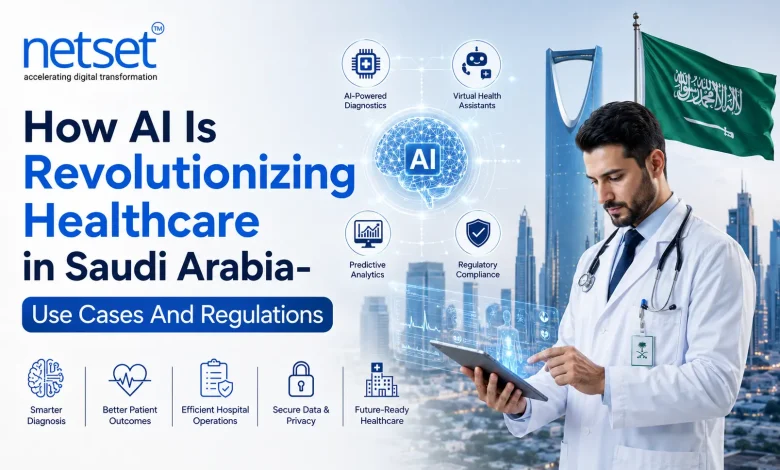
How AI Is Revolutionizing Healthcare in Saudi Arabia- Use Cases And Regulations

Saudi Arabia is on the run to become a global leader in medical innovation and is building one of the most inspiring tech infrastructures.
The key part of this infrastructure has been vision 2030 where the kingdom is making shifts from traditional, reactive treatments to a proactive AI-integrated healthcare ecosystem. This is not just about new gadgets, but it is about building a smarter, safer and more accessible system for every citizen.
From virtual hospitals to automated pharmacies, artificial intelligence is the engine driving this healthcare revolution to make sure that the kingdom stays at the cutting edge of global medicine.
The Grand Vision: How Saudi Arabia is changing the care scenario?
The journey started with Saudi Vision 2030, which was a roadmap that places health at the very centre of national transformation.
Here the government is not just adding AI as a secondary feature; they are connecting it into the core of the infrastructure of the nation. This is evident in the projected growth of Saudi Arabia’s AI Life Science, which is expected to touch $416.71 Million by 2031.
Central to this movement are organisations like the Saudi Data and AI Authority or SDAIA for short and the Ministry of Health or MOH. These bodies are working in tandem to create a connected health data ecosystem that gives seamless integration across clinical and operational boundaries.
For local clinics and large hospital chains alike, making use of AI software development services has become important to meeting these national goals. This integration is already showing results with a notable increase in academic research and real-world implementation across major Saudi medical cities.
Smart hospitals with operating theatres
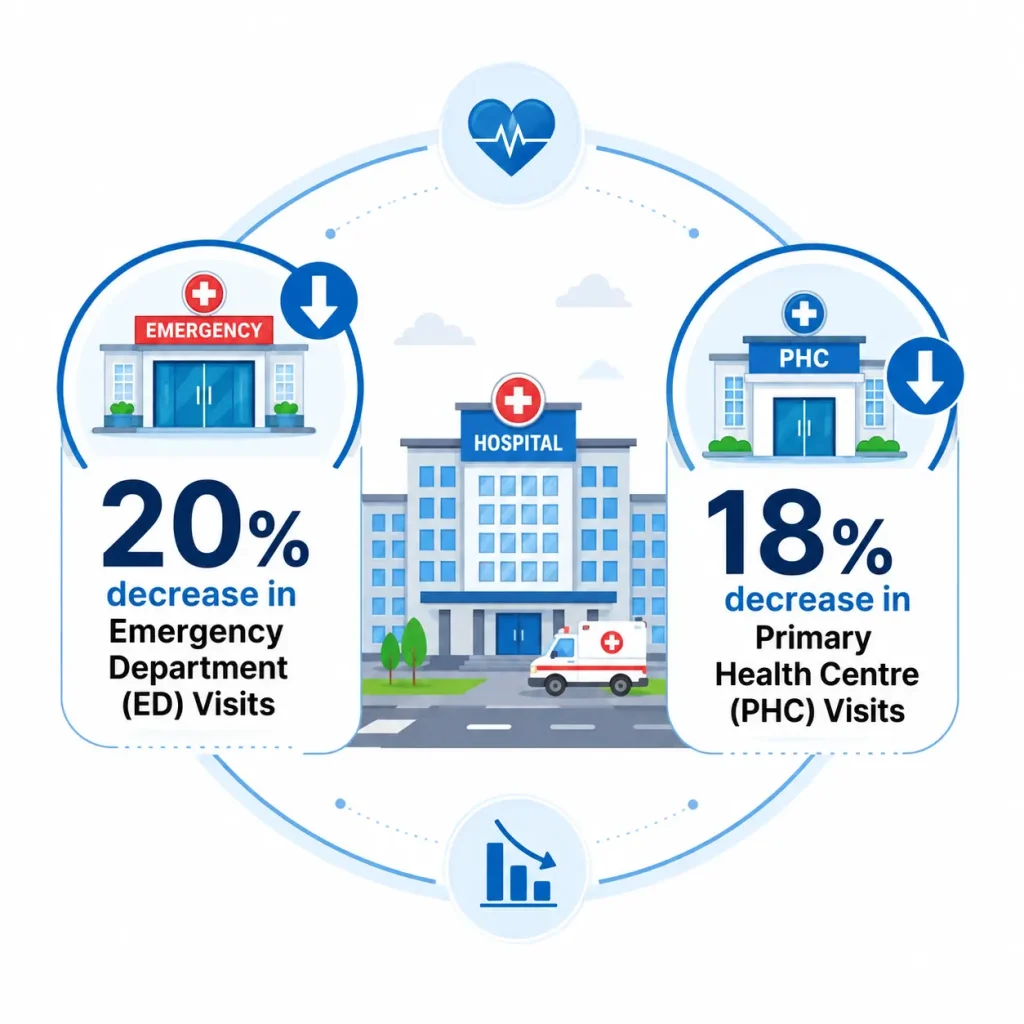
One of the most visible success stories is the Seha Virtual Hospital which already connects more than 240 healthcare facilities all across the kingdom. It combines AI and telemedicine to deliver virtual patient care to people in remote areas who are not able to do long journeys to the kingdom. The impact is measurable, as Seha has reported a 20% decrease in Emergency Department (ED) Visits and 18% decrease in Primary Health Centre (PHC) Visits.
AI is also tackling the back office of medicine, where King Fahad Medical City in Riyadh bought automated pharmacy systems that reduced medication dispensing errors from 1% to just 0.24%. Furthermore, larger hospital groups like King Faisal Specialist Hospital and Research Centre, or KFSHRC for short, use AI for smarter hospital operations to manage bed availability and patient flow using real-time command centres.
All these efficiencies are mostly developed by a generative AI development company in Saudi, which helps create the intelligent algorithms required to forecast demand and automate complex scheduling.
| AI Application | Impact Metric |
| Virtual Consultations | 50% Reduction in wait times |
| Pharmacy Automation | Dispensing errors dropped to 0.24% |
| Diagnostic Accuracy | 25% Increase in accuracy at KFSHRC |
| Medication Waste | Reduced by more than 80% |
The power of accuracy in diagnostics and custom medicine
Diagnostics is actually where AI shines brightest. In place of radiologists spending hours scanning every image, AI-powered tools now analyse thousands of images daily with high speed and accuracy, thus highlighting abnormalities for urgent review. At KFSHRC, the use of AI in various clinical applications has led to a 25% increase in diagnostic accuracy.
More than imagined, the Kingdom is investing heavily in genomic and accurate medicine. With analysis of genetic predispositions, AI can suggest custom treatment plans to an individual’s DNA.
To bring these advanced tools to life, healthcare providers are actively turning to expert mobile app developers in Saudi Arabia to build secure, patient-facing platforms that can store and process sensitive generic data while giving a brilliant Arabic-first experience.
This makes sure that the next generation of medicine is not only high-tech but also culturally and linguistically accessible.
Exploring the Saudi Regulations and Data Privacy
Innovation without oversight gets really risky and Saudi Arabia recognized this to build one of the most solid AI regulatory frameworks of the region that makes sure safety, ethical, and sustainable growth.
AI software that performs the clinical tasks, like the diagnosis or patient monitoring, is categorised as software as a medical device, or SaMD, and must follow strict pathways given by the Saudi Food and Drug Authority, or SFDA.
Data privacy is equally important. All AI platforms must meet with the Personal Data Protection Law or PDPL. This law mandates high standards for user consent, data encryption and local data residency to make sure that sensitive patient information does not leave the Kingdom without authorisation.
Just due to these complexities, picking a mobile app development company in Saudi Arabia that understands local compliance is non-negotiable for any healthcare firm.
Prefer reading: How To Build Compliant Software in Saudi Arabia Laws, PDPL & Best Practices
Key Regulatory Pillars
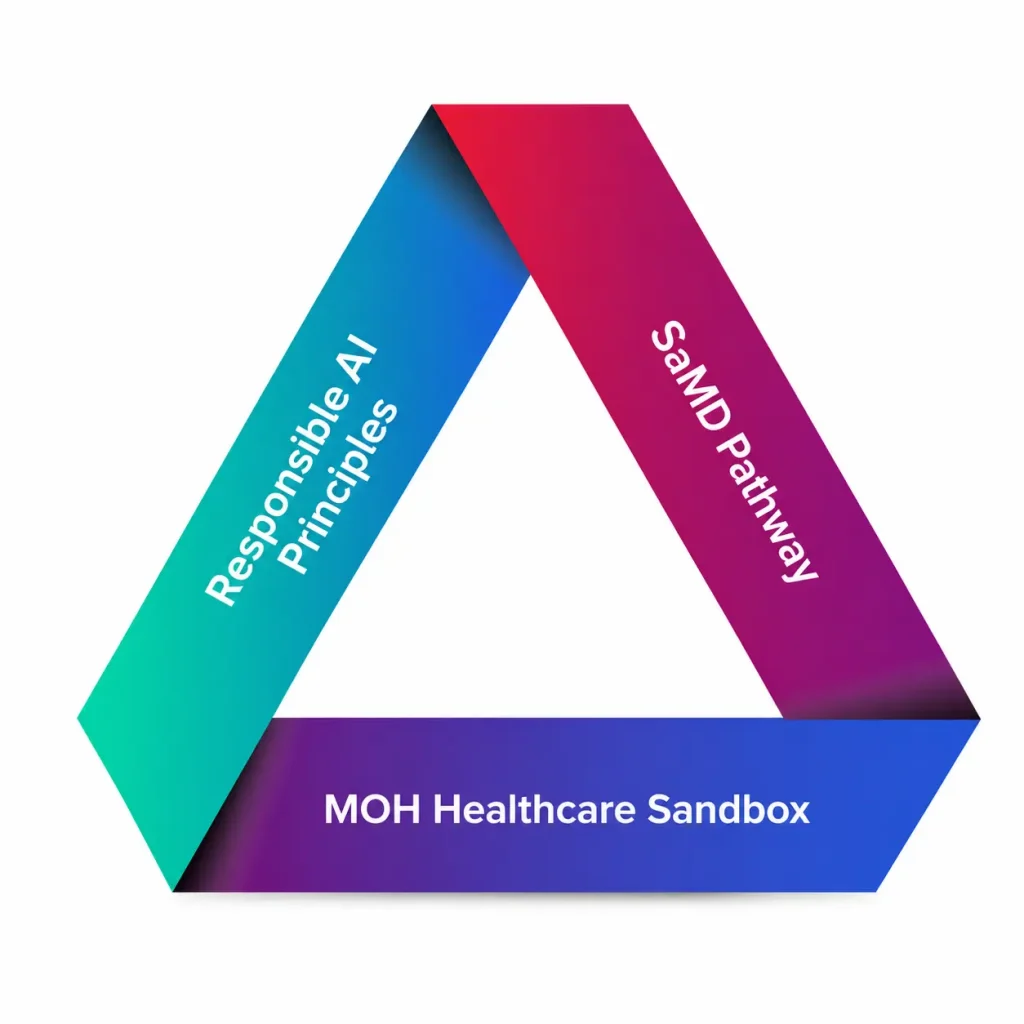
- Responsible AI principles: Defined by SDAIA to make sure that fairness and accountability stay there.
- SaMD Pathway: SFDA’s given guidelines for AI-driven clinical software.
- MOH Healthcare Sandbox: A controlled environment where companies can pilot AI solutions before full commercialisation.
Building the future by overcoming implementation challenges
Even with the progress, the road to total digital transformation brings some challenges. A notable skill gap remains among healthcare app professionals who must learn to trust and work along with AI systems.
Research suggests that while adoption is growing, only about 8.82% of major hospitals have completely established specialised centres for AI research and patient care applications.
To bridge the gap, the focus is shifting to the generative ai software development in healthcare to create clinical copilots. These are AI assistants that help doctors summarize long medical histories or draft clinical notes. With automation of repetitive tasks, AI helps lower physician burnout which is a growing concern globally.
The future of Saudi healthcare lies in this collaboration between human expertise and machine intelligence so that technology serves as a support tool in place of replacement.
Prefer Reading: Generative AI in Hospitality: 13 Ways It’s Revolutionizing the Industry
Contribute to the Saudi’s growth with your vision- build it with NetSet Software
The transformation of healthcare in Saudi Arabia is clearly a testament to the power of a clear vision mixed with world-class technology. As AI continues to evolve, the kingdom is perfectly ready to turn these innovations into every reality of its people.
NetSet Software has just the right experts to build your secure compliant, and intelligent platforms that power up this transformation. You may want to automate hospital workflows or create a diagnostic tool to empower hospitals or anything else, we bring all the technical and strategic requirements to turn your vision into reality.
FAQs
How is AI currently being used in Saudi hospitals?
AI is used for medical analysis, virtual patient consultation and automated pharmacy systems, which are notably reducing the dispensing errors.
What are the main regulations for AI healthcare software in KSA?
The two main regulations are the SFDA’s guidelines for Software as a Medical Device or SaMD and the Personal Data Protection Law or PDPL for data privacy and residency.
Will AI replace Saudi healthcare doctors in the future?
No, just see AI as a decision support tool to assist doctors with proper data and deliver them insights to make their overall decision making faster.
What is the MOH healthcare sandbox?
It is a regulatory programme by the Ministry of Health that lets technology companies’ pilot and validate their AI solutions in a real-world setting before they are fully commercialised.
How does AI make patient safety better during surgery?
AI tools can monitor a patient’s important signs in real time during procedures to predict complications like hypotension before they become important, giving earlier intervention.