Behind every thriving decentralised ecosystem stays an invisible hand that is tokenomics. It is the intersection of economics, cryptography, and behaviour that serves as the financial engine to drive network effects.
For years, the project-built value on pure speculation, but today’s market asks for sustainable utility. To design a token that survives market cycles, builders must master the holy trinity of DeFi Tokenomics: yield, staking, and governance.
Let us explore everything about DeFi Tokenomics (yield, staking and governance) and custom blockchain solutions provider help you design these mechanisms.
Understanding Yield in Tokenomics
At the heart of early-stage protocol growth stays yield farming or liquidity mining. To bootstrap decentralised applications, builders must convince liquidity providers or LPs to deposit assets into automated market makers or AMMs or lending markets.
In return for providing liquidity and taking on risks such as impermanent loss, providers may earn trading fees and, in some protocols, additional rewards in the protocol’s native token. In fact, impermanent loss remains a central issue; research analyzing Uniswap v3 showed that over 49% of liquidity providers suffered overall negative returns due to impermanent loss outpacing fee earnings.
Early-stage projects rely very much on these rewards to stimulate initial engagement but, again, excessive issuance will dilute the value over time.
The Inflation and Token Dumping Problem
However, paying for liquidity anywhere is a trap. If a token’s only utility is to be farmed and dumped, the token’s velocity spikes, devaluing it and sending the price into a hyperinflationary death spiral.
Thus, to create a sustainable feedback loop, it requires that you plan a careful economic design. A prominent example of countering inflation through fee-burning mechanics is Ethereum’s EIP-1559, which destroys a base fee per transaction, permanently burning over 4.6 million ETH out of circulating supply to date.
In place of relying on infinite broad emissions, mature projects are shifting toward fee-based, sustainable and explicit risk backstops. For example, Uniswap v3 and v4 distribute swap fees to liquidity positions that are active within their selected price ranges.
How to Build Sustainable Yield Rewards?
To align incentives, rewards must flow to actions that create irreversible utility, such as long-term liquidity commitments or important system maintenance, in place of mercenary capital that exits the moment rewards thin out.
Designing these robust incentives requires a secure foundation, which is why leading projects focus on professional DeFi smart contract development to audit and lock their incentive loops against manipulation before launch.
Designing Tokens for Staking
Staking serves a dual purpose where the first one is that it can help safeguard decentralised networks that use proof-of-stake consensus. Whereas for the second purpose, DeFi protocols can use staking to boost users to lock tokens and participate in the ecosystem.
With locking of tokens in smart contracts, users can get staking rewards while showing their long trust in the ecosystem. But it, depends on the protocol that staking rewards may depend on factors such as:
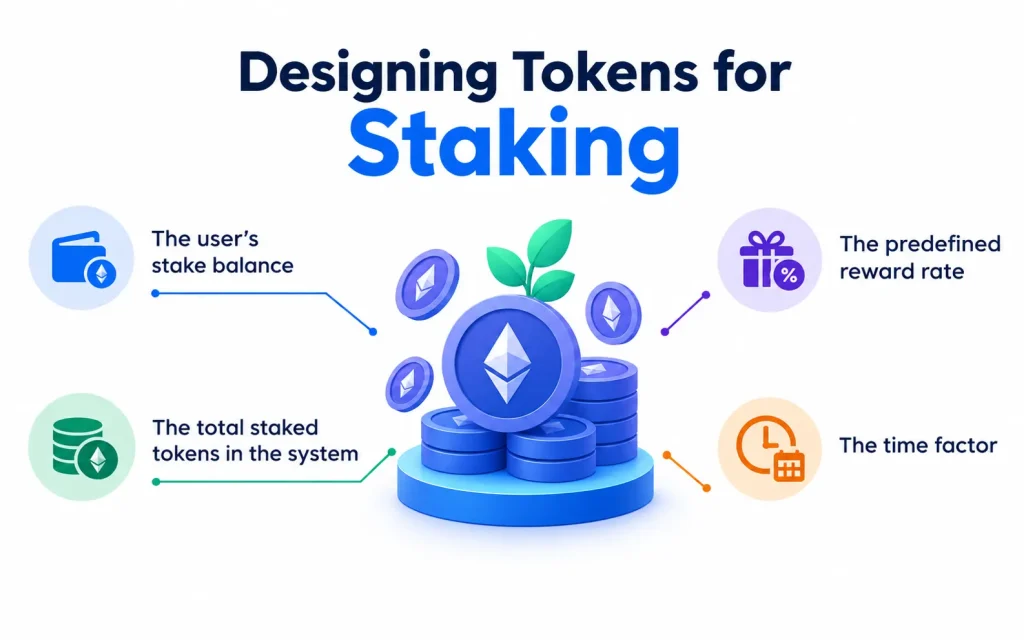
- the user’s stake balance
- the total staked tokens in the system
- the predefined reward rate
- the time factor.
Common Staking Security Risks
Without carefully designed reward and accounting mechanisms, staking systems can become vulnerable to manipulation. Poorly designed staking contracts can expose reward mechanisms to flash-loan and accounting attacks, particularly when rewards are calculated from manipulable balances or when users can deposit, claim rewards, and withdraw without appropriate restrictions.
The UEarnPool exploit also demonstrated how flawed referral and reward accounting can be manipulated to inflate eligibility and drain staking reward pools. In such flaws, an attacker can use flash-loaned funds to temporarily inflate their qualifying stake or reward share, claim inflated rewards, and withdraw before the transaction ends.
Key Variables for Secure Staking
| Staking Variable | Economic Purpose | Security Failure Mode | Recommendation |
| Time Factor | Accounts for duration of participation | Same-block reward manipulation | Require appropriate lock-up or accrual periods |
| Delay Mechanism | Limits immediate stake/unstake activity | Unconstrained stake/unstake | Enforce multi-block delays |
| Reward Calculation | Controls how rewards are distributed | Manipulable inputs can inflate rewards | Use validated, bounded inputs |
To mitigate these risks, protocols must hire Ethereum developers capable of integrating time locks, multi-block delays, and robust oracle architectures that prevent flash loan manipulation of reward pools.
Designing tokens for governance
In DeFi, decentralisation is not just a marketing term but more of an economic property to a user. Governance tokens give holders direct influence on the future of a protocol, like proposing and voting on upgrades, and suggestions for fee structures as well as treasury allocations.
Many governance models break down when a small group holds too mucu capital, when most voters stay inactive, or when hostile actors take control. In fact, major DAOs struggle with participation as research shows that fewer than 5% token holders regularly take part in the governance decisions.
Risks in voting systems
Because governance power is highly composable, delegation markets can emerge, creating choke points where votes can be benched, coerced or bribed.
The Curve Wars also showed how protocols could use incentives or ‘bribes’ to influence how governance-controlled emissions were directed.
How to Build Capture-Resistant Governance?
To build capture-resistance tokens, designers must construct a multi-layered defence. This includes:
- Vesting schedules decide when tokens are given to the team or early investors that can actually be used and prevent sudden shifts in voting power.
- Proposal thresholds and high quorums make sure that only key aligned stakeholders are able to put forward votes in order to keep governance balanced and fair.
- Make use of models like veToken (example veCRV), where users lock tokens for longer periods and the more committed they are, the stronger their voting influence becomes.
- Add built in safety delays as timelocks add a pause before approved proposals which gives the community time to double check and stop harmful changes before they go live.
Achieving this high level of security requires carefully designed smart contracts and governance systems that implement constrained sequencing, governance minimisation and hardcoded smart contract rules.
How to Launch a Token?
As soon as your tokenomics are ready, it is time that you bring them to life with smart contracts. If you go for popular blockchains like Ethereum, Polygon and Avalanche, then ERC 20 stays the standard to follow there but other networks like Solana development have their own formats.
8 Simple Steps to Launch a Token (No Code Needed)
A typical no-code token launch platform like Token Peddler follows a process similar to this:
- Start by opening a launch platform like Token Peddler and choose the blockchain of your choice from the options like Polygon, Solana, BNB Smart Chain or Base.
- Make a connection to your Web3 wallet like using MetaMask for EVM chains or Solfare for Solana as per your convenience.
- Start setting the basics of your token like what its name will be, the symbol, total supply and decimal with 18 being the standard choice for ERC 20.
- Configure basic settings, finding if the supply is capped or unlimited.
- Activate advanced options such as mintable and burnable mechanics.
- Deploy compliance and access features, choosing role-based access control or whitelists.
- Generate and review the contract parameters before deployment.
- Verify on a block explorer and import the live contract address to your wallet.
Choosing Advanced Token Features
Choosing the right feature is important.
For instance, whether you are launching a standard utility token or building/implementing a token-enabled NFT marketplace white label, configure your smart contracts with advanced options. These options can be built-in investing schedule, transfer pauses, or role-based minting and burning permissions which makes sure that you maintain flexibility and secure economic control over your asset’s circulating supply.
Prefer Reading: How to Create ERC-20 Tokens on the Ethereum Network?
Bringing Real-World Assets On-Chain
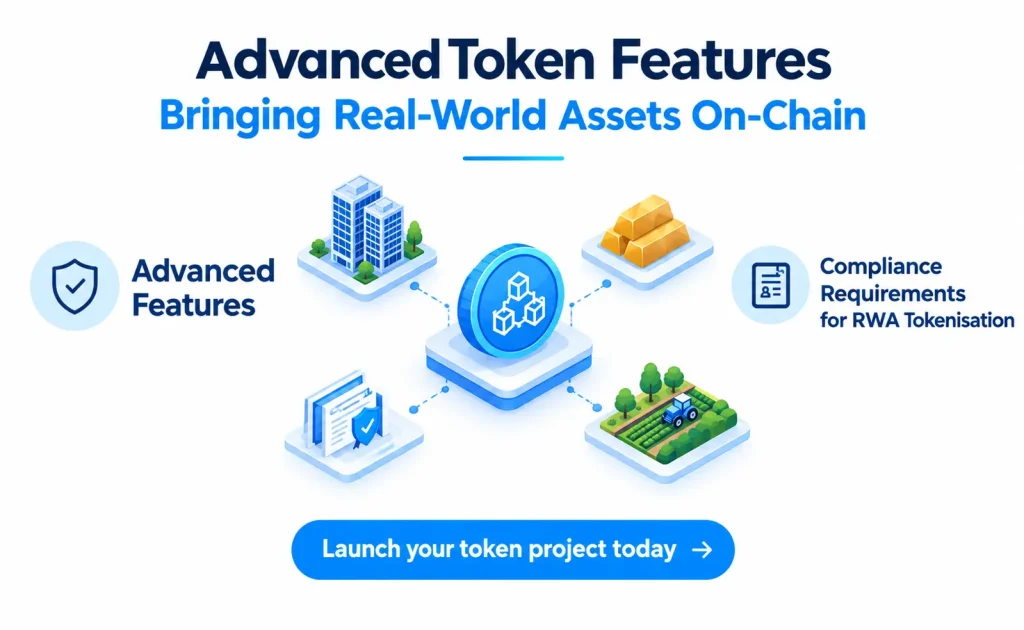
Another one of the biggest shifts in token design today is real world asset tokenization. It means breathing down physical assets like real estate, invoice, debt or supply chain receivables into smaller digital pieces that live on chain.
Demonstrating this momentum, global financial institutions like Boston Consulting Group (BCG) project that the tokenization of global illiquid assets could reach a $16 trillion market opportunity by 2030.
When you bring yield bearing assets into the world of blockchain, developers open up access to markets that were once locked away and hard to reach.
Compliance Requirements for RWA Tokenisation
However, RWA requires a fundamentally different approach than pure-play DeFi. Unlike many purely permissionless DeFi tokens, Tokenised RWAs may require compliance and legal controls across both their smart contract and supporting off-chain infrastructure.
For regulated RWA applications, tokens may need to incorporate compliance mechanisms for transfer eligibility, frozen assets and authorised users. Standards such as ERC-7943 provide interfaces for implementing these types of controls on-chain.
Finding these complex legal and technological frameworks requires partnering with an experienced RWA tokenization development company that can build custom compliance layers directly into your on-chain token architectures to make sure every transaction satisfies regulatory standards.
Launch your token project today
When your tokenomics design is ready, Token Peddler is the place which you can treat as your launchpad to bring it to life. The platform makes it super easy for businesses and creators to tokenize assets, launch NFTs and manage complex token models- all without writing a single line of code. With pre audited templates and a guided no code interface, you can just deploy tokens as per your requirements smoothly across the blockchain networks. Go and contact us today.
FAQs
What does fit matter more than copy-pasting a proven tokenomics model?
A good token model is never generic. A design that works for an AMM (where the goal is deep liquidity and resilience to volatility) can be actively harmful to a lending market (where the goal is managing risk-bearing capacity and backing up bad debt). Your tokenomics must fit your protocol’s specific economic model, risks and incentive requirements.
What is the risk of staking a contract that lacks a time factor?
If a staking system allows users to deposit, claim rewards and withdraw without appropriate timing or accounting safeguards, attackers may be able to exploit the reward mechanism within a single transaction or block. This exposes the protocol or flash loan manipulation, letting malicious actors drain reward pools instantly.
What does ‘capture resistance’ mean in decentralised governance?
Capture resistance is the design discipline of making hostile governance takeovers too expensive or impractical. It uses primitives like long-term voting escrows (veTokens), high quorums, timelocks, and proposal thresholds to prevent bad actors from using transient capital to hijack protocol upgrades.
How do inflationary and deflationary tokenomics models interact?
Inflationary token models work by releasing new tokens into the system that inspires people to be a part of it and keep liquidity active. Whereas, deflationary models lower the number of tokens in circulation to make the remaining ones more valuable. A good example of the same will be Ethereum’s EIP 1559 where part of the transaction fee is burned. The overall result stays relying on how new tokens are issued, how many are burned and the level of demand across the network.
What is uRWA (ERC-7943), and why is it important for asset tokenisation?
ERC-7943 is a proposed Universal RWA (uRWA) interface standard for tokenised real-world assets. It defines smart contract interfaces for handling compliance eligibility checks, freezing token balances under legal orders and implementing role-based enforcement directly on chain.