Dubai has long been seen for its gravity-defying architecture and its status as a premium global hub when it comes to luxury and trade. More than that, the emirate is now on the journey of its most ambitious construction project yet, which is building a digital bridge between physical assets and global liquidity.
We are seeing a fundamental transition from the era of physical scarcity to one of digital abundance where iconic skyscrapers are changed into programmable, liquid shares. This change is exactly why partnering with a premier asset tokenization development company in Dubai is the key step for forward-thinking developers ready to deliver the hidden value of the city’s skyline.
The Blueprint of Billion-Dollar Ambitions
Dubai’s aggressive move to tokenization does not exist in a vacuum; it is going to become the biggest digital wave going to travel across the Gulf. To understand the true scale of what is possible in Dubai, one only needs to look at the National Blueprint currently changing in the region as a high-stakes proof of concept.
The regional proof of scale
The regional leadership has already shown that tokenization is no longer just an experiment but a main pillar of national financial architecture. From the leaders, there is already an amount of around $12.5 billion in mandates saved for bringing real-world assets or RWAs, onto the blockchain.
This movement will not just digitize a few selected properties but will reprogram the whole asset base of a nation, whether it is real estate, energy reserves, or industrial holdings, for a programmable economy.
From a cash-heavy past to a digital-first future
The speed of this transition is alarming, looking at the region’s historical context. Before the massive introduction of digital payment pipelines, 70% of bill payments across the kingdom were made physically in cash at bank branches. The Gulf has changed decades of legacy banking to build what experts call a multi-rail financial reality.
Why does this matter for Dubai IT visionaries?
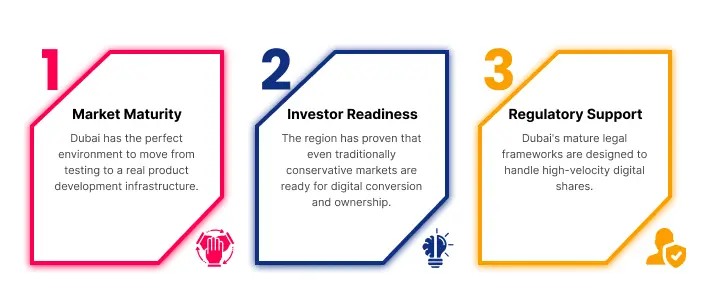
- Market Maturity: Dubai has the perfect environment to move from testing to a real product development infrastructure.
- Investor Readiness: The region has proven that even traditionally conservative markets are ready for digital conversion and ownership.
- Regulatory Support: Dubai’s mature legal frameworks are designed to handle high-velocity digital shares.
All IT visionaries have to do is partner with an asset tokenization development services provider in Dubai and they can easily tap into this big regional momentum. The goal is to replicate this success in the heart of the UAE so that they can attract a new generation of global investors who focus on transparency, security, and instant liquidity above all else.
The speed of trust—from days of paperwork to seconds of smart contracts
In the traditional world of property investment, the transaction gap has remained a major bottleneck. Title transfers, payment verifications, and registry updates have mostly suffered from fragmented systems that resulted in days or even weeks of administrative lag. For an international investor planning a high-end penthouse in Downtown Dubai, this gap shows more than just a delay, as it possesses a lot of risks to them.
The Gulf region has now given the ultimate technical answer to this problem. With the deployment of the Digital Asset Lifecycle Platform or DALP, regional benchmarks have proven that property settlement times can be cut from several days to mere seconds.
This is not like a pilot project; it is a live, production-grade reality where ownership transfer and payment verification are programmatically linked, which removes the reconciliation burden that traditionally scales with portfolio size.
When the entire lifecycle is automated right from issuance to secondary market trading, Dubai’s real estate will be a liquid asset class compared to equities or bonds. But to achieve this level of operation velocity, a strategic approach to asset tokenization platform development is required. It makes sure that every smart contract is legally enforceable and internationally credible.
Microcoding the Metropolis: Why is every square meter a data point?
The true genius of the region’s digital strategy lies in what experts call the “microcoding” of real estate. Dubai is no longer viewing buildings as monolithic structures but as collections of high-fidelity data points.
This mirrors the recent move from regional registries that signed 10 landmark agreements at the Real Estate Future Forum to allow national blockchain infrastructure and the microcoding of real estate assets.
The Architecture of Certainty
Microcoding allows for the creation of a digital twin for every square meter of property, which makes sure
- Geospatial Accuracy: Every frictional share is linked to a specific, verified physical coordinate.
- Rights Protection: Digital tokens are seen as legally binding digital deeds that grant owners the same protections as traditional paperwork.
- Portable regulator rights: Assets are architected to remain verifiable and applied even when traded across different jurisdictional stacks.
This registry as a truth model serves as the conclusive record of property rights that prevents the back office from becoming a problem as transaction volumes grow. For developers, this means every unit they build can be preprogrammed for global investment right from the moment of its registration.
But again, building such an always-on ecosystem needs the right blockchain development company in Dubai who can understand what Dubai wants to achieve.
The ROIT Revolution has benchmarks of up to an 8% return for the retail investor.
Historically, the Dubai real estate market was a playground for the institutional elite and high-net-worth individuals.
The problem was structural: investing demanded huge tickets, mostly reaching hundreds of thousands or millions, mixed with poor liquidity that could take months to exit and a perceived lack of transparency regarding expenses and asset value. Real estate tokenization is effectively dismantling these barriers, shifting the focus from exclusive ownership to democratized access.
Platforms across the region are proving that the retail investor is ready to take part if the threshold is low enough. Early movers like Sahl have focused on the fractional ownership model that lets users start building their portfolios with as little as 1000 SAR.
Just like that, the platform Jozo is currently targeting an impressive 8.2% annual return for its users that lets them own registered shares in select properties part by part without the general burdens of property management.
Comparing investment realities
| Feature | Traditional Property Investment | Tokenized Digital Shares |
| Minimum Capital | Hundreds of thousands or millions | Starting from 1,000 SAR/AED |
| Liquidity | Low (months to sell) | High (instant secondary trading) |
| Transparency | Low (manual reports/valuation) | High (real-time audit trails) |
| Returns | Manual collection | Automated via Smart Contracts |
With real estate turning into digital shares tied directly to official deeds, IT visionaries can now engage with a massive pool of over one million target investors who previously stood on the sidelines.
The architect’s vision: an always-on, interoperable future
As Dubai integrates its physical skyline with the digital economy, the goal is to create a market that is always on. This resilience was notably shown during recent global market closures; while traditional exchanges were shuttered, blockchain-based markets remained the only functioning platforms.
The future of Dubai lies in this level of sovereign native infrastructure that performs accurately when legacy systems are under the most strain.
But scaling this vision requires solving the fundamental “oracle problem,” the challenge of making sure that the physical data ingested at the point of origin, like property valuations and registry updates, remains immutable and verifiable. The region is meeting this challenge by adopting a multirail financial infrastructure.
This model does not seek to replace the existing banking system or the US dollar but instead it adds a faster, more sovereign digital layer along with them.
For the global investor, this means:
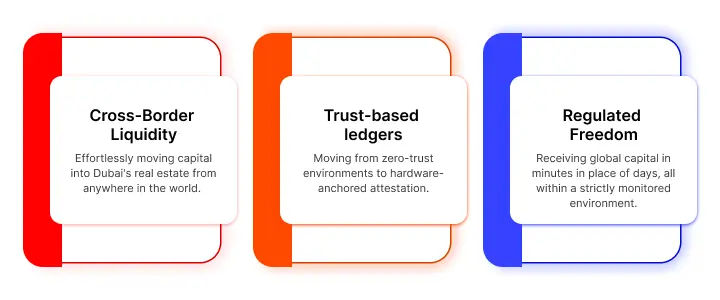
- Cross-Border Liquidity: Effortlessly moving capital into Dubai’s real estate from anywhere in the world.
- Trust-based ledgers: Moving from zero-trust environments to hardware-anchored attestation.
- Regulated Freedom: Receiving global capital in minutes in place of days, all within a strictly monitored environment.
Executing this complex interplay between physical property and digital logic demands the most important blockchain software development solutions for the real estate sector.
Only from enterprise-grade architecture can the Kingdom and Dubai make sure that every token remains regulator-portable and verifiable even when it crosses into international supervisory stacks.
Contribute to Dubai’s futuristic vision with a token platform by partnering with NetSet
The team of NetSet Software is active in the contribution to the future of global liquidity. We specialize in building futuristic real estate blockchain platforms that harmonize with the UAE’s world-leading regulatory ecosystem.
From designing complex smart contract logic to seamless cross-border onboarding, NetSet Software can empower you to launch resilient, high-velocity marketplaces.
We transform the traditional property model into a programmable one to support the always-on digital economy of Dubai that performs accurately even when legacy infrastructure is under strain.
As a dedicated asset tokenization development company in Dubai, we can help you build sovereign-grade solutions for the next century.
FAQs
Is tokenization of real estate legal in Dubai?
Yes, operations are conducted within a strictly monitored environment under supervisors like VARA and the DFSA so that digital tokens are treated with the highest standards of oversight and investor protection.
Can I receive rental returns in my digital wallet?
Yes, a smart contract facilitates the periodic and automated distribution of rental returns directly into your digital wallet. These funds can be instantly reinvested into new opportunities or withdrawn to your bank account.
What is the minimum investment for Dubai properties?
The fractional model is built for mass accessibility. While given thresholds vary, opportunities do start around 1000 AED, which removes the huge tickets hurdle connected with traditional real estate.
How is my ownership documented?
Every digital token is legally anchored to a given property and documented in government records. The registry serves as the sole source of truth so that no token is issued without a corresponding registered deed.
Can I sell my shares if I need liquidity?
Yes, unlike traditional property, which can take months to sell, tokenized assets can be given in the secondary market within the platform to achieve immediate transaction completion and ownership transfer.