Just think of a software that does not just sit there and wait for your commands. It can even anticipate your commands on your as well as your user’s patterns.
For years, software as a service or SaaS, was a static tool but today it is a living, breathing ecosystem. The collaboration of AI and the cloud is already bringing a fundamental shift that drives smarter products and faster growth.
In simple words, we are seeing the real blend of software as a service and AI where technology truly understands and responds to business as well as user needs.
How did AI redefine the SaaS DNA and make a revolution?
The whole picture of SaaS was built on the pillars of accessibility and removal of the upfront costs connected with software installation.
But as the market matures, the demand for differentiation has finally arrived as a major requirement. They asked for a shift from rule-based static platforms to adaptive systems that learn from user behavior.
Now, around 70% of SaaS providers are already implementing, and monetizing AI where the majority cite AI adoption as a key competitive differentiator.
This evolution is not just about adding a chat button but more about achieving a platform that collects data constantly in real time. Not only that, but AI SaaS solutions can adapt to changing conditions, and make intelligent decisions with minimum human intervention.
Because machine learning models are getting better as more information is processed, the forecasts and suggestions they give are also becoming really precise over time.
From a business perspective, this allows for dynamic, data-driven experiences that improve with usage. Finding this complex technical shift mostly consists of making real-time responsiveness better using cloud-native endpoints, which is a challenge that AI development consulting companies are solving in really high demand.
The Secret Superpowers of Modern SaaS
The change from simple automation to true intelligence is where the real value lies. These benefits are not just a little improvement but they are phenomenal shifts that redefine the core performance metrics like retention and revenue expansion that SaaS companies use to evaluate success.
Hyper Customization at Scale
Within the modern tech world, it is more than important to deliver custom services to maximize the efficiency of a product.
AI uses massive data sets of users to build individual experiences that connect deeply to build stronger relationships between clients and SaaS providers. Within the domain of SaaS, this means each customer gets custom attention and content that aligns with their unique needs and expectations.
Efficiency in operations at lower costs
AI-powered tools function as an important lifeline for businesses who see AI as a way to optimize operational costs with zero compromises on quality or innovation.
With delegation of routine, repetitive tasks like data compilation, report generation, and invoice creation to intelligent systems, businesses can liberate valuable time for human workers for strategic initiatives.
Since building once you scale a model requires a strong and scalable architecture, many businesses pick to partner with an AI development company in California. It is to make sure that their cloud infrastructure can handle volume processing while also bringing long-term expenses down.
Actionable Business Intelligence
Perhaps the most strategic benefit stays the ability to convert raw data into actionable insights in place of just statistics.
- AI stays updated with changing data and trends.
- Carefully understands vast information sets for faster and better decision-making.
After getting the patterns and predicting outcomes, businesses do not just make assumptions, they rely on predictive intelligence that keeps them notable in the market.
From vision to reality: high-impact use cases across the industry
The marriage of AI and SaaS is fundamentally changing how digital platforms run, expand and build value. Far from being a theoretical future facing add on, AI has become a foundational capability that drives smarter products and faster growth.
From automated tasks to forecasting customer needs, these real-world apps are changing the very nature of business engagement.
Making overall customer engagement and support better
One of the most popular applications of AI in modern software can be seen in the customer care department. There are intelligent chatbots and virtual assistants who give 24/7 support to handle routine tasks like onboarding and field queries in real time.
A few technologies like Natural Language Processing or NLP, can understand even the most complex queries and give responses keeping context in mind. The human agents are only connected if the issue escalates.
This not only lowers response times but also notably raises customer satisfaction scores or CSAT, with immediate and reliable assistance.
Boosting the software development lifecycle
Although the foundation is still the same, AI has changed how the development lifecycle right from ideation to testing to maintenance was performed. There are tools like GitHub Copilot as well as Claude Code that give developers the intelligent way of coding.
Further AI-driven automated testing identifies bugs and performance bottlenecks faster than traditional methods with high quality of the final AI-powered application before it ever reaches the end users.
This collaboration frees development to focus on creative architecture and complex problem-solving in place of repetitive boilerplate code.
Driving the transformation across specialized verticals
More than just general productivity, AI is making deep inroads into some key industries.
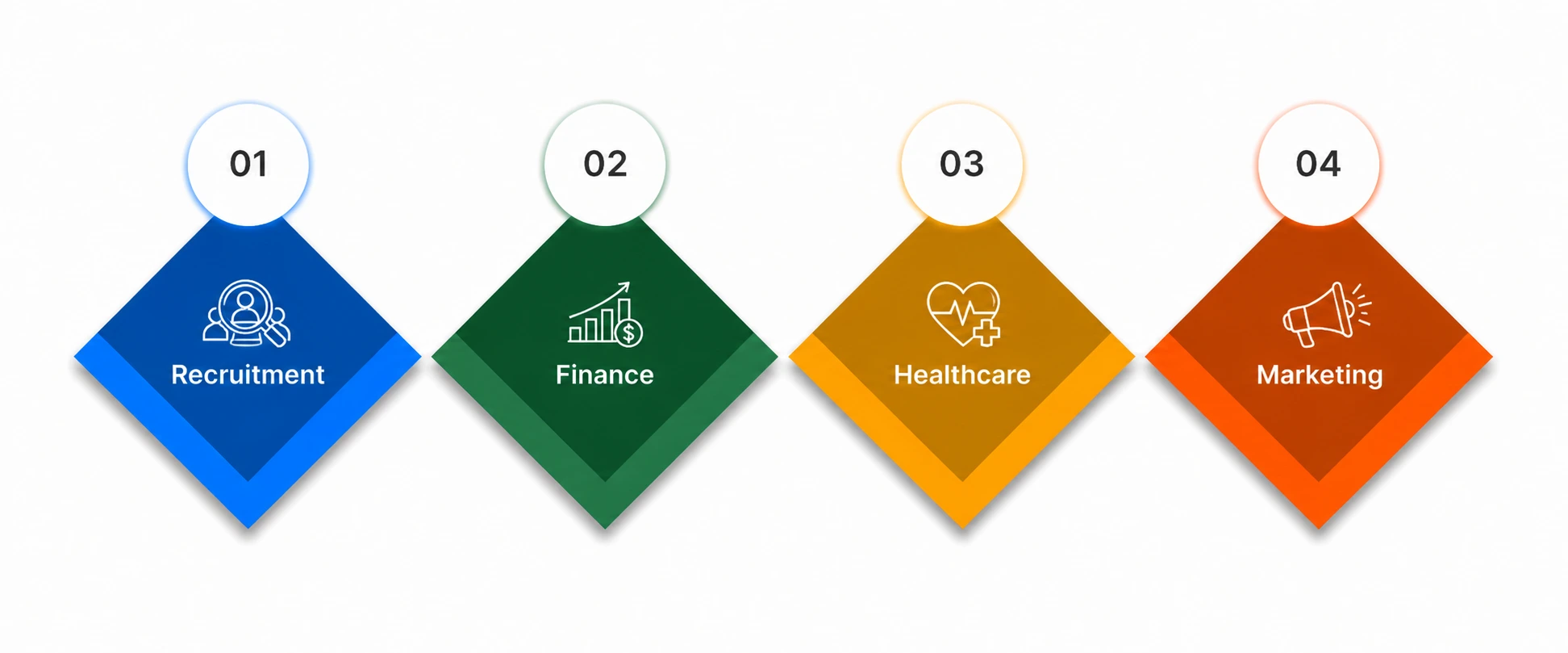
- Recruitment: Around 65% of employees are to already use AI for scanning resumes so that they can select the best candidates that fit their given needs.
- Finance: 71% of the banks have applied AI for fraud detection and, with its help, the identification of irregular patterns and prevention of unauthorized transactions early.
- Healthcare: AI helps in patient risk prediction from the existing data and suggest the best actions to the doctors, nurses and staff for better overall care
- Marketing: Platforms now use predictive analytics to segment audiences and find out which leads are most likely to convert so that businesses close better leads and run effective campaigns.
Overcoming the hurdles of AI SaaS implementation
While benefits appear like ice on the cake, the road to implementation has its own technical complexities, and you should be prepared for the below in advance.
- Apply the key regulator guidelines like GDPR, HIPPAA, and SOC into your product compliance protocols.
- Audit datasets regularly to remove unfair or skewed outputs.
- Use cloud-native tools to optimize compute and hosting expenses.
- Partner with AI development services to bridge internal expertise shortages.
- Resolve legacy incompatibilities using modular and flexible API architectures.
- Apply robust feedback loops to prevent long-term accuracy degradation.
- Monitor employee activity to detect and manage unauthorized tools.
The architect’s blueprint to solve the build vs. buy dilemma
Every SaaS firm arrives at a crossroads where they face confusion if they should invest in going with custom development or just use the speed of existing third party APIs.
This is not just a technical question but more of a strategic choice that defines
- your long-term scalability
- product differentiation
- overall business maturity.
To find the right path, architects must look more than just at code and evaluate the soul of the features they are building.
Key decision framework with strategic checklist
For this crossroads, ask the below fundamental questions:
Is this feature a core product differentiator?
If AI capabilities like a complex predictive pricing engine or vertical diagnostics are the primary reasons customers choose you over a competitor, go in-house because it gives you the tightest alignment with your unique product vision.
What is the time value requirement?
For features that are important but not unique, like sentiment analysis, speech to text, or standard chatbots, you can use prebuilt services like Azure OpenAI or Google Vision for the superior choice. This buy strategy gives an immediate entry point into the world of AI in SaaS so that you can focus on innovation instead of reinventing the wheel.
How sensitive is your data ecosystem?
For industries that are bound by strict compliance or those that handle highly proprietary datasets, a custom build gives you the necessary control over data handling and model behavior.
The final validation (power of PoC)
No matter if you build or buy, the journey from concept to a scalable product requires careful planning. Before a full-scale commitment, successful teams go for a proof of concept or PoC, to validate feasibility and mitigate the inherent unpredictability of AI projects.
Architects mostly choose between a proof of technology to test technical components, a steel thread to test the whole software lifecycle or a pilot project for limited user testing.
With cloud platforms like Microsoft Azure or AWS, you can conduct these experiments in a build once you scale the environment so that your infrastructure is ready for the transformation ahead.
Future Trends That Will Redefine Tomorrow of AI SaaS
The future of SaaS is very bright because from here the systems will not only store data but also actively optimize themselves to deliver an unbeatable value. This shift will be characterized by a move from static tools to living platforms that evolve along with the user’s needs.
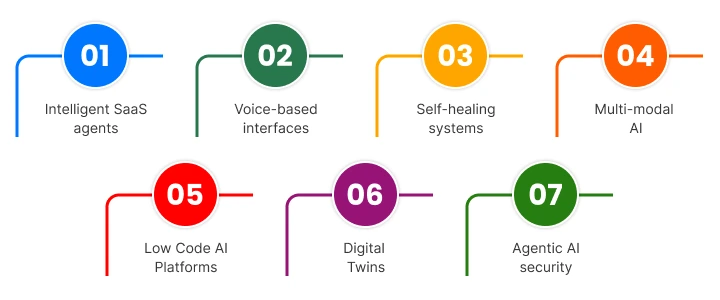
- Intelligent SaaS agents: Platforms will work on their own and take care of some of the most complex problems without a single human intervention.
- Voice-based interfaces: Finding the software with the help of natural speech in place of traditional menus will become very common in the future of SaaS.
- Self-healing systems: With the help of AI the systems and tools will detect and repair internal bugs on their own without any human assistance.
- Multi-modal AI: Parallel processing of text, images, and audio for richer context will be there.
- Low Code AI Platforms: Democratizing of software creation for users will become more common with minimal coding experience.
- Digital Twins: Virtual replicas will work along with developers to maximize the productivity of the team.
- Agentic AI security: Advanced frameworks will be there to protect autonomous software agents.
Partner with NetSet and Build Intelligent SaaS That Leads, Not Follows
Instead of just building SaaS products, we collaborate with you to become a part of the change that your business wants to bring with the idea. Our team has exceptional experts who can turn raw ideas into simple, scalable and cloud-ready SaaS with the best of AI functionalities.
You can build from scratch or just integrate advanced machine learning models into your existing SaaS. NetSet Software helps you to meet the changing market requirements, design smartest systems and deliver products that actually stand out in the market.
There is no waiting when you want to bring a change because as long as you wait, someone else would launch an idea similar to you and claim your place in the intelligent SaaS domain.
FAQs
What is AI in SaaS?
It is the integration of intelligent models to improve software performance and scalability.
How does AI reduce customer churn?
AI gives churn risk scores to help success teams get into the scene with all the important data before a customer decides to leave.
Should I build custom AI or buy an API?
You can also go for a hybrid approach where you can the core product differentiators custom and connect APIs for lesser important elements to achieve faster time-to-market.
Are there security risks with AI?
Yes, but it is easy to manage the AI risks if you follow all the given compliances like GDPR, HIPAA, and SOC 2.
Is AI going to replace SaaS developers?
No, because AI works as an assistant so that developers can achieve better productivity booster instead of getting replaced with AI.