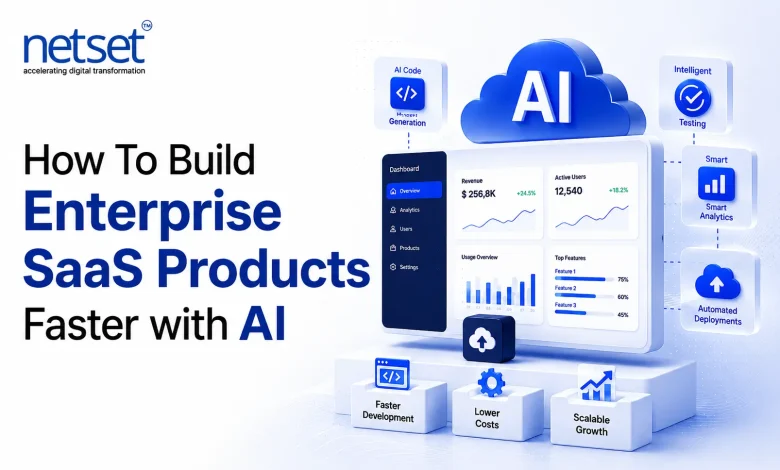
The way we build software has shifted completely from fixed rules to systems that learn from data. For business leaders, the goal is now to build faster while still giving real value.
Well, speed is important, but you also need a solid plan to move from a basic demo to a product that businesses can actually use.
If you want to build a successful SaaS product within the least possible timeframe using the power of AI, you need an AI software development services provider’s roadmap which can help you handle costs, security, and user trust from day one.
Why do most Enterprises SaaS Product projects fail early?
CBInsights analyzed 431 VC backed startups where 43 % failed because of poor product-market fit, bad timing (29%), and unsustainable unit economics (19%) which implies that there will be so much that goes into having successful AI projects.
This normally happens because teams treat AI as the entire product in place of a part of a larger system. It is easy to get a prototype working in a single weekend by connecting to an API.
However, the real problem starts when the AI goes inconsistent with answers, drops high costs of usage, or the user experience breaks under pressure.
To avoid these traps, you must change the planning of your AI SaaS product where you do not just see it as an engine, an AI model is just an engine but see it a SaaS product is the entire vehicle ready for passengers.
Before writing any code, you must find a specific painful problem that users are willing to pay to solve. Like if you are looking for AI development services in San Francisco, then make sure the partner focuses on solving these real-world bottlenecks first and knows the region inside and out in terms of tech.
The five gates of success
To keep your project on track, you can follow the below five phases that will deliver you success.
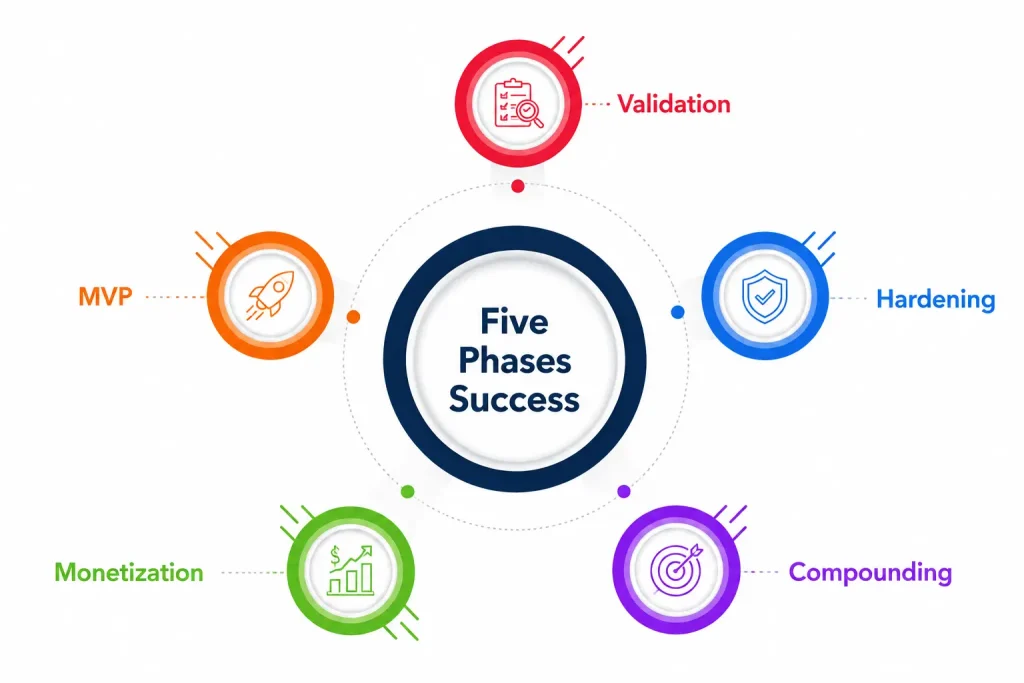
- Validation: Prove the AI solves a problem, even if a human does the work manually at first.
- MVP: Build a simple version using “rented” intelligence from existing APIs.
- Hardening: Make the system professional by adding security and monitoring.
- Monetization: Make sure that you are making money after covering AI costs.
- Compounding: Use your own data to build a product that competitors cannot easily replicate.
A simple blueprint for building better Enterprise Saas Products
The best products are built with a workflow first, which means that your core business logic stays reliable and predictable while AI acts as a helper to speed things up. If the AI fails or becomes too expensive, your product should still work. A custom AI development company will suggest you start with simple tasks like summarizing text before moving to complex agents that act on the behalf of users.
| AI Complexity Level | What It Does | Example |
| Foundational | Simple tasks like sorting or summarizing | Sorting support tickets by mood |
| Conversational | Answering questions using your specific data | A bot that knows everything in your user manual |
| Agentic | Doing research and completing multi-step tasks | An agent that handles a full loan application |
Another secret is to speed up using a schema-first approach. AI is much better at understanding a clear list of data rules than a scheme than it is at writing complex code. When you define your data rules clearly, you can automatically create the APIs your AI needs, which again reduces errors and speeds up the development.
Choosing the right tech stack for your SaaS product speed
Speed in building comes down to your tech stack like for most teams, running Next.js and Prisma in a monorepo works because it keeps code changes fast and data types consistent across the app.
But when you add AI to the more complex level of SaaS development, you face an even bigger decision: should you go for a ready-made API or host your own model?
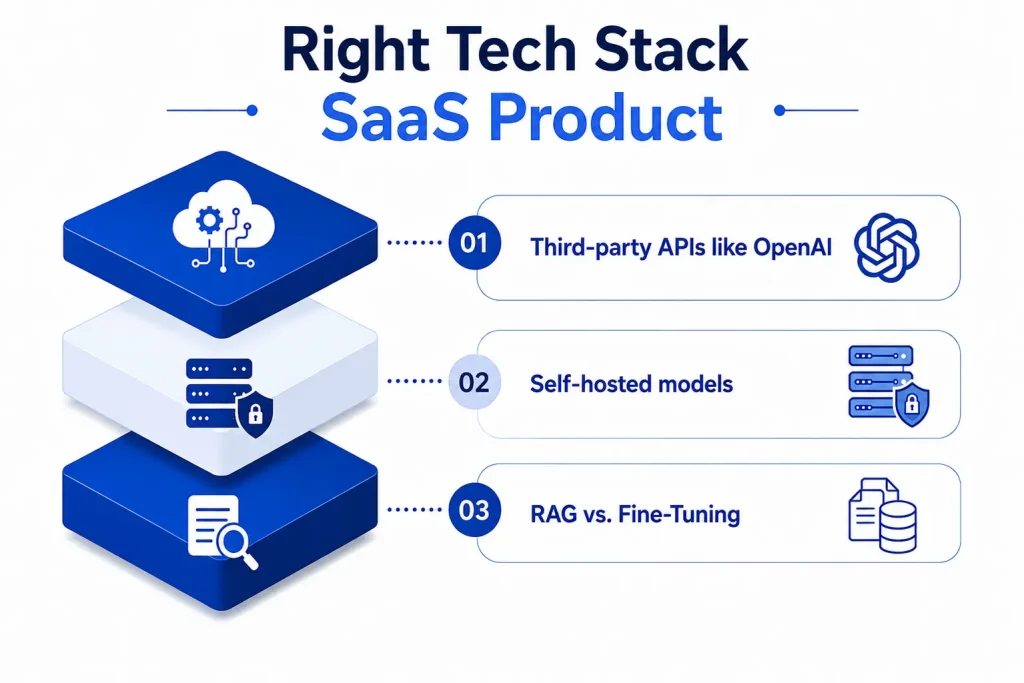
- Third-party APIs like OpenAI: This is the fastest and cheapest way to start because you just have to pay for what you use and do not have a headache of server management.
- Self-hosted models: These give you more control and privacy, where your data stays on your own servers but you have to handle all the maintenance.
RAG vs. Fine-Tuning
For most enterprise products, Retrieval Augmented Generation, or RAG, remains the best choice because it connects AI to a trusted knowledge base in real time which gives accurate and up to date answers. However, you might have to make modifications to the AI model as per your Enterprise SaaS requirements which is known as fine tuning.
Fine-tuning should be a last resort, not a starting point. Unless a base model continuously gets a specific task wrong, you are likely wasting time and money on training that could be solved with better prompting or better data.
Creating an experience that users can trust
A common mistake businesses make today is think that every AI product is like building a chatbot or similar to that experience. Well, it is true that your enterprise SaaS might have a chatbot layout but unlike generic chatbots that are easy to build, a chatbot like user experience might have a lot of things going behind it.
The real value of AI SaaS, that goes far beyond basic chat, comes from connecting automation, smart insights, and predictive features directly into the tools people already use daily. And, with that many processes going in the background, you need to deliver an experience that shares trust with users.
To build trust in an enterprise setting, follow these simple UI rules:
- Show confidence: If the AI is not sure of an answer, tell the user the same.
- Use streaming: Show the text as it is generated so the user is not starting a loading screen.
- Keep humans involved: For important decisions like medical or financial tasks, always let a human review the AI’s work before it is final.
- Ask for feedback: Give users a way to correct the AI like a feedback option that is accessible anytime so that the system can learn better over the time.
Protecting your Enterprise Saas product data
In order to build a SaaS product on a bigger level, either used by you or used by your targeted audience, you cannot ignore the grounds of security which is a basic requirement and not an extra feature.
Since AI mostly sends data to third party providers in order to perform the required operations, you must know exactly where that data is going, how it is stored, and find ways to perform checks to see if the data stay compliant with laws like GDPR or HIPAA.
You also need to watch your gross margins. In traditional SaaS, it costs almost nothing to add a new user. With AI, every single question costs money in compute power which can easily lower your profit margin from 90% down to 60% if you are not careful.
How to stay secure and profitable?
- Use MLOps: Set up tools and monitor AI costs and quality in real time so that you can catch problems early.
- Standardize Security: Build with strict access controls so one user can never see another user’s data.
- Control Costs: Use smaller, cheaper models for simple tasks and save the expensive ones for hard problems.
From idea to fast SaaS Products, built it right with NetSet
Building a fast AI SaaS product was never as simple as just picking the models and doing some prompts that everyone is doing in the market, but the product fails when it is run on an enterprise level setting.
Then when you plan to customize it, and start working on the project, you hit further real-world complexities like architecture bottlenecks, integration friction, and unreliable outputs that slow you down. That is where an experienced AI app development partner like NetSet Software comes in.
We help you build a native enterprise AI SaaS product from scratch, connect it with your existing systems with best of speed, accuracy, data trust, and real analytics. Our experts further help you to keep your product running with maintenance and update services to keep your business sustainable in the market.
FAQs
How can I start building an AI SaaS product from scratch?
Before you focus on development, make sure that you are clear about the problem you are going to solve as well as ready with a blueprint of AI SaaS development. Then get in touch with an experienced AI app development company and build a very small MVP to test the viability before you make the final product development investment.
What makes AI SaaS different from regular software?
Traditional software has strict rules like you click a button, get the exact same result every time which is very predictable. AI SaaS brings probabilistic outcomes where models understand intent (not fixed code) so the output varies.
How much does it cost to develop enterprise AI SaaS products?
The cost of enterprise AI SaaS product development varies on your choice like if you are going with a white label solution or building a product from scratch with all your specific customizations. Also, in custom development, your final pricing is defined by the complex features and functionalities you want in your product.
How can I stop the AI from giving wrong or generic outputs?
The best way is to use Retrieval-Augmented Generation (RAG) which forces the AI to look at your actual business documents before answering and not rely on its own memory.
Do I need a team of AI experts to build an AI SaaS product?
A lot of successful products are built by regular developers using “rented” intelligence from providers like OpenAI or doing vibe coding, but it fails when you plan to make an enterprise level product or even to the mid-size business. You will need custom experts to perform heavy fine-tuning on your product where AI will help to launch it fast.