JavaScript in 2026 is the driving force behind all current applications. This code is executed not only in browsers but also on servers and even in cloud computing platforms without the need to juggle different languages. For organizations that invest in software development services, this transition is reflected in their ability to shorten delivery times, increase stability, and gain better control over costs.
These days, businesses are interested in JavaScript performance and its efficiency in powering systems during runtimes rather than its popularity. With a platform requiring tens of thousands of requests per second, continuous updates, and scalability, an efficient technology becomes the key to success. That is why JavaScript excels by reducing friction throughout the entire process.
By developing a single technology stack, in which a developer is developing both the frontend and the backend of their applications, businesses are cutting the friction and improving efficiency.
How JavaScript is Reshaping Business Decisions in 2026?
Most discussions around JavaScript focus on trends. That does not help decision-makers. What matters is how it affects delivery timelines, hiring strategy, and system performance under load.
JavaScript changes how systems are built. It eliminates cross-team dependencies and complexities that are not needed in the architecture. When teams have to rely less on time to coordinate various stacks, they devote more time to developing and enhancing the product.
Where does JavaScript create a measurable impact?
- Development timelines are reduced because the frontend and backend teams share the same language.
- Debugging becomes faster due to consistent code patterns across layers.
- Deployment cycles shorten because integration issues decrease.
- System behavior becomes more predictable under traffic spikes.
These changes show up clearly in SaaS products, dashboards, and real-time systems where speed and stability directly affect revenue.
How JavaScript Handles Enterprise Workloads?
Enterprise systems require consistency under high concurrency. A system can not just work during testing. It has to be stable since thousands of users could use it simultaneously.
JavaScript supports this through its runtime model.
Key technical characteristics
- Event-driven execution handles multiple requests without blocking.
- Non-blocking I/O allows efficient use of system resources.
- Lightweight processes reduce memory consumption.
This practically implies that a JavaScript-based system can support high traffic without necessarily needing an equivalent growth in infrastructure.
Example: In real-time analytics dashboards that handle live user data, thousands of updates per second can be handled without having to open a separate thread per request.
How can JavaScript be helpful in Cost Reduction?
Cost reduction with JavaScript does not come from a single factor. It comes from a combination of efficiencies that affect the entire lifecycle of a product.
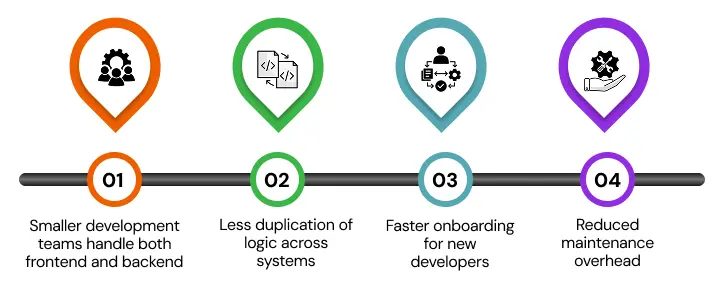
Where savings occur?
- Smaller development teams handle both frontend and backend
- Less duplication of logic across systems
- Faster onboarding for new developers
- Reduced maintenance overhead
For companies offering JavaScript development services, this results in shorter project timelines and lower overall development costs.
JavaScript vs Traditional Technology Stacks
| Factor | JavaScript Stack | Multi-Language Stack |
| Development Speed | Faster | Slower |
| Team Coordination | Simplified | Complex |
| Maintenance Effort | Lower | Higher |
| System Complexity | Reduced | High |
| Cost Efficiency | Higher | Lower |
The difference becomes clear when systems scale. A simpler stack is easier to maintain and faster to evolve.
What are the Enterprise Use Cases?
1. Real-Time Systems
JavaScript is widely used in systems where timing matters.
- Messaging platforms
- Live dashboards
- Collaboration tools
These systems depend on continuous data flow. JavaScript handles this through event-based execution without blocking operations.
2. SaaS Platforms
SaaS products require frequent updates and stable performance.
- Multi-tenant applications
- Subscription systems
- Customer portals
JavaScript supports rapid iteration, which allows companies to release updates faster.
3. Microservices Architecture
JavaScript works well in distributed systems.
- Services can scale independently
- Updates can be deployed without affecting the entire system
- Failures remain isolated
4. Serverless Applications
JavaScript is commonly used in serverless environments.
- No infrastructure management required
- Automatic scaling based on demand
- Cost tied to actual usage
When Businesses Choose JavaScript?
JavaScript works best in situations where speed and scalability matter.
Typical scenarios
- Product needs to launch within 10 to 12 weeks
- The system requires real-time data handling
- The platform must support high user concurrency
- Budget limits team size
In these cases, a unified stack reduces complexity and improves execution speed.
How Do You Hire Java Developers for Web Application Projects?
Companies still hire Java app developers for legacy systems and regulated environments. These systems require strict control and long-established architectures.
For modern applications, JavaScript teams take on broader responsibilities. A single team can manage both frontend and backend development. This reduces coordination gaps and improves delivery timelines.
Organizations working with a Java application development company often choose JavaScript because it aligns cost efficiency with delivery speed. The availability of skilled developers makes scaling teams easier.
What is the role of Java web development services?
Professional Java web development services play a key role in successful JavaScript adoption.
They ensure:
- Proper system architecture
- Performance optimization during high request volumes
- Secure deployment practices
Without structured implementation, even strong technologies fail to deliver expected results.
NetSet Software: Practical Execution at Scale
Technology decisions only create value when executed correctly. That is where implementation matters.
NetSet Software Solutions focuses on building systems that perform under real conditions, not just in controlled environments.
What NetSet delivers?
- Full-stack JavaScript development aligned with business goals
- Scalable architecture designed for high concurrency
- Performance optimization based on measurable benchmarks
- Deployment pipelines that support continuous delivery
Business outcomes
- Faster product launch timelines
- Reduced engineering complexity
- Stable systems under increasing user demand
Planning a new platform or scaling an existing one
- Need faster delivery without increasing team size
- Looking to reduce infrastructure cost
- Want a predictable system performance under load
NetSet Software works with businesses to build systems that meet these requirements with technical precision.
What is the Future of JavaScript after 2026?
JavaScript continues to evolve in areas that directly affect enterprise systems.
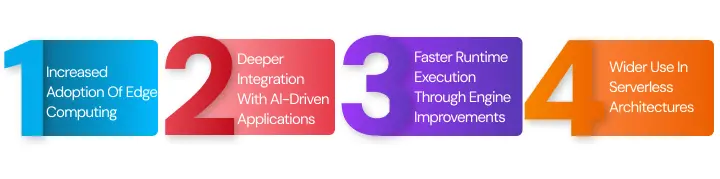
- Increased adoption of edge computing
- Deeper integration with AI-driven applications
- Faster runtime execution through engine improvements
- Wider use in serverless architectures
These changes reinforce its role in modern system design.
Common Mistakes to Avoid
- Starting development without a clear architecture
- Ignoring performance benchmarks during scaling
- Overusing frameworks without understanding trade-offs
- Skipping load testing before deployment
Each of these issues creates long-term problems that are harder to fix later.
Expert Recommendations
- Write large-scale systems in TypeScript.
- Maintain API response time less than 200ms.
- Caching of high traffic endpoints.
- Use automated pipelines for deployment
These practices improve reliability and reduce production risks.
Conclusion
JavaScript in 2026 supports business goals at both technical and operational levels. It shortens development time, costs, and allows systems to scale without complexity.
Companies with a well-defined architecture and skilled implementation teams deliver faster, can withstand performance, and maintainability in the long term with JavaScript.
Ready to build scalable systems with JavaScript?
- Want faster product launches
- Need to reduce engineering cost
- Looking for stable, high-performance systems
NetSet Software provides solutions designed for real-world performance and business outcomes.

FAQs
How does JavaScript improve development efficiency?
JavaScript enhances efficiency by enabling developers to use the same language on both the frontend and backend, coordination delays are minimized, debugging is simplified, and deployment cycles are quicker in the current application ecosystem.
Why do companies prefer JavaScript for modern systems?
JavaScript is favored by companies as it simplifies the complexity of systems, allows scalable structures, allows quicker development cycles, and can be readily used in conjunction with cloud and real-time applications.
How do software development services use JavaScript?
Software development services use JavaScript to build scalable applications, design APIs, implement microservices, and deploy cloud-native systems optimized for performance and reliability.
When should businesses hire Java app developers?
Businesses hire Java app developers for legacy systems, banking platforms, and regulated environments, while JavaScript teams manage modern applications and scalable digital platforms efficiently.
What industries benefit most from JavaScript?
SaaS, fintech, e-commerce, healthcare, and media industries are among the industries that find JavaScript a full-fledged tool based on its scalability characteristics, real-time processing, and the capacity to handle high-performance applications.