The launch of software products is a high stakes undertaking where technical accuracy, user validation and business execution meet. One wrong move, whether it comes to architecture, usability, or operational preparedness, can diminish the adoption rates, cause the failures of the performances, and impact your credibility in the market. In AI-based software systems and business applications, there is a low tolerance of error and inefficiencies at launch have a direct impact on revenue and growth.
Effective product launches are based on the existence of a systematic product development strategy, launch-ready software frameworks, and a quantifiable product launch plan. These guarantee the effective functioning of the product under the actual conditions, alignment with user workflows, and clarity to the market pain points.
This is a 90-day step by step framework offering a technical, execution-based blueprint. It deals with validation, development, testing, infrastructure preparation, go-to-market implementation and post-launch optimization. Through this model, the teams can guarantee the stability of the product, its measurable adoption, and compatibility with operations with reduced post-launch friction and re-work.
What is a Product Launch?
A product launch is a coordinated process of introducing a product to the market with measurable objectives, operational readiness, and technical stability. In the case of software products, a launch is never just about marketing, but it is the time when all the development, testing, infrastructure, and user experience factors are put into practice.
The main components of successful launch of a software product are:
- Producing a stable and working version of the product.
- Maintaining load and scaling of the system.
- Coordinating marketing, sales and support teams to execute.
- Using an organized product launch strategy with KPIs.
Completion of the product launching process occurs when the product becomes reliable and is used by the customers easily without causing them any problems, while other measures like activation, retention, and engagement rates have met their objectives.
Why the Structured 90-Day Product Launch Framework Works?
Using the build-to-run early approach is usually bound to cause scope creep, untested functionality, unreliable systems, and message inconsistency. An established structure for 90 days creates a disciplined schedule that guarantees:
- Validation occurs before major development investments
- System architecture meets performance and scalability requirements
- Teams operate with measurable objectives and deadlines
- Marketing, sales, and support are fully aligned
This structured approach is particularly critical for AI software development, where models must perform consistently under load, and in custom CRM system development, where workflows must integrate seamlessly with existing enterprise systems.
90-Day Product Launch Framework Overview
The framework divides the launch process into three key phases:
- Days 1–30: Market validation and strategic planning
- Days 31–60: Development, testing, and technical optimization
- Days 61–90: Market execution, scaling, and post-launch refinement
Every step is in line with the product development strategy as a whole to ensure that the product is market-ready.
Phase 1 (Days 1–30): Market Validation and Strategic Planning
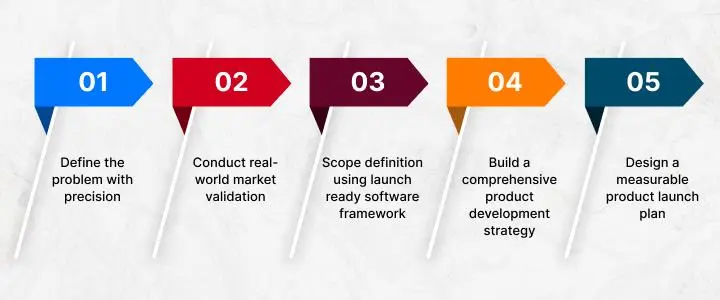
Define the Problem with Precision
Start with a clearly defined problem and target audience. For example, in custom CRM system development, focusing on “mid-sized B2B sales teams struggling with fragmented lead tracking” creates stronger adoption potential than a generic CRM positioning.
Define:
- Specific user segment
- Daily workflow challenges
- Current solutions and their limitations
Conduct Real-World Market Validation
Instead of broad surveys, conduct targeted validation:
- 12–15 structured user interviews
- Detailed competitor gap analysis
- Identification of user switching triggers
Strong signals of market opportunity include active searches for alternatives, frequent dissatisfaction with current solutions, and significant manual workarounds.
Scope Definition Using Launch Ready Software Frameworks
Leverage launch-ready software frameworks to define:
- Core features required for immediate adoption
- Secondary features programmed for later releases
- Performance and reliability benchmarks
Example: When deploying a CRM, leads and sales pipeline management as well as dashboards reporting are key features.
Build a Comprehensive Product Development Strategy
A robust product development strategy ensures development decisions support business objectives. Include:
- System architecture and modular design
- API and backend structure
- Data security, storage, and compliance requirements
- Integration points with existing enterprise workflows
Design a Measurable Product Launch Plan
Your product launch plan should define:
- Target acquisition and conversion goals
- Key performance indicators (KPIs)
- Marketing channels and campaign timelines
- Operational readiness checkpoints
Set numeric targets for adoption and system performance to track launch success effectively.
Phase 2 (Days 31–60): Development, Testing, and Optimization
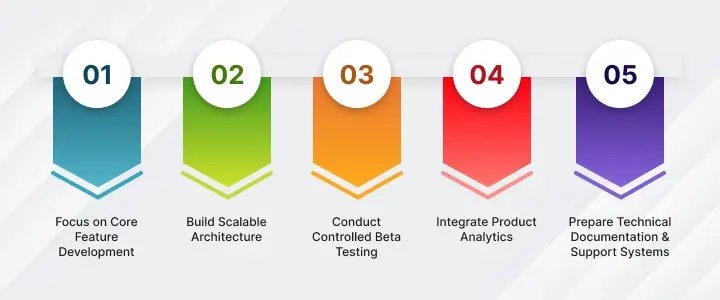
Focus on Core Feature Development
Prioritize features that directly support adoption. Avoid undocumented expansion, which increases risk and delays launch. In software development service projects, minimal viable functionality should deliver immediate user value.
Build Scalable Architecture
Performance failures immediately impact adoption. Ensure:
- API response times under 300ms
- Database queries optimized for concurrent access
- Monitoring and logging are enabled for real-time issue detection
In AI software development, maintain consistent model outputs and predictable latency even under peak loads.
Conduct Controlled Beta Testing
Release the product to a limited audience:
- 20–50 users for initial feedback
- Measure success, feature adoption, and error rates onboarding.
fixing high-drop-off points or technical failures, prewide launch.
Integrate Product Analytics
Track actionable metrics using integrated product management tools:
- Daily active users and feature adoption rates
- Session duration and engagement patterns
- Error frequency and severity
Analytics provide early insight into user behavior and technical performance.
Prepare Technical Documentation and Support Systems
Document:
- API endpoints and workflows
- User guides and operational manuals
- Support escalation processes
Proper documentation ensures smooth adoption and reduces support bottlenecks.
Phase 3 (Days 61–90): Market Execution and Scaling
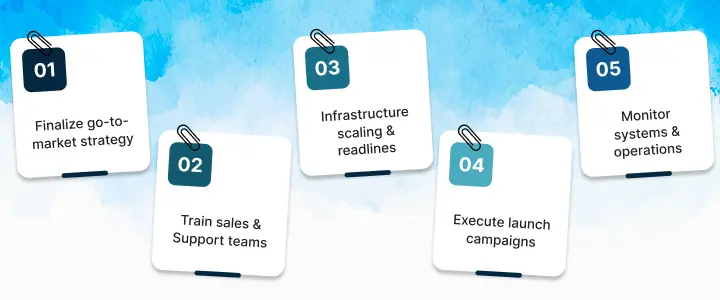
Finalize Go-to-Market Strategy
Execute the product launch plan with precision:
- Allocate channel budgets
- Define campaign ROI expectations
- Establish campaign timelines and responsibilities
Train Sales and Support Teams
Ensure operational teams understand:
- Product workflows and use cases
- Technical limitations and support scripts
- Competitive differentiation
Infrastructure Scaling and Readiness
Prepare systems for full market load:
- Enable auto-scaling and failover protocols
- Conduct load and stress tests
- Configure backups and disaster recovery
For AI systems, maintain consistent model performance under concurrent requests.
Execute Launch Campaigns
Deploy marketing campaigns:
- Email, social, PR, and partner channels
- Live demonstrations for enterprise customers
- Performance tracking via dashboards
Monitor Systems and Operations
Use real-time monitoring to:
- Track server uptime, latency, and errors
- Resolve critical issues immediately
- Ensure payment and transactional flows function
Post-Launch Optimization
Performance Data Analysis
Measure:
- Customer acquisition and conversion rates
- Retention metrics
- Technical stability under live conditions
Customer Feedback Collection
Collect actionable insights through:
- Surveys and direct interviews
- Usage analytics and session recordings
- Customer support interactions
Plan Iterative Enhancements
Prioritize improvements based on adoption and feedback:
- Retention optimization
- Feature enhancements
- Performance tuning
Common Product Launch Pitfalls
Avoid these technical and operational errors:
- Overloading the launch with unvalidated features
- Ignoring system performance under realistic conditions
- Poor coordination across engineering, sales, and marketing teams
- Delaying support and documentation until post-launch
- Not defining measurable success metrics
NetSet Software Solutions: End-to-End Product Launch Expertise
NetSet Software Solutions provides full ownership of the product lifecycle, ensuring your launch is technically precise, operationally aligned, and market-ready.
How NetSet Helps?
Strategy & Validation
- Targeted market research
- Defined product development strategy
Engineering & Architecture
- Scalable architecture for web, mobile, and AI systems
- Expertise in AI software development
Custom Development
- Enterprise-grade custom CRM system development
- Integration-ready solutions
Launch Readiness & Go-to-Market
- Implementation of launch-ready software frameworks
- Interdepartmental coordination (product, sales, marketing).
NetSet provides predictable results, quantifiable adoption, and technical reliability to any launch.
Conclusion
Every launch of a software product represents a technical challenge, operational challenge, and market challenge. Companies that avoid performing validation, ignore system performance, and lack coordination among all operations end up failing at their product launches and harming their reputation. With a carefully planned process for 90 days, you can mitigate all the above challenges through milestone planning of technical, operational, and business nature.
Do you feel assured of the capacity of your software product to scale and perform perfectly on day one? Let NetSet Software Solutions take total responsibility for your product development, architecture, and product launch.
NetSet with established methodologies, KPI metrics, and alignment will ensure that your launch is geared towards ensuring success, growth, and performance. Work with professionals who will take every step into consideration and ensure that your launch results in success.

FAQs
What defines a launch-ready product?
Product readiness at launch means offering essential functionality that addresses an obvious problem for users, ensuring reliability during peak loads, integrating seamlessly into users’ processes, and displaying consistent metrics on usability and performance.
How early should a product launch plan start?
The structure of launching an effective product should be started at least 90 days before its release. This will give time to the NetSet teams for feature validation, infrastructure testing, and stakeholder coordination.
Why is a product development strategy essential?
A product development strategy defines architecture, prioritization, and scalability paths, ensuring consistent performance under growth, efficient engineering execution, and controlled costs while reducing the risk of rework, delays, or system failures post-launch.
What metrics matter during launch?
Some important metrics for determining successful product launch are user-acquisition rate, conversion rate, retention cohorts, system uptime, response time, and number of errors since they provide direct evidence on product reliability and usability as well as scalability.
Why is beta testing critical?
The beta testing phase enables organizations such as NetSet to confirm actual user actions, identify problems in edge cases, test for optimal performance, and improve usability before releasing products to the customers.