The old path to bring a new drug to market is an ever running marathon that can take over a decade and cost billions if not millions of dollars.
However, the modern picture of pharmaceutical research has changed completely. It has replaced manual trial-and-error with high-speed computational prediction. Thanks to AI drug discovery software development company actively changing a slow, expensive process into a targeted digital sprint.
The fact is that this evolution is not just about speed, it is about increasing the probability that candidates enter human trials which historically fail most of the time.
Drug Discovery Before AI with Billion Dollar Bottleneck
For decades, the pharmaceutical industry has faced a “painful reality” where bringing a single drug to market can take up to decade, with massive investments mostly ending in late-stage failure.
The traditional method has always relied on manual laboratory experiments to test thousands of compounds one at a time, a process that is “judgment-heavy” and fragmented.
These manual approaches lead to the below multiple pain points requiring to solve:
- Lengthy Discovery Cycles: Finding a biological target and a matching molecule can take five long years of fierce screening.
- Exorbitant Costs: Physical wet-lab screening is really expensive, with single experiments can even reach up to thousands of dollars.
- Late-Stage Failures: Many promising drugs fail because they are toxic to humans, a fact that is mostly discovered only after years of clinical investment.
How AI Reshapes the Research Part for Drugs?
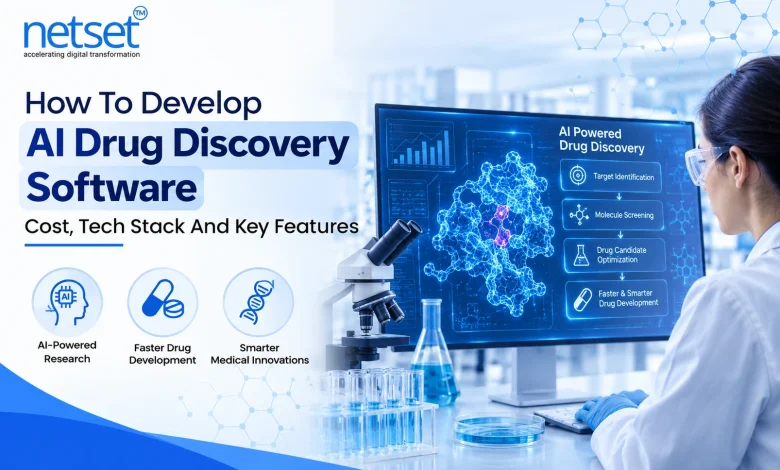
AI-driven platforms fundamentally rewrite the drug development stack. In place of testing random chemicals in a lab, researchers use computational models to simulate billions of molecular interactions on a screen in seconds.
This “in silico” approach lets teams find high-quality candidates before a single physical experiment is run.
| Aspect | Drug Discovery with traditional methods | Drug Discovery using the power of AI |
| Timeline | 10 to 15 years | Notably reduces to just months |
| Success Rate | Low like 10% overall | 80 to 90% in Phase I trials |
| Data Usage | Limited and siloed | Large-scale integrated datasets |
| Cost to Phase | May even reach Millions of dollars | Stays 30 to 50% less than traditional costs. |
AI opens doors for a “Self-Driving DMTA” which stands for design, make, test, and analyze cycles (that too constantly). It predicts how a compound will behave in the body, how it will be absorbed, metabolized, and whether it is toxic, which notably lowers the rate of late stage failures taking place in the clinics.
The 3 Must-Have Features in AI Drug Discovery Software
A production-grade AI platform is no doubt a complex ecosystem. Modern platforms should connect generative ai software development in healthcare to “invent” completely new molecular structures in place of just searching existing catalogs.
Predictive Modeling (ADMET & Efficacy)
This is the engine of the software as it predicts absorption, distribution, metabolism, excretion, and toxicity (ADMET) risks as early as possible. When such risks are detected during the time of laboratory testing, it saves precious investment in unsafe compounds.
Explainable AI or the XAI
In a regulated industry, “black-box” models are a liability. XAI gives visualization of molecular features driving predictions, which is very important for scientific trust and regulatory credibility at the time of FDA (Food and Drug Administration) scrutiny.
High-Throughput Virtual Screening
This allows the system to score the binding affinity of millions or even billions of compounds against a target instantly. It finds the most promising “hits” without the need for expensive physical reagents.
Detailed Development Phases in AI Drug Discovery Software Development
Building these platforms asks you for a structured implementation funnel to move from a “research ambition” to a production-grade tool. You have to make sure that you go with the right ai software development services provider because this journey requires blending cloud engineering with computational biology (something very complex).
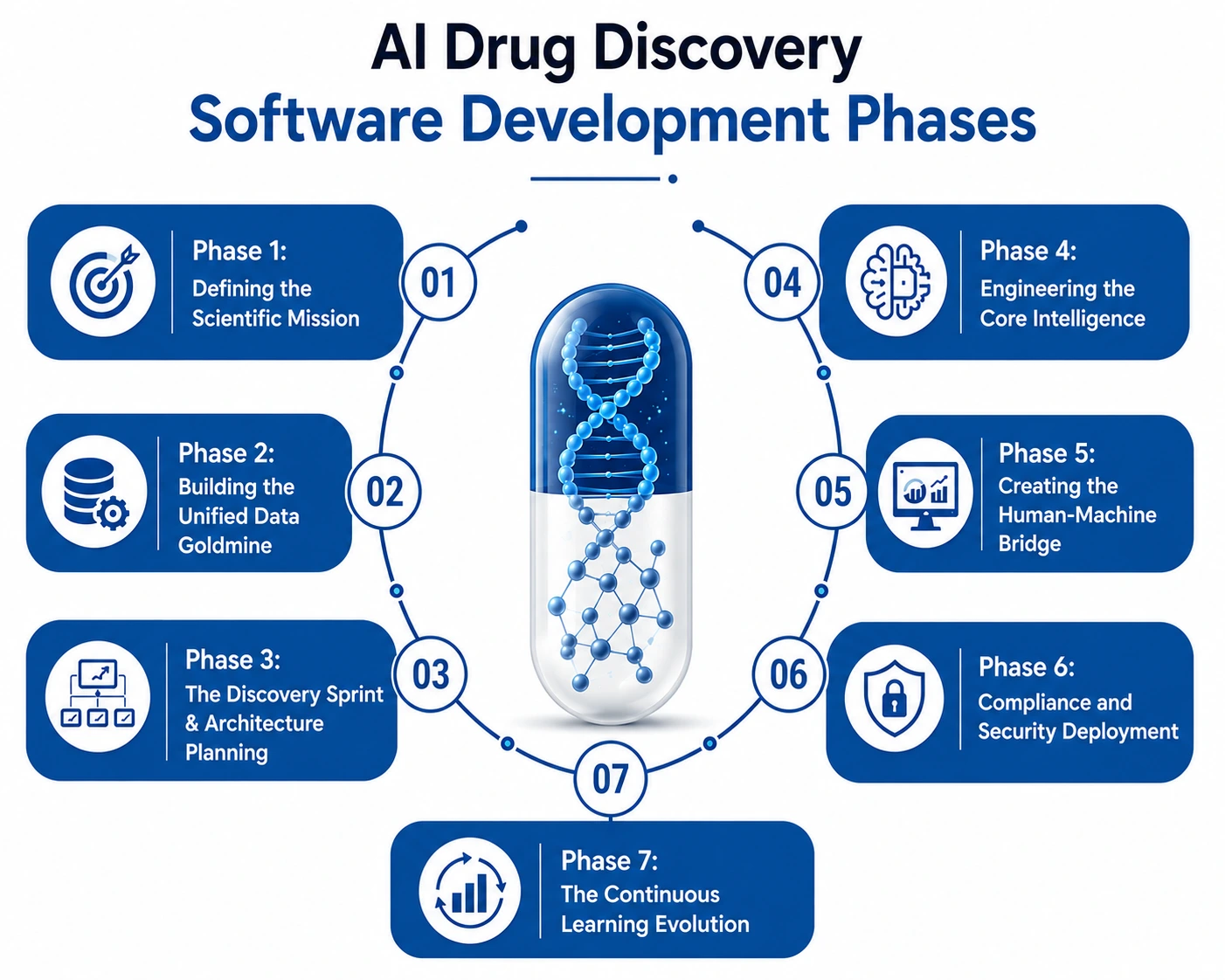
Phase 1: Defining the Scientific Mission
Before writing code, you must define the goals and objectives in your therapeutic area with its future use cases.
- Precision Goals: Are you building a virtual screening platform for oncology or a generative design tool for CNS diseases?
- Success Metrics: Precision at this stage defines every technical requirement that follows.
Phase 2: Building the Unified Data Goldmine
Data is the foundation of any AI platform, but the toughest job is to take out the data from siloes and make it to the best use possible.
- Aggregation: You must aggregate molecular libraries, genomic sequences, and clinical trial results from public sources like ChEMBL or DrugBank.
- Cleaning: High-quality datasets give better model accuracy far more than complex architectures.
Phase 3: The Discovery Sprint & Architecture Planning
A structured discovery process validates the technical approach before notable resources are committed.
- Prototyping: Build a validated prototype to address compliance requirements and define the computational infrastructure.
- Decision Matrix: This is the time to decide between Deep Learning for toxicity or Reinforcement Learning for efficacy.
Phase 4: Engineering the Core Intelligence
This phase transforms models into active analytical tools.
- Pipeline Construction: Build systems that ingest data, standardize molecular representations (like SMILES strings), and validate information for training.
- Model Training: Select base architectures, such as graph neural networks for property prediction or diffusion models for molecule design.
Phase 5: Creating the Human-Machine Bridge
The interface finds out if scientists will adopt the tool or treat it as a peripheral gimmick (not useful).
- Researcher Interface: Design dashboards tested with real scientists to make sure visualizations of molecular structures are intuitive.
- Real-Time Dashboards: Many firms now utilize python mobile app development services to create mobile-friendly dashboards for researchers to track long-running GPU training or lab results on the go.
Phase 6: Compliance and Security Deployment
Drug discovery data is competitively sensitive and subject to strict regulations.
- Technical Safeguards: Make use of AES-256 encryption, access updates on the basis of the role, and detailed audit logs.
- Regulatory Alignment: Make sure that the architecture supports FDA 21 CFR Part 11 and HIPAA where patient data stays there.
Phase 7: The Continuous Learning Evolution
The best platforms improve over time by incorporating new experimental results back into the training data.
- Retraining Loops: Apply pipelines that automatically retrain models as new assay data accumulates.
- Monitoring: Set up systems to detect “model drift” when performance degrades as the chemical space being explored moves.
Solving the Challenge of Tech Stack for AI Drug Discovery Software
In order to build such a platform that can handle petabyte-scale genomic workloads, you need a strong technical backbone that does not collapse.
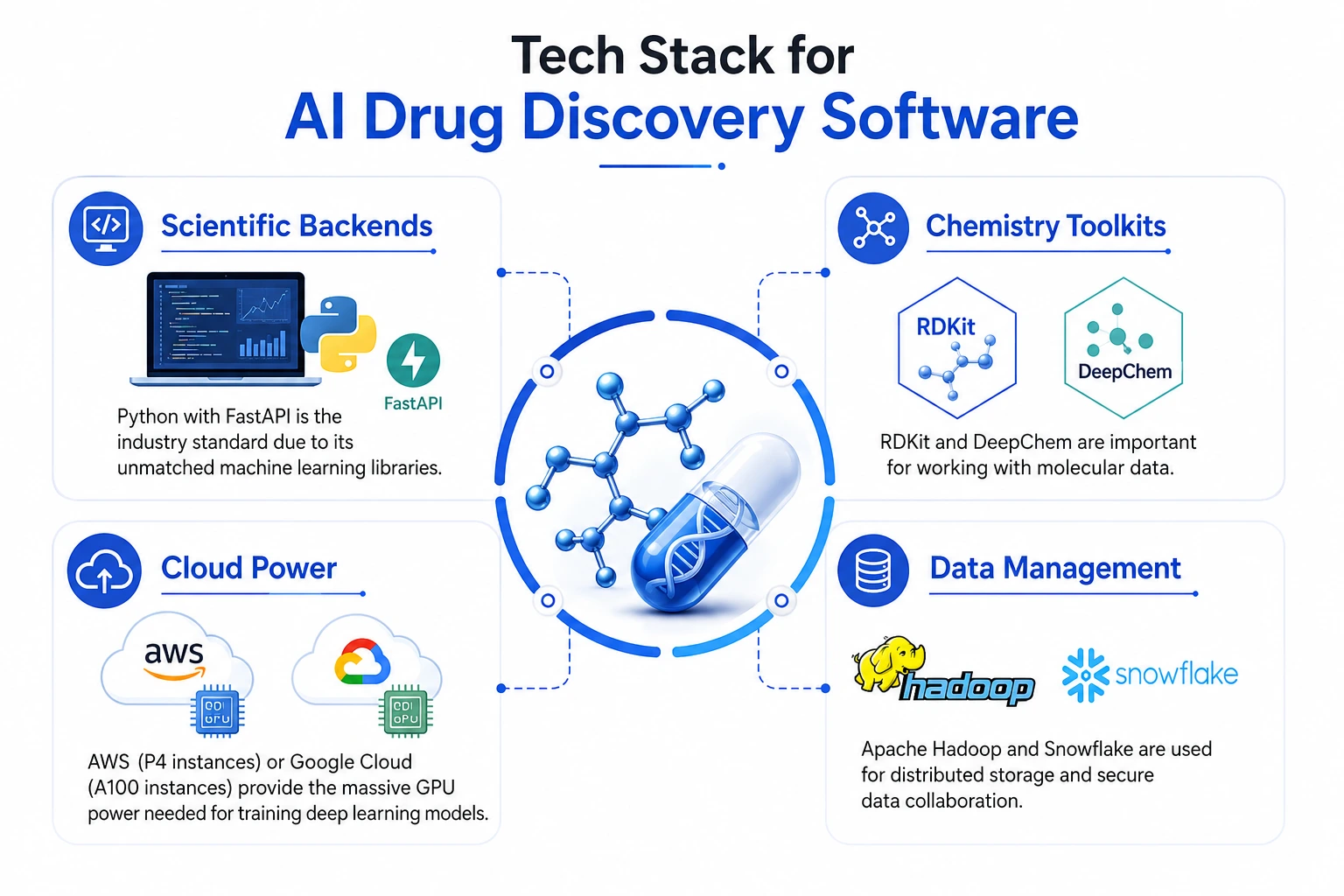
- Scientific Backends: Python with FastAPI is the industry standard due to its unmatched machine learning libraries.
- Chemistry Toolkits: RDKit and DeepChem are important for working with molecular data.
- Cloud Power: AWS (P4 instances) or Google Cloud (A100 instances) provide the massive GPU power needed for training deep learning models.
- Data Management: Apache Hadoop and Snowflake are used for distributed storage and secure data collaboration.
AI Drug Discovery Software Development Cost
The investment required varies based on the “breadth of research workflow integrations” and the complexity of the AI models. For example, if you are in Dubai then partnering with the best web development company Dubai with mobile and AI specialization can help optimize these costs.
| Platform Complexity | Estimated Cost | Scope of Work |
| Basic MVP | Starts from $20,000 and can range to up to $50,000 | Simple properties, basic analytics, and dashboards. |
| Moderate Platform | From $50,000 to $100,000 | Integrations of APIs, advance modeling for prediction, and compound screening. |
| Advanced Ecosystem | Starts from $100,000 to depending upon the complexities | Generative design, large-scale GPU training, and full compliance. |
Why Partner with NetSet to build your AI drug discovery Software?
If you want to build a software that acts as a bridge between raw biological data and life saving medicines, then you need to have an experienced AI development company having experience in the medical field.
When you hire fullstack developers with NetSet Software, with dedicated domain expertise in biotech, you make sure your platform is not just a promising experiment, but a production-ready engine for innovation.
Now it does not matter if you are a startup opting for validation of a new therapeutic target or an enterprise ready to modernize your R&D stack, we will deliver you the technical precision that brings your medicine vision to life.
FAQs
How long does it typically take to develop an AI drug discovery MVP?
A functional MVP can be delivered in 4 to 8 months on average. However, complex enterprise platforms with deep clinical integrations may take 12 to 24 months.
Does this software always require HIPAA compliance?
HIPAA is required only if the platform handles patient-level clinical data or PHI. Platforms working solely with chemical libraries or public biological data still need strong security but may not require HIPAA.
What is the difference between virtual screening and generative design?
Virtual screening scores and ranks existing chemical libraries. Generative design uses models like VAEs or GANs to “invent” entirely new molecular structures with desired properties from scratch.
How does AI make Phase I clinical trial success rates?
Drugs discovered with AI have up to 90% success rates in Phase I trials, as compared to the industry average which just stays up to 65%. The reason is that AI screens out unsafe compounds early, and gets rid of high toxicity or poor metabolic stability before human testing begins.
What is the most important factor when it comes to the accuracy of an AI model?
The most important factor here is the quality of data because if the training data is not consistent, even the smartest algorithm will give unreliable results. Your data should be clean, well structured and maintained to get your model to perform and bring accurate predictions.