Think of a dispatcher who is staring at a wall-sized map that is covered in faded sticky notes with multiple spreadsheets to track dozens of delivery trucks.
This is the story for the majority of logistics businesses, and the reality is that running on spreadsheets is already outdated and has become a liability waiting to surface. The modern tightening delivery windows and strict regulatory mandates have turned fleet operations into a critical engineering problem.
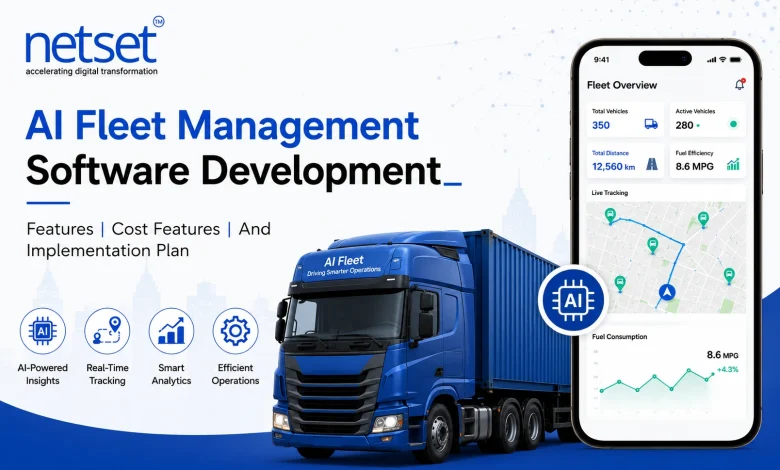
This is why the demand for AI fleet management software development is increasing more than ever and if you want to build one, this is the guide for you.
The main features of AI fleet management software
Modern fleet management is not something related to the future, but is gradually becoming a reality. While basic GPS tracking is the foundation, an enterprise level platform works as a thinking machine that processes raw telematics into impactful decisions.
This intelligent layer changes a vehicle into a data source that is constantly feeding information about engine health, fuel usage, and drive behavior into a unified dashboard.
The Smooth Network of Route Optimization
Static route planning is completely obsolete and is replaced by AI-powered algorithms that now account for a number of variables
- real-time traffic congestion
- accurate prediction of weather patterns
- prediction of delivery windows
- predicting weight capacity
- instant reroute of the whole fleet instantly if a highway is blocked.
For a fleet of 500 vehicles, even a minor 10% improvement in route efficiency adds up to the big annual fuel savings.
Predictive maintenance to stop breakdown from happening
The repairs of vehicles are costly but with an AI software development service provider, enterprises can build systems and move to condition-based maintenance.
These systems tap into the vehicle brain with OBD II devices using machine learning to find patterns in oil pressure, engine temperature, and diagnostic codes.
In place of waiting for a breakdown on an important highway, the system will predict a failure window, catch a fault 500 miles before it even takes place and also schedule service during natural downtime.
The real-time driver behavior scoring
Safety is a main driver when it comes to ROI, and AI-powered monitoring goes a lot further than just simple speed alerts.
It can analyze the below in real time.
- harsh braking
- rapid acceleration
When connected with AI dashcams, these systems can detect if a driver is distracted or using a phone and start providing immediate in-cabin coaching.
Such a virtual coaching approach has the potential to decrease accident rates by 40% and notably lower insurance premiums.
The offline feature for unstable internet
A good engineering requirement for the driver’s interface will be the offline functionality.
Because vehicles mostly pass from cellular dead zones or parking garages, the app must be designed to queue the data locally and sync with the central server automatically once a connection is restored.
This will make sure of the important safety of data and proof of delivery signatures that are never lost.
The right cloud and database choice for your AI-powered fleet management development
With decoupling the platform into independent services, like GPS tracking, billing, and route optimization, every component can be built, deployed, and scaled separately. However, the choices related to cloud and database drops have a huge impact on the success of the platform.
Cloud vs. Hybrid: Your Scalability Sweet Spot
While a monolithic build looks simple at the start, most enterprises hit maintenance walls within the first year because the fleet complexity starts becoming real. For the cloud architecture, you can go with AWS or Microsoft Azure as they give you automatic scaling and built-in redundancy for your 24/7 global operations.
If your organization follows strict data residency and security mandates, then a hybrid (public and private cloud) approach will be your best bet. It is because you can keep proprietary algorithms on-premise but send real-time operational logic to the cloud for best accessibility.
Picking the database to handle massive data points
Fleet data is unique, in high volume, geospatial, and strictly time series by nature.
A fleet of just 100 vehicles generates about half a million location updates within just 24 hours and standard relational databases won’t be able to take heavy load. You have to use time series databases like InfluxDB or TimescaleDB that can handle the telemetry data and coordinates received from sensors.
To make sure that this data moves from the vehicles to the dashboard instantly, your development partner will use Apache Kafka or AWS Kinesis to send the same in sub-millisecond windows.
The bridge between legacy and modern units
A main engineering challenge is to make sure that the platform can talk to a mixed fleet of older CAN bus units and modern OBD II devices. The goal is a hardware-agnostic IoT ingestion pipeline.
When you use lightweight protocols like MQTT and specialized APIs to integrate dashcams, fuel cards, and ELDs, the system creates a unified source of truth no matter the vehicle’s age or manufacturer.
Making your AI fleet management system a multiplatform success
If a driver finds the mobile app cumbersome or a dispatcher is burdened by data, the system will fail to achieve its ROI.
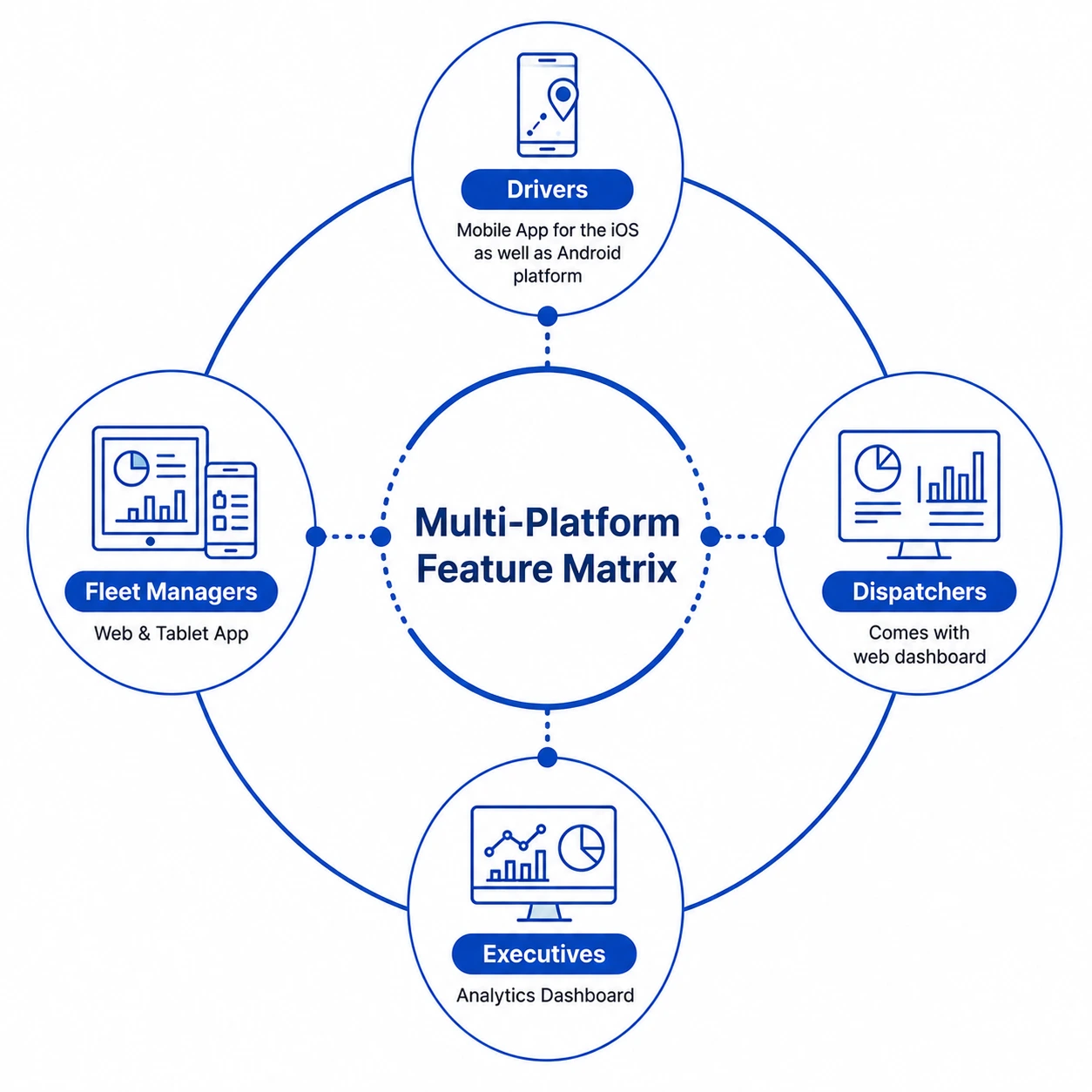
Now, to avoid this, successful platforms are engineered with multi-role ecosystems where every user, from the cab to the boardroom, interacts with their own view of their mission-critical tasks.
Multi-Platform Feature Matrix
| User Role | Primary Interface | Core Features Required |
| Drivers | Mobile App for the iOS as well as Android platform | Route guidance, HOS/ELD logging, digital inspection (DVIR), and two-way messaging |
| Dispatchers | Comes with web dashboard | Real-time map view of all vehicles, drag-and-drop job assignment, and automated alerts |
| Fleet Managers | Web & Tablet App | Maintenance scheduling, driver scorecards, and exception-based performance reporting |
| Executives | Analytics Dashboard | Total fleet cost analytics, ROI reporting on software investment, and compliance risk views |
The technical execution of these roles will ask you for a strategic choice in mobile frameworks. For the driver app, cross-platform stability is important.
Many enterprises choose to hire React Native developers in India to build high-performance mobile solutions. It gives 20 to 30% cost savings compared to separate native builds while also keeping the responsiveness required for real-time tracking.
Decoding the fleet management development costs and ROI
Building a custom fleet platform is an infrastructure investment and not a simple software purchase.
The total cost is mainly driven by the complexity of the AI logic, the number of hardware integrations and the depth of the multiplatform solutions that are required to serve drivers and dispatchers at the same time.
For enterprise-grade systems, the investment generally falls into three distinct tiers on the basis of the operational scale and intelligence requirements.
Investment tiers right from MVP to enterprise ecosystems
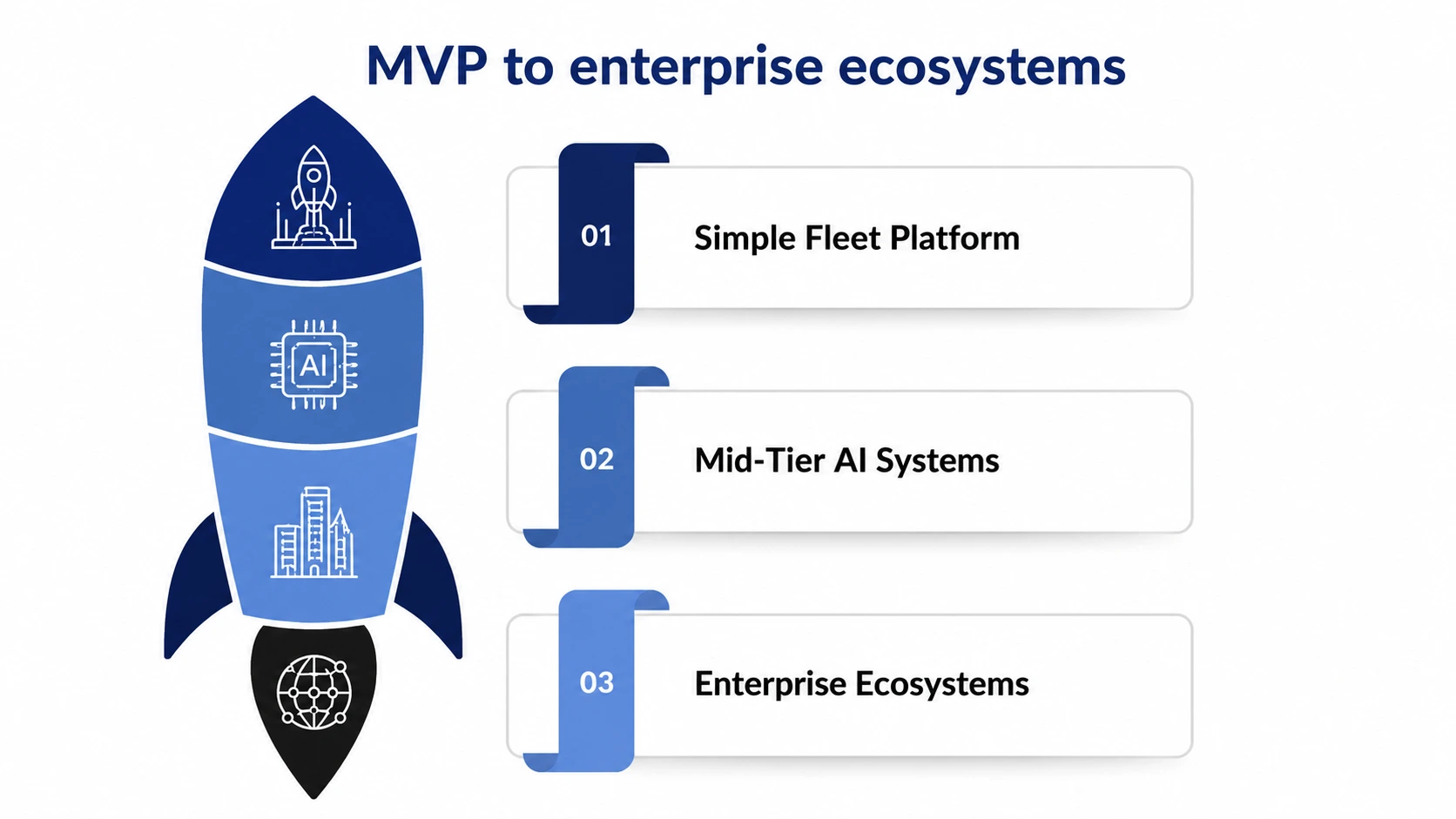
- Simple Fleet Platform: You can plan the budget of $25,000 to $50,000 for this one as it suits business having under 50 vehicles with features like GPS tracking, a basic admin dashboard, and standard reporting.
- Mid‑Tier AI Systems: Priced between $50K–$100K, these platforms add smart features on top of basic tracking. They include route optimization, driver performance scoring, and ELD compliance tools. This tier is where most growing logistics companies find the right balance of cost and intelligence.
- Enterprise Ecosystems: Ranging from $100K–$200K, these are full enterprise builds. They offer custom AI/ML analytics, deep ERP connections, and white‑label options. Designed for large, multi‑regional fleets, they provide maximum flexibility and scale for complex operations.
The hidden bill: Hardware rollouts and API fees
The software build is only part of the equation. Organizations must factor in the rolling costs of a deployment. Telematics hardware like the OBD II units and AI dashcams generally cost between $50 and $300 per vehicle.
More than that, there are ongoing expenses like cellular data plans that are generally $10 to $30 per vehicle and third-party API fees for premium mapping and traffic data that can add $500 to $5,000 to the monthly operating budget.
An implementation road map for seamless fleet management software deployment
You need to understand the phases if you want to achieve a successful AI fleet management development software.
Phase 1 with discovery and operational audit
Here you have to map every existing pain point, right from dispatcher phone tag to manual compliance logs, to define the high-impact feature requirements.
Phase 2 for architectural foundation
Decide early on how telemetry data will be partitioned and down sampled to make sure there is sub-second performance. This is where a custom AI web development services provider builds the nervous system that is capable of handling millions of data points without latency.
Phase 3 for the 90-day MVP pilot
You can launch a core feature version with a subset of 5 to 10 vehicles. This identifies important usability issues like the mobile app interface challenges in cold climates before a full-scale capital commitment is achieved.
Phase 4 with hardware and an intelligence layer
Here connections of OBD II units and dashcams take place. Then the calibration of AI models against your given historical routes and localized driver patterns goes into process.
Phase 5 for compliance and security tightening
Although security should be in the foundation right from the start, you still need to perform constant load testing. These tests must be on realistic peaks and validate FMCSA/ELD automation to remove audit risks.
Phase 6 for phased training and change management
Deploy by region in place of all at once. You can use champion drivers to advocate for the system and study the adoption rate. Once things go fine, you can later go for large-scale deployment of your software.
What about future-proofing and preparing for the EV and autonomous shifts?
As the global fleet management market goes to reach the projection of more than $70 billion valuation by the year 2030, the next frontier is no longer just about tracking but more about electrification and autonomy.
The future-ready platforms now have to solve for EV given operational challenges like the battery range calculations, charging station proximity, and time-of-use energy cost management.
Parallelly, the integration of advanced driver assistance systems or ADAS, is acting as a bridge toward a semi-autonomous future.
Modern AI layers do more than just suggest routes; they also monitor automatic braking, lane departure warnings, and collision avoidance activations to refine the driver risk profiles and lower the insurance premiums.
To build these capabilities into your data model today, you must make sure that your fleet remains competitive as internal combustion engines are phased out.
Transform your fleet management vision into to a working system: Partner with NetSet
For constructing an enterprise-level fleet ecosystem, you need a high-stakes engineering endeavour where domain expertise will also act as an ultimate differentiator.
The team at NetSet Software is specialized in transforming complex logistical friction to an AI-powered competitive benefit for a number of businesses throughout the world. From high-concurrency IoT ingestion pipelines to driver-first mobile experiences, we give you the technical depth required to have a fleet that does not just run but thinks.
Go for applying your custom software on 500 vehicle operations or integrate it with your existing legacy stacks to modernize them; we will partner with you in building an intelligent business for you.
FAQs
How long does it take to build custom fleet software?
A basic MVP focuses on core GPS tracking, generally taking 3 to 4 months. But a fully featured enterprise system with predictive AI modules and deep ERP integration normally asks 8 to 12 months for a stable rollout.
Can custom software integrate with existing ERP systems like SAP?
Yes, custom built platforms use special techniques to connect telemetry data directly into existing enterprise modules like financial accounting and plan maintenance which gives a unified data ecosystem.
Is it better to build or buy off-the-shelf fleet tools?
When you have small fleets of less than 50 vehicles then off-the-shelf tools with standard workflows can be a good budget choice. But, for larger businesses custom development will be superior as it gives full data ownership, special compliance controls, and long-term scalability.
What hardware devices can be connected into the system?
Modern systems are designed to be hardware agnostic, connecting with OBD II units, electronic logging devices or ELDs, AI-powered dashcams, fuel card sensors, and even RFID scanners for cargo tracking.
What are the ongoing costs of maintenance after launch?
Maintenance generally costs 15 to 20% of the initial build cost annually. This covers important security patches, server hosting, API fee management, and constant feature updates as regulations get stronger.