Real-world assets or the RWA tokenization, are evolving from financial assets to physical infrastructure on their topmost gear. Vehicle fleets are a new use case because they combine tangible assets with recurring commercial revenue.
A fleet of ride-hailing cars, rental vehicles, or delivery vans is more than a collection of depreciating vehicles. When professionally managed, it can generate predictable cash flows from daily operations for anyone owning it.
Fleet tokenizations put this economic activity on custom blockchain solutions by showing ownership or economic rights using the digital tokens. This creates two opportunities at the same time: fleet operators can access a broader pool of capital, while investors can gain fractional exposure to income-generating vehicle assets without purchasing an entire fleet.
Why are vehicle fleets suitable for tokenization?
The difference between a personal car and a commercial fleet is important. A privately owned vehicle is usually a cost for its owner. It loses value over time, requires maintenance and insurance and remains unused for most of the day. Personal vehicles are estimated to sit idle for around 95% of the day.
Commercial fleets work differently. Ride-hailing vehicle rental cards and delivery cards can remain active for long periods and generate revenue with their repeated use. Their performance can therefore be measured using operational data such as mileage, utilization, rental activity, and daily revenue.
This makes a managed fleet closer to income-generating infrastructure than a simple consumer asset.
Closing the fleet funding gap
When you go for building a commercial fleet, it asks for up front capital investment and on traditional level operators were relying on bank loans, leasing companies, institutional investors and their own capital.
Tokenization as a big solution
A fleet can be divided into digital shares so that multiple investors gain fractional exposure to the underlying assets or their revenue. These vehicles continue to work normally, showing how blockchain technology structures ownership, investment, and revenue participation.
This model could become very useful as shared mobility, electric fleets, delivery networks, and autonomous transportation continue to expand. These businesses require substantial capital to acquire and maintain vehicles.
With RWA tokenization platform development, operators can create a digital infrastructure for raising capital, managing investors, recording ownership, and distributing eligible returns.
Prefer Reading: Create Your Token in Minutes: How NetSet’s No-Code Crypto Token Platform Works
Private Cars vs. Managed Fleets
| Feature | Private Personal Car | Managed Vehicle Fleet |
| Main Purpose | Personal transportation | Commercial income generation |
| Usage | Often idle for most of the day | Frequent or extended daily use |
| Cash flow | mainly an expense | Generates recurring revenue |
| Funding | personal cash or bank financing | Business, institutional, or fractional capital |
| Data | limited to operational tracking | GPS, mileage, maintenance, revenue, and usage data |
Real-world fleet tokenization examples
Fleet tokenization is already moving beyond the theory. Projects in Europe and the Middle East show how physical vehicles can be connected to blockchain-based ownership and revenue models.
Eloop’s tokenized Tesla Fleet
Vienna-based car sharing company Eloop tokenized part of its Tesla fleet and connected around 100 electric vehicles to the Peaq blockchain network.
The model allowed token holders to receive fractional payouts linked to rental revenue. Blockchain-based records also provided greater transparency into the performance of the underlying fleet.
The significance of the project is not simply that cars were represented by tokens. It shows how a physical fleet can continue operating in the real world while blockchain infrastructure handles digital ownership and investor participation.
CryptoAutos in Dubai
Dubai-based CryptoAutos takes a similar approach with a premium vehicle fleet valued at around $20 million in early 2025.
Fractional investors received exposure to rental income and resale value of the vehicles with earnings distributed in stablecoins.
This shows an important benefit of tokenization: that income generated by physical assets can be connected to digital investment infrastructure without requiring investors to own or manage the vehicle themselves.
Toyota and Ava Labs Prototype
Fleet tokenization is also gaining attention beyond special RWA projects. Toyota and Ava Labs jointly created a prototype of the mobility orchestration network or MON, to find how automated systems can interact with blockchain infrastructure. This bigger development suggests that blockchain could eventually play a role in areas like vehicle identity, mobility payments, ownership, and automated transactions.
For fleet operators entering this space, working with an experienced RWA tokenization development company can help bring together the different requirements involved in asset management, blockchain infrastructure, compliance, and automated payments.
How does fleet tokenization work?
Tokenizing a fleet involves more than creating cryptocurrency. The digital needs to represent a clearly defined connection to the underlying physical assets of their economic value.
The process generally involves creating the legal ownership structure, verifying the fleet, defining investor rights, creating smart contracts, completing compliance checks, and connecting the platform to reliable vehicle data.
Compliance built into the token
Real-world assets require stronger controls than ordinary digital tokens.
As per the structure and jurisdiction, a fleet tokenization platform may ask KYC checks, investor whitelisting, transfer restrictions, role-based permissions, and mechanisms in order to handle disputes or incorrect transactions.
Smart contracts can automate many of these rules
For businesses operating in regulatory markets, an experienced asset tokenization development company in Dubai can help align the technical platform with the relevant regulatory and compliance requirements.
Important smart contract features
Identity and Whitelisting: Only investors who have completed required KYC checks can be allowed to hold or transfer tokens.
- The uRWA Interface : (ERC 7943) adds compliance features like freezing accounts, recovering tokens sent to the wrong address, and taking care of legal requirements.
- Vesting and lockups : Make sure that tokens given to founders, operators or other stakeholders are released gradually on set schedules to spark long-term commitment and lower the risk of immediate selling.
- Controlled Administration: Role-based permissions allow authorized operators to manage specific platform functions or resolve technical issues without giving a single administrator unlimited control.
- Deflationary Burn: When vehicles are permanently retired from the fleet, further equal tokens can be burned to keep the digital supply connected with the underlying physical assets.
Once deployed, these rules can execute automatically using smart contracts, while operators manage the platform using the administrative dashboards.
The biggest challenge (to keep physical assets and tokens in sync)
Fleet tokenization has one challenge that does not exist to the same extent with purely digital assets, that is, the underlying assets are constantly moving.
A vehicle can travel hundreds of kilometers, accumulate mileage, require repairs, become temporarily unavailable, or be involved in an accident. These physical uncertainties are commonly referred to as kinetic risk.
For investors, the important question is how this changing physical condition is reflected in the digital asset.
This is where blockchain oracles become important.
Solving this problem
A blockchain cannot directly access information from a vehicle’s GPS system, maintenance database, or rental platform. An oracle acts as the bridge between these off-chain systems and the blockchain.
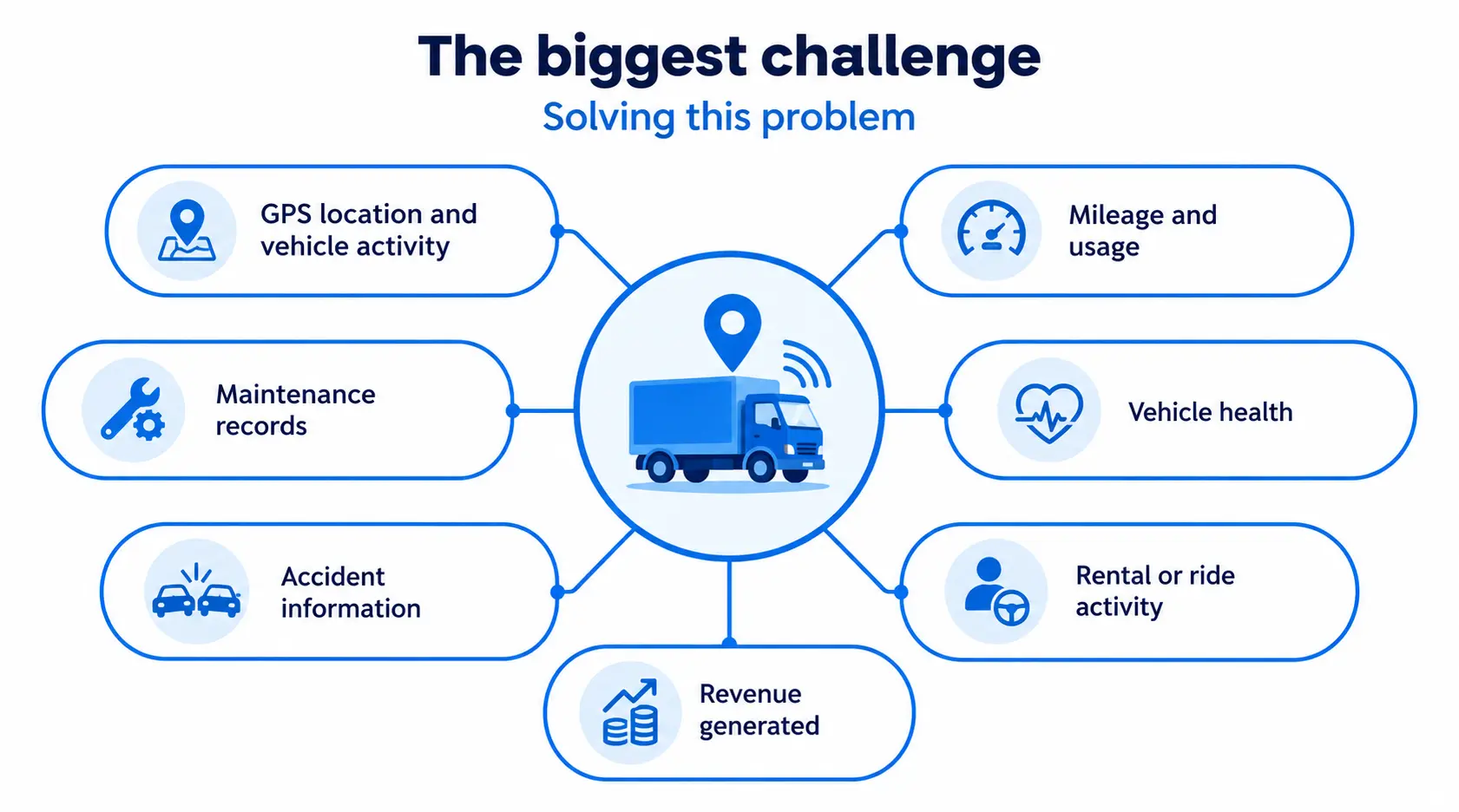
For a fleet, the data may include:
- GPS location and vehicle activity
- Mileage and usage
- Maintenance records
- Vehicle health
- Accident information
- Rental or ride activity
- Revenue generated
This information can be collected through telematics and IoT systems, processed through trusted data infrastructure, and then supplied to blockchain applications.
The result is a more accurate connection between the physical fleet and its digital representation.
- If a vehicle is retired, for example, the platform can update the asset records and adjust the token supply accordingly.
- If fleet revenue changes, the relevant distribution calculations can also be updated.
This makes modern asset tokenization services particularly important for fleet projects.
The blockchain itself is only one part of the solution but a successful platform also requires secure data collection, oracle infrastructure, fleet-management integrations, and automated smart contracts.
The Role of Stablecoins in Fleet Payouts
Stablecoins can make the payment side of fleet tokenization more practical.
Because stablecoins are designed to maintain a value linked to fiat currencies such as the US dollar, they can be used to settle digital transactions without exposing every operational payment to the volatility of conventional cryptocurrencies.
Last year, stablecoin transaction volume reached approximately $33 trillion, growing 72% year over year.
For tokenized fleets, stablecoins can provide a digital settlement layer for investor distributions. Instead of manually processing payments through traditional banking systems, eligible revenue can potentially be converted and distributed automatically through smart contracts.
This does not remove the need for legal, accounting, or compliance processes, but it can make recurring digital settlements significantly easier to automate.
Prefer Reading: How To Create A Stablecoin Without Writing Code Step-by-Step in 2026
Further Market Opportunity for Fleet Tokenization
The wider tokenized RWA has already crossed $14.1 billion in the start of this year, supported by assets such as government bonds and private credit.
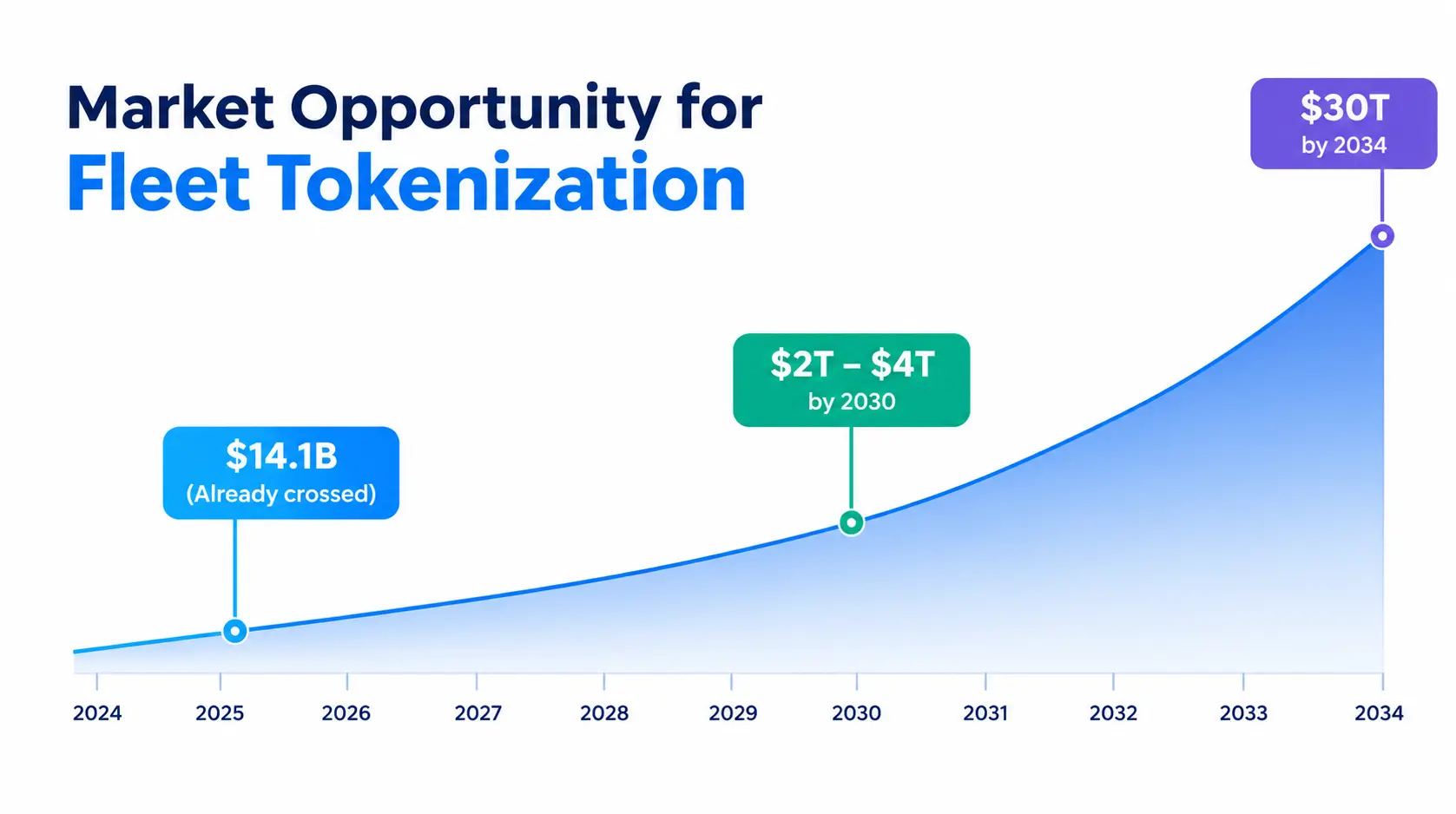
For the future, the estimation of growth is showing bigger numbers, with some forecasts placing the market between $2 trillion and $4 trillion by 2030, while more aggressive projections reach as high as $30 trillion by 2034.
Fleet tokenization represents only one part of this market, but it has a unique advantage: vehicles can generate measurable revenue through real-world activity.
- For mobility companies, this creates a potential alternative to relying entirely on traditional financing.
- For investors, it can provide access to a physical asset class with measurable operating performance.
- The opportunity will ultimately depend on factors such as regulation, fleet economics, investor demand, insurance, asset verification, and the quality of the underlying data.
Drive Your Fleet Into the Future with NetSet
Fleet tokenization brings together three elements that have traditionally operated separately: physical vehicles, commercial revenue, and digital finance.
If you want to tap into this market, then NetSet Software is a well-known blockchain development company in Dubai and has helped global businesses tokenize fleet operators for eligible assets with automated compliance rules, and a smooth revenue distribution.
The result is not simply a digital version of your vehicle fleet vision but a whole new blockchain financial structure in which real-world mobility infrastructure directly interacts with global digital capital markets.
Explore Our Case Study: Blockchain Asset Tokenization Liquidity for Financial Advisors
FAQS
How do fleet tokens generate earnings for investors?
Returns can be linked to revenue generated by commercial vehicles. After expenses such as maintenance, insurance, and fuel are accounted for, eligible net revenue can be distributed to token holders according to the project’s legal and economic structure.
What is kinetic risk in fleet tokenization?
Kinetic risk refers to physical risks affecting moving vehicles, including accidents, mechanical problems, wear and tear, and other operational issues. Insurance, fleet management, and appropriate risk controls can help manage these risks.
Which token standards support RWA compliance?
Standards such as ERC-7943 (uRWA) and ERC-3643 can provide features for identity verification, transfer restrictions, regulatory checks, and token recovery.
How does an oracle help a tokenized fleet?
An oracle connects real-world fleet data with blockchain systems. Information such as mileage, GPS activity, vehicle health, and revenue can be used to keep digital records and calculations aligned with actual fleet performance.
Which blockchains can support fleet tokenization?
The best option actually depends on transaction costs, scalability, security, liquidity, stablecoin support, and the compliance requirements of your project still Solana, Avalanche. Polygon, and Ethereum will remain a great choice.