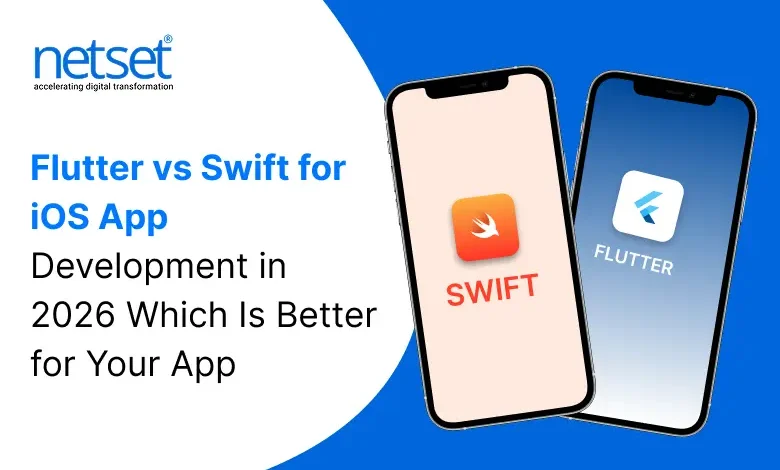
Flutter vs Swift for iOS App Development in 2026 Which Is Better for Your App

Just imagine a case of a founder in 2026 who has this vision for the next big thing on the app stores. They approach three agencies for quotes, where one talks about the raw power of native Swift, another one promises the constant reach of Flutter, and the third one suggests a hybrid approach. There is a big difference in the quotes too as they are apart by around 40% and the timelines do not feel the same either.
Now picking up a framework in 2026 is no longer a technical check box because it shapes the performance, cost, and long-term scalability of your product. In a world where user expectations for instant experiences are at an all-time high, the technology you choose today is going to define your ability to scale for years to come.
We are not looking for a universal winner but more of the perfect fit for your specific roadmap, budget, and target audience.
Swift: The heart of Apple World
Let us start with Swift, the official language of Apple and is already at its peak with the release of Swift 6. This language aims for precision, safety, and deep integration with the whole Apple ecosystem, right from the dynamic island on the latest iPhones to the immersive worlds of Apple Vision Pro.
This year, Swift has matured into a glamorous powerhouse of reliability, bringing strict concurrency checking to remove data race bugs before they ever reach a user’s device. For those who want to grow exclusively inside Apple’s university, Swift remains the gold standard for high-performance iOS app development.
It gives direct access to the latest hardware-level optimizations, which is why every swipe and tap feels premium, instant, and secure.
Flutter: The speed specialist
When you enter Flutter, Google’s open-source UI toolkit, you get the “write once, run anywhere” reality with remarkable consistency. In 2026, Flutter 3.38 and the Impeller rendering engine have successfully fixed the “jank” issues of the past that deliver smooth animations to rival native apps even on 120 Hz displays.
Flutter’s layered architecture draws its own pixels, which gives you the total creative freedom to build a branded experience that looks identical on both iOS and Android. Reaching more users across mobile and web with the same performance is a unique competitive benefit you can achieve.
The startups that want to validate ideas quickly often go to hire Flutter app developers to cover both platforms with a single team and a shared codebase that notably lowers the initial barrier to entry.
Prefer Reading: How much does it cost to hire a Flutter developer in 2026
The race for speed-performance in the real world
When we put these frameworks into the race of performance, there are some technical trade offs that start getting clear.
Swift wins when it comes to cold starts because you can compile it directly machine code for near instant launches without any major issues. Flutter, while nearly on par for standard apps, still needs those extra milliseconds to initialize its runtime engine before you can render your first screen.
But again, for design-heavy apps, Flutter shines with its optimized rendering engine that hits a consistent 60+ FPS for complex custom UI animations. The difference is most noticeable in battery efficiency and memory management because Swift’s native ARC (automatic reference collection) is more serious and resource efficient than Flutter’s garbage collection.
For apps where every millisecond and milliamp counts, like high-frequency trading or real-time delivery tracking, experienced iOS app development is important to make sure that you get native-level responsiveness.
Designing the experience: Native feel vs. custom branding
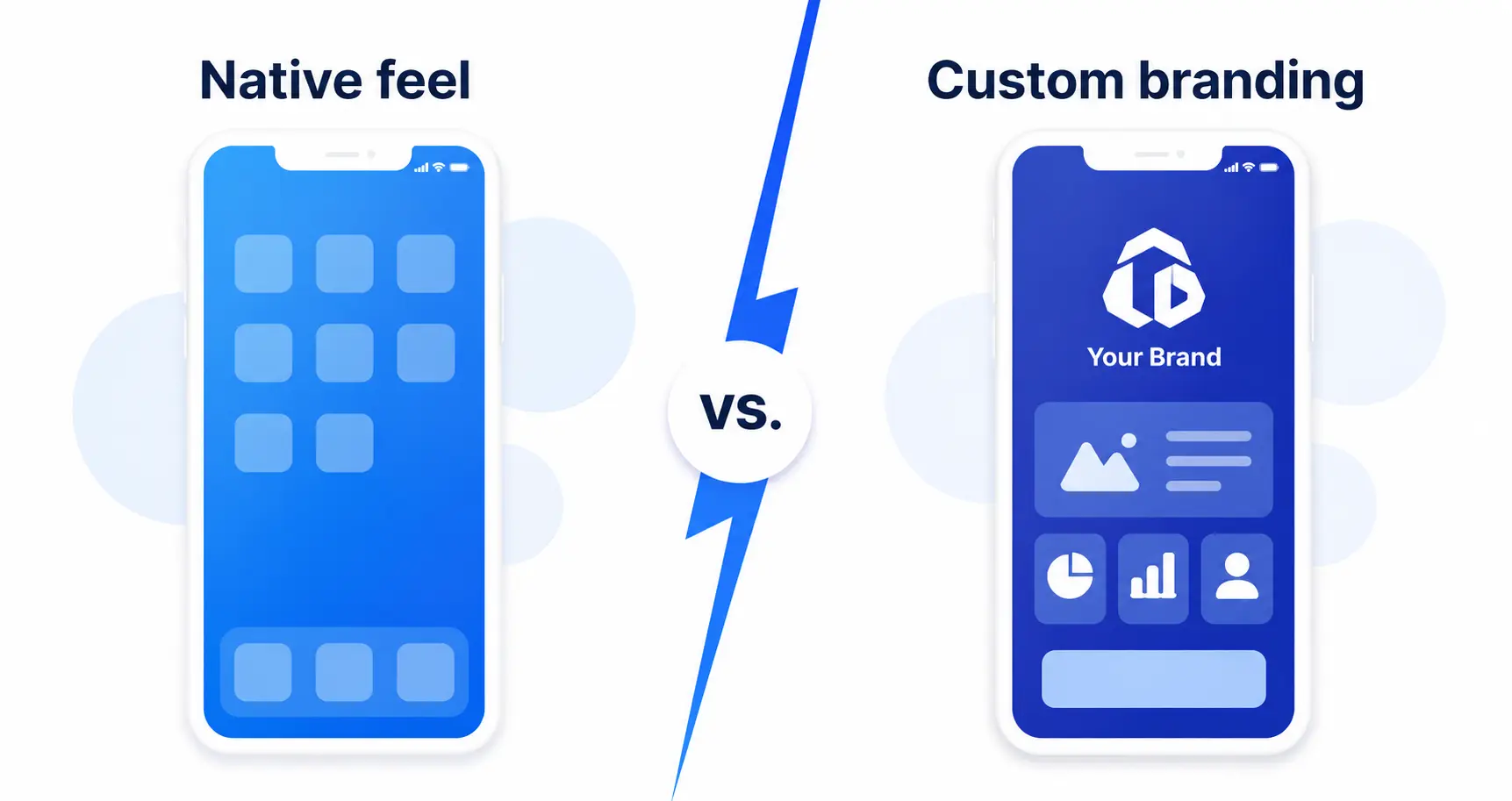
We have to admit that user experience today is not just about looks because users care about how your app behaves and feels under the thumb.
Swift apps use Apple’s native components like SwiftUI and UIKit, which means they meet with the human interface guidelines. It makes the buttons, navigation, and gestures feel right because they are exactly what long time iPhone users expect.
Flutter gives you pixel perfect customization that allows you to leave those standard platform conventions and go for a unique brand identity.
However, this freedom comes with a hidden cost where developers must manually implement iOS-specific behaviors like edge swipes, safe area margins, and haptic patterns to avoid a bad user experience.
When a product requires that polished, standard Apple aesthetic for a premium audience, many organizations prefer to hire Swift developers.
Living through updates—maintenance and future proofing
What happens every September when Apple releases a new iOS? Swift developers get day one access to all their new APIs like ARKit, HealthKit, and Live Activities.
But flutter relies on a plugin system that can lag behind native releases by days, weeks, or even months until the community actually builds it.
For example, Flutter support for the Dynamic Island features arrived nearly two years after the hardware feature launched. Over a three-year period, cross-platform apps can have notable technical debt as plugins break or go unmaintained during OS shifts.
To navigate these yearly shifts safely and make sure that your app stays in compliance with the latest security standards, it is wise to hire iOS app development experts who understand the underlying native roadmap and can build custom bridges when generic plugins fall short.
The Cost of Success: Budgeting for Now and Later
There is a common myth that Flutter saves exactly 50% on development costs. In reality, while you save on shared business logic like authentication, API calls, and data models, the need for platform-specific UI polish and debugging iOS edge cases means actual savings for dual-platform projects go closer to 25 to 30%.
For iOS-only projects, the cost saving is actually zero because you pay for the cross-platform overhead without receiving any Android benefit. Swift apps often boast a lower total cost of ownership over a five-year period because Apple manages backward compatibility within its own frameworks.
Flutter wins on upfront speed for a dual launch; Switch wins on long-term stability for an iOS-first brand.
The Ultimate Comparison Table for Flutter vs Swift in 2026
| Feature | Swift (Native iOS) | Flutter (Cross Platform) |
| Core Philosophy | Made for precision and deep integration with the ecosystem of Apple. | Built for flexibility and “write once, run anywhere” efficiency. |
| Language | Swift 6 which is a strongly typed, modern and memory safe language. | Dart is an optimized language when it comes to reactive UIs, and is also familiar to Java/JS developers. |
| Rendering Engine | Native iOS graphic stack | Impeller draws its own pixels on a canvas and has become default in 2026. |
| Performance | Always top tier due to direct hardware access and fastest cold starts. | Near native where you can achieve smooth 60+ FPS, slight overhead for engine initialization. |
| UI/UX Feel | Automatically follows Apple’s Human Interface Guidelines or HIG. | Pixel perfect customization because it requires effort to mimic native iOS gestures and all the other things. |
| Ecosystem Access | Day one access to new APIs like ARKit, HealthKit, Dynamic Island) | Depending on the plugin community, the more they build, the more elements developers have. |
| App Size | Lean and optimized so generally smaller binaries. | Larger that is usually around 30 to 50% bigger because of the bundled engine. |
| Cost (initial one) | High for dual platforms as it requires two separate teams. | When it comes to dual platform projects, there is around 25 to 30% of the savings. |
| Maintenance | Lower long term debit for iOS first brands. | Lower for shared logics but higher when it comes to plugin updates and OS shifts. |
| Support for wearables | It is native so Swift is the only path for watchOS, tvOS and vision OS. | Limited as there is no direct support for watchOS or full visionOS experiences however you can target android ecosystems easily. |
| Security | Direct due to built in apple security with the features like keychain, biometrics and sandboxing. | Bridge is reliable as it achieves high security with the support of community plugins. |
| Best for | Performance heavy apps like gaming or AI, or if there are apps in finance and apple exclusive products. | Startups or MVPs or any other design led apps that require quick solutions to reach dual platforms. |
Tips to find the right Swift and Flutter developers for success
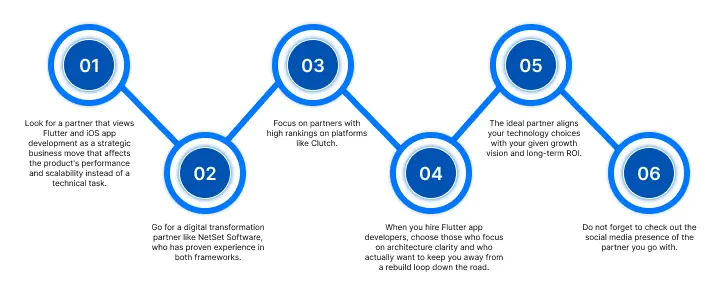
- Look for a partner that views Flutter and iOS app development as a strategic business move that affects the product’s performance and scalability instead of a technical task.
- Go for a digital transformation partner like NetSet Software, who has proven experience in both frameworks.
- Focus on partners with high rankings on platforms like Clutch.
- When you hire Flutter app developers, choose those who focus on architecture clarity and who actually want to keep you away from a rebuild loop down the road.
- The ideal partner aligns your technology choices with your given growth vision and long-term ROI.
- Do not forget to check out the social media presence of the partner you go with.
Picking your path for the 2026 decision matrix (in the simplest way)
Pick Swift if: You are building an iOS-exclusive app that requires maximum performance for AR/VR or gaming, requires immediate access to Apple’s latest hardware features or are targeting visionOS and Apple watchOS development.
Pick Flutter if: You need a constant MVP for both iOS and Android parallelly, have a design-led brand with a custom UI that departs from native conventions or are working with a tighter initial budget for a cross-platform app development launch.
Final Verdict
This year, both Swift and Flutter have matured into world-class tools. The performance gap has become very little but the strategic choice remains as sharp as ever.
Swift is your foundation if you want to go with that premium, long term excellence, whereas Flutter is your engine if you want to build fast and for cross-platform growth.
The best technology is never just the most popular one, but the one that actually fits with your vision, your budget, and where your users will be three years from now.
FAQs
Which is more effective in terms of cost for my business within Flutter or Swift?
For the budget friendly side, Flutter is better for businesses who want to target both iOS and Android at the same time. But for products that are exclusive to the Apple ecosystem, Swift is more economical and the right choice to deliver that ultimate experience.
What is the case where Swift performance goes better than that of Flutter?
While Flutter does give close to native performance for standard business apps and dashboards, Swift is the clear winner if you want to target high computation or hardware intensive tasks for iOS.
Can I create a companion Apple Watch or Apple Vision Pro experience from a Flutter app?
No, not directly, because development for watchOS and visionOS remains exclusive only to the Swift developers so there is no bridge that will let you use Flutter codebase to build apps for Apple exclusive devices.
Can I work on my project with Flutter and then, as my app scales, switch to Swift with code reuse to target Apple users?
The architecture of Dart and Swift is completely different, so when you plan to scale, you have built everything from scratch so it will not be possible to reuse the code between these two technologies.
How does the choice of framework decide if I get to use the latest features on launch day?
If you go with Swift you are going to receive day-one access to every new API Apple announces at their yearly worldwide developers conference. But, the case is different with Flutter as it relies on a community-driven plugin system to bridge these native features, which can lead to delays of several months.