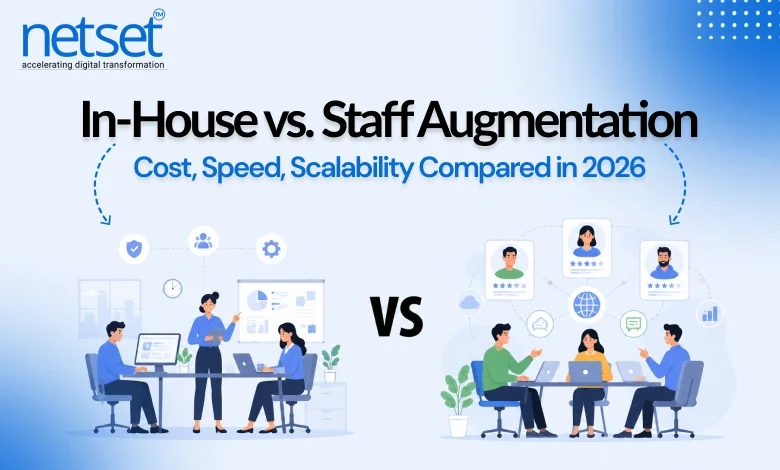
In 2026, the hiring debate has shifted from a simple HR issue to an important architectural decision.
Most of the modern tech leaders are no longer just asking who they should hire but are asking about which model protects their delivery speed without burning through their financial runway. The choice between a core in-house team and staff augmentation services is often the difference between a resilient roadmap and a stalled release.
With this guide, we want to look past the “hourly rate” myth to compare costs, speed, and scalability with several contexts. You will find out why the most successful companies are moving away from rigid structures to hire dedicated developers who fit their specific stage of growth.
The “Stability Tax” that comes attached with internal hiring
The most common mistake tech leaders make is assuming the base salary of a developer as their true cost. In this market local hiring carries a “stability tax” that can inflate your burn rate by 50% over the base salary alone. While a median US salary might sit at $133,080, top-tier roles in tech hubs do exceed $174,000, but the best part is that this salary is only about 70% of the total spend.
When you hire dedicated developers internally, you commit to a total cost of ownership that includes benefits, taxes, and recruitment fees. This financial burden is why many are shifting, and, in fact, the global IT staffing market is projected to grow notably as firms look for converting these fixed costs into variable ones.
Once shifted to a variable spend model through IT staffing solutions, companies often realize a first-year ROI of 40% to 60% by avoiding high upfront costs.
The recruitment process that kills time-to-market for most businesses
Speed is the most important benefit in software execution and the biggest hidden cost in modern development is not the salary but the delay. Most of the traditional in-house recruitment were slow by design, with cycles averaging 45 to 95 days right from job posting to offer acceptance.
When you add a notice period and the time required for a new hire to become productive, the same roadmap can easily slip by months.
How does staff augmentation solve this?
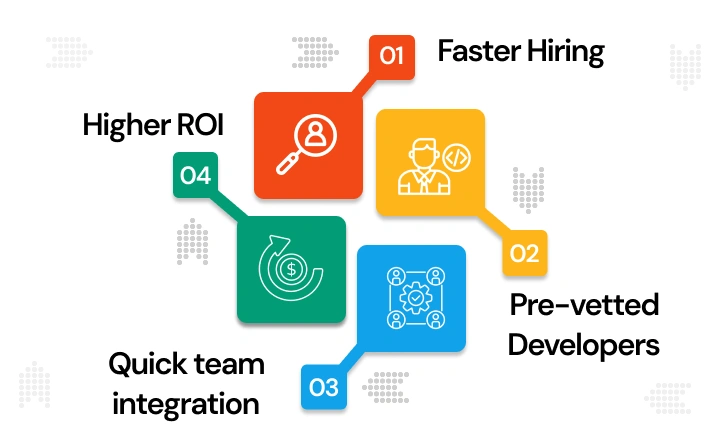
A staff augmentation company in the USA changes this equation. They provide vetted specialists who can be integrated into your team in as little as 48 hours. This efficiency is critical, as the research shows, for the average time-to-hire for technical roles continues to rise and often stalls product launches.
Since these developers are pre-vetted, their time to productive output is much lower, which directly results in a faster return on investment for new features.
How Can “Elastic Engineering” Protect Your Bottom Line?
In 2026, scalability is all about adjusting your engineering capacity in response to market shifts or funding changes without the weight of permanent headcount.
In-house teams scale slowly in both directions and growing a team takes months, while slowing down comes with its own potential legal risks and a notable blow to team morale. In comparison, staff augmentation services deliver you elastic engineering. This flexibility is important for startups that require moving fast but cannot afford high replacement costs.
With the tech turnover rate often reaching around 13%, the highest among all sectors, relying only on permanent hires can be a risky strategy. This model allows the permanent workforce to remain focused on long-term IP while the augmented perimeter handles the heavy lifting of execution.
The Head-to-Head Difference: Which Model Wins for Your Current Project?
Now that we have discussed a number of important elements, it is time to look at the key differences in a detailed tabular format to help you determine which model delivers the best ratio of capability to cost for your given needs.
| Factor | In house hiring | Staff Augmentation |
| Management Burden | Stays normally full because you manage the work, HR and career growth | Stay internal because you just manage the daily tasks and your vendors will be the ones handling all the HR tasks. |
| Cost Structure | Highly fixed because of the salaries, benefits and taxes you must pay every month. | Stays variable because you pay as you go hourly/monthly rates. |
| IP and control | Stays maximum as you have direct ownership and domain deep domain logic. | Stays high due to direct management over daily tasks and all the commits. |
| Time to deploy | It is generally slow because it takes around 45 to 95 days. | It is fast because you can onboard a team within just 48 hours to 2 weeks. |
| Scalability | Stays rigid because it is very difficult and expensive if you plan to scale down or even scale up. | This one is highly flexible because you can scale up and down within just 2 to 4 weeks of notice to your vendor. |
| Ideal use case | If you want a core product ownership and long-term architecture, then this is the option to go with. | If you want to cover the skill gap quickly without training and hiring investments or want to spike quickly in your project, then this is the best choice. |
What Can We Learn from the Most Expensive Strategic Failures?
To understand the in-house vs. staff augmentation cost debate better, there are certain mistakes that highlight the limitations of the traditional models.
Common Mistake 1
A common mistake occurs when companies hand off projects as “black boxes” to external agencies. This often leads to products that fail because the developers did not understand the internal culture or the scope was too vague. In 2026, smart leaders avoid these failures by using augmented staff who work directly inside their own systems.
Common Mistake 2
Another failure occurs when companies over-hire for a product direction that has not been validated. When you hire permanent engineers before reaching product market fit it will mostly lead to a codebase that would be discarded within six months (or may lead to a failed overall idea).
However, augmentation allows you to test new technologies with specialized experts, so that you can validate the approach before you commit to the long term costs of a permanent hire.
Why is Internal Leadership Your Best Insurance Policy?
While staff augmentation services provide the capacity to move at high velocity, they are not a substitute for strategic direction. A recurring failure occurs when managers attempt to use augmented staff without providing a technical vision. To succeed, your internal processes must be mature enough to absorb external talent.
The top way to mature your internal processes
This requires established CI/CD pipelines and clear documentation standards to make sure that a “plug-and-play” experience is there. Augmented developers should be treated as an extension of your team so you have to add them in daily stand-ups and all your important Slack channels.
Industry data suggests that companies effectively connecting external talent see higher project success rates than those that keep them siloed. Successful integration delivers that when you hire dedicated developers, they become part of your culture, not just a line item.
The magic of Nearshore staff augmentation companies
The most interesting argument in the hiring debate is the reality of regional talent arbitrage. In 2026, the cost of a senior developer in a US tech hub like San Francisco has reached a peak where total annual costs can exceed $250,000. By comparison, global remote hubs allow companies to access the same level of expertise at a fraction of the burn rate.
When you partner with a staff augmentation company in the USA that provides nearshore talent, you are not just saving on base salary. You are bypassing the massive benefits load mandatory in the United States.
In many international scenarios, a senior developer results in an effective annual cost that is notably lower than a local hire. This represents a huge saving in the first year, nicely extending your runway by nearly two years without sacrificing engineering quality.
But which model fits your product’s current life cycle?
Deciding how to scale is an architectural decision based on your product’s stage of growth.
For startups
For startups in the early stages, hiring permanent engineers is generally a mistake because the product is likely to be first. At this stage, augmented seniors provide the flexibility to experiment without long-term commitment.
For scaling stage
Once you reach a stage of scaling, staff augmentation services shine by allowing your internal core team to own the architecture while the augmented “perimeter” executes at speed. It is estimated that over 70% of businesses now use some form of outsourcing or augmentation to manage costs and access skills.
When to choose augmentation vs in-house?
You should choose to hire dedicated developers through an augmentation model when the need is skill-specific. However, for roles that require deep institutional memory, the in-house model remains the gold standard.
Prefer Reading: Outsourcing & Team Augmentation Case Study
Ready to Scale Beyond the Ordinary with NetSet Software?
The right partner is the final step in moving from a rigid hiring model to a high-velocity engineering culture. NetSet Software’s staff augmentation services provide a full-service infrastructure that allows you to treat remote specialists as if they were local hires.
In a market where a single missing specialist can cause a deadline to slip, we provide the immediate capacity needed to keep your roadmap on track.
Also, when you partner with us to hire dedicated developers, you gain access to a pre-vetted talent pool that bypasses the traditional recruitment drag. We deliver a candidate shortlist typically within 48 to 72 hours, with developers ready to start within two weeks. Our IT staffing solutions handle the complex parts of global scaling like international payroll and legal compliance so that your leadership remains focused on innovation.
FAQs
Is staff augmentation actually cheaper than in-house hiring?
Yes, when measured by total cost of ownership, avoiding the “stability tax” of benefits and recruitment often leads to 40% to 60% cost savings in the first year.
How do I choose the right staff augmentation company?
Focus on technical vetting depth and communication alignment. A reliable partner should mirror your internal communication rhythm and understand your specific industry.
What is the biggest risk involved in product development?
The main risk is “knowledge loss” if there is not a clear internal tech lead. Success requires good documentation and internal ownership of the architectural vision.
Can augmented developers work on my core features?
Absolutely, the augmented staff work inside your tools and attend your stand-ups which makes them a true extension of your core team.
When is it better to hire in-house instead of going with augmented developers?
In-house hiring is best for long-term core IP ownership and strategic technical leadership. If the role is central to your competitive edge for the next three years, hire in-house.