Healthcare organizations invest heavily in digital infrastructure such as electronic health records (EHR), telemedicine platforms, artificial intelligence systems for diagnosis, and patient engagement solutions.
However, a significant proportion of healthcare software initiatives fail to reach production-grade maturity or stall before delivering measurable clinical or operational value. These failures are not driven by technological limitations but by execution complexity across regulatory, architectural, and operational layers.
In such cases, healthcare organizations require a structured, outcome-driven software project rescue framework with clearly defined intervention stages.
According to a survey conducted by HIMSS Market Insights, two-thirds of healthcare executives identify limitations in infrastructure as a significant hindrance to implementing innovative healthcare technologies.
Furthermore, security and compliance issues continue to be a significant challenge for about 70% of healthcare organizations.
Moreover, various reports have shown that 30-50% of healthcare software projects fail to deliver value due to various reasons, such as a lack of compliance issues, complexity in integration, and governance issues.
This blog will discuss how healthcare organizations can identify failing healthcare projects and use a structured recovery strategy to rescue failed software projects.
Why Healthcare Software Development Projects Fail?
Before indulging in rescuing troubled projects, organizations must understand the underlying reasons that cause failure. Healthcare software projects, in particular, have been observed to fail due to several reasons.
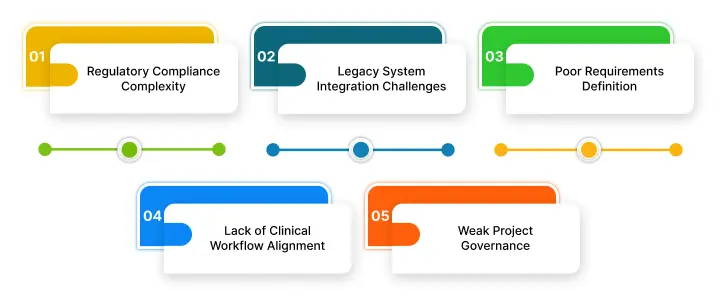
1. Regulatory Compliance Complexity
Healthcare software needs to adhere to rigid rules and regulations such as HIPAA, FDA rules, and other data privacy rules applicable to the region.
In case the compliance requirements are identified at a later stage of development, architectural refactoring becomes mandatory, leading to significant timeline slippage and cost overruns.
Typical compliance challenges include:
- Secure patient data storage and encryption
- Detailed audit trails for regulatory review
- Access control and identity management
- Data retention and patient consent management
Delayed compliance integration inevitably results in full or partial architectural re-engineering, significantly impacting delivery timelines and system stability.
2. Legacy System Integration Challenges
Healthcare institutions rely on numerous legacy platforms such as EHR systems, laboratory information systems, billing systems, and imaging software.
Connecting modern applications with these systems requires interoperability standards such as:
- HL7
- FHIR APIs
- DICOM integration
- Custom middleware layers
Underestimating interoperability and integration complexity remains a primary root cause behind project failure and recovery escalation.
Isolated systems create:
- Inconsistent patient records
- Delayed clinical workflows
- Operational inefficiencies
3. Poor Requirements Definition
A majority of failed initiatives exhibit poorly defined, unstable, or continuously evolving requirements baselines.
In the absence of stakeholder-aligned requirement baselines, the development teams will create features that are not related to the real workflow.
The symptoms include some of the following:
- Scope infringement
- Conflicting stakeholder feedback
- Repeated requirement revisions
- Growing backlog without delivery
Projects exhibiting these patterns consistently transition into full-scale recovery scenarios
4. Lack of Clinical Workflow Alignment
The use of healthcare technology must be incorporated into standardized clinical practice.
Clinicians demonstrate high resistance to systems that disrupt established clinical workflows or increase cognitive load.
Healthcare IT implementations often fail due to insufficient clinicians’ involvement during the design and testing stages.
5. Weak Project Governance
Substantial healthcare software initiatives require disciplined governance frameworks.
Without structured oversight, teams encounter systemic breakdowns, including:
- Uncontrolled scope expansion
- Poor communication
- Unclear accountability
- Delayed decision-making
These governance failures often trigger the need for external software project rescue companies to intervene.
Many of these challenges also extend to digital health app development, where scalability, compliance, and user engagement must be addressed from the initial stages.
Prefer Reading: Fixing Failed Software Projects Smartly – A Founder’s Rescue Playbook
The Cost Of Failed Healthcare Software Projects
Healthcare software failures are not only technical setbacks; they can also create significant financial and operational consequences.
Failed implementations directly result in:
- Extended development budgets
- Delayed product launches
- Disruptions in clinical workflows
- Regulatory compliance risks
For healthcare organizations, these failures directly impact patient care outcomes and operational continuity. As a result, many organizations choose to fix failed software projects through structured software project rescue strategies rather than abandoning the investment entirely.
Early Warning Signs Of A Failing Healthcare Software Project
Healthcare organizations should monitor indicators that a software project is trending toward failure
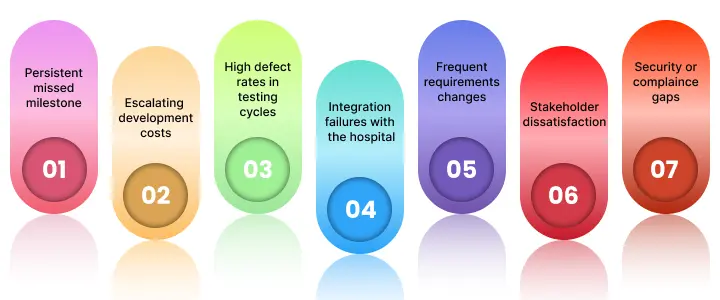
These signs include:
- Persistent missed milestones
- Escalating development costs
- High defect rates in testing cycles
- Integration failures with the hospital
- Frequent requirement changes
- Stakeholder dissatisfaction
- Security or compliance gaps
The simultaneous appearance of these indicators indicates an active project failure trajectory requiring immediate intervention in order to rectify collapsed software projects before the costs run too high.
When multiple failure indicators appear simultaneously, many healthcare organizations choose to hire a team of dedicated software developers who can intervene quickly and prevent further architectural, operational, and financial degradation..
The Healthcare Software Project Rescue Framework
Software project rescue needs a systematic approach. At NetSet Software Solutions, project recovery engagements are usually based on a multi-phase framework.
Phase 1: Rapid Technical and Operational Assessment
A diagnostic review is the initial stage of software project rescue.
This phase involves a multi-layer diagnostic covering:
Technical evaluation
- Architecture design review
- Codebase quality analysis
- Infrastructure and cloud configuration
- Security posture assessment
Operational review
- Stakeholder alignment
- Project governance structure
- Delivery roadmap and backlog evaluation
Upon root cause identification, the next step will be stabilization and risk containment.
Phase 2: Stabilization and Risk Containment
Following root cause identification, the primary focus shifts toward the stabilization of the project environment.
Commonly, the following activities occur during project stabilization:
- Resolving critical system defects
- Stabilizing infrastructure and deployment pipelines
- Addressing urgent compliance risks
- Freezing uncontrolled feature development
This phase halts further system degradation, establishes operational control, and creates space for structured software recovery planning.
Phase 3: Strategic Recovery Roadmap
Then, the project undergoes structured realignment against measurable delivery objectives.
Commonly, a software project recovery roadmap includes:
- Prioritized feature delivery
- Revised technical architecture
- Compliance implementation strategy
- Integration milestones for hospital systems
- Updated timeline and cost projections
This phase requires effective communication with stakeholders to regain their trust in the failing project.
Phase 4: Architecture Modernization
In many failing healthcare systems, the architecture itself is the primary bottleneck.
Modernizing the architecture typically includes:
- Moving to cloud infrastructure.
- Adopting microservices for modular scalability.
- Implementation of the interoperability layers based on FHIR.
- Introduction of automated test pipelines.
These architectural enhancements enable long-term maintainability and regulatory compliance.
Phase 5: Agile Delivery Reset
Projects that collapse under conventional waterfall methodologies demonstrate measurable recovery gains through a structural shift.
Agile recovery strategies include:
- Short delivery cycles
- Continuous stakeholder feedback
- Incremental releases
- Automated quality testing
This approach allows organizations to deliver value gradually while reducing project risk.
The Role Of A Software Project Rescue Company
In many cases, internal teams are too deeply embedded in the project to objectively diagnose its problems.
A specialized software project rescue company delivers:
- Independent technical assessment
- Recovery strategy design
- Experienced engineering leadership
- Regulatory and healthcare field experience.
External intervention accelerates recovery timelines while minimizing operational disruption.
At NetSet Software Solutions, project rescue initiatives typically combine:
- Healthcare domain specialists
- Software architects
- DevOps engineers
- Compliance experts
This multidisciplinary approach enables organizations to rescue failed software development projects and turn them into stable production systems.
With experience in various healthcare technology platforms, cloud architectures, and interoperability solutions, NetSet Software Solutions delivers specialized expertise required to fix failed healthcare software projects and guide them towards successful deployment.
Best Practices To Prevent Future Healthcare Project Failures
Although software project rescue is effective, prevention is better than cure.
Healthcare organizations must adopt the following best practices:
1. Integrate Compliance Early
Compliance must be embedded at the architectural design level, not a checklist provided at the end.
2. Prioritize Interoperability
Interoperability standards like FHIR and HL7 should be designed for healthcare systems.
3. Involve Clinical Stakeholders
Doctors and nurses must be actively involved in designing, testing for usability, and validating the workflow of digital applications for patient care.
4. Adopt DevSecOps Practices
Building tools for patient care with a continuous cycle of security testing, automated compliance monitoring, and continuous integration (CI) and continuous delivery (CD) significantly reduces security, compliance, and operational risk exposure..
5. Implement Strong Governance
Clear project ownership, milestone tracking, and executive sponsorship are critical to delivery success.
Why Healthcare Organizations Choose NetSet Software Solutions for Project Rescue
Healthcare software delivery operates within a high-complexity, regulation-intensive ecosystem, where legacy systems, interoperability constraints, and compliance mandates introduce significant execution risk.
NetSet Software Solutions specializes in:
- Software project rescue
- Rescuing troubled projects
- Rescue failed software development initiatives
- Modernization of legacy healthcare platforms
- Healthcare interoperability engineering
- Secure cloud infrastructure implementation
Our engineering teams work with healthcare providers, digital health startups, and medical technology companies to transform failing initiatives into successful digital healthcare platforms.
Conclusion
Healthcare software delivery operates within a high-complexity, regulation-intensive ecosystem. The regulations, legacy systems, and system requirements add complexity to healthcare software projects, which make it a challenging infrastructure for software projects.
Organizations must initiate immediate corrective intervention when such projects start failing.
An effective recovery strategy for a software project rescue is a combination of technical diagnostics, software modernization, and project management resulting in a production-grade, scalable, and compliant system, scalable, and compliant system.
If your project is already showing signs of failure, missed milestones, rising costs, or integration breakdowns, delaying intervention will only increase recovery cost.
NetSet Software Solutions typically start with a rapid 5–7 day technical assessment to identify root issues and define a recovery roadmap.
FAQS
1. What is software project rescue?
Software project rescue is a structured intervention process involving technical diagnostics, architectural correction, and delivery realignment to recover failing software initiatives.
2. When should a healthcare software project be rescued instead of abandoned?
A project should be rescued when the core architecture remains salvageable, compliance gaps are addressable, and business objectives are still viable despite delivery failure.
3. How long does a healthcare software project recovery take?
Recovery timelines typically range from 6 to 16 weeks, depending on system complexity, codebase quality, and integration dependencies.
4. Why do healthcare software projects fail?
Failures are primarily driven by regulatory non-compliance, poor interoperability design, unstable requirements, weak governance, and a lack of clinical workflow alignment.
5. Can a failed healthcare software project be successfully recovered?
Yes. With structured recovery, architectural restructuring, and agile delivery reimplementation, failing projects can be transformed into stable, production-grade systems.