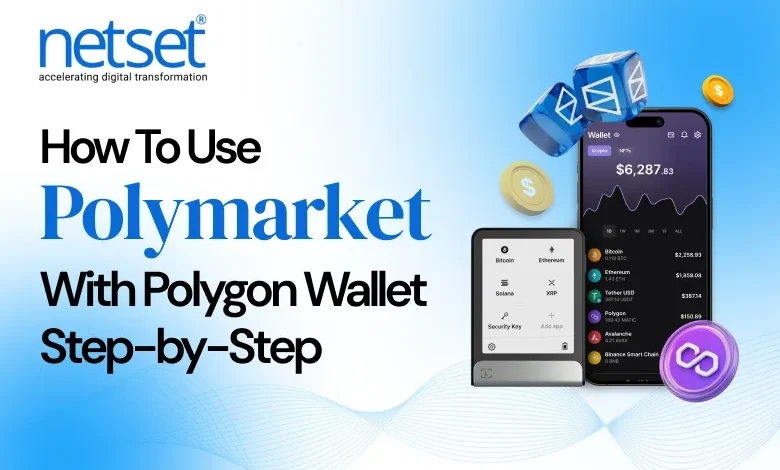
Polymarket is a decentralized prediction market where outcomes are traded as priced probabilities. Users do not deposit funds into a centralized system. Instead, positions are created and settled through a connected wallet using USDC. Each “YES” or “NO” share reflects a market-implied probability, with prices ranging between 0 and 1.
Despite the apparent simplicity, first-time users consistently fail during execution. The failure pattern is predictable: misconfigured network settings, incorrect asset routing, and deficient knowledge of transaction dependencies. These are not advanced issues. They occur because most guides focus on steps without explaining the Polymarket business model.
Polymarket operates on Polygon to reduce cost and latency. Average transaction fees range from $0.001 to $0.01, with confirmations typically under five seconds. This makes it feasible to test strategies with small capital allocations, which is not economically viable on the Ethereum mainnet.
This guide focuses on correct execution. Each section addresses a specific failure point and explains the underlying mechanism so you can complete the process without relying on assumptions.
How Does the Polymarket Execution Model Work in Practice?
At a structured level, Polymarket functions as a probability exchange. When you purchase a “YES” share at 0.40, you are acquiring exposure to a 40% implied probability. If the outcome resolves in your favor, the share settles at $1. If not, it resolves at $0.
This pricing model introduces two distinct profit paths:
- Pre-resolution trading: entering at a lower probability and exiting as the price increases.
- Final settlement: holding shares until the outcome is confirmed.
Most experienced users operate in the first category. They treat positions as tradable instruments rather than binary bets. This reduces exposure time and allows capital rotation across multiple markets.
Understanding this distinction is critical. Without it, users default to holding positions until resolution, which increases risk and reduces flexibility.
What Infrastructure Must Be Correct Before Any Transaction Is Attempted?
Execution depends on four aligned components:
- Wallet configuration.
- Network selection.
- Asset availability.
- Gas token presence.
A failure in any one component results in transaction rejection or obscured balances.
The wallet, typically MetaMask, must be explicitly configured to operate on Polygon. This is not a passive setting. If the wallet remains on Ethereum, USDC sent via Polygon will not appear, even though the address is correct.
USDC must exist on Polygon, not just in the wallet. This distinction is frequently misunderstood. Tokens are chain-specific representations, not universal balances.
Finally, MATIC must be present to cover gas fees. Even a transaction costing $0.005 will fail if the wallet holds zero MATIC. This is a common operational oversight.
How Do You Configure Polygon Correctly to Avoid Hidden Execution Errors?
Network configuration is the first irreversible checkpoint.
Once Polygon is selected within the wallet:
- The base token changes from ETH to MATIC.
- Transaction fee estimation reflects Polygon pricing.
- Contract interactions route through Polygon nodes.
If any of these conditions are not met, the wallet is not correctly configured.
A practical validation step is to initiate a small transaction. If the estimated gas fee exceeds $0.05, you are likely still on Ethereum. Polygon transactions rarely exceed $0.01 under standard network conditions.
This validation should be completed before funding the wallet. It prevents misrouted transactions and unnecessary recovery processes.
How Do You Fund the Wallet Without Introducing Asset Fragmentation?
Funding introduces the highest risk of irreversible error.
There are two valid approaches:
Direct Polygon Withdrawal from Exchange
This is the preferred method. You purchase USDC and withdraw it using the Polygon network. The exchange handles chain routing, and funds arrive in the correct format.
The critical decision point is the withdrawal network selection. Choosing Ethereum instead of Polygon results in funds arriving on a different chain, requiring bridging.
Bridging from Ethereum
Bridging is used when assets already exist on Ethereum. It involves locking tokens on one chain and minting equivalents on another.
While technically sound, bridging introduces:
- Additional transaction fees.
- Longer execution time.
- Increased failure points.
For most users, direct withdrawal is operationally simpler and more reliable.
Across both methods, the primary failure case remains the same: correct address, misconfigured network. This results in inaccessible funds from the intended interface.
How Is Wallet Connectivity Established and Verified?
Wallet connection is a permissioned interaction between the platform and the user’s wallet.
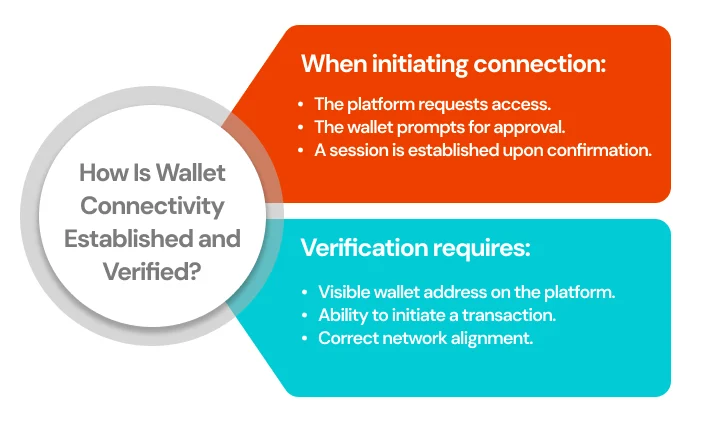
When initiating connection:
- The platform requests access.
- The wallet prompts for approval.
- A session is established upon confirmation.
If the wallet is locked, on an invalid network, or already connected to another session, the request may fail without an explicit error.
Verification requires:
- Visible wallet address on the platform.
- Ability to initiate a transaction.
- Correct network alignment.
Without these confirmations, subsequent actions should not be attempted.
How Should the First Trade Be Executed to Preserve Capital?
The first trade should not be treated as a profit opportunity. It is a system validation exercise.
Select a market with:
- Sufficient liquidity.
- Stable pricing.
- Clear outcome timeline.
Assume the following scenario:
- YES price: 0.45
- Capital allocation: $20
- Shares acquired: ~44.4
If the price increases to 0.60 before resolution, the position can be sold for approximately $26.6, generating a profit without waiting for final settlement.
This illustrates the importance of price movement over outcome prediction. Capital efficiency improves when positions are actively managed rather than passively held.
Execution errors at this stage typically include:
- Entering illiquid markets.
- Misinterpreting price as guaranteed probability.
- Failing to monitor the position after entry.
Can You Make Money on Polymarket Through Consistent Execution?
Profitability depends on process discipline rather than platform mechanics.
Users who generate consistent returns:
- Analyze probability vs price discrepancy.
- Enter positions before the market consensus forms.
- Exit based on price movement, not outcome confirmation.
Users who incur losses:
- Follow trending positions at inflated prices.
- Ignore liquidity constraints.
- Hold positions without defined exit criteria.
The platform provides the infrastructure. Outcomes are determined by decision quality and execution timing.
Prefer Reading: How Does Polymarket Make Money Through Prediction Markets
What Cost Factors Actually Impact Net Returns?
Transaction fees on Polygon are negligible. The primary cost drivers are market-based:
- Spread between buy and sell price.
- Slippage during execution.
- Opportunity cost of capital.
For example, entering a position at 0.70 limits maximum upside to 0.30. Entering at 0.40 provides 0.60 potential upside. The difference is not in fees but in entry timing.
This is where most users miscalculate. They focus on gas costs while ignoring price positioning.
How Is Position Exit and Capital Recovery Managed?
Exiting requires converting shares back into USDC.
The process is sequential:
- Sell position at the current market price.
- Confirm transaction.
- Receive USDC in wallet.
Attempting to withdraw without converting shares results in incomplete transfers.
Once funds are in USDC, they can be:
- Retained for further trading.
- Transferred to an exchange.
- Converted into fiat.
Polygon’s low latency ensures that exit transactions are confirmed quickly, allowing rapid capital redeployment.
How Does the Polymarket Business Model Translate Into an Enterprise Opportunity?
The polymarket business model operates as a decentralized probability exchange rather than a betting platform. Revenue is generated through transaction spreads and market participation, not fixed odds.
This model has direct implications for businesses exploring prediction markets.
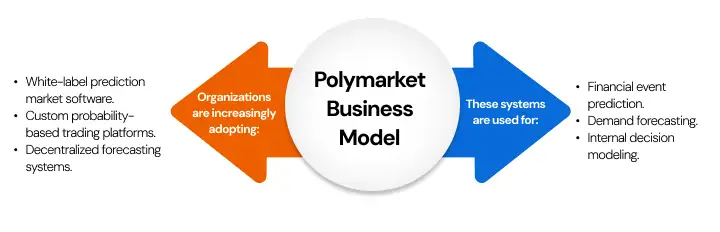
Organizations are increasingly adopting:
- White-label prediction market software.
- Custom probability-based trading platforms.
- Decentralized forecasting systems.
These systems are used for:
- Financial event prediction.
- Demand forecasting.
- Internal decision modeling.
Building such platforms requires more than UI replication. It demands robust contract logic, liquidity design, and scalable infrastructure.
[Prefer Reading: Prediction Markets on the Polygon Blockchain Case Study]
Why Are Businesses Working With an Experienced Development Company?
Developing a prediction market platform involves multiple technical layers:
- Smart contract architecture.
- Wallet integration.
- Transaction optimization.
- Real-time pricing engines.
Execution quality determines platform viability.
NetSet Software Solutions has over a decade of experience delivering blockchain solutions with production-level reliability. Their work in polymarket clone development services focuses on building systems that handle real transaction volume, not just prototypes.
For organizations evaluating a polymarket clone development company, the evaluation criteria should include:
- Contract security.
- Scalability under load.
- Integration flexibility.
Prefer Reading: A Step-by-Step Guide to Building Your Own Polymarket Clone Platform
Conclusion
Using Polymarket with a Polygon wallet is not complex, but it requires precision. Most failures are not technical limitations but execution errors introduced during setup and funding.
Polygon removes cost constraints and enables rapid transaction cycles, making it suitable for iterative trading strategies. However, profitability depends on disciplined execution, not platform access.
For businesses, the underlying model presents a scalable opportunity. The rise of decentralized prediction systems is creating demand for white-label prediction market software and advanced polymarket clone development services.
Whether you are a user or an operator, the advantage lies in validated execution, not access to the system.

FAQs
Do I need prior crypto experience to use Polymarket effectively?
No prior experience is required, but understanding wallet setup, network selection, and transaction flow significantly reduces errors. Beginners who skip these basics often face failed transactions or misplaced funds during initial execution stages.
How do I ensure my funds are on the correct network before trading?
Always verify that your wallet network is set to Polygon and confirm that USDC appears under that network. Sending funds on Ethereum instead of Polygon is the most common cause of missing balances.
Is Polymarket suitable for long-term holding strategies or short-term trading?
Most users benefit from short-term trading based on price movement rather than holding until resolution. The platform’s design favors active position management, allowing users to capture value from shifts in probability over time.
What is the biggest mistake new users make when starting on Polymarket?
The most frequent mistake is sending funds on the wrong network or attempting trades without sufficient MATIC for gas fees, which leads to failed transactions and confusion during initial setup and execution.
How can businesses benefit from building a platform similar to Polymarket?
Businesses can use prediction markets for forecasting, analytics, and user engagement. With solutions like polymarket clone development services, companies can launch customized platforms that effectively monetize data-driven insights and decentralized participation models.