Enterprises are currently keen to realize AI strategies in their business applications, yet the conversion of the desire into practical results is not an easy task. Companies in all sectors are no longer posing the question of whether they should embrace AI, but how to do it in a manner that is efficient and sustainable.
The 2025 State of AI global survey by McKinsey and Company stated that 88 percent of organizations claim to use AI regularly in at least one business process, and only 39 percent of the organizations report the enterprise level of AI on earnings before interest and taxes (EBIT).
This gap points out that adoption is not enough to ensure success. The presence of AI development services within this company with a well-considered AI strategy is much more likely to lead to actual business outcomes and prevent expensive mistakes.
The guide offers a step-by-step guide to developing a strategic AI roadmap for enterprise apps, along with actionable insights, high-impact applications, and cost factors to make sure that your AI efforts can produce measurable business value.
As a mobile app development company, NetSet Software Solutions builds scalable, enterprise-grade applications designed to deliver clear ROI, faster time-to-market, and long-term operational efficiency.
What Is an Enterprise AI Strategy?
Enterprise AI strategy is a rigorous plan that sets the way in which a company will discover, set priorities, execute, regulate, and expand AI projects throughout its processes.
A strategy, in contrast to AI experimentation in an ad hoc style or isolated pilots, assists in making sure that AI effort is intimately connected to business outcomes, i.e., operational performance, reduction of expenses, income growth, or consumer experience.
An effective enterprise AI strategy consists of:
- Easy business goals that are based on quantifiable KPIs.
- Technology preparedness tests and data.
- Use case priorities and ROI anticipations.
- Ethics and compliance governance and accountability.
- Departmental and system scalability.
In the absence of this structure, AI investments will turn out to be costly pilot projects that have not produced any effect.
Prefer Reading : AI in Product Development: Key Benefits, Cost Factors & Implementation Strategies
Why Do Enterprises Need an AI Strategy?
Although the adoption of AI is still developing, a survey by McKinsey indicates that the majority of organizations are still in their infancy, with most not having the ability to scale projects at the enterprise level. This fact proves why companies need to invest in strategic AI planning:
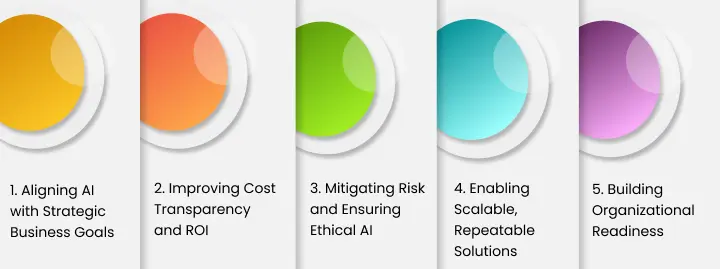
1. Aligning AI with Strategic Business Goals
A variety of major factors govern the choice of a business to deploy AI technologies. These are process automation (data entry), insight generation (identifying and analyzing data), personalization (personalized offers based on customer segment, etc.), and operational efficiency (turnaround times, costs, etc.). An official plan makes sure that AI is based on goals like revenue increase, cost efficiency, and competitive superiority.
As an example, implementing AI in the customer care department can save on the cost of customer support and improve the satisfaction rates; implementing AI in supply chain planning can decrease inventory shortages and improve customer service.
2. Improving Cost Transparency and ROI
Generative AI development is potentially resource-intensive to develop. An effective AI plan will ensure that businesses do not waste money on technologies that will not deliver business results. The use cases are ranked according to the estimated ROI, data preparedness, and technical viability in order to offer budget discipline and measurable value creation.
3. Mitigating Risk and Ensuring Ethical AI
Artificial intelligence models usually use sensitive information. With increased regulation of data privacy and model transparency, responsible AI practices are necessary in enterprises, which can be ethical, fair, privacy-conscious, and explainable. These governance practices are implemented in the roadmap at the early stages by an AI strategy.
4. Enabling Scalable, Repeatable Solutions
Scaling AI refers to integrating models into the workflows in departments and lines of business. In the absence of a strategy, a lot of businesses are trapped using AI in closed silos or pilots that do not get past the gateway to become enterprise-wide.
5. Building Organizational Readiness
The use of AI is more a matter of people rather than technology. A strategy will make sure that teams are ready, trained, and enabled by the governance structures and cross-functional interaction, which will fill the gap between technical teams and business stakeholders.
Prefer Reading : How AI Can Help Businesses Reduce Operational Costs
NetSet 4‑Layer AI Strategy Framework for Enterprises
To guide enterprises from experimentation to impact, NetSet Software Solutions uses a structured 4‑layer AI strategy designed to integrate AI at scale.
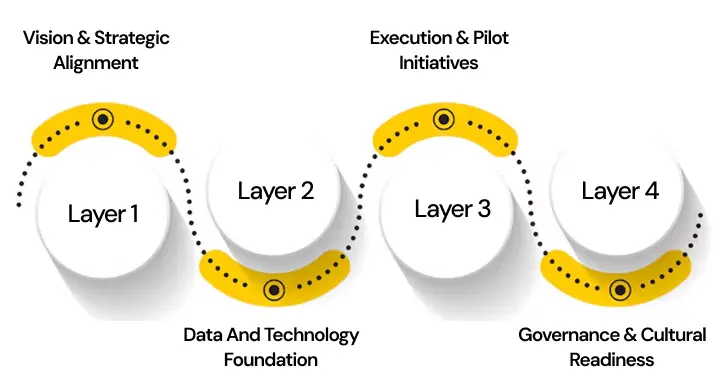
Layer 1: Vision & Strategic Alignment
The layer will explain to you the vision and the usage of AI in the organization.
- Elaborate on business objectives that are associated with AI solutions (e.g., cost savings, better speed, competitive positioning).
- Use the top management and achieve interdepartmental conformity.
- Establish the KPIs and success measurements for every AI initiative.
Not having a clear vision, the teams are likely to approach technology in search of problems instead of solving actual problems in the business world.
Layer 2: Data and Technology Foundation
The performance of AI relies on data accessibility and quality:
- Determine information infrastructure, quality, management, and preparedness.
- Create a data gap and strategize on how to fill these gaps or how to buy new data.
- Provide infrastructure capability like extensible cloud facilities and information pipelines.
Well-founded data are necessary to have robust training and deployment of models, whose reliability and scalability are.
Layer 3: Execution & Pilot Initiatives
Implementation is performing the strategy.
- Determine the use cases with high impact and rate them on both business and feasibility standards.
- Prove the assumption by assembling minimum viable products (MVPs) or pilot models.
- Compare the results with the set KPIs to improve and streamline.
Pilot initiatives allow enterprises to receive early feedback, minimize the risk, and focus on the projects that bring definite results.
Layer 4: Governance & Cultural Readiness
To be successful in the adoption of AI, an organization must be prepared:
- Put up control mechanisms of ethical utilization, model observation, and responsibility.
- Establish data stewardship and risk mitigation policies, as well as continual compliance policies.
- Encourage cross-functional education, AI cluelessness, and internal agents of AI adoption.
The culture would promote AI adoption, which can be sustained over a long period through governance.
Our 90‑Day AI Implementation Framework
To provide an execution roadmap with early measurable results, we structure enterprise AI adoption into 3 key phases:
Phase 1 (Days 0–30): Discovery and Planning
In this phase:
- Carry out business and technology measurements.
- Put the use cases related to AI in strategic order of priority and data readiness.
- Specify measures of success, KPIs, and project models.
- Develop a first-cut implementation backlog.
Deliverables: AI roadmap, data readiness report, prioritized list of use cases.
Phase 2 (Days 31–60): Pilot Development and Validation
Execution steps include:
- Prove and experiment with pilot AI models on existing data or realistic data.
- Compare performance to set KPIs.
- Optimize model algorithms and pipelines on pilot feedback.
Deliverables: Pilot models are tested, reports of validation, and operational recommendations.
Phase 3 (Days 61–90): Scaling and Governance
Focus on:
- Implementing successful models in the production environments.
- The process of operationalizing monitoring, model versioning, and governance.
- In-training teams and developing documentation.
- Relocation of solutions into expansive business systems.
Deliverables: Commercial applications of AI, regulations, and internal training of valid personnel.
Top AI Use Cases Driving Enterprise Value in 2026
Enterprises leverage AI across multiple domains with measurable impact:
| Industry | High-Impact Use Cases |
| Healthcare | Early identification of diseases with predictive models, and virtual assistants support patients at high speeds |
| Finance | Real-time fraud monitoring, credit risk evaluation, automated compliance checks (AML) |
| Retail & E-commerce | Dynamic pricing strategies depending on the customers’ real-time demands and custom product suggestions to all users. |
| Manufacturing | Equipment failure prediction to reduce downtime, production quality monitoring, and defect detection |
| Transportation | Intelligent route planning to reduce delays, demand forecasting for fleet and logistics optimization |
| Telecommunications | Network performance monitoring, identifying and preventing customer churn |
| Energy | Power distribution optimization through smart grids, accurate demand prediction to balance supply |
| Education | Tailored e-learning based on student achievement and behavioral patterns |
| Real Estate | Demand prediction and property value forecasts to make more efficient pricing and investment choices |
The use cases illustrate how some organizations have achieved early success with AI in improved efficiencies and higher levels of customer interaction.
Best AI Use Cases Delivering the Highest ROI
Certain AI applications consistently deliver measurable ROI:
| High‑ROI AI Application | Primary Benefit |
| Process Automation | Reduces operational overhead |
| Conversational AI | Enhances customer engagement |
| Predictive Analytics | Improves forecasting accuracy |
| Fraud Detection | Protects revenue and trust |
| Personalization Engines | Boosts conversion and retention |
With proper implementation, all of these potential areas of improvement can result in ongoing savings or revenue generation.
Measuring Success: KPIs That Matter
Enterprises will follow:
- Business Impact/ROI – More revenue, less cost, and efficiency.
- Model Performance – Accuracy, precision, recall, and stability.
- Scalability Potential – Cross-function and cross-data set ability.
- Governance and Compliance – Ethical alignment, audit trails, bias metrics.
In the absence of strict measurement, one cannot tell whether pilot experimentation is present or if there is actual enterprise value.
How Much Does it Cost to Build an Enterprise AI App?
The cost of creating an AI-powered enterprise solution depends on many things, ranging from the level of complexity and customization you require for your project to your growth rate. Below you will find some examples.
| Type | Examples | Cost | Timeframe |
| Basic AI Solutions | Chatbots, simple ML models, automated forms | $20,000 – $40,000 | 1–2 months |
| Mid-Level AI Solutions | NLP, image classification, recommendation engines | $50,000 – $100,000 | 2–4 months |
| Advanced AI Solutions | Generative AI, deep learning, and real-time processing | $100,000 – $180,000+ | 4–6+ months |
| Custom Enterprise AI | Medical diagnostics, financial forecasting, and large industrial AI | From $100,000 | 6+ months |
Key cost drivers include data preparation, model complexity, infrastructure, integration, and maintenance.
At NetSet Software Solutions, we provide custom AI development services and generative AI integration services that maximize ROI while keeping projects cost-effective and scalable.
Technology Stack for AI Strategy and Development
The construction of AI at scale would make use of a strong stack:
- Data Platforms: Data warehouses, data from various enterprises, and ETL tools.
- ML Frameworks: TensorFlow, PyTorch, and Scikit-Learn.
- Artificial Intelligence of NLP and Vision: Transformer Architecture and Generative Architectures.
- Container orchestration on clouds: DevOps, AWS, Arizona, and GCP.
- Security governance: identity management, audit logs, and encryption.
Utilizing the appropriate technology stack provides improvements in terms of both performance and security while providing operational continuity.
How NetSet’s Strategic AI Roadmap Can Be an Essential Step for Your Enterprise
A successful implementation of AI should start with a clear, structured plan. NetSet Software Solutions provides AI development services that connect your enterprise objectives and AI solutions that can be implemented. This roadmap will see your AI initiatives be scalable, compliant, and business-oriented.
Why choose NetSet?
- Experience: Over 10 years of experience in finance, healthcare, and retail.
- Practical Frameworks: TensorFlow, PyTorch, and Azure AI and advanced ML and NLP applications are competent.
- Custom Roadmap: Dedicated to the high-impact AI applications leading to the tangible ROI.
- Consultation & Planning: Complimentary consultation to find AI opportunities and an implementation plan based on our AI development services.
Using NetSet, enterprises are getting a clear and actionable AI strategy that removes risk, speeds up adoption, and assigns AI to provide real business value. Become much smarter and data-driven tomorrow with NetSet Software Solutions.
FAQs
Why do enterprises need a formal AI strategy?
An AI roadmap is a strategic plan that enables investments made by a custom AI development company, such as NetSet, to be in line with the business objectives, maximize returns, and provide quantifiable results to different departments.
What are common challenges in enterprise AI adoption?
Businesses are usually prone to data gaps, governance complexities, skills shortages, and undefined KPIs. The barriers can be overcome by hiring an AI development services firm to support the deployment.
How long does it take to see results from AI implementation?
With the implementation being stringent and the 90-day plan in place, it will begin to show significant results in the areas of automation, predictive analytics, and efficiency improvements in the businesses.
Do I need specialized AI infrastructure for development?
Yes, enterprise AI development often requires robust infrastructure to train and process AI models efficiently. Netset Software Solutions helps set up this infrastructure as part of its AI implementation for enterprise apps.
Can AI enhance enterprise mobile apps?
Yes. With the expertise provided by the Mobile App Development Company in the area of AI, NetSet can directly incorporate predictive analytics, personalization, and automated intelligence into the mobile apps of enterprises.