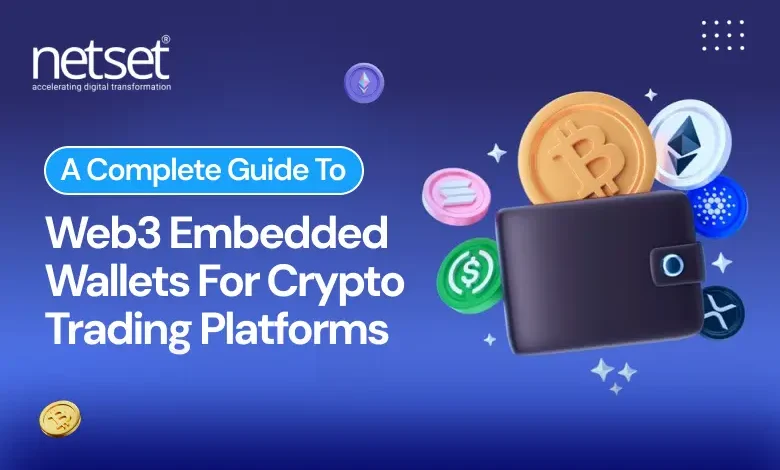
Web3 is changing how users interact with digital platforms, with wallets driving this new user experience. For crypto trading platforms, embedded wallets streamline onboarding, unify identity and transactions, and improve user experience and conversions.
This is causing significant friction in user acquisition channels, especially in trading platforms where speed and ease of execution have a significant bearing on conversion rates.
Embedded wallets change this paradigm altogether. Rather than users having to get used to blockchain-based systems, Web2 user experiences are being applied to blockchain-based interactions.
According to a 2024 report by Chainalysis, more than 60% of users do not pass the point of funding their wallets, with onboarding processes taking more than 10-12 minutes.
For organizations building Web3 crypto wallets or trading platforms, embedded wallets are no longer optional. In production environments, teams at NetSet Software Solutions consistently observe that wallet architecture directly impacts onboarding efficiency, retention curves, and transaction throughput.
What Is a Web3 Crypto Wallet?
A Web3 crypto wallet is a cryptographic interface that helps users interact with blockchain networks such as Ethereum. It does not conventionally store assets; rather, it stores the user’s private keys that define the user’s ownership.
Key responsibilities include:
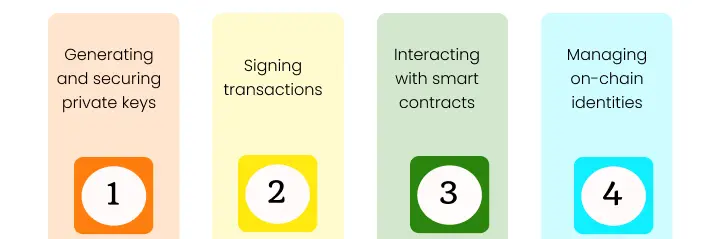
- Generating and securing private keys
- Signing transactions
- Interacting with smart contracts
- Managing on-chain identities
Unlike traditional financial systems, control is not account-based but key-based. This distinction is critical when designing Web3 Wallet Development systems, as security, recovery, and usability all depend on how keys are managed rather than how accounts are stored.
Evolution of Wallet Infrastructure
Wallet infrastructure has evolved across three distinct phases:
Custodial Wallets
Platforms control private keys on behalf of users. While onboarding is simplified, this introduces centralized risk and regulatory overhead.
Non-Custodial Wallets
Users retain full control of private keys. This conforms to the principles of decentralization but presents usability issues, especially around key management.
Embedded Wallets
Embedded wallets provide usability with distributed security models. They eliminate dependency on external wallets through advanced techniques such as MPC(Multi-Party Computation).
This is an evolution of an industry-wide shift from ‘control-first’ to ‘experience-first’ architecture without compromising security.
Market Opportunity & Adoption Trends
Web3 adoption is now largely driven by applications, not infrastructure. This includes trading platforms, NFT development ecosystems, and DApps, which need to onboard users smoothly to go beyond the crypto community.
According to Web3 crypto wallet growth statistics, over 820 million crypto wallets globally, onboarding drop-off rates remain close to 70%, with less than 20% of users retained beyond the first week.
Embedded wallets address key adoption barriers:
- Elimination of seed phrase friction
- Reduced onboarding time from minutes to seconds
- Improved mobile compatibility
- Increased transaction completion rates
Prefer Reading: What Makes NetSet Software AI White-Label Web3 CryptoCurrency Wallet Truly Different
What Are Web3 Embedded Wallets?
Embedded wallets are in-app wallets that are dynamically configured during user onboarding. The embedded wallets are highly integrated into the application layer and enable users to communicate with blockchain systems without the need to engage other external applications.
Unlike traditional wallets, embedded wallets:
- Are created automatically during authentication
- Support social login mechanisms
- Abstract private key management
- Enable seamless transaction execution
This model is foundational to modern Web3 development solutions, particularly in environments where user experience directly impacts revenue.
What are the types of Web3 Wallets?
Understanding wallet types is essential for architectural decisions:
| Wallet Type | Key Control | User Experience (UX) | Complexity Level | Risk Profile |
| Custodial Wallets | Platform-controlled | Simplified | Low | High centralization risk |
| Non-Custodial Wallets | User-controlled | Complex | High | User error & key loss risk |
| Embedded Wallets | Distributed (MPC-based) | Integrated & seamless | Medium | Balanced (reduced single-point failure) |
Embedded wallets fall in the middle of the spectrum between custodial and non-custodial wallets.
Embedded Wallet Architecture
This section defines the core technical foundation of embedded wallet systems.
1. Wallet Provisioning Layer
Wallets are generated dynamically during user onboarding. Instead of generating a single private key, modern systems use distributed key generation protocols. The wallet is mapped to a user identity (email, OAuth, or passkey), creating a linkage between authentication and cryptographic control.
2. MPC-Based Key Management
Multi-Party Computation (MPC) replaces conventional private key storage with key shares distributed across multiple entities:
- Client device share
- Server-side share
- Recovery or backup share
In production systems, NetSet Software Solutions applies MPC configurations with distributed trust boundaries, ensuring that no single failure domain compromises key security while maintaining low-latency transaction signing.
3. Transaction Lifecycle
A production-grade transaction flow includes:
- Intent Capture: User initiates an action (e.g., trade execution)
- Transaction Construction: Backend services assemble the transaction payload
3. Simulation Layer (Critical Security Step): The transaction is simulated against the blockchain state to detect:
- Malicious contract calls
- Unexpected token transfers
- Execution failures
- Distributed Signing: The MPC protocol signs the transaction without exposing the full key
- Broadcast & Confirmation: The blockchain receives the transaction and confirms it.
This lifecycle ensures security and reliability, especially in high-frequency trading.
4. Infrastructure Layers
A complete embedded wallet system consists of:
- Frontend SDK Layer: This layer deals with authentication, wallet, and UI abstraction.
- Backend Orchestration Layer: This layer is used to deal with transaction logic, retries, and coordination.
- Blockchain Interaction Layer: This can be said to be the layer that deals with interaction with RPC nodes to make an execution.
5. Account Abstraction Integration
With ERC-4337, wallets evolve into programmable entities:
- Transactions can be bundled
- Gas fees can be sponsored
- Complex logic can be executed within a single operation
This transforms wallets from passive tools into active execution environments.
Core Features of Embedded Wallets
Modern embedded wallets provide:
- Multi-chain compatibility
- Gasless transaction capabilities
- Social authentication
- Secure recovery mechanisms
These features are essential for delivering scalable cryptocurrency exchange development services.
Security & Custody Models
Security in embedded wallets is defined by key control distribution:
- MPC-based custody reduces single-point risk
- Threshold signatures enhance resilience
- Hardware-backed storage increases protection
The challenge is balancing decentralization with usability without relying on hidden trust dependencies within the systems.
Advanced Security Considerations
Production systems must address:
- Phishing attacks targeting signing requests
- Malicious smart contract development interactions
- Session hijacking in web environments
- Frontend injection vulnerabilities
Transaction simulation and strict validation layers are essential to mitigate these risks.
Compliance & Regulatory Considerations
Embedded wallets operate within a complex regulatory landscape:
- KYC/AML requirements
- Custodial classification ambiguity
- Jurisdiction-specific compliance
For any web3 development firm, compliance architecture must be integrated early in the system design, not modified.
Use Cases of Embedded Wallets
Embedded wallets are widely adopted across:
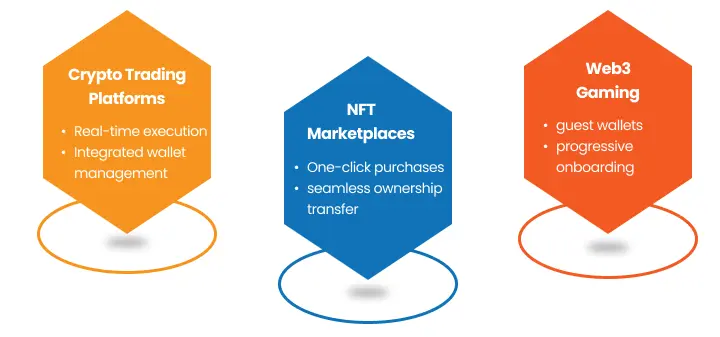
Crypto Trading Platforms
- Real-time execution
- Integrated wallet management
NFT Marketplaces
- One-click purchases
- seamless ownership transfer
Web3 Gaming
- Guest wallets
- Progressive onboarding
These use cases demonstrate the versatility of Web3 crypto wallets in real-world applications.
Only 5–10% of users become repeat participants after initial interaction, indicating a structural failure in onboarding and wallet experience design. (Source: Coin Law)
Embedded Wallets in Trading Platforms
In trading systems, wallets are directly tied to execution pipelines:
- Orders trigger transaction creation
- Wallets sign and authorize execution
- Blockchain confirms settlement
Performance factors include:
- Latency in signing
- Network congestion
- Transaction finality
Efficient Web3 Crypto wallet architecture directly impacts trading performance.
Integration & Development
Implementing embedded wallets involves:
- SDK integration on the frontend
- API orchestration on the backend
- Secure transaction pipelines
Providers such as Privy, Alchemy, and thirdweb offer modular solutions that accelerate development timelines.
Backend Architecture & Scalability
Scalable systems require:
- Event-driven processing
- Queue-based transaction handling
- Temporary synchronization mechanisms
- Retry logic for failed transactions
These components ensure system reliability under high load conditions.
Observability & Reliability
Production systems must include:
- Transaction monitoring pipelines
- Logging frameworks
- Failure detection mechanisms
- Alerting systems
Without observability, failures remain undetected until they impact users.
Cost Architecture of Web3 Embedded Wallets
The cost of embedded wallet systems is not limited to gas fees; it is driven by infrastructure, transaction execution, and signing operations.
At the infrastructure level, cloud environments like Amazon Web Services handle authentication, wallet provisioning, and transaction orchestration. Inefficiently optimized RPC usage alone can increase costs by up to 50%, especially in read-heavy systems.
The second major cost center is wallet infrastructure. Providers such as Alchemy or Fireblocks charge based on wallet activity and transaction signing. At scale, signing requests, not wallet creation, becomes the dominant expense driver.
Transaction execution adds another layer. On networks like Ethereum, gas fees fluctuate significantly, making cost predictability difficult without optimization strategies.
Efficient systems reduce cost through:
- Transaction batching to minimize on-chain operations
- Layer 2 execution to lower gas fees
- RPC caching to reduce redundant calls
The key insight is simple: Cost efficiency in embedded wallets is an architectural outcome. Systems designed for optimized execution scale sustainably, while unoptimized systems see costs grow faster than user adoption.
How to Choose the Right Web3 Wallet?
Selection depends on:
- Application type
- Security requirements
- Scalability needs
- Compliance constraints
A well-designed wallet system aligns technical architecture with business objectives.
Future Trends
The next phase of Web3 crypto wallet evolution includes:
- Account abstraction at scale
- AI-driven transaction execution
- Cross-chain interoperability
Wallets are evolving into programmable identity and execution layers.
Conclusion
The embedded wallets are revolutionizing user experience with Web3 in real-world environments. The quicker users get used to onboarding and using the wallets, the less they recognize that the wallet is part of the system. The change is not about feature additions; it is about removing friction from the system at points that matter most.
For Web3 trading platform development teams, wallet architecture is now directly related to activation rates, transaction success rates, and retention. For platforms that rely on external wallet solutions, this often leads to issues and problems.
From an execution perspective, for Web3 crypto wallet systems, there is now increased focus on execution-first approaches, similar to that adopted by NetSet Software Solutions for wallet system infrastructure.
FAQs
What is a Web3 embedded wallet?
A Web3 embedded wallet is an in-app cryptocurrency wallet. It is utilized for interacting with the blockchain without the requirement of using other apps. It employs Multi-Party Computation (MPC) for providing security in transaction signing.
Are embedded wallets truly non-custodial?
Embedded wallets are non-custodial or semi-custodial. MPC-based wallets divide key shares among various sectors, thus minimizing single-point failures. NetSet Software Solutions offers models with balanced control, security, and recoverability.
How do embedded wallets improve onboarding in crypto platforms?
Embedded wallets eliminate seed phrases and extensions by enabling authentication via email, social login, or passkeys. NetSet Software Solutions implements such flows to reduce onboarding time, improving activation rates, retention, and transaction completion in trading platforms.
Can embedded wallets support multiple blockchains?
Today’s embedded wallets have been designed with multi-chain environments in mind, including Ethereum, Solana, and Layer 2 networks. This means that users can have unified asset management, transactions, and interactions in a single interface.
What should businesses consider when choosing a Web3 wallet solution?
Businesses should also consider the intricacies of security designs, scalability, compliance, and integration. NetSet Software Solutions provides Web3 Wallet Development services with a focus on reliable execution, user experience, and scalability in accordance with changing blockchain technology requirements.