
Every software app development project begins with amazing excitement because the ideas feel fresh and the vision looks huge. Then as deadlines slip and budgets go tight, that excitement starts fading away.
If you are also facing the same, then do not worry; studies show nearly half of projects go over budget, and one in five fails to meet its goals. But there is good news because failure is never final.
With the right software project rescue partner, you can bring your application back on track before it is too late.
What actually causes projects to fail?
Every software project starts with an ambition to bring revolution, but many feel the instability along the way. The reasons are less about the idea itself but more about the execution.
- Not up to the mark blueprints: As teams jump into development, without a clear roadmap, it is natural for them to face missing deadlines as well as unnecessary investments.
- Not aligned communication: When stakeholders, developers, and managers are not on the same page, misunderstandings grow with added technical challenges like outdated architecture.
- Not right management: Without proper management, teams are not able to solve hurdles and security flaws.
The reason for all these pointers is a project feeling sticky, draining resources without delivering the value they should. And businesses that are able to find it out already take the first step towards a successful software project rescue.
Understanding software project rescue in simple terms
The term might sound complex but software project rescue is just a process of stepping in just when a project struggles and guiding it back towards success. You can see it as a lifeline for apps that are there to optimize budget, correct behind schedule, and avoid failing to meet expectations. In place of starting from scratch, rescue focuses on finding what went wrong, making the situation balanced, and creating a plan to move forward.
At the core, software project rescue is all about clarity, which begins with a deep audit of the project. When the issues are clear, rescue specialists design a recovery strategy that focuses on the most important fixes first. The goal is not just to patch problems but to rebuild the confidence where you align stakeholders, reset the timelines, and introduce better practices so that the project promisingly delivers value.
No matter if you are a startup or a large enterprise system, the rescue approach gives businesses a second chance to achieve their goals without wasting the investment already made. In short, software project rescue is the bridge between failures and success, which is a structured way to save your application before it collapses completely.
How does software project rescue solve problems and promise success?
When a project feels stuck, software project rescue acts as a reset button and in place of calling off the project, rescue specialists step in to stabilize the situation chart.
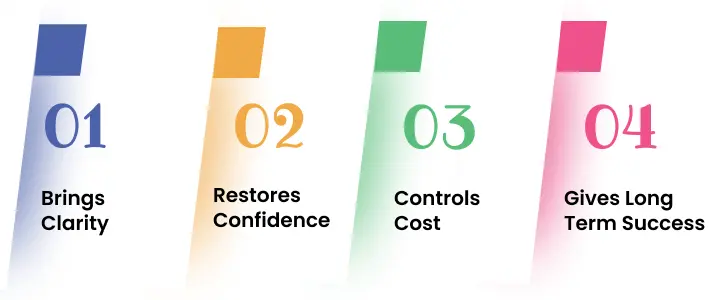
Brings Clarity
The first way rescue helps is by bringing clarity where teams solve hidden issues like poor code quality, misaligned goals, and communication breakdowns using audits and assessments. Once these problems are visible, they can be sent for systematic addressal for the good.
Restores Confidence
The best part about rescue is that it starts bringing confidence again because when timelines are reset, critical fixes are made, and stakeholders align back, teams start building the due confidence. With this, everyone sets to work towards the same outcome.
Controls cost
Budget stays a real challenge for most of the failing projects but rescue helps to control budget overruns as it streamlines the workflows and removes unnecessary features. It also focuses on resources that truly matter to a project, thus helping businesses to get back on track without wasting any more investment.
Gives long-term success
When confidence comes back and the budget gets aligned, the project finally starts getting back on track. It is more than just immediate issue fixing, as it introduces better practices, agile methods, strong communication, and risk management frameworks so that the project does not fall into the same traps again.
Step-by-step software project rescue process
Now rescuing a failing software project is not about quick fixes but asks for a structured process to stabilize, rebuild, and guide the application towards success. Well, let us show you how it generally works:
Step 1: Figuring out what went wrong with audit
The first step is all about going back to the project and to perform a deep dive into it, which is not as easy as it sounds. Here, rescue specialists review the quality of the code, workflows, communication channels, and budget usage, which helps them to find out the root causes of failure.
As per the recent industry data, 52.7% of software projects go over their original budgets by nearly 90%, mostly because of poor planning and hidden inefficiencies. But thankfully, an excellent audit prevents this waste from taking place.
Step 2: Planning and building a roadmap
Once the issues are clear, a recovery plan is nearly ready. This normally includes setting realistic timelines, focusing on critical fixes and aligning the stakeholders on achievable goals. All the poor project management is cited as the downfall of 47% of unsuccessful software projects, which is why structured planning is the heartbeat of every project.
Step 3: Execution and Stabilization
The rescue team applies changes, fixes technical flaws, streamlines processes, and makes overall collaboration better. In this phase, most of the time, specialists bring agile methods that help them to keep project progress more transparent and adaptable than before. You can see this phase as about stabilization of the app so it can deliver core functionality without further issues.
Step 4: Monitor plan to keep the project optimized
Rescue does not end with execution, which is why there is a need to perform constant monitoring so that the project stays on track. The team keeps on refining workflows, retraining the models if needed and adjusting the strategies so that future setbacks stay out of the picture.
And, if you don’t know, around 54% of CIOs admit their teams are not getting enough time to handle strategic and innovation matters, which is one important overload factor causing failures in the projects.
Step 5: Post-rescue sustainability
Finally, when the focus shifts to long-term success, you have to take care of a few certain things. These are training, governance frameworks, and regular audits so that the project does not slip back into the old patterns. If you ignore this, your investment may again start to stop delivering value after the rescue phase, but if you perform it, your project stays rescued for a long time.
All of the above software development project rescue steps are necessary if you are serious about bringing your application project from downfall to a hit in the market.
Challenges to keep in mind
Without any doubt, rescuing a software project is never going to be a smooth ride and while the process gives you a lifeline, businesses have to consider the challenges too that can make the recovery complicated.
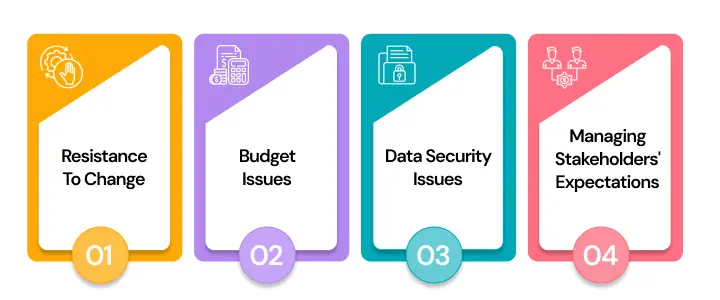
Resistance to change
Teams most of the time resist the new workflows or technologies introduced at the time of rescue. This slows adoption and can slow the progress. There was a McKinsey study that found that 70% of change programs fail just because of employee resistance and lack of management support, which makes stakeholder buy-in complex.
Budget Issues
Do not think that the rescue efforts are just free because they do ask for some additional investment. Without clear ROI planning, costs can be tough and as proven in PMI research, 35% of failed IT projects cite budget overruns as a primary cause, which again highlights the financial issue.
Data Security Issues
When you keep on introducing new tools, frameworks, and integrations, it can easily expose the risks. Here, rescue teams must know the compliance and security checks at every stage to avoid any form of costly breaches.
Managing stakeholders’ expectations
We cannot deny the fact that stakeholders or investors prefer to see results as quickly as possible but another fact is that rescue is a slow process. You set realistic timelines and communicate progress transparently, which is important to maintain trust.
Rescue your project with NetSet Software
When your software project feels like it’s slipping away, you do not have to start over, as you just need the right partner to bring it back on track and that is where NetSet Software can help you.
We are one of the most reliable software project rescue agencies, where we love finding out the root failing cause of exceptional projects and designing custom recovery strategies. Our process contains deep audits, roadmap creation, execution, and long-term sustainability so that you get end-to-end IT software project rescue solutions.
So, do not let your investment go in void and partner with us to revive it towards success.
FAQs
What is software project rescue in simple words?
It is a process to understand why a project is failing and design a plan to revive it and prepare it for success.
When should I consider an IT software project rescue?
If your project is over budget, behind schedule, or fails to meet goals, it is just the right time to act and hire an IT software project rescue solutions provider.
What do software project services include?
The service mostly is a process of auditing, workflow restructuring, stakeholder aligning, and technical fixes so that a project is not only recovered but also readily achieves long-term sustainability.
How is a software development project rescue not similar to starting the project from scratch?
It is just like if your car gets damaged and in place of replacing your car, you repair the broken parts to make it just like new.
Can application rescue be applied to legacy systems?
Yes, software project and application rescue does consist of modernizing outdated systems because the process delivers security, scalability, and value in the long run.