
If you are working with the traditional referral-based law firm, then you are just a relic because modern legal clients now compare, scroll, and shortlist firms with digital-first lenses before ever picking up the phone. This shift means that winning is no longer just about practicing law but also about delivering trust and accessibility in online spaces.
For founders and tech-forward partners, this transformation requires more than just doing law better because it demands a custom legal software development partner to bridge the gap between discovery and consultation.
Then with advanced legal management software, SEO, website, and other strategies, a legal firm meets the on demand expectations of the modern client and we are going to discuss the top most 7 strategies
#1 Digital first impression with clear design
A law firm’s website is mostly the very first touchpoint in a given client’s journey, which makes it the bedrock of digital credibility. In this comparison, culture users quickly judge a firm’s professionalism with the speed and clarity of its online presence. All the modern firms leave dense lawyers speak (a lawyer register) with intuitive digital space that lets their clients find answers without outside assistance.
How to achieve it?
But, to get a solid level of responsiveness and accuracy on your legal firm website you need more than a simple template. You have to go with custom application development services, to build a site that is:

- good with performance
- great with mobile optimization
- load instantly
- feature interactive multimedia like videos and charts,
A website that fails to adapt to these mobile habits effectively signals a lack of technical competence driving around 79% of users to look elsewhere before even leaving the first page of search results.
#2 Using semantic SEO to answer real client pain points
More than a slick interface, modern firms are dominating search results by mastering semantic SEO because number one organic spot on google captures an average click through rate of 27.6% and number drops down notably for other spots.
So, in place of stuffing pages with generic terms, successful practices focus on topic clusters and keyword intent to address the specific problems keeping their clients up at night. This means building a library of helpful guides that answer information queries like ‘What are my rights after a workplace accident?’ in place of just listing services.
This approach establishes the firm as a trusted authority before the client is even ready to hire.
How to achieve this?
Changing such a data-driven strategy mostly requires the technical expertise of a custom software development company to build the underlying architecture that supports these complex content maps and internal linking structures. With a focus on the bigger picture of client intent rather than exact keyword matches, firms make sure they appear exactly where their target audience is already looking.
#3 Closing the 91% gap with self-service mobile apps
The most notable benefit in the current market lies in meeting the communication preferences of younger, tech-native clients. Research shows that while these clients prefer communicating with secure on-demand apps, only 9% of law firms currently give self-service mobile apps, which creates a huge experience gap that modern firms are now exploiting.
Firms that give a dedicated app see adoption rates over 80%, changing the client experience while also saving the firm an average of 1300 hours per year with the automation of routine status updates.
How to achieve this?
To achieve these features effectively, firms must integrate modern law firm management software into their workflow. This software will deliver them realtime data syncing so that when a client checks their case status at 10 PM, they are seeing accurate, live information without needing to call an attorney.
#4 Streamlining the journey with safe client portals
Legal proceedings are always stressful, and analytics show that 1 in 4 clients feel anxious simply because they do not know what is happening with their case. Modern firms are solving this with an offer to secure client portals that centralize updates, messaging, and document access in a single transparent location. This moves toward client-centric control that reduces the black hole of email and removes the need for clients to constantly follow up for status updates, which currently only 35% of firms are able to track effectively.
How to achieve this?
To achieve a solid level of transparency within client portals, firms move away from fragmented tools and adopt unified legal management software. Also, with 24/7 access to information on the client’s own terms and timelines, firms build a level of deeper trust that traditional communication could never match.
#5 LinkedIn strategies that survive the CFO test
For firms targeting corporate clients, winning online means your digital presence must survive a second-hand explanation the moment a lead has to justify hiring you to their CFO or board. The content that focuses solely on being credible often fails this test; in its place, messaging must be written in the language of internal defense and risk mitigation.
Further, successful firms are shifting their focus from stagnant company pages, which reach only 2 to 3% of followers. When an individual attorney posts a hero post with industry insight, they see a 10 to 15% baseline reach, which can be further amplified with coordinated team engagement.
How to achieve this?
Applying such a content engine at scale mostly requires custom legal software development to track performance metrics and make sure that high-value insights reach the right decision-makers at the right time.
#6 Automated social proof and feedback loops
Winning firms do not wait until the end of a case to ask for review; they identify peak satisfaction milestones to trigger feedback requests automatically because 97% of consumers read online. With a setup of automated systems to request reviews after a favorable ruling or a successful settlement, firms can systematically build an arsenal of 5-star social proof. These tools let firms identify detractors early so that immediate interventions happen before a minor frustration turns into a negative public review.
How to achieve this?
This data-driven approach to reputation management is mostly powered by custom application development services, which let firms integrate the Net Promoter score or NPS, that directly tracks the client’s journey. With real behavior data and automated feedback loops, tech-forward practices can fix weak points in their service delivery in real time instead of guessing during growth phases. This makes sure that satisfied clients are transformed into a walking billboard for the firm’s expertise.
#7 Building authority in niche digital communities
More than traditional search engines and broad social platforms, modern firms are winning by being the go-to level voice in modern online communities. This long-game strategy consists of joining.
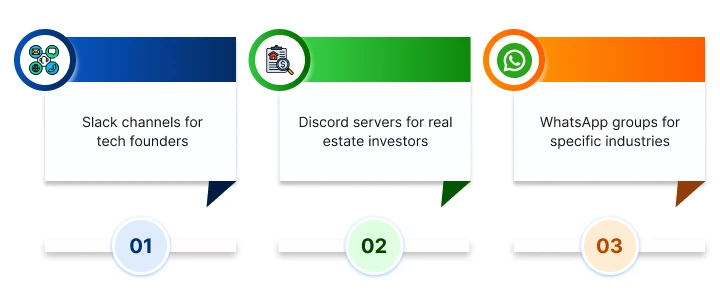
- slack channels for tech founders
- Discord servers for real estate investors
- WhatsApp groups for specific industries
With free advice and answering questions without an immediate sales pitch, lawyers build a sound pool of potential clients who see them as trusted advisors and not just direct service providers. In fact, a right group of 300 engaged community members is mostly worth more than 5,000 passive followers on a public profile.
How to achieve this?
Sustaining this level of engagement across multiple platforms needs a sophisticated backend organization. Firms that sell here often partner with a custom software development company to create internal tools that track community trends and manage response timelines. This makes sure that the firm remains present and helpful without overwhelming its legal staff. With consistently adding value to these niche ecosystems, firms transform passive readers into warm leads who already have built-in trust before the first consultation even begins.
Final words
The digital first client journey is the new legal reality, and scale firms must transform how they deliver trust and accessibility through every touch point. Winning is not about volume, but about showing consistently with genuine intent to help.
With the strategies discussed above and a right digital transformation partner like NetSet Software, you can shift from a traditional business model to a digitally advanced business.

FAQs
How long will it take to see results in my legal business in terms of SEO and content marketing?
It normally takes a few months of posting quality resources and right technical optimization to see the content start to rank on the first page of search results and generate a stable stream of qualified leads.
Is a mobile app really important for a small or mid-sized law firm?
Yes, since only 9% of law firms currently give a seal service mobile app, it serves as a key differentiator that builds trust with tech native clients and saves the firm over 1000 administrative hours annually.
What is the most cost effective way to generate new clients with the help of digital platforms?
It is common that a lot of startups have limited budgets, and for them organic SEO with strategic networking in their given communities are the most cost effective as well as long term methods without the recurring costs of paid advertising.
Should our website content use formal legal terminology?
No, successful firms use basic lingo and clear designs that allow clients to find answers quickly like if the client is searching for “what to do after a workplace accident?” your answer must answer it clearly.
Can I increase the number of referrals I get from current clients for my business ?
Referrals increase notably when firms stay in regular touch using automated systems. Providing custom alerts about regulatory changes or automated newsletters keeps your firm on top of mind, long after a case has been resolved.