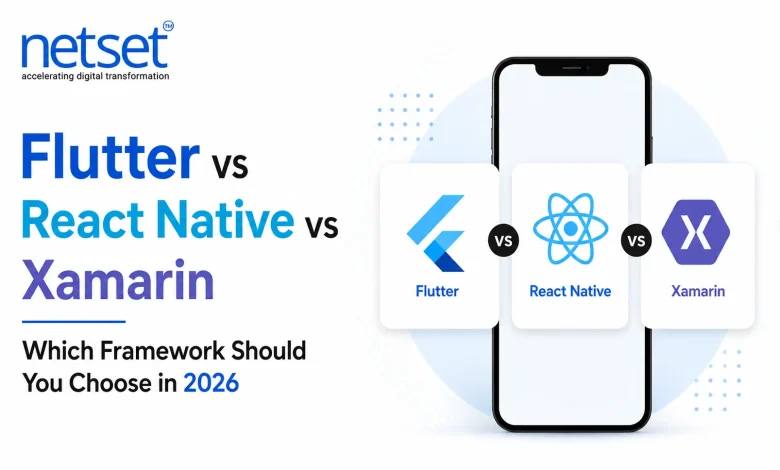
The year 2026 marks a major turning point for mobile engineering as the old argument of choosing between high quality or low cost is finally over. Modern tools have gotten so much better that they now offer performance that is almost identical to apps built specifically for one system.
For business leaders, the goal is no longer just making an app. Success now depends on choosing a setup that fits your team’s skills and your long-term budget while avoiding older and unsupported technologies.
The billion-dollar shift: Why do cross-platform frameworks own the market?
This year, the market for shared code software is expected to already reach a massive $200 billion within less than 4 years time. This is not just a passing trend, as it is how the world builds apps now. Over 40% of all new mobile projects use cross-platform mobile frameworks to share between 70% and 95% of their code across iOS and Android.
This One Code-Base approach is a huge win for companies. In place of paying for two separate teams to build the same features but on different platforms, businesses can deploy just one team to achieve the same thing for multiple platforms.
That cuts development time by up to half and makes it much easier to keep the app updated because when you update at one place, all the versions get updated. With these tools, brands can focus their money on new features in place of paying to write the same logic twice.
The Architect’s Checklist to pick your foundation between Flutter, React Native, and Xamarin
Before you decide which framework is best to write your app code, you need a plan, and with this modern tech year, developers and business owners look at four main things to pick up the right tool.
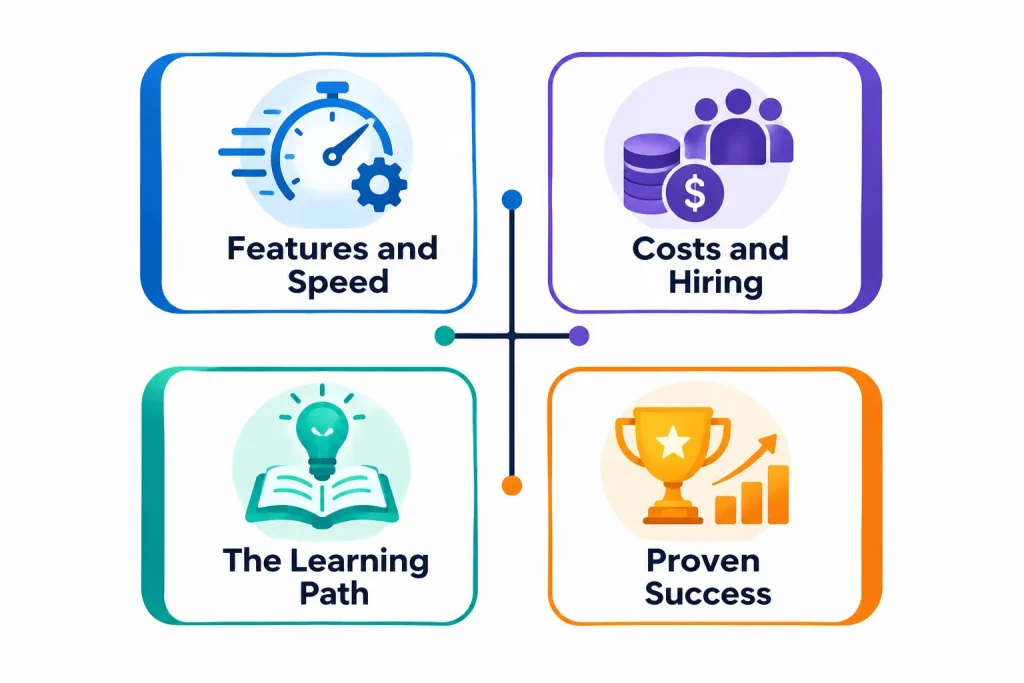
- Features and Speed: Does the app’s focus stay on its animations and overall looks, or does it require enterprise level features or functionalities, or is it going to be the balance of both?
- Costs and Hiring: How much will it cost to find good developers (for the mentioned technologies) and will it be easy to keep them onboarded for the long term?
- The learning path: Is it easier for your team to use the skills they already have, like JavaScript or C# and the ongoing market change adoptions?
- Proven Success: Have other big companies used this tool to build apps that handle millions of users.
The main benefit of checking these items will be that it helps you to avoid technical debt, that means your extra expenditure on just fixing the bad early choices.
Head-to-head comparison between Flutter, React Native, and Xamarin & .NET MAUI
Since we finally have our checklist with us, we can now discuss all three frameworks on the basis of that.
Flutter: The visual architect of high-performing apps
Flutter, from Google, is currently dominating the space of cross-platform development with a 46% share in the market. It is a complete UI toolkit that lets you build apps for phones, the web, and even desktop computers from one spot, meaning one team will be responsible for all your development.
Key features
Flutter’s main power is the impeller rendering engine, the tool that draws every single pixel on the screen directly. Because the framework does not have to worry or talk to your phone’s standard components, it stays very fast and smooth in performance. Then the hot reload feature is one of the godly ones out there which lets developers see their changes instantly.
Learning Curve
To use Flutter, your team needs to be an expert at Dart language which is a little less common in the field of software development. While Dart is a clean and easy-to-learn language, it usually takes about 3-4 weeks for most developers to feel comfortable with it unlike JavaScript that feels handy and easy right from week 1.
Development Cost
Because it has hundreds of widgets that are ready to integrate and use, the overall development costs stay budget friendly as compared to any other framework. But, since the framework demands experience in Dart language, the overall pool of available talent is a little bit smaller, so it might take a bit longer to hire Flutter app developers‘ talent for your team.
Real-World Proofs
Flutter is the power behind massive apps like Google Pay, Alibaba, eBay Motors, and BMW’s car systems.
React Native- The ecosystem king of speed and scale
React Native, backed by Meta (previously Facebook), is the favorite for teams that want to hire fast and launch quickly and hold about 32% of the market.
Key features
Unlike Flutter, React Native makes use of real native components so you can revoke native components even with this framework. This year, there are a few architecture changes that have fixed the old speed problems, thus making this framework a very responsive one for standard business apps.
Learning Curve
This one is the easiest framework to learn for the 67% of developers who already know JavaScript. Most of the teams can get up and run in just a few days.
Development Cost
It is very cost-effective because the talent pool is really large for this framework. When you need to grow your team, the ability to hire React Native developers in India lets you find expert help in as little as 3 to 4 weeks as well at the most budget-friendly prices.
Real-world proofs
It is the backbone of the big tech giants that everybody is known to that is apps like Instagram, Discord, Shopify, and Pinterest.
Xamarin & .NET MAUI: The enterprise legacy modernized
If you are looking at Xamarin in 2026, then know that it is not known with this particular name and is followed by its successor that is .NET MAUI. And, this has gone official since 2024 when Microsoft officially ended support for Xamarin so no new projects have to go with .NET MAUI and start there.
Key Features
.NET MAUI uses C# and works perfectly with other Microsoft tools like Azure and Visual Studio. It is designed for businesses who need that their app can work on windows as well as macOS computers as well as mobile phones.
Learning Curve
For teams that already build Windows software, this feels like home. However, if your team does not know C#, the learning curve is much steeper than React Native.
Development Cost
While the tool is free, finding specialists can be harder. Many companies need to hire Xamarin developer India experts to help them move their old Xamarin apps over to the new MAUI system.
Real-World Proofs
Large companies like Alaska Airlines and Caterpillar use this framework for their heavy duty business tools and enterprise ecosystem.
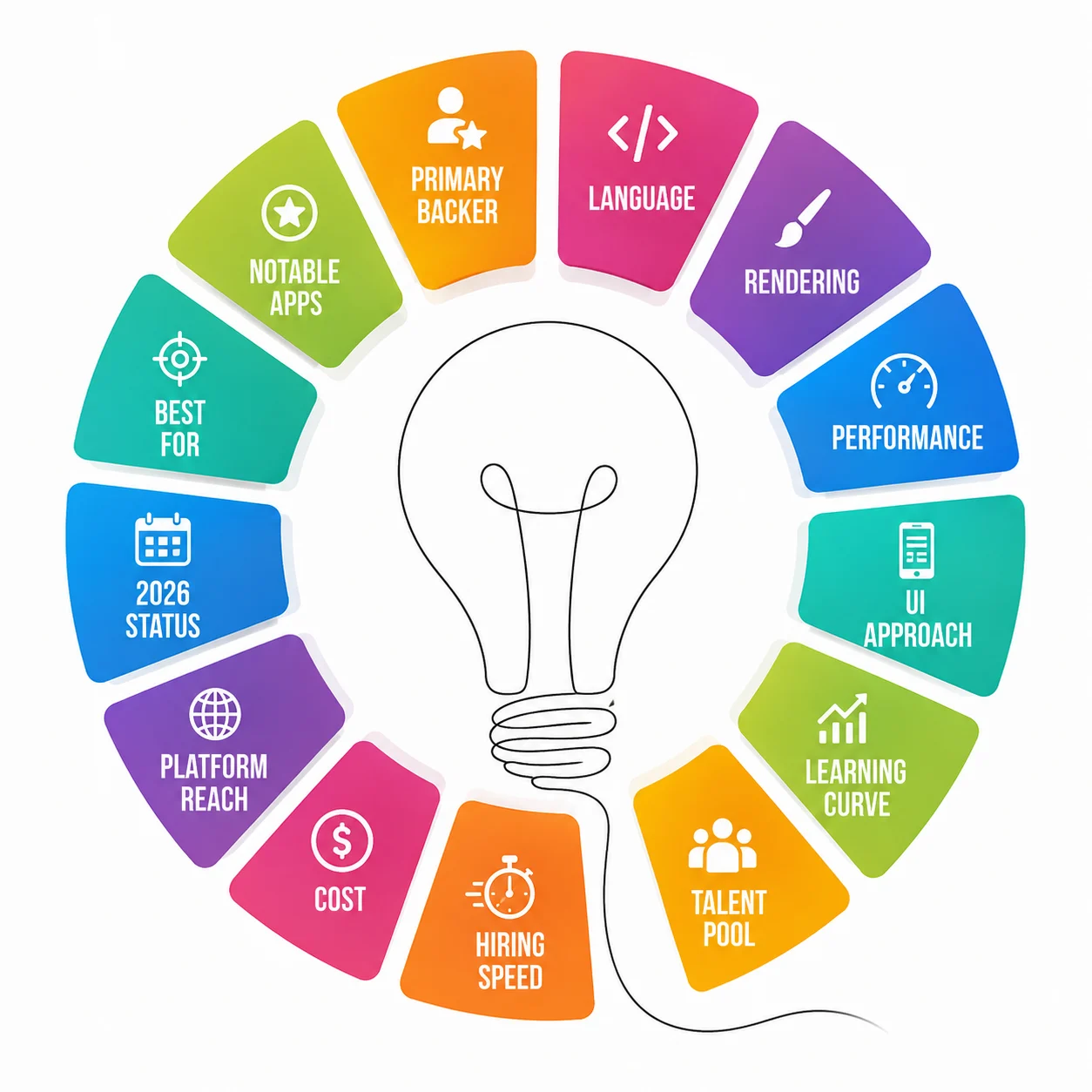
Flutter, React Native, and Xamarin- 2026 Framework Comparison at a Glance
| Dimension | Flutter | React Native | Xamarin / .NET MAUI |
| Primary Backer | Meta (Facebook) | Microsoft | |
| Language | Dart | JavaScript / TypeScript | C# (.NET) |
| Rendering | Custom (Impeller Engine) | Native Components | Native Components |
| Performance | Top-tier: 60+ FPS; native ARM compilation | High: Improved by New Architecture | Strong: Native API access; can be “heavy” |
| UI Approach | Pixel-identical across all devices | Platform-authentic (looks native to OS) | Platform-authentic (uses native primitives) |
| Learning Curve | Moderate: 2–3 weeks for Dart | Low: Days for JS developers | High: Steep if new to C#/.NET |
| Talent Pool | Growing; dominant in India/SE Asia | Largest: Deep global pool | Specialized; mainly enterprise C# shops |
| Hiring Speed | 6–8 weeks on average | Fastest: 3–4 weeks on average | Variable; niche talent |
| Cost | Efficient initial dev; stable maintenance | Lower initial hiring cost; higher maintenance | Higher due to specialized enterprise skill sets |
| Platform Reach | Mobile, Web, Desktop, TV | Mobile first but easily to web too | Mobile, Windows, and macOS |
| 2026 Status | Market Leader with a good number of share that is 46% | Ecosystem King with a market share of 32% | Popular among Legacy Enterprise with the share of 12% |
| Best For | If you want heavy UI stuffs and have a brand driven consumer app | If you are a startup or have existing JS teams or need a fast prototyping and launch in the market | Enterprise internal tools, .NET shops |
| Notable Apps | Google Pay, Alibaba, BMW, eBay Motors | Instagram, Discord, Shopify, Pinterest | Alaska Airlines, Caterpillar, MS Office |
Let’s make it more simple for you
For the best framework to use in your project, change your approach from going with the best one to going with the one that checks most of the ticks related to your project requirements.
- React Native is ideal if your team already works with JavaScript and if you want a dedicated feel for iOS and iOS because apps automatically adopt the native style of each platform. It is also suitable if you want to do a fast hiring and quick project starts due to the large talent pool available.
- Flutter best suits the projects that demand the same look across iOS, Android, web, and desktop platforms without any native adjustments like React Native.
- .NET MAUI is perfect if your backend is built on Microsoft tools, your developers prefer C#, or you’re modernizing an old Xamarin app.
Still Confused? Discuss with NetSet’s Cross-Platform Developers
Making the wrong tech choice can lead to bugs and wasted money, and when it comes to cross platform development, we at NetSet, bring more than a decade of experience to guide you in picking the right framework.
NetSet Software can run tests to show you exactly how each framework will perform for your specific idea. If you decide to go with the development, our developers have successfully launched global cross platform projects that are loved by the people, and can help you to launch your vision.
FAQs
Can I go with Xamarin for my project in 2026 or it is completely outdated?
Do not go with Xamarin in 2026 because Microsoft has officially stopped rolling out updates to the framework since May 2024, so new security holes will never be fixed for your project. Better plan a move to.NET MAUI which you can see as the modern version of Xamarin.
Which framework is the fastest?
Flutter usually wins on speed because it compiles directly to the phone’s hardware code. React Native is also very fast now thanks to its “new architecture,” and for most business apps, you will not notice a difference.
Can I use these frameworks for AI features?
Both Flutter and React Native can easily connect to AI tools like ChatGPT or Gemini using APIs, and if you want to connect advanced agentic AI then you can do it too but would need a team of experts to achieve proficiency.
Why is hiring in India so popular for these tools?
India has the largest pool of Flutter and React Native experts where while a senior dev in the US can charge up to $150,000, a senior dev in India costs between $42,000 and $68,000, which is just around 4 times cost effective.
Will my app look the same on all phones?
If you go with Flutter, then know that it draws on UI so on all platforms the design would look the same but in React Native, if it uses native components, the app would look similar to the app that looks on the dedicated platforms.