AI has progressed from being just a product to becoming an essential element in core business architecture. Reports by Precedence Research predicted that the global AI market value will reach over $1.8 trillion by 2030. The AI Global Market will continue to grow and will witness a CAGR of 35%, as businesses add AI capabilities to their products, business processes, and customer experience (CX).
PwC claims that artificial intelligence may add up to 15.7 trillion to the world economy by 2030 and is one of the most transformative technologies that would affect enterprise software and digital infrastructure.
AI is no longer limited to being a programmable software component. For companies and organizations, it has started driving personalizations, real-time analytics, and predictive decision-making for the future inside modern apps.
Implementing AI in the company isn’t likely to be as simple as integrating an API or deploying a chatbot in your system. An experienced AI development company can combine an advanced AI platform and a scalable mobile infrastructure.
This is where NetSet steps in. A trusted technology partner for global startups, SMBs, and enterprises. From Custom AI solutions to AI-powered platforms, it has the technical expertise to make you an AI-integrated company.
What Makes NetSet Software a Leading AI App Development Company in 2026?
Selecting an AI development partner should be on a strategic level as per the desired product scalability, operational efficiency, and long-term innovative capabilities. NetSet Software sets itself apart by offering complete solutions for AI engineering, product development frameworks, and enterprise-level digital systems.
1. End-to-End AI Product Engineering
NetSet supports businesses throughout the full AI product lifecycle:
- AI product strategy and architecture design
- AI model development and integration
- Mobile and web application development
- Enterprise automation systems
- Post-launch optimization and model retraining
This will make AI systems not only aimed at launching, but also NetSet integrates NLP models to build AI assistants, intelligent search engines, and automated communication systems.
Constantly develop with user data and business expansion.
2. Rapid MVP Development for AI Products
Many businesses struggle to validate AI ideas quickly. NetSet addresses this challenge through its MVP Product Development framework, enabling companies to test AI concepts without long development cycles.
Key capabilities include:
- Rapid MVP launch in 4–8 weeks
- Prototype AI models for early product validation
- Scalable architecture for future expansion
- Lean product testing before full-scale development
This method significantly reduces product risk and accelerates time-to-market for AI applications.
3. Integrated Product Development Services
Unlike firms that specialize in only one area, NetSet delivers multi-disciplinary technology services that support complete digital ecosystems.
Web & Mobile Application Development
NetSet builds scalable digital platforms using modern mobile and web technologies:
- Enterprise web applications
- Cross-platform mobile applications
- Custom product platforms
- API-driven architectures
Custom Software Development
The company also develops bespoke enterprise software systems, including:
- Product engineering solutions
- Business automation software
- Enterprise workflow systems
- Scalable SaaS platforms
AI Automation Systems
NetSet designs AI-powered automation platforms that streamline business operations through:
- Intelligent workflow automation
- Agentic AI systems
- Decision-support models
- Predictive analytics engines
Blockchain Development Solutions
The company also builds blockchain-based platforms, including:
- Smart contract development
- Decentralized applications (DApps)
- Blockchain integration with AI systems
Launch-Ready Product Frameworks
To accelerate product development, NetSet provides pre-engineered frameworks, including:
- MVP development kits
- Reusable product architecture templates
- Modular AI integration systems
These frameworks enable businesses to implement digital products more quickly through enhanced dependability.
Prefer Reading: Why Global Brands Partner with NetSet Software for AI & Digital Transformation
What Technologies Power Modern AI Apps in 2026?
Today’s AI application development employs architectures based on advanced models, a scalable cloud platform, and modern mobile frameworks.
Most of the technology development firms that dominate AI development use tech layering to develop intelligent applications.
According to research by McKinsey & Company, more than 55 percent of organizations in the world have already implemented artificial intelligence in at least one business area, and its adoption is growing rapidly in product development, marketing, and customer operations.
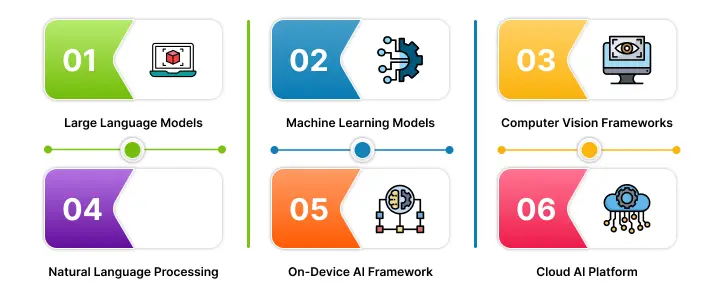
Large Language Models (LLMs)
Many intelligent capabilities of contemporary AI applications are powered by large language models.
Common use cases include:
- Conversational assistants
- Automated content generation
- Intelligent customer support systems
- Enterprise knowledge assistants
Popular LLM implementations include:
- GPT-based models
- Claude-style reasoning systems
- fine-tuned enterprise LLM models
Companies known for heavy LLM usage include:
- GenAI-Labs
- Riseup Labs
- Synergy Labs
- Goji Labs
- AppMakers USA
NetSet integrates these models into enterprise applications, automation platforms, and AI-driven products.
Machine Learning Models
Conventional machine learning remains critical for predictive intelligence in AI apps.
Typical ML applications include:
- Recommendation engines
- Fraud detection systems
- Behavior prediction models
- Classification and clustering algorithms
Companies known for strong ML engineering include:
- Saigon Technology
- Azumo
- Diffco
- Riseup Labs
NetSet implements machine learning pipelines designed for high-volume data environments and enterprise analytics platforms.
Computer Vision Frameworks
Mobile applications are able to process and understand visual data through computer vision.
Common implementations include:
- Object detection systems
- Facial recognition technology
- Image scanning tools
- Visual search applications
Popular frameworks include:
- OpenCV
- MediaPipe
- TensorFlow Vision
- custom convolutional neural networks (CNNs)
These frameworks work according to the demand for usage.
Natural Language Processing (NLP)
NLP-based artificial intelligence systems can read speech, texts, and intent.
Core NLP use cases cover
- Voice assistants
- Sentiment analysis
- Language translation
- Intelligent search
Common NLP tools include:
- SpaCy
- Hugging Face Transformers
- Rasa
- Speech-to-text APIs
NetSet uses NLP-integrated models to develop AI assistants, a smart search engine, and automated communication systems.
On-Device AI Frameworks
With modern AI applications, there is a tendency to have models run on mobile devices to enhance speed and privacy.
Key frameworks include:
- Core ML for iOS devices
- TensorFlow Lite
- PyTorch Mobile
- Google ML Kit
On-device AI allows applications to deliver low-latency intelligence without heavy cloud dependency.
Cloud AI Platforms
There are still essential needs in cloud infrastructure to train, deploy, and scale AI models.
The most popular cloud AI ecosystems are:
- SageMaker and Rekognition are some of the AWS AI services.
- Google Cloud AI, such as Vertex AI.
- Microsoft Azure AI and Cognitive Services
NetSet engineers develop cloud-native AI applications that can handle scale workloads of enterprises.
Mobile Development Frameworks
Modern AI apps are typically built using advanced mobile technologies.
Key frameworks include:
- Native iOS development with Swift
- Native Android development with Kotlin
- Flutter for cross-platform apps.
- React Native for hybrid applications.
Backend systems are commonly built using Node.js or Python microservices to support AI models.
DevOps and Scalable Architecture
AI applications require stable infrastructure and automated deployment systems.
Common DevOps tools include:
- Docker containers
- Kubernetes orchestration
- CI/CD pipelines
- Serverless computing
- Microservices architectures
Such technologies ensure that AI applications can be expanded effectively as user demand increases.
What Does AI App Development Cost in 2026?
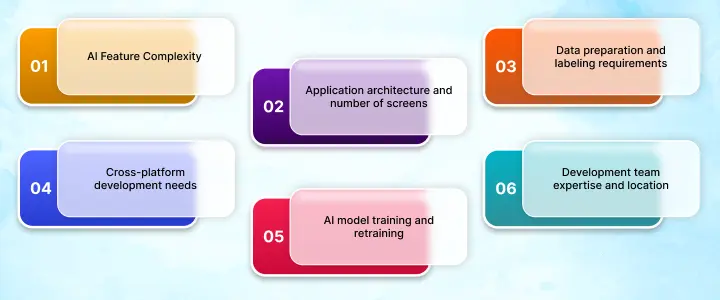
The general cost of AI application development is determined by several technical considerations:
Basic AI App
Simple AI features such as:
- Chatbots
- Recommendation systems
- Automation tools
Estimated cost: $40,000 – $80,000
Mid-Level AI Application
Includes features such as:
- Voice recognition
- Image processing
- Predictive analytics
Estimated cost: $80,000 – $150,000
Advanced AI Application
Complex AI products with capabilities such as:
- generative AI systems
- AI agents
- Multimodal AI models
- Large-scale data pipelines
Estimated cost: $150,000 – $300,000+
What Factors Influence AI Development Costs?
Several technical factors influence the overall cost of AI app development:
- AI feature complexity
- Application architecture and number of screens
- Data preparation and labeling requirements
- Cross-platform development needs
- AI model training and retraining
- Development team expertise and location
There are also long-term AI maintenance and infrastructure costs that should be budgeted by companies.
How Should Businesses Choose the Right AI App Development Company?
The choice of the appropriate development partner makes an AI project successful or unsuccessful.
Key evaluation factors include:
1. Clear AI Expertise
Look for companies with real experience in:
- Machine learning
- NLP systems
- Computer vision
- generative AI models
- AI automation systems
2. Strong Mobile Engineering Capabilities
AI features must be integrated into reliable mobile platforms built with:
- iOS and Android frameworks
- Flutter or React Native
- Secure backend architecture
3. Proven Project Experience
A credible AI development company should demonstrate:
- Real case studies
- Measurable results
- Strong client reviews
- Industry-specific expertise
4. Scalable Engineering Teams
Your development partner should be able to scale teams as product demand grows.
This includes:
- AI engineers
- Backend developers
- Mobile developers
- DevOps specialists
5. Long-Term Product Support
AI systems require ongoing optimization.
Choose a partner that provides:
- Model retraining
- System updates
- Infrastructure scaling
- Feature expansion
How Can Businesses Future-Proof AI Applications Beyond 2026?
The technology of AI evolves rapidly, and thus, applications developed now have to be flexible.
Build Flexible Architecture
Applications should use a modular microservices architecture to allow continuous feature expansion.
Use Retrainable AI Models
AI systems should include pipelines for:
- Data updates
- Model retraining
- Performance monitoring
Prioritize Data Security
Secure AI systems require:
- Encrypted data storage
- Ethical data practices
- Global privacy compliance
Implement On-Device AI
Running models locally improves:
- Performance
- Privacy
- Reliability
Plan Continuous Improvement
AI products should be regularly updated through:
- User feedback analysis
- AI model optimization
- Feature upgrades
Conclusion
The global software industry is being transformed by AI application development. Companies are not developing mobile applications anymore; they are developing analytical digital applications powered by machine learning, generative AI, and automated decision-making systems.
Collaborating with AI Engineering leads to a competitive edge for firms in the digital economy.
For companies building next-gen AI products, NetSet Software Solutions has emerged as a trusted technology partner.
If you are searching for AI app development services in India, custom AI solutions, and scalable AI-powered applications, NetSet will provide you with the expertise that you need to turn innovative ideas into market-ready intelligent products.
FAQ
1. What are AI development services?
AI development services include designing and building artificial intelligence as per your business operational workflow and automated decision-making.
2. Why should businesses invest in custom AI solutions?
Custom AI solutions are specifically built for a company or a business to run their own operational workflow.
3. Where can businesses hire AI app developers in India?
Businesses and companies can hire developers from India through specialized companies like NetSet, which are also experts in outsourcing expert developers.
4. Can AI apps work without the internet?
Yes, if they use on-device AI. Technologies like Core ML and TensorFlow Lite allow apps to run AI models directly on the phone, making them faster and more private.
5. What is the biggest challenge when building AI apps?
The biggest challenge is data collecting it, cleaning it, and training the AI correctly. Good data leads to good AI. Poor data leads to problems.