Prediction markets no longer work on theoretical charts but on a practical benchmark.
They are no longer fringe experiments designed by economists to test theories in controlled environments, nor are they tools used exclusively by a small group of crypto-native traders.
Prediction markets platforms are now large-scale, with actual money, real participants and quantifiable impact on the way uncertainty is priced in the fields of politics, finance, sport, and world events.
The prediction markets are websites where people buy and sell outcome-based tokens, which are probabilities of what will happen in the future.
The market-driven predictions made by collective belief supported by capital lead to changes in prices in real time, which, in most cases, are more successful than traditional approaches.
Social networks such as Polymarket failed to become popular as they were new or trendy.
They succeeded because they demonstrated a powerful principle in action: when individuals have a financial incentive to be correct, collective intelligence consistently outperforms centralized forecasting models.
Consequently, startups of prediction market platforms, founders, and businesses are no longer posing the question: Do prediction markets work? They are questioning their ownership of the infrastructure.
Many teams are no longer considering using third-party platforms and instead consider how they can have Polymarket clone development services that are customized, scalable, and aligned to a particular business goal.
This guide approaches Polymarket clone development not as an experiment, but as a commercial-grade platform decision.
Why Prediction Market Platforms Are Growing So Rapidly?
The rise of prediction markets is not speculative. It is measurable.
By the end of 2025, Polymarket surpassed $2 billion in cumulative trading volume, with U.S. election markets alone contributing over $400 million.
During major news cycles, individual markets processed millions of dollars in daily trades, demonstrating that users were not merely experimenting, they were participating with conviction.
Volume alone does not explain adoption. Accuracy plays a defining role.
Several studies examined independently on historical prediction markets indicate that the prices move towards correct values as the resolution gets closer.
Late-stage market accuracy, in most instances, is above 90%, competing or surpassing polls, expert panels and classic forecasting models.
For businesses, this performance sends a clear signal:
- Prediction markets demonstrate sustained demand
- They generate repeat engagement
- They function reliably under real financial pressure
What a Polymarket-Style Platform Actually Is?
One of the most common misconceptions is that Polymarket is simply a betting platform with a modern interface.
Structurally and economically, it is not.
A Polymarket-style platform functions more like a financial exchange than a sportsbook. Users do not wager against a house. Instead, they trade outcome-based tokens whose prices represent aggregated probability estimates.
At a basic level:
- A verifiable question is defined as “Will Event X occur before Date Y?”
- Two outcome tokens are created: Yes and No
- Each token is backed by collateral, typically a stablecoin
- The combined value of all outcomes equals one unit of collateral
- Prices fluctuate entirely based on trading activity
If the “Yes” token trades at $0.62 and the “No” token at $0.38, the market implies a 62% probability. No odds are set manually. Trading itself generates prices.
While conceptually simple, scaling this model to thousands of users and hundreds of active markets introduces significant technical, liquidity, and trust-related challenges.
What Most Polymarket Clones Get Wrong Early On?
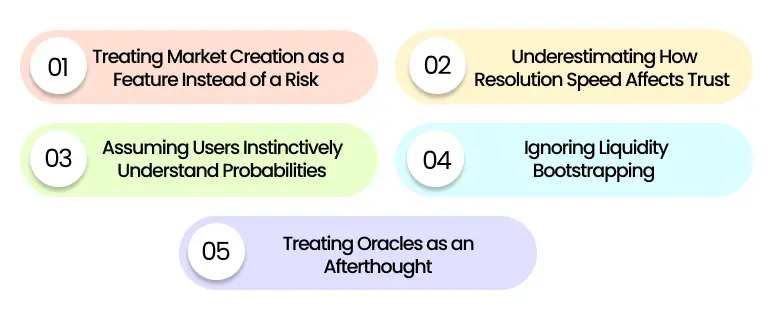
Most prediction market failures stem from design and trust decisions, not smart contract errors.
Teams often assume that once contracts are deployed and interfaces resemble familiar platforms, users will naturally participate.
Prediction markets do not work that way. They are highly sensitive to liquidity depth, transparency, education, and settlement clarity.
Small early mistakes compound rapidly once real users and real capital are involved.
1. Treating Market Creation as a Feature Instead of a Risk
Unrestricted market creation floods platforms with vague or low-interest questions. Liquidity fragments across inactive markets, resulting in:
- Unreliable pricing
- Dormant markets
- Rapid loss of user confidence
Polymarket avoided this by aggressively curating markets and concentrating liquidity early. Controlled market creation is not a limitation; it is often a survival requirement.
2. Underestimating How Resolution Speed Affects Trust
Users may tolerate financial losses. They do not tolerate uncertainty.
Slow or ambiguous settlement erodes trust faster than volatility. When users cannot predict when or how a market will resolve, confidence deteriorates.
Clear wording, predictable timelines, and transparent dispute handling matter more than extreme decentralization in early stages.
3. Assuming Users Instinctively Understand Probabilities
Prediction markets price probabilities, not payouts.
Without proper UX education:
- Risk is misunderstood
- Trades feel misleading
- Engagement drops after initial interaction
Successful platforms proactively explain outcome tokens and probability pricing before users place their first trade.
4. Ignoring Liquidity Bootstrapping
Liquidity does not emerge automatically.
Platforms without seeded liquidity or early incentives experience unstable pricing and unreliable signals.
Many technically sound clones stall within weeks due to shallow markets.
5. Treating Oracles as an Afterthought
Oracles determine truth.
Any ambiguity in outcome reporting or dispute resolution immediately damages credibility. Volatility may be accepted, but questionable settlements are not.
Early clarity around reporting incentives, dispute processes, and resolution authority is essential for long-term trust.
This is where teams stop experimenting and start building with Netset Software Solutions.
What Does It Actually Cost to Build a Polymarket Clone Platform?
This is where most theoretical discussions fail, and real decision-making begins.
Building a Polymarket clone software development to production-grade is not a simple task. Prices are determined according to the regulatory demands and jurisdiction, scalability anticipations, and liquidity architecture.
The common investment levels are:
- MVP (Curated markets, limited scope):
$60,000 – $90,000 | 3–4 months - Production Platform (Mainnet-ready, liquidity planning):
$120,000 – $180,000 | 4–6 months - Enterprise-Grade Platform (Audits, governance, compliance):
$200,000+ | 6–9 months
Underestimating budget or timelines is one of the most common reasons platforms fail post-launch.
[Prefer Reading: How Much Does It Cost to Build a Prediction Market Platform Like Polymarket or Augur?]
Build From Scratch vs White-Label Prediction Market Software
For many businesses, the decision is not whether to build, but how?
Building from scratch makes sense when:
- Custom market mechanics are required
- Regulatory workflows are unique
- Prediction markets are core to long-term strategy
White-label prediction market software is ideal when:
- Speed-to-market matters
- Proven architecture reduces risk
- Customization can be phased gradually
White-label solutions allow faster launches while preserving ownership and scalability.
Step-by-Step: What It Takes to Build a Polymarket Clone
Step 1: Designing Markets That Actually Attract Liquidity
The most significant success factor in early-stage prediction markets is the liquidity design.
Fewer, quality markets always beat small catalogues. Market and dispute windows, as well as category-specific logic, should be created deliberately.
Step 2: Choosing the Right Blockchain Infrastructure
The decision of blockchain has a direct impact on adoption and cost. The cost of gas is high and discourages trading.
The relocation of Polymarket to Polygon is indicative of the requirement to be in low-cost and swift-confirmation environments.
Popular options include:
- Polygon
- Arbitrum
- Optimism
- Base
Economics, not ideology, should guide infrastructure decisions.
Step 3: Smart Contract Architecture
A production platform requires:
- Market factories
- Outcome token logic
- Trading mechanisms
- Settlement and redemption flows
Most platforms begin simple and evolve toward hybrid models as volume grows.
Step 4: Oracle Design and Dispute Resolution
Optimistic oracle models dominate due to speed and economic alignment. Clear resolution schedules matter more than maximum decentralization early on.
Step 5: Frontend UX That Builds Confidence
Users must immediately understand:
- What they are trading
- How probabilities work
- When settlement occurs
Confidence directly drives volume.
Step 6: Security, Audits, and Risk Management
Audits reduce vulnerabilities, but best practices also include:
- Testnet simulations
- Time-locked permissions
- Continuous monitoring
Trust compounds slowly and collapses instantly.
Step 7: Scaling for Real-World Usage Spikes
Elections and breaking news create sudden demand. Platforms must be built for peak moments, not average traffic.
Conclusion
Building a Polymarket clone is not about copying interfaces or deploying contracts.
It is about understanding human incentives, liquidity behavior, trust dynamics, and uncertainty at scale.
When executed correctly, a prediction market platform becomes more than a product, it becomes a trusted signal in a noisy world.
At Netset Software Solutions, Polymarket clone development is approached as a long-term product initiative, engineered to withstand real users, real capital, and real-world scrutiny.
For teams evaluating whether prediction markets belong in their product roadmap, early architectural decisions determine whether a platform merely launches or earns lasting credibility.
FAQS
What is a prediction market platform?
A prediction market platform is a platform that allows its users to buy and sell based on the real-life event outcomes through probability markets. Prices indicate group wisdom, and thus the platforms are useful in predicting trends, events, and decisions in finance, politics, and business.
How do you build a decentralized prediction market like Polymarket?
To create a decentralized prediction market, it is necessary to have smart contracts, oracle integration, liquidity mechanisms, and secure user interfaces. Companies which engage in predictive market software development services for most businesses to minimize risk, make sure that they comply and can start more quickly with scaled infrastructure.
What features are essential in prediction market software solutions?
Its main characteristics are market creation, outcome settlement, liquidity management, oracle integration, wallet support, and secure trading logic. These elements make it accurate, transparent, and trustworthy to its users and enable high-volume trading within a prediction market platform.
Why choose white-label prediction market software?
The white label prediction market software enables quicker deployment, reduced costs of development, and decreased technical risk. Businesses are able to do branding and feature customization whilst taking advantage of proven, scalable, secure, and regulatory-flexible architectures.
Who provides enterprise-grade prediction market platform development?
Specialized Web3 firms like Netset Software Solutions offer enterprise-ready prediction market software development, including centralized and decentralized models. Their solutions are designed for scalability, security, and long-term business growth.