Do you know what makes product development so challenging in this competition-ridden environment?
It is because businesses are under constant pressure to bring innovations, reduce costs, and deliver custom experiences yet being ahead in the competition. All the traditional methods can be seen struggling already to keep up with the modern demands, thus leading to longer cycles, much higher risk,s and missed opportunities.
But, thanks to Artificial intelligence because it has automated repetitive tasks, helps predict customer needs nearly accurately and a lot more things that you might not be knowing. The question of if one should adopt AI is no more, rather the question is how fast they can integrate it into their product development.
So, what all strings are attached to the concept of AI product development and why the right AI development services provider makes a huge difference in product success? Well, we will uncover all of this in this blog so stay tuned.
What exactly is AI in product development?
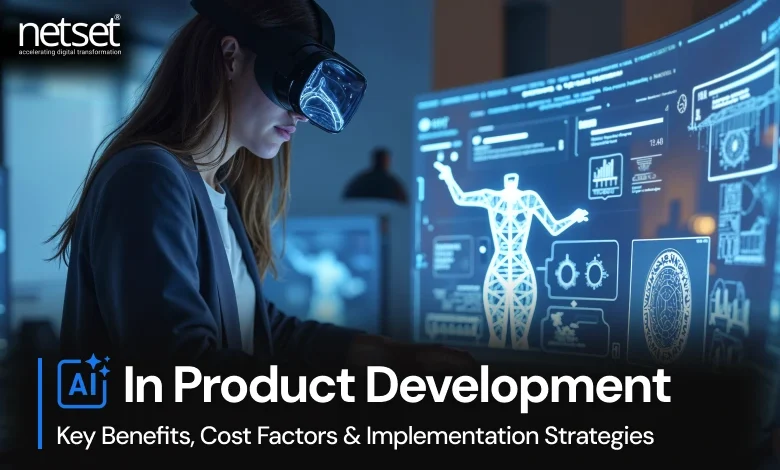
When we use the term AI product development, then the concept of product development remains the same but gets mixed with intelligent algorithms, machine learning models and automation tools across the entire product lifecycle. In place of relying completely on human intuition or manual processes, AI lets teams design, test, and scale products with much greater accuracy and speed.
AI can be applied at the multiple stages that can be:
- Research and ideation where AI studies market trends and customer feedback to identify opportunities.
- Design and Prototyping where tools are able to AI generate design variations, simulate performance, and reduce errors before the real tangible production.
- Testing and Quality Assurance where machine learning models predict potential failures and optimize testing cycles.
- Scaling and Personalization where AI helps to customize products just according to customer needs, for better adoption and satisfaction.
And we take a look at the statistics then, as per PWC, enterprises that are advanced in using AI and machine learning in product development generate over 30% of their revenues from fully digital products or services.
A few important Benefits that AI in Product Development Delivers
See, AI is not a buzzword in product development, it is a practical tool that delivers measurable benefits without any dependency on a specific industry. According to McKinsey, businesses that adopt AI in product development can achieve up to 20% faster time‑to‑market compared to traditional methods. With intelligence into workflows, businesses can achieve so many things that they were not able to with traditional product development.
Faster Prototyping with lowest or no Errors
The design tools that use AI can simulate performance and detect flaws at the earliest, which cuts down on costly iterations. This reduces development cycles and gives highest possible accuracy in the process of product development.
User Experiences that feels natural to each customer
AI acts as a key in products to adapt to user behaviour which is mostly done with functionalities like smart recommendations, custom interfaces and other strategies which genuinely increases the customer satisfaction and retention.
Decision Making with a vast amount of Data
AI can study massive datasets which were out of the limits of human efforts to uncover insights that guide product features, pricing, and market positioning. And, when something like that takes place, the final decisions are inspired from evidence, not guesswork.
Advantage in competition with innovation
Companies who apply AI app development services in San Francisco can connect advanced features like predictive analytics, natural language processing, or computer vision which gives their products a unique existence in crowded markets.
Improvement that never stops
Humans may get tired, but AI systems can learn all the time + over time which makes products smarter as each interaction passes. This builds a cycle of constant enhancement without requiring constant manual updates.
What about the factors that affect AI Product Development cost?
Without any doubt, AI does bring in immense value to product development, but it also comes with unique cost considerations which is why you have to understand these factors to help businesses plan realistically and avoid budget surprises.
The ultimate cost of Talent and Expertise
To start with, hiring skilled AI engineers, data scientists, and ML specialists comes with a big expense because these skills demand dedication, investment, and effort to even learn. However, you may reduce the burden of recruiting an in house team by going with a custom AI development company with off course proper checks.
Infrastructure and Tools
AI projects need powerful hardware (in terms of GPUs and cloud servers) and also some special software frameworks. These infrastructure costs scale as the complexity of a project rises and the data volume increases so you have to be aware of these elements.
The constant Maintenance and Updates
Well after all AI is also a machine which needs constant retraining guidance and monitoring to stay accurate because if you inject a wrong data set, it will keep on producing the results on those wrong datasets. And, such maintenance and update costs with compliance checks again demands investment which might not be suitable for young startups.
Hidden Costs (Integration and Compliance)
More than just development, you also have to consider the budget for integrating AI into existing systems and meeting regulatory requirements. These come under the tab of hidden costs which does drop a notable impact on the total expenditure if not planned upfront.
Scalability Investments
As products grow, AI systems must handle larger datasets and more users and when you go for scaling infrastructure and algorithms you have to keep a separate budget for that.
However, do not be worried about the cost factors, as they are shared to you so that you can plan your budget better because the long-term benefits will save you millions or even billions in costs if you are a big enterprise.
Some Important Implementation Strategies for AI in Product Development
When you adopt AI in product development, you have to not just think of it as a technology but also as a strategy. As per Gartner, 80% of executives believe AI will notably change product development strategies by 2027, which is why structured implementation is important. All the companies who succeed with AI have taken a structured approach so that their innovation aligns with business goals and customer needs.
- Start Small with Pilot Projects: Begin with limited AI initiatives to test feasibility and measure ROI because Pilot projects reduce risk and provide valuable insights before scaling.
- Build Cross‑Functional Teams: AI projects do good when product managers, engineers, and data scientists come together as cross‑functional teams have best technical capabilities aligned with market demands.
- Partner With Experts: When you go for a trusted AI Development Services provider you get proven frameworks, knowledge, and scalability for your product.
- Focus on Scalability and Compliance: As businesses grow, so do AI systems and building scalable architectures that meet regulations bring long term sustainability.
- Continuous Monitoring for Improvement: As AI models get better over time, they require regular monitoring and feedback loops so deliver best accuracy and relevancy.
Challenges and Risks that come with AI Product Development
 According to TechRepublic, a media site, 34% of businesses quoted data privacy and security challenges as few of their biggest challenges when they adopt AI. Well, AI does deliver some amazing benefits, it has its own challenges that businesses must address if they want a promised success.
Data Privacy and Security
Since AI systems are all about vast amounts of data, if you mishandle this sensitive information, then it can result in breaches, regulatory penalties, and loss of customer trust.
High Upfront Investment
Although outsourcing can reduce costs, AI projects might require some notable spending in terms of infrastructure, tools, and expertise.
Talent Shortage
Skilled AI professionals are in high demand and without access to the right talent, projects may stall or deliver subpar results.
Risk of Biasness with AI Models
AI algorithms, that never intentionally do it, may inherit biases from training data, which can take the form of unfair or inaccurate outcomes. So, for every business it is important to apply key checks that can lower such risks.
Integration Complexity
Connecting AI with existing workflows and legacy systems can be complex because it asks for careful planning sessions and special expertise.
When you ignore the above risks, you may end up performing unnecessary investments, compliance issues, or build products that fail to meet expectations.
How can you choose the Right AI Partner?
As per Accenture’s report, 84% of the executives believe they won’t achieve their growth objectives until and unless they scale with AI. Going with the right partner for AI product development is not only about technical skills but is also about trust, vision, and proven expertise.
A few must-haves
A reliable custom AI development company San Francisco does have a strong portfolio of right projects, which shows their ability to deliver AI solutions in your respective industry. With that you also should review the case studies and client testimonials to verify if the team can adapt to your unique product goals or not.
Don’t forget about transparency
The best partners always go for clear communication, detailed roadmaps, and upfront pricing so you know exactly what to expect. If we see more than cost, then innovation capabilities matter, where your partner should deliver proficiency in advanced areas.
Discuss support and scalability
Finally, long term support and scalability are important too as AI projects do not end at launch and do consist of retraining, monitoring, and compliance updates. A strong partner will commit to ongoing collaboration, so that you scale infrastructure and algorithms as your business grows. Now security and regulatory compliance are also attached when we mention scalability, so make sure to discuss the same too.
Partner with NetSet Software- a trusted AI development services provider
If you are planning to accelerate time to market, customize customer experiences, or lower costs, the right partner can help you transform ideas into market-ready products. Do not just adopt AI but rather utilise it as a strategic to stay ahead of the competition.
All you have to do is connect with our team or fill in the detailed form to find how custom AI development solutions can reshape your product development process and drive long term success.
[Prefer Reading: Why Global Brands Partner with NetSet Software for AI & Digital Transformation]
FAQs
Is AI product development different from traditional product development?
AI adds intelligent algorithms, machine learning, and automation layers to design, test, and scale products faster and more efficiently, which was not there in traditional product development.
How exactly does AI lower the cost of product development?
With automation of repetitive tasks, predicting the demand, and reducing errors, AI lets companies cut down costs related to wasted resources in development cycles.
Does AI product development also benefit small businesses?
The AI development services are affordable, which lets small businesses use AI for market research, customer insights, and product personalization without big upfront investments.
What are some risks that come with AI in product development?
The main risks relate to data privacy, high initial costs, and some degree of bias in AI models, but they are completely solvable with the help of experts.
How can I pick the best AI partner for my project?
Proven experience, transparent communication, and discussion over long-term support are a few traits of a right partner.