In December 2025, a company that sells sports gear and jerseys sets foot into the prediction markets, an industry doing $24 billion a month. Fanatics, a team gear brand, launched Fanatics Markets and turned millions of sports fans into traders.
Fanatics wasn’t alone as big sports betting platforms such as DraftKings and FanDuel had long since entered this market space.
Yet the market is still far from saturated. There is considerable room for new entrants, and more importantly, launching a platform no longer requires the scale of a billion-dollar brand like Fanatics. With the right custom white-label prediction market software, almost any business can enter the market without building the underlying technology from the ground up.
This blog explains what the platform is, how it works, industry insights, and how you can launch a prediction market platform of your own.
What Are Fanatics Markets?
Fanatics Markets is a regulated events trading platform where users bet on and trade contracts on real-world events.
Rather than betting on fixed odds, users buy shares that are linked to possible outcomes.
The price of these shares changes based on public sentiment, similar to how stock prices move.
To put it in simple words, in the Fanatics prediction markets, you’re buying and selling “yes/no” bets on things that will happen in the real world. Like “Will the Yankees win against the Rangers?” or “Will the Fed cut the interest rate this year?”
Fanatics launched the platform in 24 states on both iOS and Android. The launch had a two-phase rollout plan. The first rollout included basic categories like sports, finance, economics and politics. Then, the second phase introduced crypto, stocks, climate, tech, entertainment, and even pop culture (Fanatics, 2025).
How Fanatics Markets Actually Works?
Fanatics Markets is simpler than it sounds. You open the app and pick a topic (Let’s say “Sports”). Then you choose a contract (basically a yes/no question) and type in how much money you can put in. If you’re prediction is right, you get paid. Simple!
Each contract is priced between 0 and $1. This price reflects how likely users believe an outcome is. Let’s say a contract on the LA Lakers winning against the Chicago Bulls is at 65 cents. It means 65% of the users think the Lakers will win. If they do win, you get 100 cents against your 65 cents bet, and if they don’t you get none.
The more people put money in favor of the Lakers, the higher the contract price goes (like the stocks), and you can trade your contract before the results come to cash in the profits or cut the loss.
Who’s Running the Engine Underneath?
Fanatics Markets is handled by Crypto.com’s CFTC-registered derivatives exchange, which provides the institutional-grade backend that handles the actual trading.
Why Prediction Markets is Fastest Growing Finance Market Right Now?
Fanatics did not arrive early. It came just in time, given that this entire category is growing faster than almost any industry ever does.
The numbers tell the story. In just eight months Kalshi and Polymarket went from under $5 billion in monthly trading volume to over $24 billion, an increase of more than four times. Kalshi alone handled $23.8 billion in aggregate notional volume during 2025, an increase of over 1,100% year-on-year.
In first quarter of 2026, even CFTC-regulated prediction markets saw over $36.6 billion traded, and 87% of Kalshi’s trade volume comes from the sports category.
That’s the reason why Fanatics decided to enter the prediction market and why DraftKings, FanDuel and Robinhood made the same decision.
Core Features Every Prediction Market Platform Needs
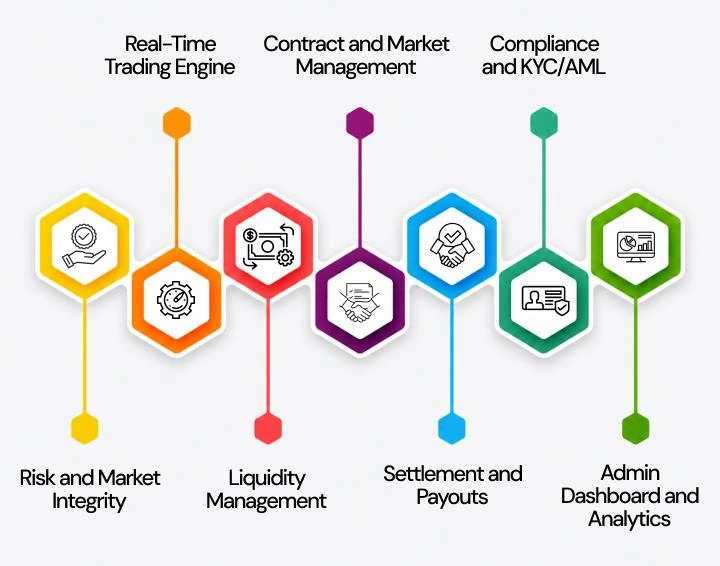
Here’s what each core component does, and what it takes technically.
| Feature | What It Does | Technical Aspects |
| Real-Time Trading Engine | Matches buy and sell orders and prices contracts. This is what makes the platform an exchange, not a fixed-odds sportsbook. | Central Limit Order Book, in-memory matching, low-latency execution, and concurrency control for peak load. |
| Contract and Market Management | Lets operators spin up markets, define yes/no outcomes, set resolution rules, and settle contracts automatically. Multi-leg contracts like Fanatics’ Combos are supported here too. | State machine, oracle-fed outcome resolution, parlay logic, configurable settlement triggers. |
| Compliance and KYC/AML | User verification services, suspicious activity detection, and prevention of market entry wherever gambling is prohibited. | For state-specific regulations, third-party KYC/AML solutions, IP and GPS geofencing, sanctions list and PEP screening, with permanent audit trails. |
| Risk and Market Integrity | Guards the platform and its users against manipulation and insider activity, in line with CFTC Core Principle 3. | Position and exposure limits, real-time anomaly detection, surveillance algorithms, and pattern analysis that flags coordinated or insider trades. |
| Liquidity Management | Keeps order books deep. This allows users to enter and exit positions without extreme price swings. | AMM models or external market-maker integrations, logic for incentives and rebates, plus spread monitoring tools. |
| Settlement and Payouts | Handles contract trades and pays out, accurately, the moment an event concludes. | Automated settlement engine, multi-rail payments (card, bank, and optionally stablecoin), wallet management, and reconciliation systems. |
| Admin Dashboard and Analytics | Gives operators a real-time view of trade volume and user activity. | P/L & exposure dashboards, alerting, and regulator exports. |
In-House Development or White Label: What to Choose?
Build from scratch or launch on white-label software? Here’s a comparison of both to help you make the right decision.
| Factor | In-House Build | White Label |
| Time to Market | 12–18 months, often longer. | Weeks to a few months. |
| Upfront Cost | High. Engineering, infrastructure, and compliance from zero. | A fraction of the cost. Core systems already built. |
| Compliance | Built and certified yourself. Slow and expensive. | Pre-built KYC, AML, and audit tooling, ready to configure. |
| Trading Engine | Designed, tested, and hardened in-house. | Battle-tested engine included out of the box. |
| Maintenance | Your team owns every update, fix, and audit. | Handled by the provider. |
| Customization | Total control, at the cost of time. | Brand and configure freely; core stays managed. |
| Risk | You carry it all, technical and regulatory. | Shared with an experienced provider. |
Build Your Own Prediction Market Platform With NetSet
Fanatics proved that a strong brand plus the right technology can turn an audience into an active trading community in a matter of weeks. The same opportunity is open to sportsbooks, media companies, fintech brands, and startups that want a share of this fast-growing market.
At NetSet Software, we help businesses launch their own prediction market apps with white label software that is built for compliance, speed, and scale. When you partner with us, you do not just enter the market, you launch with a foundation designed to grow with it.

FAQs
Is Fanatics Markets legal and regulated?
Yes. Fanatics Markets runs on Crypto.com’s CFTC-registered derivatives exchange, so the actual trading sits on regulated infrastructure. That said, the rules are still being written. In June 2026 the CFTC published its proposed framework for prediction markets, and how that shakes out will shape the space for years to come.
What is white label prediction market software?
It’s a ready-built platform you can brand as your own. Rather than spending months engineering a trading engine, contract management, and compliance tools from scratch, you get all of that pre-built and simply put your name on it. The heavy technical lifting is already done.
Which industries can benefit from prediction markets?
More than you’d expect. Sports brands are the obvious fit, and sports is still the biggest category by volume, but the door is open much wider than that. Media companies, fintech platforms, and early-stage startups all have a real shot here. Contracts today span finance, politics, economics, and culture, which means almost any business with an engaged audience has something to build on.
How long does it take to launch a prediction market app?
It depends. Scope, features, and compliance requirements all move the timeline. Building in-house can take many months, sometimes longer, while white label software cuts that down dramatically. Partner with an experienced provider and you can go to market in a fraction of the time it’d take to start from zero.