How Much Does It Cost To Build An AI Coworker Like Claude?

AI is not only used for research and testing but is also used in sales processes, customer service, internal knowledge management, financial activities, and decision-making. Corporations are transitioning from asking “How will AI help?” to “Where will AI help quickly?” This has driven the need for on-site AI coworkers.
When business leaders talk about an AI coworker like Claude, they typically envision a system capable of interpreting requests, finding information in the company, producing useful work outcomes, connecting to software systems, and assisting workers with routine tasks.
It performs closer to an internal digital operator than a public chatbot. Next, it is cost-driven: How much does an AI coworker like Claude cost to develop?
That depends on the work performed, systems accessed, security needs, number of users, automated workflows, and intended ownership. A focused departmental assistant can launch with a moderate budget. A cross-functional enterprise platform requires a larger investment because it supports broader operations.
This guide explains the real cost ranges, technical architecture, implementation variables, ownership economics, and how businesses use AI agent development and AI development services to build internal AI systems that create lasting value.
How AI coworker beneficial for your Business Environment?
An open AI tool responds to prompts. A business AI coworker contributes to execution.
For example, a marketing manager could ask it to compile campaign results and make suggestions for future actions. A supportive team leader can request it to analyze open cases, find recurring problems, and generate replies.
The difference is important. Companies don’t adopt AI technology out of curiosity. Instead, they point out the importance of speed, accuracy, less bureaucracy, better information access, and increased efficiency of employees.
That is why an AI coworker often becomes more valuable than a standalone chatbot.
Core Components Behind an AI Coworker Like Claude
An effective AI coworker is not built from one API call. It combines several systems working together.
The user-facing layer includes chat, search, task panels, or workflow dashboards. Behind that sits an orchestration layer that routes requests, applies logic, calls models, and manages tool access.
A retrieval layer searches internal documents, databases, CRM records, policies, product material, or historical communications. Security layers control permissions, logging, and access boundaries. Monitoring systems track usage, response quality, and cost efficiency.
Typical components include:
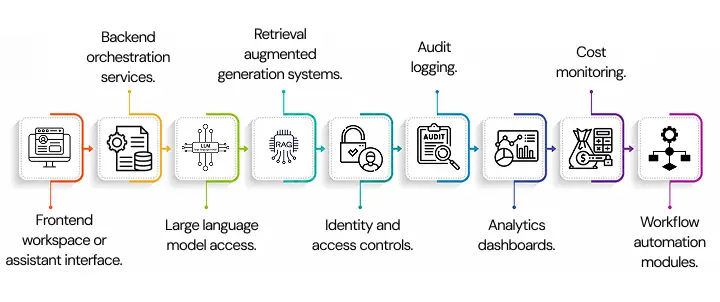
- Frontend workspace or assistant interface.
- Backend orchestration services.
- Large language model access.
- Retrieval augmented generation systems.
- Identity and access controls.
- Audit logging.
- Analytics dashboards.
- Cost monitoring.
- Workflow automation modules.
Without these layers, many projects remain limited pilots.
Real Cost Range to Build an AI Coworker Like Claude
Budget depends on what the system must do and how many people rely on it.
| Build Scope | Typical Cost Range | Delivery Timeline | Common Use Case |
| Focused MVP Assistant | $25,000 to $75,000 | 4 to 8 weeks | One team, one workflow |
| Department AI Platform | $80,000 to $180,000 | 2 to 4 months | Sales, support, HR |
| Multi-Team Production System | $200,000 to $500,000 | 4 to 8 months | Growing businesses |
| Enterprise AI Operating Layer | $500,000+ | 6 to 12+ months | Large organizations |
A startup may only need proposal drafting, internal search, and email assistance. A bigger organization might need approvals, multilingual capabilities, CRM, analytics, and access control throughout various departments.
Why Costs Differ Between Companies?
The largest pricing factor is scope clarity. A company with defined business goals often launches faster and spends less than one pursuing a broad “build something like Claude” initiative.
In case the assistant has to integrate itself with Salesforce, HubSpot, Slack, financial services applications, support software, and internal databases, engineering efforts increase.
The third consideration is the governance requirement. Organizations that deal with contracts, personal data of customers, health care information, and other controlled information will need better controls.
The fourth factor is usage scale. A tool used by twenty employees differs greatly from one used by two thousand employees daily.
Technical Cost Breakdown by NetSet
Most commercial budgets span several engineering streams.
| Workstream | Typical Range |
| Discovery and planning | $5,000 to $25,000 |
| UI/UX and frontend development | $10,000 to $60,000 |
| Backend engineering | $20,000 to $120,000 |
| Retrieval systems and data indexing | $15,000 to $90,000 |
| Third-party integrations | $3,000 to $25,000 each |
| Security implementation | $15,000 to $100,000+ |
| QA, testing, evaluation | $10,000 to $50,000 |
This is why model token pricing alone does not represent total project cost.
Infrastructure and Ongoing Operating Costs
After launch, companies manage recurring expenses. These vary by user activity and system design.
Common monthly costs include:
- Model API usage.
- Cloud hosting.
- Storage and vector databases.
- Monitoring tools.
- Security services.
- Maintenance and upgrades.
- Prompt and workflow optimization.
A smaller deployment may operate within a few thousand dollars monthly. A widely used internal system can rise significantly depending on traffic and automation volume.
Companies with ownership control often reduce recurring costs through request routing, caching, efficient prompts, and multi-model strategies.
How Retrieval Systems Influence Value?
Many internal AI tools fail because they rely only on model intelligence without company context.
Retrieval systems solve this by indexing approved documents, contracts, SOPs, product manuals, tickets, sales notes, policy files, and structured records. When an employee asks a question, the assistant fetches relevant content before generating an answer.
This improves factual grounding and relevance.
For example, instead of giving a generic refund answer, the assistant can respond using the company’s current refund policy. Instead of generic product guidance, it can use the latest pricing sheet or implementation notes.
For most businesses, retrieval quality matters as much as model quality.
Where AI Agent Development Creates Higher ROI?
Many organizations no longer want systems that only answer questions. They want systems that perform actions. That is where AI agent development becomes commercially valuable.
An AI agent can perform tasks that include checking up on a new sales lead, pulling information from their CRM database, finding account possibilities, and making notes to follow up on later.
They can also classify support tickets, assign priority and status of the ticket, document searches, and even start draft responses to the tickets.
That type of workflow execution often creates a higher ROI than text generation alone because it reduces process time directly.
Why Businesses Use AI Development Services?
Internal technology teams often understand the business need but lack dedicated delivery bandwidth. They may also need architecture guidance, model expertise, or integration support.
That is why many companies engage AI development services and providers.
External specialists often help with:
- Opportunity discovery.
- Technical architecture.
- Secure implementation.
- System integrations.
- Performance tuning.
- Testing frameworks.
- Rollout execution.
- Ongoing optimization.
This approach often reduces avoidable rework and instantly delivers time.
Prefer Reading: 24/7 AI Agents: Enhancing Productivity and Customer Satisfaction
Why Businesses Choose NetSet to Build Their Own AI Coworker?
NetSet Software supports businesses that want an owned AI system aligned to internal operations rather than a generic external platform.
That often includes internal assistants for sales enablement, support operations, knowledge management, finance workflows, and cross-functional productivity.
Ownership gives companies greater control over:
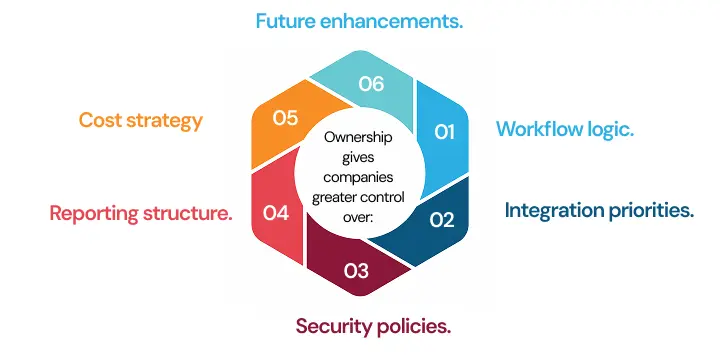
- Workflow logic.
- Integration priorities.
- Security policies.
- Reporting structure.
- Cost strategy.
- Future enhancements.
It’s a valuable factor as adoption expands. Additional use cases don’t require a system rebuild. For companies leveraging AI as a foundational technology, owning the system often leads to greater long-term value in their ownership.
Common Mistakes That Increase Cost
The first common mistake is building too broadly in phase one. Narrow, measurable launches often create faster returns.
The second mistake is ignoring internal data quality. Poor source data produces substandard outputs.
The third mistake is launching without adoption planning. Require value in their day-to-day activities.
The fourth error is the concentration solely on prompts without considering architecture, retrieval quality, analytics, and governance. Ignoring these factors will generally save organizations more money than cutting costs on vendors.
How to Start the Right Way?
The strongest first phase usually targets one visible workflow problem.
Examples include:
- Proposal drafting delays
- Slow internal document search
- Support queue overload
- Manual onboarding questions
- Repetitive finance summaries
Once one workflow proves value, expansion into other teams becomes easier, faster, and more cost-efficient.
Conclusion
The cost to build an AI coworker like Claude depends on what the business expects it to deliver. A focused internal assistant can begin in the five-figure range. A cross-functional production platform often enters six figures. Enterprise-scale systems rise higher because they support more users, more systems, and stricter governance.
The better buying question is not “What is the lowest price?” It is “What recurring work can this system remove, and what is that worth each month?”
Companies that answer that clearly make stronger strategic investments.
NetSet Software Solutions is your trusted Custom AI development company to increase the operational workflow with its custom AI solutions to build your own AI co-worker, like Claude, with a competitive building cost and technical advancement.
FAQs
How much does it cost to build an AI coworker like Claude?
Development projects internally may be as expensive as $25,000 to $75,000. Development projects for bigger platforms that employ many different teams begin at $150,000.
What does AI agent development include?
AI agent development focuses on systems that complete actions across tools and workflows, not only chat responses. It often includes automation logic, memory, orchestration, and integrations.
Why hire a custom AI development company?
Unlike any other type of AI solutions, a bespoke artificial intelligence development company like NetSet will design its technology according to your procedures, systems, security needs, and future aspirations.
Are AI development services useful for mid-sized businesses?
Yes, mid-sized companies can enjoy the advantages of quick deliveries, better architectural decision-making, and better implementation if the task is done by specialists.
What are Custom AI Solutions?
Custom AI Solutions are purpose-built systems designed for business workflows such as support automation, sales enablement, internal search, finance reporting, and operations management.