A prediction market data provider is a system that delivers real-time price updates, order book states, trade execution streams, and historical datasets for use in probability-based trading platforms.
These prediction market platforms function as continuous pricing systems. Each executed trade updates outcome probabilities, modifies liquidity distribution, and triggers state changes across the system. The data provider defines execution accuracy, propagation speed, and consistency across all downstream services.
The selection of a market data provider directly determines:
- Execution reliability
- Latency performance
- Analytical capability
- System scalability
These parameters establish deterministic system behavior under high-frequency trading conditions and define consistency across distributed execution ecosystems.
They directly influence state synchronization accuracy, data integrity, and real-time processing efficiency across the platform.
Prefer Reading: How To Build A Custom Prediction Market Platform Like Kalshi
Key Evaluation Criteria for Providers
A production-grade provider is evaluated on:
- Latency performance (sub-second streaming updates)
- Data completeness (order books, trades, historical datasets)
- Schema consistency (normalized multi-market structures)
- Infrastructure reliability (failover, uptime guarantees)
- Throughput capacity (high-frequency event handling)
These parameters determine performance under a high data-processing cost.
Why Your Platform Depends on a Market Data Provider?
Prediction markets operate on event trading state transitions. Each trade updates:
- Order book depth
- Market probability
- Liquidity positioning
Synchronization failure causes:
- State divergence between backend and frontend
- Incorrect execution states
- Distorted pricing signals
Platforms such as Polymarket and Kalshi operate on real-time pipelines, where state consistency is maintained across distributed systems within milliseconds.
What Data Do You Actually Need?
Prediction market systems depend on structured, multi-layer datasets.
Core Data Requirements
- Real-time price streams: Continuous updates derived from executed trades.
- Order book depth: Bid/ask levels representing liquidity distribution.
- Trade execution logs: Timestamped records for reconciliation and auditing.
- Market metadata: Event identifiers, outcome structures, categorical tagging.
- Historical datasets: Tick-level and aggregated data for modeling and analytics.
Real-time data pipelines have a significant impact on pricing accuracy, execution consistency, and latency in trading systems.
How Data Flows Across a Prediction Market System?
A production system follows a deterministic, event-trading pipeline with synchronized state updates.
1. Data Flow Architecture
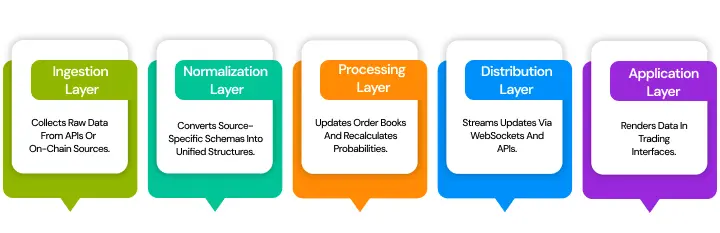
- Ingestion Layer
Collects raw data from APIs or on-chain sources. - Normalization Layer
Converts source-specific schemas into unified structures. - Processing Layer
Updates order books and recalculates probabilities. - Distribution Layer
Streams updates via WebSockets and APIs. - Application Layer
Renders data in trading interfaces.
This flow operates as a unidirectional event pipeline with each state transition propagating across services without conflict.
2. Execution Flow
Trade execution → order book update → probability recalculation → broadcast to clients
Production systems operate within 50–300 ms update intervals, maintaining near real-time consistency.
Direct API vs Aggregated Market Data Provider
| Parameter | Direct API | Aggregated Provider |
| Latency | Lowest | Higher |
| Data Structure | Raw | Normalized |
| Integration Effort | High | Reduced |
| Maintenance | Continuous | Managed |
| Coverage | Single source | Multi-source |
Selection Logic
- Trading systems depend on direct APIs
- Analytics systems depend on aggregated datasets
Top 7 Prediction Market Data Providers and What They Offer
Here’s an overview of some of the leading prediction market data providers, including the types of data they deliver, technical capabilities, and practical use cases. This will help you understand which provider aligns best with your platform’s needs.
1. PredictionData.dev — Enterprise-Grade Tick-Level Data
Data Provided:
- Tick-level Level 2 (L2) order book updates, including price and bid/ask depth across major exchanges such as Polymarket.
- Historical trade logs and on-chain fill data spanning multiple markets.
- Extensive historical archives, covering up to three years and tens of billions of individual data points.
- Additional WebSocket streams with over 99.9% uptime and daily export capabilities.
Use Cases:
- Backtesting trading strategies.
- Quantitative research and modeling.
- Market replay analytics for evaluating past market behavior.
- Deep historical studies and statistical analysis.
2. PolyRouter — Unified Cross-Platform API
Data Provided:
- Normalized real-time and historical market data aggregated from multiple sources, including Polymarket, Kalshi, Manifold, and Limitless, accessible via a single API.
- REST endpoints for market discovery, price histories, and advanced filtering.
- WebSocket streaming for live updates across all supported platforms.
Use Cases:
- Developers are integrating data from multiple platforms without building separate adapters.
- Dashboards and analytics platforms require unified, consistent data.
- Multi-market monitoring and reporting.
3. Probalytics — Aggregated Real-Time Streams
Data Provided:
- Real-time market streams delivered via REST and Server-Sent Events (SSE) for platforms such as Polymarket and Kalshi.
- Normalized feeds include price updates, market status, and execution data.
- Aggregated streams designed for high-frequency data applications.
Use Cases:
- Automated trading systems and algorithmic strategies.
- Multi-exchange trade operations.
- Research platforms require consistent, normalized data streams.
4. PredictAPI.dev — Polymarket-Focused Real-Time Data
Data Provided:
- Real-time order book data for Polymarket, updated approximately every second.
- Historical price data and order book snapshots to support algorithmic trading strategies.
- WebSocket support enables low-latency data delivery (~15 ms average).
Use Cases:
- High-frequency trading specifically on Polymarket.
- Platforms building custom execution systems or algorithmic strategies.
- Latency-sensitive trading applications.
5. Propheseer — Multi-Market Normalized Data API
Data Provided:
- Unified API delivering normalized market data across Polymarket, Kalshi, Gemini, and other platforms.
- REST and WebSocket endpoints with a consistent JSON schema for all markets.
- Market metadata, including lists, prices, volumes, and event structures.
Use Cases:
- Multi-platform analytics applications.
- Dashboards require consistent, normalized market data.
- Tools that combine data from multiple exchanges for analysis or reporting.
6. DeltaBase — Historical CSV & BigQuery Datasets (Free Option)
Data Provided:
- Downloadable historical trade data and market metadata for platforms like Polymarket and Kalshi in CSV format.
- BigQuery datasets are updated daily for structured queries and large-scale analysis.
- Free access for short-term historical ranges, with extended archive access planned.
Use Cases:
- Academic research and data analysis.
- Exploratory studies and offline backtesting.
- Data-driven strategy evaluation without direct API integration.
7. PredictInsider — GraphQL Market Streams
Data Provided:
- Real-time market feeds via GraphQL subscriptions, combining both on-chain and platform-level data.
- Live trades, market status updates, and volume analytics with sub-second latency.
- Unified metadata and trade records are available through a single endpoint for simplified integration.
Use Cases:
- Real-time dashboards and charting tools.
- Push-based analytics platforms require immediate data updates.
- Platforms need a unified data feed for alerts or real-time trading signals.
Summary
Each provider specializes in different types of data delivery, from tick-level order books and historical archives to aggregated multi-platform feeds and low-latency WebSocket streams. Selecting the right provider depends on your platform’s use case, latency requirements, and integration capabilities.
How Important Is Latency and Speed?
Latency defines execution precision and state consistency.
Key Metrics
- Tick-to-display latency
- Order book refresh rate
- Trade confirmation delay
According to industry analysis, a delay of just 1 millisecond has the potential to affect trade execution, which reinforces the need for low-latency infrastructure in trade systems.
Benchmarks
- 50–300 ms update intervals
- 1,000–10,000 events per second processing capacity
- Continuous WebSocket streaming
NetSet Software Solutions builds streamlined data intake architectures that consolidate multiple data sources into normalized pipelines, reducing integration complexity while maintaining execution consistency.
How to Evaluate Data Quality and Accuracy?
Prediction markets require strict data validation.
Evaluation Criteria
- Schema consistency
- Timestamp precision
- Validation mechanisms
- Error handling
Timestamp drift above 100 ms introduces pricing inconsistencies and impacts execution accuracy.
What Differentiates an Enterprise-Grade Data Provider?
Enterprise systems operate under strict performance constraints.
Required Capabilities
- Deterministic execution consistency
- High-throughput ingestion (1,000–10,000 events/sec)
- Fault-tolerant architecture
- Distributed processing pipelines
This ensures consistent data flow, accurate state updates, and reliable processing across distributed systems at high event rates.
Key Features to Look For in a Provider
- REST APIs for structured queries
- WebSocket streaming for real-time updates
- Horizontal scalability
- Rate limiting controls
- Secure authentication
- Event replay capability
- Data versioning
How Pricing Models Actually Work?
Pricing models in market data infrastructure are structured around measurable consumption units, where cost directly maps to request frequency, data volume, and streaming intensity across the system.
Pricing Structures
- API request-based pricing
- Data volume-based pricing
- Subscription tiers
Benchmarks
- $0.1 to $10 per million requests
- Additional cost for real-time streaming
- Premium pricing for historical datasets
Pricing structures and benchmarks are an indication of how providers allocate compute resources, deliver data at scale, and maintain low-latency access to real-time and historical data.
Prefer Reading: How Does Polymarket Make Money Through Prediction Markets
How to Choose Based on Your Business Model?
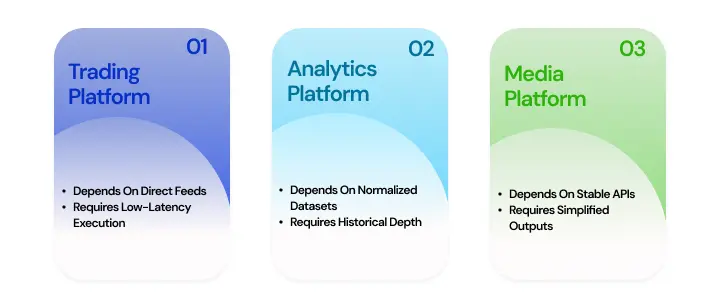
1. Trading Platform
- Depends on direct feeds
- Requires low-latency execution
2. Analytics Platform
- Depends on normalized datasets
- Requires historical depth
3. Media Platform
- Depends on stable APIs
- Requires simplified outputs
Final Checklist Before You Decide
Before you overlook certain patterns in diverse platforms, go through this final checklist.
- Real-time streaming availability
- Order book depth access
- Historical dataset completeness
- Schema consistency
- Latency benchmarks
- Throughput capacity
- Pricing scalability
- Compliance alignment
Conclusion
The selection of a prediction market data provider is a critical factor in system reliability, execution consistency, and scalability.
Platforms using structured, low-latency, and normalized data pipelines maintain:
- Consistent execution states
- Scalable architecture
- Reliable analytical outputs
If there is a delay in the execution of the platform, inconsistencies in the state of the data, or a lack of scalability, delaying the resolution of the architecture will only lead to more system instability and increased system costs.
NetSet Software Solutions offers unified ingestion architectures that integrate various data sources into a single pipeline. This reduces complexity while maintaining execution consistency.
FAQs
- What is the best prediction market data provider for low-latency trading platforms?
The best provider offers sub-second streaming, consistent order book updates, high event throughput, minimal tick-to-display delay, and WebSocket support. Reliability under load is critical, as execution precision depends on stable latency and data consistency.
- How do I choose a prediction market data provider for real-time trading systems?
Focus on Latency, schema consistency, and infrastructure reliability. The provider should support normalized data, real-time streaming, and failover. A dependable provider ensures deterministic state updates, keeping your trading system running smoothly and error-free.
- What data does a prediction market platform need to ensure accurate trade execution?
The execution process needs to be done with accurate real-time prices, order book depth, trade logs, and market data. The historical data is as important as this because without these data layers, inaccurate results will be obtained.
- What is the difference between direct APIs and aggregated market data providers?
Direct APIs deliver raw, low-latency data from a single source but need complex integration. Aggregated providers offer normalized multi-source feeds with less engineering effort. Trading platforms use direct feeds; analytics platforms use aggregated feeds.
- Why is low latency critical in prediction market data infrastructure?
Low latency ensures market updates propagate instantly, preventing pricing errors and execution issues. Even slight delays can distort probabilities. Providers like NetSet Software Solutions use optimized pipelines for real-time synchronization and accurate execution.