Around a decade ago, mobile app development (for iOS and Android) required two separate teams which demanded 2x the cost, efforts and timeline during the development. After the development and deployment phases too, double investments were required to maintain and support the iOS and Android version of apps which also caused inconsistent user experiences and lost customers.
Cross-platform frameworks have changed the complete picture, allowing a single codebase to power multiple platforms without duplication. By 2026, these frameworks are scalable solution for enterprise-ready solutions so that businesses can accelerate launches at a cost savings with consistent apps across the devices.
But from the wide range of cross platform app development frameworks available in the market, your concern might be, “What are the best cross platform frameworks and which one fits my business best?” As a leading cross-platform development company, this is what we are going to answer you today.
Prefer Reading: The Complete Guide to Developing Mobile Apps for iOS and Android- From Design to Launch
Key Benefits of Cross-Platform App Development: Why is it the default choice of businesses in 2026?
Cross‑platform development has become the default strategy for businesses worldwide, largely driven by the explosion of app usage across devices. With smartphones alone accounting for 86.9% of global usage and tablets, wearables, and smart TVs adding to the mix, users expect a seamless experience everywhere. This heavy demand challenge is solved by cross platform development with the below benefits it offers.
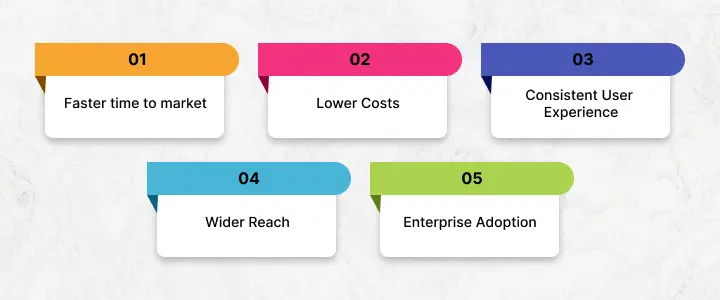
1. Faster time to market
Studies show cross-platform frameworks lower the development time by up to 30 to 40%, which is an incredible inspiration for businesses planning to achieve faster product launch. Not only a faster launch, but businesses can respond to market changes effectively.
2. Lower Costs
Instead of maintaining separate iOS and Android teams, businesses can hire mobile app developers who are experts at cross platform development. With overall effort into a single codebase, companies save time and resources.
3. Consistent User Experience
When a codebase is unified, it makes sure that design and functionality remain consistent all across the devices, thus building brand identity and customer trust.
4. Wider Reach
With one app serving multiple platforms, businesses target a range of users without any increased workload of platform specific development.
5. Enterprise Adoption
Although we just entered into the new financial year, before this year wraps, you can expect more new mobile projects to be built by enterprises using cross-platform frameworks because they see this approach as a reliable production-grade solution.
Many organizations, instead of going for an in-house option, prefer to partner with a mobile application development company India to maximize the product of success without technical overhead.
Top cross-platform frameworks in 2026 (as per your business model)
Now reaching to the core part of our blog, let us talk about the top cross-platform frameworks. There is no one size fits all because every framework has its own core strength that makes it better fit for a given business model.
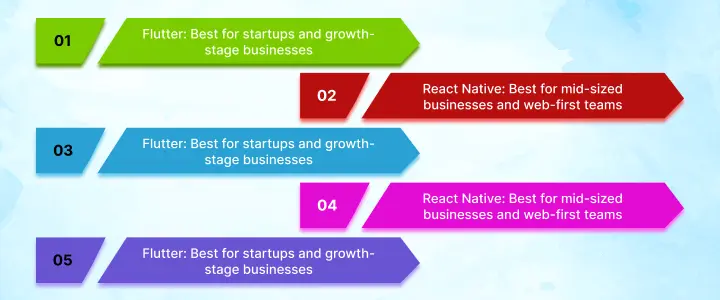
Flutter: Best for startups and growth-stage businesses
Google’s open-source framework, Flutter, stays common choice for startups (not limited to startups only) who want quick launches without missing on the design part. Its single codebase smoothly supports iOS, Android, web, and desktop, which makes it ideal for MVPs and quick scaling. The startups benefit from Flutter‘s hot reload feature a lot, which boosts development cycles and lowers the time to market by up to 50%.
Strength of Flutter
- A rich widget library which promises pixel-perfect and consistent UI for apps.
- Strong support from Google and a massive developer community available for Q&A.
- Excellent for building visually appealing apps quickly.
Limitations
- Larger app size compared to native builds.
- Performance slows with complex animations or heavy graphics.
Top adopters
- BMW (in their car apps), Google Ads (campaign management), Alibaba (eCommerce), Toyota (enterprise apps).
React Native: Best for mid-sized businesses and web-first teams
The framework built by Meta remains a solid contender for mid-sized businesses and companies wanting stable web teams. It utilises JavaScript, which allows web developers to transition into mobile smoothly, and achieve cost-efficiency for firms already using React for their website. The SaaS providers and eCommerce platforms choose React Native to extend the web products into mobile.
Strengths with React Native
- Big ecosystem of 1000s of libraries, ready to use
- Easy onboarding for web developers
- Strong community and third-party integrations
Limitations of React Native
- Performance overhead as compared to Flutter.
- Reliance on third-party modules for advanced features.
- UI consistency sometimes requires extra effort.
Top Adopters
- FB + Instagram (represented by Meta group), Discord, Uber Eats, Walmart, and Shopify.
.NET MAUI: Best for enterprises with a Microsoft ecosystem
Microsoft’s .NET MAUI succeeds Xamarin and is custom for enterprises investing more in Microsoft technologies. With seamless integration into Azure and Visual Studio, it is ideal for regulated industries like finance and healthcare. The enterprises benefit from C# familiarity, which reduces the training costs and ensures compliance.
Strengths of .NET MAUI
- Tight integration with Azure and enterprise tooling.
- C# base appeals to enterprise developers.
- Strong support for compliance-heavy industries.
Limitations
- Smaller community as compared to Flutter/React Native.
- Slower adoption among the startups and smaller firms.
Top adopters
- Finance and healthcare enterprises (most of them), and the global .NET development firms like eSparkBiz, Roundedcube, and Next Idea Tech
Uno Platform- Best for governance and multiplatform projects
Uno Platform is getting massive traction this year for projects that require wide reach with the support for six platforms like iOS, Android, WebAssembly, macOS, Linux, and Windows. It is perfect for government and enterprise projects where accessibility and consistency remain important.
Strengths of Uno Platform
- C#/XAML base for Microsoft ecosystem developers
- Broad platform coverage including WebAssembly
- Strong appeal for regulated public sector projects
Limitations of Uno Platform
- Ecosystems are still growing with fewer ready-made libraries.
- Smaller developer pool compared to Flutter or React Native
Top Adopters
- Toyota (migrated from Xamarin.Forms)
- IA Financial Group (insurance apps)
- TradeZero (trading platform)
Kotlin Multiplatform: Best for Android-heavy teams and native UI needs
Kotlin Multiplatform or KMP, has proved itself as a modern contender this year because it lets teams share business logic across the platforms while also keeping native UI layers undisturbed. This makes it ideal for Android-centric companies to expand into iOS without losing the native performance.
Strengths of Kotlin Multiplatform
- Native performance with shared business logic.
- Flexibility to design platform-specific URLs.
- Gives strong appeal for companies having android only apps.
Limitations of Kotlin Multiplatform
- The ecosystem keeps on growing as compared to Flutter or React Native.
- A little smaller community which means less plug and play solutions.
Top Adopters
- Duolingo (language learning app), BiliBili (instant messaging features), and JetBrains ecosystem projects.
A Final Suggestion: How NetSet Can Power Your Cross-Platform Vision?
The truth is; even if you pick the right framework, you have only won half of the battle because the real challenge attaches with turning that tech framework into a real product that clients value. And, that is where partnering with mobile app development services India like NetSet Software brings the difference.
We are in the building of products that go beyond the custom coding, where our teams help businesses identify the right framework, prepare blueprints supported by deep market research for the product.
So, whether you want to quickly release an MVP using Flutter or want to build an enterprise level app in React Native, we can deliver you a scalable multi-platform product that leads the market.
Prefer Reading : Why React Native Is Still the Top Choice for MVP Development
FAQs
- Is cross platform development a safe choice for enterprise apps or its best for startups only?
The new.NET MAUI and Uno Platform are made to connect well with enterprise grade tools (Azure, compliance libraries) so that businesses from finance, healthcare, and government projects can innovate with the unbreakable security.
2. Are cross platform apps able to access device features like native apps?
Yes, frameworks like Flutter and React Native give plugins/APIs for camera, GPS, biometrics, and further Kotlin Multiplatform lets native UI layers have full control like native app development.
3. How does cross-platform affect app performance as compared to native?
Performance stays less efficient than pure native but frameworks have matured to cover this difference (Flutter and Kotlin are great examples).
4. How is the long term maintenance and updates experience with cross platform development?
Cross-platform apps are easy to maintain as updates can be applied across the platforms at the same time, which lowers the burden of inconsistent user experience.
5. Is talent availability a challenge with cross-platform frameworks?
Not anymore because cross platform development is highly popular and you can partner with leading cross platform app developers suiting your business requirements.