In the modern tech environment, enterprises are under pressure to make their AI systems more reliable, scalable, and context aware. There are large language models that do struggle with outdated knowledge and hallucination, which creates risks for business decision-making.
The retrieval augmented generation platforms solve this by mixing real-time data retrieval with powerful generative models, thus delivering accuracy at scale. For companies that aim to stay a leader in the market, the ability to hire retrieval-augmented generation (rag) developers is taking a strategic focus.
Why do enterprises need production-grade RAG platforms?
The companies in 2026 deal with big volumes of data where from customer interactions and compliance records to research archives and operational workflows, the scale of information makes it impossible for traditional AI systems to keep pace.
The problem
The large language models, while powerful, do struggle with their outdated knowledge and hallucination when they are used alone, which creates a risk for decision-making, compliance, and customer trust.
RAG platform as solution
RAG or in full form, Retrieval augmented generation platforms solve this challenge with its two important capabilities that is retrieval of relevant, up-to-date information from enterprise knowledge bases, and generation of relevant and context-aware responses. With this dual approach the AI outputs stay not only fluent but also factually right and for enterprises, it means less errors, strong compliance, and more reliable insights.
Demand hike
The demand for production-grade RAG platforms is also boosting, with research showing that 85% of the companies want to customize AI as per their requirements with RAG into their AI workflows with best accuracy and scalability. All the industries—finance, healthcare, and legal services—where misinformation can result in regulatory penalties are leading the adopters.
The main benefits
More than compliance, RAG platforms do unlock competitive benefits where they enable enterprises to deliver custom customer experiences, accelerate research and development, and streamline internal knowledge management.
For example, a financial services firm can use RAG to deliver real-time investment insights on the basis of the latest market data, while a healthcare provider can make sure that treatment recommendations are aligned with current medical guidelines.
More demand for LLM developers
This growing demand has built opportunities for specialized partners who offer large language model development services. Nearly every enterprise (and even startups or mid size companies) is more than ever looking to hire LLM developers who can design retrieval pipelines, optimize integrations, and connect RAG systems into operations.
There is no business who see RAG systems as experiments with AI pilots but are ready to connect production grade platforms that deliver them the best ROI.
Core Architecture of a Production-Grade RAG Platform
A production-grade retrieval augmented generation platform is more than a technical experiment because it has taken the form of a structural system that aims to deliver accuracy with scalability as well as trust for enterprises. To understand how RAG works at scale, it helps to break down the architecture into 4 important layers, where each serves a distinct business purpose.
[Prefer Reading: DeepSeek R1 Open Source Models Selecting the Right Architecture with RAG
Retrieval layer
At the foundation is always the retrieval system, who source the accurate, up to date information from knowledge bases, document repositories, or external data sources. The vector databases and embeddings act as power to this process so that the system matches queries with really rich and contextually relevant information.
For businesses, the retrieval layer makes sure that AI outputs are rich in facts and not in assumptions which is why large language models need this layer else they will be at risk (outdated and inaccurate information) in producing information or responses.
Generation layer
Once relevant data is there, the generation layer takes over, and this is where large language models condense the information into readable, human-like form. It consists of the fine tuning things like prompt engineering, and domain specific adaptation which make this layer business ready.
Just to understand better, a legal services firm may fine tune its LLM to work with case law, while a healthcare provider may tweak it to medical guidelines. In simple words, the generation layer changes raw data into actionable insights that decision makers can trust.
Orchestration layer
A production level RAG platform needs to be seamless with coordination between retrieval and generation. For this, the orchestration layer comes in which manages pipelines, caching, and monitoring to deliver efficiency. It is the decision maker about things like when to query the database, how to handle repeated requests, and how to optimize latency.
For sure, this layer is very important for enterprises as it makes sure that millions of queries can be processed without any performance issues plus it also gives monitoring dashboards that help leaders track performance and reliability.
Security and compliance layer
No enterprise platforms are complete if there are not strong safeguards, as the security and compliance layer makes sure that sensitive data stays protected and that output aligns with industry regulations.
There are features like role based access control, encryption, and audit trails that are very important in industries like finance and healthcare because it not only prevents data breaches but also makes sure that AI systems remain compliant with frameworks.
But why does architecture matter?
Each layer of the RAG architecture is designed with enterprise goals in mind, like retrieval making sure accuracy, generation delivering actionable insights, orchestration guaranteeing scalability, and compliance safeguarding trust. Together they form a system that transforms AI from a pilot project into a production-grade solution.
This is why enterprises increasingly partner with a large language model development company to design and deploy RAG platforms. There is specialized expertise that is required to balance retrieval pipelines, optimize embeddings, and connect orchestration tools.
A lot of businesses now choose to hire retrieval automated generation (RAG) developers who can customize these layers to their unique workflows and make sure that the architecture is not only technically perfect but also strategically aligned with the goals of the business.
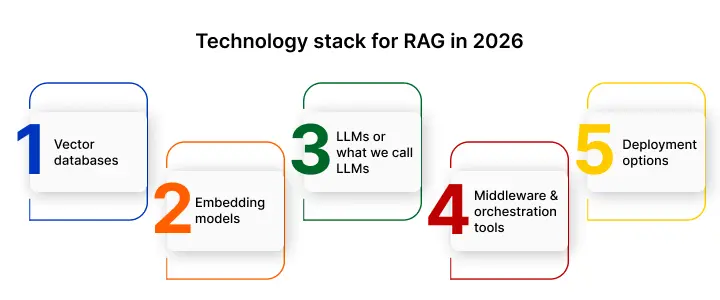
Technology stack for RAG in 2026
A production level retrieval augmented generation platform is only strong when the technology stack behind it is strong. This is the reason why enterprises are left with no choice but to have a mature ecosystem of tools and frameworks that make RAG deployment faster, more reliable, and more scalable.
Layer 1: Vector databases
The retrieval backbone of any RAG system is the vector database, where these databases store embeddings, numerical representations of text or documents and allow for fast similarity searches. There are popular options, which include
- Pinecone, which is known for its scalability and managed infrastructure.
- Weaviate gives modularity and integrations like built in machine learning.
- FAISS (Facebook AI Similarity Search), a powerful open source library which is optimized to perform heavy similarity search.
The final choice depends on scale and compliance like a global bank may prefer Pinecone’s managed services for reliability, but a research institution might go with FAISS for flexibility.
Layer 2: Embedding models
Embeddings are the bridge between raw data and retrieval, and thankfully enterprises can choose from a wide range of embedding providers.
The first one is OpenAI embeddings, which is widely adopted for general-purpose tasks and then we have Cohere embeddings, which is strong in multilingual and domain-specific contexts.
You also have Hugging Face models, which are open-source options for customization and while selecting the right one, try to analyse whether the retrieval aligns with the business needs. If you take a case of, let’s say, a multinational enterprise then their focus will be on multilingual embeddings because they have to serve diverse markets.
Layer 3: Large language models or what we call LLMs
The generation layer relies on LLMs to synthesize retrieved data into coherent responses, where options include:
- GPT-4 successors, which offer advanced reasoning and contextual understanding.
- Anthropic Claude models are known for safety and alignment.
- Open source LLMs (LLaMA, Mistral, and Falcon), which lets enterprises fine tune models for their unique and personal use cases.
Most of the businesses prefer to work with a large language model development company to select, fine-tune, and deploy the right LLM so if you find technical concepts complex then you can be relaxed because you have someone taking care of it.
Layer 4: Middleware and orchestration tools
Connecting retrieval and generation requires orchestration frameworks and today you have LangChain, which is a popular framework for building RAG pipelines, followed by LlamaIndex, which specializes in document indexing and retrieval orchestration.
Also, custom pipelines are possible, which are built by enterprises for unique workflows but for this you have to hire LLM developers who can design you an efficiency system.
Layer 5: Deployment options
Enterprises must decide where to host their RAG platforms so they have options like
- Cloud, which delivers scalability and managed services.
- Hybrid make sure to balance the flexibility of cloud with on premise compliance.
- On premises which is important for industries who deal with strict data sovereignty requirements.
Just for an example, assume there is a healthcare provider then the best choice for them will be hybrid deployment as they have to balance patient privacy with scalability, but a government agency should go with on premises hosting.
But why do RAG tech stack choices matter?
The tech stack is not just a technical decision but a business strategy because elements work together like Vector databases find retrieval speed, embeddings define contextual accuracy, LLMs shape response quality and orchestration deliver scalability.
It is also the reason why enterprises heavily rely on large language model development service providers to design and implement their RAG stack because experts make sure that every layer is optimized for success.
Key considerations for building product-grade RAG
- Make sure retrieval pipelines and vector databases can handle millions of queries without any performance issues or bottlenecks.
- Balance retrieval accuracy with response speed, and optimize embeddings and caching.
- Keep computing intensive LLMs and storage heavy retrieval systems with best deployments.
- Don’t ignore to align with GDPR, HIPAA, and industry regulations where you use encryption and audit trails.
- Do connect RAG implantation to measurable outcomes like compliance and customer experience for best operational efficiency.
Gain maximum efficiency with the RAG platform. Partner with NetSet
When it comes to working with a large language model development company, NetSet Software can deliver you the best value. We can help design retrieval pipelines, fine-tune LLMs, and connect orchestration tools for enterprise-level performance.
With us you get a dedicated team of RAG developers who have delivered scalable, secure, and compliant AI solutions without any industry and border restrictions. You can trust us as a strategic ally who will promisingly deliver you accuracy, compliance, and measurable ROI.
FAQs
What is a RAG platform?
A Retrieval Augmented Generation (RAG) platform combines real time data retrieval with large language models so that the final outputs are accurate, and relevant to the context.
Why makes RAG better than a standalone LLM?
Standalone LLMs often hallucinate or rely on outdated knowledge. RAG platforms ground outputs in current, relevant data, ensuring accuracy and compliance.
Which are some industries that gain the best benefit from RAG?
A few industries like Finance, healthcare, legal services, and customer support are adopting at a very fast scale, because they require reliable, compliant, and up to date insights.
How can I hire retrieval‑augmented generation (RAG) developers that can deliver me a successful product?
There are partners like NetSet Software who have dedicated RAG developers with an experience of delivering success to a range of businesses.
Why partner with a large language model development company?
A trusted partner provides expertise in large language model development services, ensuring your RAG platform is scalable, compliant, and tailored to enterprise needs.