We have come a long way, where basic chatbots are no longer the center of innovation and instead autonomous agents are actually a need of the hour. They are not like traditional software, as they help solve complex problems on their own, bringing a real change in the process of how companies scale. And this shift asks for simple prompting to professionally trained models.
The business leaders for whom success is about connecting reasoning models with real-world tools; they are looking for guidance on how they can do custom AI agent development and, more importantly, train them to handle tasks just like humans.
The Core Foundation of a Modern Agent
Before we even consider training an AI agent, it is important for us to understand the core requirement of a modern agent so when you invest in custom AI software development solutions, you know what actually makes an agent modern.
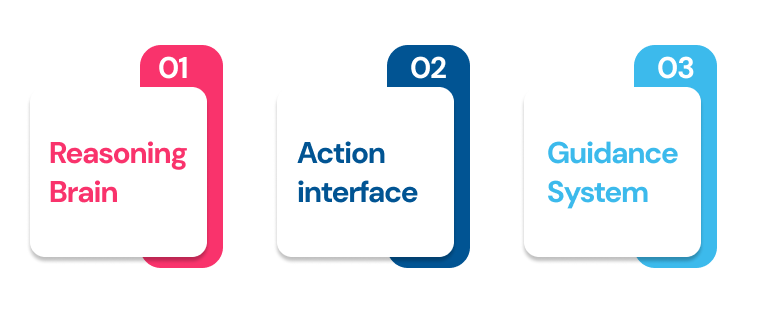
Reasoning Brain
The core of every AI agent is its model, but with this, we do not mean that the smartest model is the best choice for every task. Most of the popular systems go for a tiered approach to reasoning; for example, a large model might be used for handling complex tasks like refund approvals, whereas a smaller and faster model is used for fast classification.
Here the goal is to match the reasoning capability to the requirement of the task so that the costs and latency remain low. It is because a great reasoning brain does not just predict the upcoming word but also evaluates the current state of workflow and decides if the task should be handed over to the real human or not.
Action interface
An agent without the right tools is just a talker and not a doer, which is why an agent requires a standard interface to interact with your business ecosystem. This is where professional AI software development services come in handy because these partners will help you in defining the actions (APIs, databases, legacy tools).
All these definitions must be clear and descriptive so the agents know exactly what each tool does and what information it needs. These action needs can be throwing a query about a transaction to the database or sending a confirmation email, thus providing a bridge that turns the decision of AI into a real-world result.
Guidance System
For sure, even if your model is very capable, it still needs clear boundaries, which are defined in a guidance system. These systems:
- Make sure that the agent has clear instructions without any ambiguity.
- Define how the agent will behave in special case events.
- Make sure that agent follows the standard operating procedures as per the company
In guidance systems there is also a concept of guardrails, which monitors data privacy risks and off-topic risks. With a clear road map for the agent to follow, you can easily build and train an agent who follows compliance strictly.
6 steps to train an agent
Now coming back to the very core of this article, know that training an agent is itself an engineering process that asks for discipline. You have to move away from trial-and-error prompting and structure the pipeline of data preparation as well as validation. Here is the roadmap that is used by a top-tier custom AI development company to make sure that an agent moves safely from the lab to the real world.
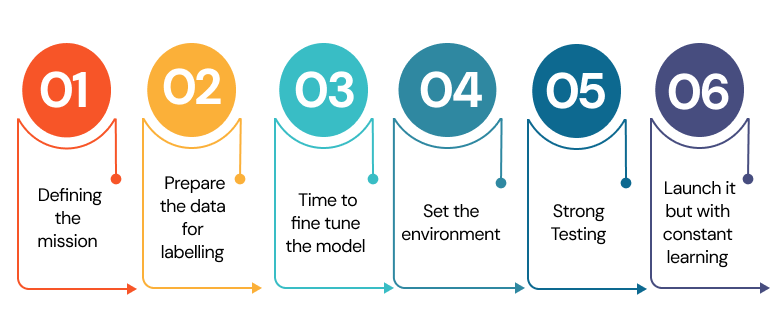
Step 1: Defining the mission
The first step (just as per the universal law) is finding out exactly where an agent can add the most value. You look for workflows where traditional, rule-based software hits a wall. These are normally the tasks that are context-based decisions or judgments, like whether to approve a complex refund or do a vendor security review or not.
Make checks and find out if your process has too many “if or then” questions/branches then that is the place, for which, you can build an AI agent. When you have a clear scope, you prevent uncontrolled possibilities and make sure that your agent remains focused on your core objective.
Step 2: Prepare the data for labelling
Just as a student learns from the syllabus, an agent learns from your data so you need to collect high-quality transcripts, support logs, and interaction data which reflect the actual tasks the agent is going to handle.
But raw data is not enough, as this modern tech world also requires data labeling, which involves humans adding the right tags to raw data. To do so, you have to find out the intent behind a custom query or the sentiment in a specific response. With high-quality labels on your data, you can make sure that AI understands the context as well as the “why” behind any human interactions.
Step 3: Time to fine tune the model
While the data before training models consist of a huge knowledge base, they do not have the specialized tribal knowledge from the specific industry. It gets important to fine-tune it where you have to constantly train the model as per the labeled dataset. This lets the agents adapt to the voice of the brand, understand that important industry-based jargon, and handle the possible nuances of specific business policies.
A lot of businesses go for a safer choice, which is finding AI agents development services India to manage these complex fine-tune pipelines so that the agent is not just a generalist but a specialist.
Step 4: Set the environment
Actual training consists of the configuration of the mathematical parameters that guide how the agent learns. You have to:
- Look at the “learning rate” to find how much the model adjusts its weights on the basis of errors.
- Manage the size of batch and events, that is the number of times the model passes from the whole dataset.
- Achieve the right balance between the two for best output.
The trick is that if you train too much, the agent bulk up its memory with the data (overfitting) and fails on the new queries, whereas if not trained properly, the agent will not have deep, and complex reasoning.
Step 5: Strong Testing
Before you go live, the agent must be able to pass a series of “mini exams” where you can use A/B testing to compare the different versions of the logic and response style of the agent. You also have to focus on cross validation to make sure that the model does generalization well to new or unseen data.
Here, try to look for “hallucinations,” where the agent states an incorrect fact with confidence. Just as the agent hits its performance and accuracy benchmarks, you can consider taking it out of training and planning its production or release.
Step 6: Launch it but with constant learning
Once your agent is out of the training part and is integrated into your website or app, do not consider the work to be over yet. You have to perform real-time monitoring to track the success rates and user satisfaction so set up error logging to record struggle moments of the agent.
This feedback loop is important and when you regularly update the agent with new data from live interactions, you can make sure that it adapts to user needs and makes the performance better over time.
[Prefer Reading: How AI Can Help Businesses Reduce Operational Costs in 2026
Plan the scaling- Use multiple agents to work as a team
In a survey by pwc, 73% of the respondents believed that use of AI agents will give them notable benefits within the year. Most of these businesses, successful ones with AI agents, are not winners just by training one AI model. It’s because there is a tripping point for one agent where the instructions may start to overlap each other and when your agent does so, it starts making mistakes.
As a solution, a custom AI development strategy consisting of a multi-agent model works best here. These strategies can be multiple, so let’s talk about them.
Digital team with a boss
This is the most common way to bring multiple agents into alignment using the “manager pattern.” Just imagine that there is a central manager agent who acts as the main contact for your users but does not do all the heavy lifting himself. It will just hear the user’s goal and delegate the work to the right agent which can be one for data research, one for writing, and another for technical support.
The manager then collects their answers and puts them into a single response. This setup is perfect when you need a unified brand voice but also require very deep expertise in multiple different areas at once.
A digital relay race
In many industries that are service based, Handoff pattern fits the best which is like a relay race where one agent passes the baton to another. For example, a “triage agent” who just greeted a customer and found that they have a technical billing problem and instead of solving it, the triage agent “hands off” the complete conversation state to a special “billing agent.”
This second agent takes over completely using its own unique set of tools and rules to finish the job which also makes sure that users are always talking to the experts that are most qualified for their problem without ever having to repeat.
Why do multi-agent systems win?
Ok, wait, you know the strategies but what actually makes the multi-agent system win? Well, when the work is divided among each individual agent, the results become more reliable and easier to test. If the research agent makes a mistake, you only have to fix that one small part of the system and not the entire problem. This is a modular approach and is followed by top AI software development services that build enterprise-grade systems to handle thousands of complex tasks every day without breaking a sweat.
Let’s build and train your Multi AI agent team- partner with NetSet
In place of chasing the progress, it is best to start leading it because the gap between market leaders and everyone else is just defined by the speed of agents in the modern tech world. To start building and training your AI agents, schedule a call with NetSet Software (an expert AI agents development services India provider) to get the finest product in the market.
When you collaborate, you get 2 decades of extremely specific experience and a solution provider who connects as a long-term partner instead of short-term service provider.
[Explore Case Study: AI Office Case Study
FAQs
Agent vs chatbot- which will be the best choice for my business in 2026 and even after that?
The difference is just that, chatbots answer questions whereas agents execute workflows. You have to utilise custom AI agent development, to build systems that freely use tools and solve multi step (complex) problems.
What is the cost of training an agent that promises success to my business?
The cost of training the AI agent depends on the data scale and the complexity of the task, where most of the businesses get the highest ROI with custom AI software solutions.
What data is required while training the AI agent?
You need high quality logs and transcripts where if you are not from a technical background, you can go for an expert AI development services provider for cleaning and labelling the data right away for the agents.
How long will it take for me to build the AI agent?
While in-house hiring will be slow, a dedicated custom AI development company can move you from concept to live pilot in just eight to twelve weeks.
Why should I go for multi-agents?
If you go with one agent, they may feel overwhelmed easily, which is why a modular and more reliable team of agents will make it easy to manage everything.