
AI Automation in Maritime Operations
(From Manual Copilots to Autonomous Workflows)
Executive Guide for Maritime CEOs, COOs, CIOs, and Operations Leaders
Maritime operations have always depended on precision, coordination, compliance, and timing. But the operating environment has changed significantly.
Today, maritime companies are managing more vessels, more data, more compliance requirements, more distributed teams, more customer expectations, and more operational exceptions than ever before. At the same time, many companies are still relying on human teams to manually connect information across ERP systems, vessel monitoring platforms, emails, spreadsheets, Microsoft 365, maintenance systems, compliance records, and customer communication channels.
The result is not simply operational inefficiency.
The result is a workflow bottleneck.
Most maritime businesses already have software. They already have data. They already have systems for finance, operations, compliance, service management, documentation, and communication. Yet the work still moves manually between these systems.
- A coordinator checks an email.
- An operations manager verifies vessel status.
- A compliance officer reviews records.
- A service manager updates a work order.
- A finance team checks billing information.
- A customer success team prepares a status update.
- A senior leader waits for a summarized report.
This is the hidden cost of fragmented operations.
AI has now created a new opportunity for maritime companies. But the opportunity is often misunderstood. The real value of AI is not in adding another chatbot to the business. The real value is in building an intelligent operational layer that connects systems, understands context, applies business rules, supports decision-making, and executes approved workflows.
This is the shift from AI as a tool to AI as an operating layer.
For maritime leaders, the strategic question is no longer:
“Can we use AI in our business?”
The real question is:
“How do we redesign our operations so AI can reduce manual work, improve decision speed, strengthen compliance, and scale execution without adding proportional headcount?”
This executive guide is written for maritime decision-makers who want to understand where AI automation can create practical business value, where the risks are, and how to move from basic AI copilots toward controlled autonomous workflows.
Executive Summary
Maritime operations are reaching a breaking point.
The industry is under increasing pressure to improve efficiency, reduce manual coordination, maintain compliance, improve customer transparency, and make faster operational decisions. However, many maritime companies are still operating through disconnected systems and human-dependent workflows.
This creates a fundamental problem: the company may be digitally enabled, but it is not operationally automated.
Most organizations have already adopted multiple software systems across ERP, vessel operations, maintenance, compliance, workforce coordination, reporting, and communication. But these systems often operate in silos. They store information, but they do not automatically coordinate work across the business.
This is where many AI initiatives fail.
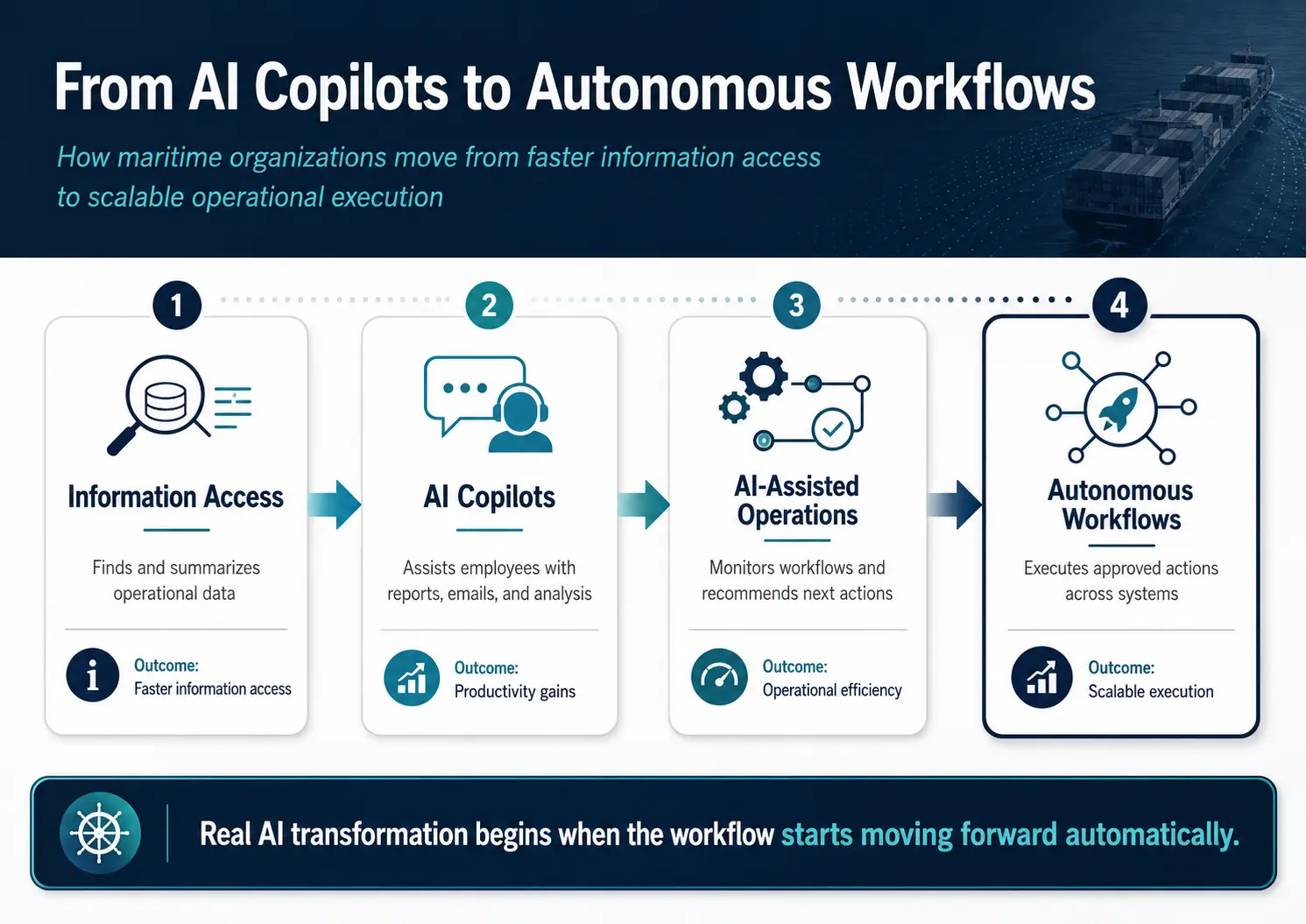
A large number of companies begin by deploying AI as a chatbot or copilot. Employees use AI to search for information, summarize documents, draft emails, or prepare reports. These use cases are useful, but they do not transform operations because the human still remains the workflow engine.
The current pattern often looks like this:
Ask AI → Read Output → Make Decision → Update ERP → Notify Stakeholders → Track Follow-up
This improves productivity, but it does not remove the operational bottleneck.
True AI automation begins when AI is connected to the company's operational systems and embedded into real workflows. In this model, AI does not merely answer questions. It monitors events, detects exceptions, applies business context, recommends actions, triggers workflows, updates systems, and creates visibility for leadership.
The future of maritime AI will move through four levels of maturity:
- Information access
- AI copilots
- AI-assisted operations
- Autonomous workflows
Most maritime companies today are still between the first and second levels. They can retrieve information faster and assist employees with basic tasks, but they have not yet automated meaningful operational execution.
Industry leaders will move further.
They will build AI automation frameworks that combine five critical layers:
- Operational data sources
- Integration layer
- Deterministic rules layer
- AI intelligence layer
- Action layer
This layered approach is important because not every decision should be left to AI. Compliance rules, safety rules, contractual obligations, approval thresholds, and financial controls must remain deterministic. AI should assist with context, pattern recognition, prioritization, anomaly detection, recommendations, and communication while rules-based systems control decisions that require accuracy, consistency, and auditability.
For maritime executives, this distinction is critical.
The goal is not blind automation.
The goal is controlled automation.
The highest-value opportunities for AI automation in maritime operations include workforce and time compliance, vessel operations monitoring, maintenance and asset reliability, crew and workforce management, compliance and audit automation, customer reporting, incident triage, and executive visibility.
The companies that succeed will not be the ones that buy the most AI tools. They will be the ones that connect their systems, map their workflows, define decision rules, identify high-value automation points, and gradually introduce autonomous execution where the business case is clear.
The future of maritime operations is not AI-powered chat.
The future is AI-powered operations.
1. Maritime Operations Have a Workflow Problem, Not a Technology Problem
Most maritime companies do not lack software.
In fact, many maritime organizations already operate with a wide range of digital systems. They use ERP platforms to manage finance, procurement, customers, vendors, and operational records. They use Microsoft 365 for email, documents, spreadsheets, Teams communication, and internal coordination. They use vessel tracking or monitoring systems to understand operational movement. They use maintenance platforms to manage assets and service schedules. They use compliance systems to manage regulatory requirements, certifications, audits, and documentation.
On paper, this looks like a mature digital environment.
But inside the day-to-day operation, the reality is often very different.
The systems exist, but the workflows are still manual.
Information sits in one system. Communication happens in another. Decisions are made through emails or calls. Updates are entered manually into ERP. Reports are prepared separately. Compliance checks depend on people remembering what needs to be reviewed. Customer updates are created after someone manually collects information from multiple places.
This is why maritime operations have a workflow problem, not a technology problem.
The issue is not that companies do not have enough tools. The issue is that these tools do not work together as one connected operating system.
The Modern Maritime Technology Stack
A typical maritime company may already have several important systems in place:
- ERP or business management system
- Finance and billing tools
- CRM or customer management platform
- Microsoft 365, Outlook, Teams, SharePoint, and Excel
- Vessel tracking or vessel monitoring systems
- Crew and workforce management tools
- Maintenance and asset management platforms
- Compliance and audit documentation systems
- Field service or technician scheduling tools
- Customer reporting and communication channels
Each of these systems may be useful individually. But the real operational challenge begins when work has to move across them.
For example, a service request may begin as an email. The customer information may sit in the ERP. The vessel schedule may be available in another system. Technician availability may be managed separately. Compliance requirements may be stored in documents. The final customer update may need to be sent through email. Leadership may want a summary in a weekly operations report.
The process depends on people collecting, interpreting, updating, and communicating information across multiple systems.
That is not automation.
That is digital fragmentation.
Why More Software Is Not Solving the Problem
When operations become complex, the natural response is often to add another tool.
A reporting tool is added because leadership does not have enough visibility.
A task management tool is added because follow-ups are being missed.
A compliance tool is added because audits are becoming harder.
A communication tool is added because coordination is slow.
An AI chatbot is added because employees need faster access to information.
But every new tool also creates another place where information can live.
Unless these systems are connected into a unified workflow, the company only increases the number of systems employees must check.
This is why many digital transformation initiatives underperform. They improve isolated parts of the business but fail to improve the flow of work across the business.
The real question is not:
“How many systems do we have?”
The real question is:
“How much work still depends on humans manually moving information between systems?”
That is where the hidden inefficiency lies.
The Hidden Cost of Operational Fragmentation
Operational fragmentation creates costs that are often not visible in a standard financial report.
The cost appears in delayed decisions.
The cost appears in duplicated effort.
The cost appears in missed follow-ups.
The cost appears in compliance exposure.
The cost appears in poor customer communication.
The cost appears in operational bottlenecks.
The cost appears when leadership does not have real-time visibility into what is happening.
In maritime operations, these problems can become serious because the business environment is highly time-sensitive.
A delayed maintenance update can affect vessel availability.
A missed compliance check can create regulatory risk.
A poorly coordinated technician schedule can increase service cost.
A slow customer response can damage trust.
An incomplete operational report can weaken management decisions.
These are not simply administrative issues. They directly affect profitability, service quality, compliance readiness, and operational control.
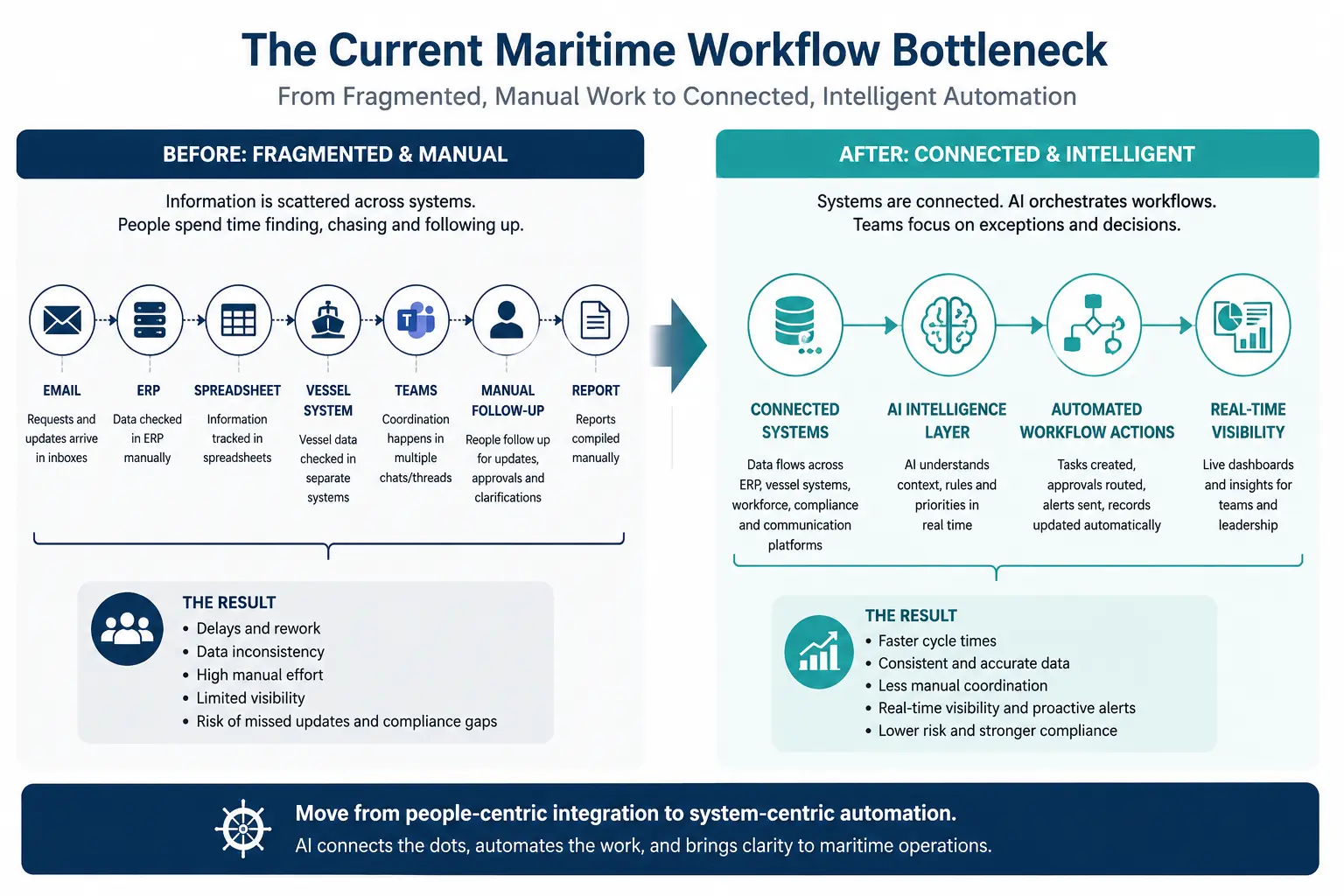
Humans Have Become the Integration Layer
In many maritime companies, employees are effectively acting as the integration layer between disconnected systems.
They read the email.
They check the ERP.
They open the spreadsheet.
They verify the vessel schedule.
They message the technician.
They update the work order.
They prepare the customer response.
They create the management report.
This model works when the company is small and the volume is manageable. But as the company grows, this model becomes difficult to scale.
The organization becomes dependent on individual knowledge, manual follow-up, and operational memory.
This creates three major risks.
First, the business becomes vulnerable when experienced employees are unavailable.
Second, operational consistency becomes difficult because different people may follow different processes.
Third, leadership does not get real-time visibility because the true status of work is scattered across systems and conversations.
This is the point where maritime companies need to stop thinking only in terms of software adoption and start thinking in terms of workflow automation.
The Shift Required
The next stage of maritime digital transformation is not about replacing every existing system.
It is about connecting the systems that already exist and building intelligent workflows across them.
This means creating an operational layer that can:
- Pull information from different systems
- Understand the business context
- Apply rules and approval logic
- Identify exceptions and risks
- Recommend the next action
- Trigger workflows where appropriate
- Update systems automatically
- Notify the right stakeholders
- Create real-time visibility for leadership
This is where AI automation becomes valuable.
AI should not be treated as a standalone tool sitting outside the business. It should be embedded into the operational flow of the company.
When this happens, AI moves beyond answering questions. It starts helping the business run more efficiently.
The Executive Perspective
For CEOs, COOs, CIOs, and operations leaders, the key takeaway is simple:
Your company may already be digital, but that does not mean it is automated.
Digital systems store information.
Automated workflows move work forward.
AI-enabled operations create intelligence between systems and action.
The companies that win in maritime AI will not be the companies that buy the most tools. They will be the companies that connect their existing systems, reduce manual handoffs, and redesign workflows around intelligent execution.
The first step is not to ask where AI can be added.
The first step is to ask:
“Where is our organization still depending on people to manually move work from one system to another?”
That is where the real automation opportunity begins.
2. The AI Trap: Why Most Maritime Organizations Stop Too Early
Most maritime organizations begin their AI journey with the right intention but stop at the wrong level.
They introduce AI to improve productivity, reduce manual work, and help teams make faster decisions. But in many cases, the implementation remains limited to basic search, document summarization, email drafting, or report preparation.
These use cases are helpful. But they are not operational transformation.
They improve how employees work with information, but they do not change how work actually moves through the organization.
This is the AI trap.
A company may feel it has adopted AI because employees are using a chatbot or copilot. But if the same people still have to check systems manually, make every decision manually, update records manually, notify stakeholders manually, and track follow-ups manually, then AI has not transformed the workflow.
It has only made parts of the manual process faster.
This distinction is critical for maritime leaders because the real ROI comes only when AI starts participating in operational execution, not merely in information retrieval.
Stage 1: AI as a Search Engine
The first stage of AI adoption usually begins with information access.
Employees use AI to ask questions such as:
- What is the status of this vessel?
- Which customer emails are pending?
- What was the last service update?
- Where is the latest compliance document?
- What maintenance activity was recorded last week?
- Which crew or technician was assigned to this job?
This is useful because it reduces the time employees spend searching across systems, emails, folders, and documents.
Instead of manually opening multiple tools, the employee can ask a natural-language question and receive a summarized answer.
For maritime companies, this can be especially valuable because operational information is often scattered across ERP systems, Outlook, Teams, SharePoint, spreadsheets, vessel records, service notes, and customer communication.
However, this stage has a clear limitation.
AI can find or summarize information, but the employee still has to decide what to do next.
The system may tell the operations coordinator that a maintenance task is overdue. But the coordinator still needs to verify the priority, check technician availability, update the work order, inform the customer, notify the manager, and track the next action.
So while the search experience improves, the workflow remains manual.
Stage 2: AI as a Copilot
The second stage is where AI becomes a productivity assistant.
At this level, employees use AI to help with tasks such as:
- Drafting customer emails
- Preparing operational summaries
- Generating internal reports
- Summarizing long email threads
- Analyzing documents
- Creating meeting notes
- Preparing compliance summaries
- Drafting service updates
- Creating management briefings
This is where most companies begin to see visible productivity gains.
A manager can prepare a weekly report faster.
A customer service team can draft responses faster.
A compliance officer can summarize documents faster.
An operations team can analyze information faster.
This is useful, but it is still not true automation.
The reason is simple: the human remains responsible for the entire workflow.
AI helps create the output, but the employee still drives the process from start to finish.
For example, if a customer asks for an update on a vessel-related service request, AI may help draft the response. But the employee still has to collect the latest operational data, confirm whether the information is accurate, decide what can be shared, send the email, update the CRM or ERP, and follow up later.
The copilot improves speed, but it does not remove dependency on manual execution.
Why This Is Still Not Transformation
AI copilots are valuable, but they can create a false sense of progress.
From the leadership perspective, it may appear that the company is now AI-enabled.
Employees may be using AI daily. Reports may be produced faster. Emails may be drafted faster. Internal research may take less time.
But the deeper operational structure remains unchanged.
The same handoffs exist.
The same approvals exist.
The same manual updates exist.
The same disconnected systems exist.
The same operational bottlenecks exist.
The only difference is that employees now have a faster assistant.
That is useful, but it is not enough.
For maritime companies, this distinction matters because the biggest operational costs are not usually caused by slow writing or slow searching. They are caused by delays, missed handoffs, duplicate work, poor visibility, compliance gaps, and human-dependent coordination.
A chatbot does not solve these problems unless it is connected to workflows.
The Human Bottleneck
In many maritime operations, the real workflow still looks like this:
Ask AI → Read Output → Make Decision → Update ERP → Notify Stakeholders → Track Follow-up
This process may be faster than before, but it is still human-driven.
The employee is still the one connecting the dots.
The employee is still the one moving work forward.
The employee is still the one remembering what needs to happen next.
The employee is still the one updating systems.
The employee is still the one escalating exceptions.
This creates a natural ceiling on ROI.
No matter how good the AI assistant becomes, the organization can only move as fast as the people operating the workflow.
This is especially problematic in maritime environments where operational decisions are time-sensitive and involve multiple stakeholders: vessels, crew, technicians, customers, compliance teams, suppliers, finance teams, and management.
When humans remain the workflow engine, scale becomes expensive.
To handle more work, the company needs more coordinators, more managers, more follow-ups, more reporting effort, and more manual supervision.
AI should help break this pattern.
The Difference Between Assistance and Automation
The key distinction maritime leaders need to understand is the difference between AI assistance and AI automation.
AI assistance helps a person complete a task.
AI automation helps the business complete a workflow.
For example:
AI assistance means helping an employee draft a customer update.
AI automation means detecting that a customer update is required, pulling the latest operational data, applying communication rules, preparing the message, routing it for approval if needed, sending it to the customer, updating the ERP, and logging the action.
That is a different level of business value.
The same applies to compliance.
AI assistance means summarizing a compliance document.
AI automation means monitoring compliance requirements, detecting missing documentation, validating deadlines, escalating risks, creating audit-ready logs, and notifying responsible stakeholders.
Again, the value is not just in producing information. The value is in moving the process forward.
Why Maritime Companies Stop Too Early
Many maritime organizations stop at the copilot stage because it is easier to implement.
A chatbot can be deployed quickly.
A document assistant can be introduced quickly.
An email drafting tool can show immediate productivity benefits.
A reporting assistant can reduce some manual work.
But deeper automation requires more discipline.
It requires business rule definition.
It requires workflow mapping.
It requires system integration.
It requires data quality improvement.
It requires approval logic.
It requires audit trails.
It requires change management.
This is why many organizations stay at the surface level.
They adopt AI as a productivity tool but never convert it into an operational capability.
For maritime companies, this is a missed opportunity.
The real competitive advantage will come from companies that move beyond AI experiments and begin embedding intelligence into the operating model itself.
The Executive Perspective
For maritime leaders, the AI trap is simple:
Using AI does not automatically mean the business is becoming automated.
If AI is only answering questions, the company is still dependent on people to act on those answers.
If AI is only drafting emails, the company is still dependent on people to manage the customer workflow.
If AI is only summarizing reports, the company is still dependent on people to interpret, escalate, and execute.
The next level is to connect AI with operational systems, deterministic rules, and workflow actions.
That is where AI moves from being a helpful assistant to becoming part of the business execution layer.
The leadership question should therefore change from:
“Where can our employees use AI?”
to:
“Which workflows can AI help monitor, trigger, execute, and improve?”
That shift is what separates basic AI adoption from real maritime AI transformation.
3. The Maritime AI Maturity Model
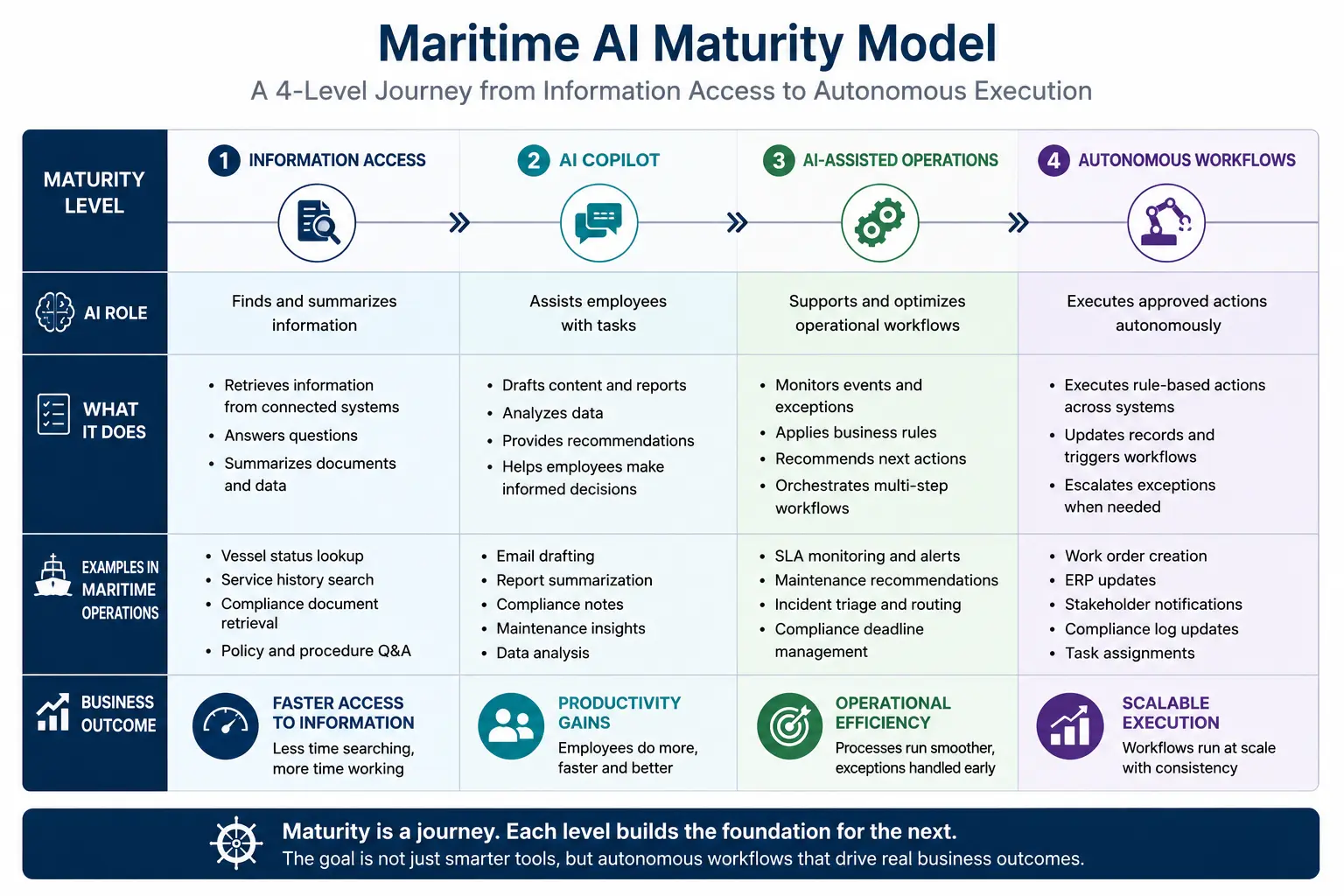
Maritime AI adoption should not be treated as a single technology decision.
It is a journey of maturity.
A company does not move directly from manual operations to autonomous workflows. It progresses through stages. Each stage creates value, but each stage also has limitations. The challenge for maritime leaders is to understand where their organization currently stands and what is required to move to the next level.
The attached guide skeleton defines this progression clearly: information retrieval, AI copilot, AI-assisted operations, and autonomous workflows. This maturity model is important because it gives executives a practical way to evaluate AI initiatives beyond surface-level adoption.
The question is not simply whether the company is using AI.
The real question is:
“What level of operational maturity has AI reached inside the business?”
Level 1 — Information Retrieval
At the first level, AI helps employees find information faster.
This is usually where most organizations begin. Employees use AI to ask questions across documents, emails, reports, manuals, operational records, or internal knowledge sources.
For example, an employee may ask:
- What is the latest status of a vessel?
- Which service request is pending?
- Where is the compliance certificate?
- What was the last customer update?
- Which technician handled this job?
- What maintenance activity was completed last month?
This level improves access to information. It reduces time spent searching through emails, folders, spreadsheets, and systems.
For maritime companies, this can be useful because operational data is often spread across many places. A natural-language interface can make it easier for teams to retrieve information without navigating multiple systems manually.
However, Level 1 does not change the workflow.
AI can retrieve information, but the employee still needs to interpret it, decide what to do, update the relevant system, notify the right people, and track the follow-up.
The business outcome at this stage is better information access, not true operational efficiency.
Level 2 — AI Copilot
At the second level, AI becomes a productivity assistant.
Employees use AI to help prepare outputs. This may include drafting emails, creating reports, summarizing operational updates, preparing customer communication, analyzing documents, or generating management summaries.
Examples include:
- Drafting a customer update based on service notes
- Summarizing vessel performance data
- Preparing a weekly operations report
- Creating a compliance summary
- Reviewing long email threads
- Generating meeting notes
- Preparing internal briefings
This stage creates visible productivity gains. Employees can complete certain tasks faster and with less administrative effort.
For example, a manager who previously spent two hours preparing a weekly report may now complete the first draft in minutes. A customer service team may respond faster. A compliance officer may summarize documentation more efficiently.
But the workflow is still human-led.
The employee still initiates the task.
The employee still checks the information.
The employee still makes the decision.
The employee still sends the communication.
The employee still updates the system.
The business outcome at this stage is employee productivity improvement.
This is valuable, but it should not be mistaken for full AI transformation.
Level 3 — AI-Assisted Operations
At the third level, AI begins to participate in operational workflows.
This is where the real transformation begins.
AI is no longer only responding to employee questions or helping produce documents. It is connected to operational systems and starts supporting business processes directly.
For example, AI can help with:
- Compliance validation
- Maintenance recommendations
- Workforce optimization
- Incident triage
- Customer communication preparation
- Operational risk detection
- SLA monitoring
- Exception identification
- Report generation based on live operational data
At this level, AI can monitor data, detect exceptions, suggest actions, and prepare workflow steps for human approval.
For example, if a maintenance deadline is approaching, the system can identify the risk, check available technicians, prepare an escalation, and recommend the next action.
If a customer update is overdue, the system can detect the gap, pull the latest service information, draft the message, and route it to the responsible manager.
If compliance documentation is missing, the system can identify the issue, notify the responsible team, and create an audit trail.
This stage is powerful because AI starts reducing manual coordination.
Humans are still involved, but they are no longer responsible for discovering every issue or manually preparing every next step. The system starts bringing the right work to the right person at the right time.
The business outcome at this stage is operational efficiency.
This is where maritime companies begin to see measurable impact in faster response times, fewer missed follow-ups, better compliance visibility, reduced administrative workload, and improved management control.
Level 4 — Autonomous Workflows
At the fourth level, AI and automation begin executing approved workflows with limited human intervention.
This does not mean AI makes every decision independently. It means the company has identified specific workflows where the rules are clear, the risks are controlled, and the system can safely execute actions based on approved logic.
Examples include:
- Automatic escalations
- Automated status reporting
- ERP record updates
- Stakeholder notifications
- Work order generation
- Compliance reminders
- Customer update triggers
- Internal task creation
- Exception alerts
- Executive dashboard updates
At this level, the system does not simply recommend what should happen. It moves the workflow forward.
For example, when a service milestone is completed, the system can update the ERP, notify the customer, inform the account manager, attach relevant documentation, and include the update in the executive dashboard.
When a compliance deadline is approaching, the system can notify responsible stakeholders, escalate if there is no response, update the compliance log, and prepare an audit-ready trail.
When a vessel-related issue is detected, the system can create an incident record, assign responsibility, notify the operations team, and track resolution progress.
This is where AI automation starts creating operational scalability.
The company can handle more work without increasing administrative headcount at the same rate.
The business outcome at this stage is scalable execution.
Where Most Maritime Companies Are Today
Most maritime companies today are between Level 1 and Level 2.
They may have started using AI for search, summarization, email drafting, reporting, and basic productivity improvement. These are useful steps, but they do not yet represent operational transformation.
In many cases, the company still depends on people to:
- Monitor systems
- Identify exceptions
- Move information between tools
- Make routine decisions
- Update records
- Send notifications
- Prepare reports
- Follow up manually
This means AI is present in the business, but it is not yet embedded into the operating model.
The company is AI-enabled at the employee level, but not automated at the workflow level.
Where Industry Leaders Are Heading
Industry leaders will move beyond AI as an assistant.
They will build AI-enabled operational systems that connect data, apply business rules, detect risks, recommend actions, and execute controlled workflows.
This shift will change how maritime operations are managed.
Instead of employees constantly checking what needs attention, the system will identify what needs attention.
Instead of managers manually compiling updates, the system will generate live operational visibility.
Instead of compliance teams chasing missing records, the system will detect gaps and escalate them.
Instead of customer teams manually preparing routine updates, the system will trigger communication based on real operational events.
Instead of leadership relying on delayed reports, executives will have near real-time visibility into operational health.
This is the direction maritime AI is moving.
The companies that reach Level 3 and Level 4 will not only improve productivity. They will create a different operating model.
The Executive Perspective
The maritime AI maturity model gives leaders a practical way to assess progress.
Level 1 answers:
“Can our teams find information faster?”
Level 2 answers:
“Can our teams produce work faster?”
Level 3 answers:
“Can our workflows become more intelligent and proactive?”
Level 4 answers:
“Can our operations execute routine actions with less manual dependency?”
The goal is not to jump immediately to full autonomy. That would create risk and resistance.
The goal is to move deliberately.
Start by improving information access.
Then support employees with copilots.
Then connect AI to operational workflows.
Then automate controlled actions where the business case is clear.
This staged approach allows maritime companies to capture value while maintaining control, compliance, and operational trust.
For executives, the key takeaway is simple:
AI maturity is not measured by how many employees use AI.
It is measured by how much manual workflow dependency the organization has removed.
4. The Maritime AI Automation Framework
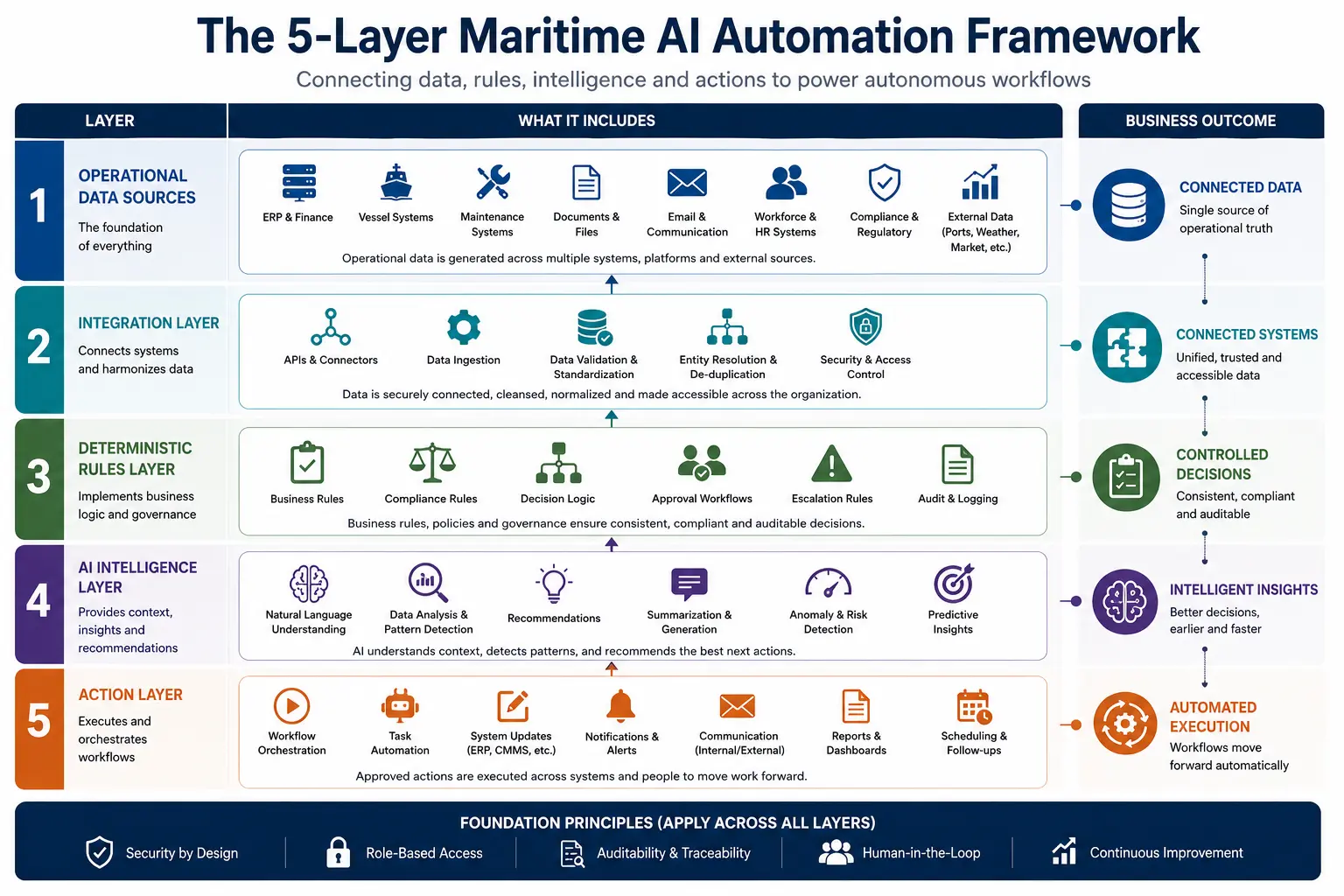
Maritime AI automation should not be built as a single chatbot, a single dashboard, or a single software feature.
It should be designed as an operating framework.
The reason is simple: maritime operations involve multiple systems, multiple stakeholders, multiple decision points, and multiple levels of risk. A customer update, a compliance alert, a maintenance recommendation, or a vessel operations issue may require data from several different sources before the right action can be taken.
This means AI cannot work effectively in isolation.
To create real business value, AI must sit inside a structured automation framework that connects data, applies rules, generates intelligence, and triggers action.
A practical maritime AI automation framework consists of five key layers: operational data sources, the integration layer, the deterministic rules layer, the AI intelligence layer, and the action layer. This layered structure is important because it separates what systems should know, what rules must control, what AI should interpret, and what actions should be executed.
The goal is not to allow AI to freely make operational decisions.
The goal is to build a controlled system where AI strengthens execution while business rules, approvals, and audit controls remain intact.
Layer 1 — Operational Data Sources
The first layer is the existing operational data environment.
Most maritime companies already have the systems needed to run the business. These may include:
- ERP systems
- CRM platforms
- Vessel monitoring systems
- Maintenance systems
- Compliance systems
- Crew and workforce management tools
- Microsoft 365, Outlook, Teams, SharePoint, and Excel
- Field service systems
- Customer communication records
- Finance and billing systems
- Documents, reports, manuals, and audit files
These systems contain valuable operational data.
The problem is that this data is usually fragmented.
A customer request may be in Outlook.
The contract details may be in the ERP.
The vessel status may be in a separate system.
The technician schedule may be in Excel.
The compliance requirement may be in a document.
The latest internal discussion may be in Teams.
AI automation starts by recognizing that these systems should not be replaced immediately. In most cases, the better approach is to connect them.
The first question is not:
“Which system should we remove?”
The first question is:
“Which systems contain the operational context required to make better decisions?”
Once these data sources are identified, they become the foundation for AI-enabled operations.
Layer 2 — Integration Layer
The second layer is the integration layer.
This is the layer that connects different operational systems into one usable ecosystem.
Without integration, AI remains limited. It may summarize documents or answer isolated questions, but it cannot understand the full business context.
For example, if AI can read emails but cannot access ERP data, it may understand the customer request but not the commercial or operational status.
If AI can access vessel schedules but cannot access maintenance records, it may see availability but miss reliability risks.
If AI can access compliance documents but cannot access live operational records, it may identify rules but not detect real-time non-compliance.
The integration layer solves this problem by connecting systems through:
- APIs
- MCP connectors
- Webhooks
- Event streams
- Database connectors
- Secure document connectors
- ERP integrations
- Microsoft 365 integrations
- Workflow automation tools
This layer allows AI and automation systems to read the right data, understand context, and respond to operational events.
The integration layer is not just a technical component. It is a business-critical foundation.
Without integration, AI remains an assistant.
With integration, AI can become part of the operating model.
Layer 3 — Deterministic Rules Layer
The third layer is the deterministic rules layer.
This is one of the most important parts of the maritime AI automation framework.
Not every decision should be left to AI.
Some decisions must follow fixed rules because the cost of inconsistency is too high. This is especially true in maritime operations, where compliance, safety, contracts, SLAs, financial controls, and operational responsibilities must be handled with accuracy and auditability.
Examples of deterministic rules include:
- Compliance deadlines
- Safety requirements
- SLA thresholds
- Contractual obligations
- Approval limits
- Escalation rules
- Payroll and workforce compliance rules
- Billing rules
- Customer notification rules
- Audit documentation requirements
- Role-based access controls
These rules should not depend on AI interpretation alone.
AI may help identify context, summarize information, or recommend action, but deterministic business rules should decide what must happen when a defined condition is met.
For example, if a compliance certificate expires in 15 days, the escalation rule should be fixed.
If a service response SLA is breached, the notification rule should be fixed.
If a payment approval exceeds a defined threshold, the approval workflow should be fixed.
If a work order requires safety documentation before execution, that requirement should be fixed.
This principle is critical:
Deterministic decisions should remain deterministic.
AI should support the decision-making environment, but business-critical rules should remain controlled, testable, auditable, and predictable.
Layer 4 — AI Intelligence Layer
The fourth layer is the AI intelligence layer.
This is where AI creates value by interpreting context, identifying patterns, and helping teams make better decisions.
AI is especially useful where the situation is complex, unstructured, or context-heavy.
For example, AI can help with:
- Pattern recognition
- Anomaly detection
- Risk prioritization
- Contextual analysis
- Predictive recommendations
- Document summarization
- Email and communication analysis
- Operational exception detection
- Stakeholder-specific reporting
- Maintenance insights
- Crew and workforce recommendations
- Customer communication preparation
This layer does not replace the rules layer. It complements it.
The rules layer says what must happen based on fixed business logic.
The AI intelligence layer helps understand what is happening, why it matters, and what should be considered next.
For example, a rule may identify that a maintenance task is overdue. AI can then analyze related service history, asset usage, vessel schedule, technician availability, and customer impact to recommend the best next step.
A rule may detect that a compliance document is missing. AI can review related records, identify the responsible department, assess risk level, and prepare the escalation message.
A rule may identify that a customer update is due. AI can collect the latest operational context and draft a message suited to the customer, account manager, or internal leadership.
This is where AI moves beyond simple assistance.
It begins to provide operational intelligence.
Layer 5 — Action Layer
The fifth layer is the action layer.
This is where business value is created.
Many AI initiatives fail because they stop at insight. They produce answers, summaries, recommendations, or reports, but they do not move the workflow forward.
The action layer changes that.
It allows the system to execute approved workflow steps such as:
- Sending notifications
- Updating ERP records
- Creating work orders
- Assigning tasks
- Escalating incidents
- Generating executive reports
- Updating dashboards
- Creating compliance logs
- Sending customer updates
- Triggering approval workflows
- Scheduling follow-ups
- Creating audit trails
This is the difference between AI as a knowledge tool and AI as an execution layer.
For example, if a vessel-related service milestone is completed, the system can update the ERP, notify the account manager, prepare the customer update, and include the event in the executive report.
If a compliance risk is detected, the system can create an internal task, notify the responsible owner, escalate if the deadline is missed, and maintain an audit record.
If a maintenance issue is identified, the system can generate a work order, recommend available technicians, notify operations, and track resolution.
This is where maritime companies start seeing real ROI.
Not because AI has produced another answer, but because the workflow has moved forward with less manual dependency.
Why the Framework Matters
The five-layer framework matters because it gives maritime leaders a practical structure for AI adoption.
Without this structure, AI initiatives often become disconnected experiments.
One team uses AI for reports.
Another team uses AI for emails.
Another team uses AI for document search.
Another team explores a chatbot.
These experiments may be useful, but they do not create a connected operating model.
A proper AI automation framework ensures that AI is connected to the real business environment.
It clarifies:
- Which systems provide data
- How data flows between systems
- Which decisions are rule-based
- Where AI should add intelligence
- Which actions can be automated
- Where human approval is required
- How auditability will be maintained
- How business outcomes will be measured
This is the difference between adopting AI tools and building AI-enabled operations.
The Executive Perspective
For maritime CEOs, COOs, CIOs, and operations leaders, the framework provides a simple way to evaluate any AI initiative.
Before approving an AI project, leaders should ask:
Does it connect to our operational data?
Does it understand the workflow context?
Does it respect deterministic business rules?
Does it improve decision quality?
Does it trigger or support real business actions?
Does it create auditability and control?
Does it reduce manual handoffs?
If the answer is no, the initiative may still be useful, but it is likely only a productivity tool.
If the answer is yes, the initiative may become part of the company's operational automation strategy.
The goal is not to build AI for the sake of AI.
The goal is to create an intelligent execution layer across maritime operations.
That is where the next generation of maritime efficiency will come from.
5. High-ROI Maritime AI Automation Opportunities
AI automation should not begin with the most complex or futuristic use case.
It should begin where the business impact is clear.
For maritime companies, the highest-value opportunities usually sit in workflows that are repetitive, time-sensitive, compliance-sensitive, coordination-heavy, and dependent on multiple systems. These are the workflows where people spend significant time checking information, chasing updates, preparing reports, escalating issues, and keeping operations moving manually.
The objective is not to automate everything at once.
The objective is to identify where AI automation can reduce operational friction, improve visibility, reduce risk, and create measurable business value.
Several areas consistently emerge as high-ROI opportunities for maritime AI automation, including workforce and time compliance, vessel operations monitoring, maintenance and asset reliability, crew and workforce management, compliance and audit automation, and customer and stakeholder reporting. These are practical areas because they sit close to daily operations and directly affect cost, risk, service quality, and management control.
1. Workforce and Time Compliance
Workforce and time compliance is one of the strongest starting points for AI automation in maritime operations.
Many maritime companies manage distributed teams, field staff, vessel-related personnel, technicians, supervisors, subcontractors, and administrative teams across different locations and schedules. Time records, attendance data, work logs, job assignments, overtime, leave, payroll inputs, and compliance requirements may sit across multiple systems or spreadsheets.
When this process is manual, the company faces several risks:
- Incorrect time entries
- Missed overtime rules
- Delayed payroll validation
- Manual approval bottlenecks
- Lack of visibility into workforce utilization
- Compliance exposure
- Disputes around hours worked
- Labor cost leakage
AI automation can help by monitoring time records, comparing them with work assignments, identifying missing entries, detecting unusual patterns, flagging compliance gaps, and preparing exception reports for managers.
For example, if a technician is assigned to a vessel-related task but no time entry is recorded, the system can flag the missing record. If overtime crosses a defined threshold, the system can trigger an approval workflow. If work logs do not match scheduled assignments, the system can notify the responsible manager.
The business impact is direct: reduced labor leakage, better compliance control, faster payroll validation, and improved workforce visibility.
This is not about replacing HR or operations managers. It is about giving them a reliable system that continuously monitors exceptions and brings the right issues forward before they become costly.
2. Vessel Operations Monitoring
Vessel operations involve constant movement, changing schedules, service events, operational exceptions, and stakeholder updates.
In many organizations, vessel-related visibility still depends on people checking multiple sources and manually preparing summaries. This creates delays in decision-making and weakens the ability to respond quickly to operational changes.
AI automation can help by connecting vessel data, schedules, service records, maintenance information, customer commitments, and operational communication.
The system can monitor events such as:
- Vessel status changes
- Schedule deviations
- Delayed arrivals or departures
- Service milestone updates
- Unresolved operational exceptions
- Missed internal follow-ups
- Customer update requirements
- Risk indicators linked to vessel operations
For example, if a vessel schedule changes and that change affects a planned service activity, the system can identify the impact, notify the operations team, prepare a customer update, and trigger a task for rescheduling.
If an operational exception remains unresolved beyond a defined threshold, the system can escalate it to the responsible manager.
If a vessel-related event affects customer commitments, AI can prepare a contextual update based on approved communication rules.
The business impact is improved operational responsiveness.
Instead of waiting for someone to manually identify issues, the system continuously watches for relevant changes and brings exceptions to the surface.
3. Maintenance and Asset Reliability
Maintenance is one of the most important areas where AI automation can create measurable value.
Maritime assets are expensive, operationally critical, and often subject to strict safety and reliability expectations. Even small delays in maintenance planning, documentation, technician coordination, or parts availability can create larger operational issues.
Traditional maintenance workflows are often reactive. Teams respond when an issue is reported or when a scheduled maintenance task appears on a calendar. But the supporting process is still heavily manual.
AI automation can improve this by analyzing:
- Maintenance history
- Service frequency
- Asset usage patterns
- Vessel schedules
- Technician availability
- Spare parts status
- Previous failure records
- Inspection reports
- Open work orders
- Customer or operational priority
Based on this information, the system can identify risks, recommend maintenance actions, prioritize work orders, and help teams plan more effectively.
For example, if an asset has repeated service issues and is scheduled for high-importance operations, the system can recommend an early inspection. If a maintenance task is due but no technician has been assigned, it can create an alert. If parts are required but not available, it can notify procurement before the issue causes delay.
The business impact is reduced downtime, better asset reliability, improved maintenance planning, and fewer last-minute operational surprises.
This is where AI can move the company from reactive maintenance coordination to proactive operational reliability.
4. Crew and Workforce Management
Crew and workforce coordination is another high-value area because it directly affects operational capacity.
Maritime companies often need to align people, skills, availability, location, certifications, schedules, and job requirements. In many cases, this matching process depends heavily on manual judgment and operational memory.
AI automation can help by creating better visibility across workforce data.
The system can assist with:
- Crew availability
- Technician scheduling
- Certification validity
- Skill matching
- Location-based assignment
- Shift planning
- Workload balancing
- Leave and absence impact
- Job priority alignment
- Escalation for staffing gaps
For example, if a technician with a specific certification is required for a service task, the system can identify available qualified personnel. If a crew member's certification is expiring, it can trigger renewal reminders. If one team is overloaded while another has available capacity, the system can suggest redistribution.
The business impact is improved resource utilization.
This does not remove the need for human judgment. But it gives managers better data, faster recommendations, and earlier visibility into workforce constraints.
In an industry where delays can quickly become expensive, better workforce coordination can create a meaningful advantage.
5. Compliance and Audit Automation
Compliance is one of the most sensitive areas in maritime operations.
The challenge is not only knowing the rules. The challenge is ensuring that documentation, evidence, approvals, certifications, inspections, logs, and audit trails remain complete and up to date across a complex operating environment.
Manual compliance tracking creates several risks:
- Missing documents
- Expired certifications
- Delayed approvals
- Incomplete audit trails
- Poor evidence collection
- Lack of ownership
- Last-minute audit preparation
- Regulatory exposure
AI automation can support compliance by continuously monitoring records, identifying gaps, validating documentation status, and escalating missing items.
For example, if a required document is missing from a vessel file, the system can notify the responsible owner. If a certificate is nearing expiry, it can trigger a renewal workflow. If an audit requires evidence from multiple systems, AI can help collect and organize the required information.
However, compliance automation must be designed carefully.
The rules that define compliance should remain deterministic. AI can assist with document analysis, classification, summarization, and exception detection, but the underlying compliance logic should remain rule-based, auditable, and controlled.
The business impact is reduced regulatory exposure, faster audit readiness, and improved internal control.
For maritime leaders, this is not only an efficiency opportunity. It is a risk management opportunity.
6. Customer and Stakeholder Reporting
Customer communication is often one of the most underestimated automation opportunities.
Many maritime companies spend significant time preparing updates for customers, partners, management, vendors, internal teams, and external stakeholders. These updates may relate to vessel status, service progress, maintenance activity, operational delays, compliance status, or incident resolution.
The challenge is that the information needed for reporting usually sits across multiple systems.
One person may need to check the ERP, review emails, confirm with operations, inspect service records, verify documents, and then prepare the update manually.
AI automation can simplify this process by generating stakeholder-specific reporting based on live operational context.
For example:
- Customers receive clear service status updates
- Account managers receive customer-specific summaries
- Operations leaders receive exception-based reports
- Compliance teams receive documentation gap reports
- Executives receive high-level operational dashboards
- Finance teams receive billing-linked operational triggers
The business impact is improved service quality and transparency.
Instead of reporting being a manual activity, it becomes an automated output of the operational workflow.
This also improves consistency. Customers receive timely updates. Managers get better visibility. Leadership sees the business without waiting for manually prepared reports.
7. Incident Triage and Escalation
Maritime operations often involve urgent issues that require quick coordination.
An incident may come through email, phone, Teams, a field report, a vessel system, or a customer message. The first challenge is often not solving the issue. It is identifying the issue quickly, understanding its priority, assigning responsibility, and escalating it properly.
AI automation can support incident triage by analyzing incoming information, classifying the issue, identifying urgency, checking related operational data, and routing it to the right team.
For example, if a customer reports a vessel-related issue, the system can review the account, service history, vessel status, previous incidents, and open work orders. It can then classify the issue, recommend priority, create an incident record, and notify the right owner.
If the incident is not acknowledged within a defined time, the system can escalate automatically.
The business impact is faster response, better accountability, and fewer missed issues.
This is especially valuable in environments where operational delays can affect customer trust, safety, cost, or compliance.
8. Executive Visibility and Decision Intelligence
Executives do not need more reports.
They need better visibility.
In many maritime companies, leadership visibility depends on manually prepared summaries. By the time the report reaches the leadership team, the underlying situation may already have changed.
AI automation can create real-time or near-real-time visibility across operational health.
This can include:
- Open operational exceptions
- Delayed service items
- Compliance risks
- Workforce utilization
- Maintenance backlog
- Customer escalations
- Vessel-related delays
- SLA performance
- Revenue-linked operational bottlenecks
- High-risk unresolved issues
Instead of reading long reports, executives can see what requires attention.
The system can surface exceptions, explain business impact, recommend next steps, and maintain drill-down visibility into the source data.
The business impact is stronger management control.
For CEOs, COOs, CIOs, and operations leaders, this is one of the most valuable outcomes of AI automation: the ability to see operational reality without waiting for manual reporting cycles.
How to Prioritize AI Automation Opportunities
Not every workflow should be automated immediately.
Maritime leaders should prioritize based on four factors:
- Business impact
- Manual effort
- Risk exposure
- Automation readiness
A strong first use case usually has the following characteristics:
- It occurs frequently
- It requires multiple systems
- It creates delays when handled manually
- It has clear rules or decision thresholds
- It affects cost, compliance, customer experience, or operational visibility
- It can be measured before and after automation
This is why workforce compliance, customer reporting, maintenance planning, incident escalation, and compliance monitoring are often strong starting points.
They are operationally important, measurable, and usually contain repetitive workflow patterns.
The Executive Perspective
For maritime leaders, the best AI automation opportunities are not necessarily the most advanced ones.
They are the ones closest to business pain.
A good AI automation initiative should answer at least one of these questions:
- Does it reduce manual coordination?
- Does it improve response time?
- Does it reduce compliance risk?
- Does it improve customer communication?
- Does it reduce operational bottlenecks?
- Does it improve workforce or asset utilization?
- Does it give leadership better visibility?
- Does it help the company scale without proportional headcount growth?
If the answer is yes, the opportunity is worth exploring.
The goal is not to automate for the sake of automation.
The goal is to remove the manual friction that slows the business down.
6. Building Your AI Automation Roadmap
AI automation in maritime operations should not be approached as a one-time software implementation.
It should be approached as a staged transformation roadmap.
The reason is simple: maritime companies operate in complex environments where systems, processes, people, approvals, compliance requirements, customer commitments, and operational risks are deeply connected. If AI automation is introduced too quickly without process clarity, it can create confusion, resistance, and operational risk.
A successful roadmap should move in controlled phases.
The goal is not to rush toward full autonomy. The goal is to create a reliable path from fragmented operations to intelligent execution.
A practical AI automation roadmap should move through four phases:
- Connect operational data
- Deploy AI copilots
- Automate high-value workflows
- Introduce controlled autonomous actions
Each phase builds the foundation for the next one.
Phase 1 — Connect Operational Data
The first phase is to connect the company's operational data.
Objective: create a single source of operational truth.
This does not mean replacing every existing system. In most maritime organizations, the systems already exist. The problem is that they are not connected well enough to support intelligent workflows.
A company may have customer information in the ERP, emails in Outlook, files in SharePoint, vessel updates in a monitoring system, workforce data in spreadsheets, maintenance records in another platform, and compliance documents in separate folders.
Before AI can support meaningful automation, it must be able to access the right operational context.
This phase usually includes:
- Identifying core operational systems
- Mapping where critical data currently lives
- Connecting ERP, email, documents, maintenance, vessel, compliance, and workforce systems
- Creating secure data access rules
- Defining role-based permissions
- Cleaning high-value operational data
- Establishing data ownership
- Creating a basic operational knowledge layer
This phase is foundational because AI cannot automate what it cannot understand.
If the data is fragmented, outdated, duplicated, or inaccessible, AI will produce incomplete answers and weak recommendations.
For maritime leaders, this phase may feel less exciting than launching an AI assistant. But it is the most important phase.
Without connected data, AI remains a surface-level tool.
With connected data, AI can begin to understand the business context.
Phase 2 — Deploy AI Copilots
The second phase is to deploy AI copilots for employee productivity.
Objective: increase team efficiency and reduce manual information effort.
At this stage, AI helps employees work faster with information. It can summarize emails, retrieve documents, draft reports, prepare customer updates, answer internal questions, and assist with operational analysis.
This phase may include AI copilots for:
- Operations teams
- Customer service teams
- Compliance teams
- Maintenance teams
- Finance teams
- HR and workforce teams
- Field service coordinators
- Executive leadership
Examples include:
- Asking AI for the latest status of a customer issue
- Summarizing vessel-related communication
- Drafting a customer update
- Preparing a weekly operations summary
- Finding missing documents
- Reviewing service notes
- Summarizing compliance records
- Creating internal briefing notes
This phase creates visible productivity gains.
Employees spend less time searching, reading, summarizing, and drafting. Managers receive faster summaries. Customer teams respond more quickly. Compliance teams can review documentation more efficiently.
However, this phase should be treated as a stepping stone, not the final destination.
AI copilots improve the speed of manual work, but they do not fully automate workflows.
The purpose of this phase is to build user confidence, identify high-friction workflows, and collect feedback from teams on where automation can create the most business value.
Phase 3 — Automate High-Value Workflows
The third phase is where AI automation begins to create deeper operational impact.
Objective: remove manual operational work from selected workflows.
At this stage, the company moves beyond asking AI questions or using AI to draft outputs. AI and automation begin working together to monitor events, detect exceptions, prepare actions, and move workflows forward with human approval where required.
This phase should focus on workflows that are:
- Repetitive
- Time-sensitive
- Rule-driven
- Coordination-heavy
- Dependent on multiple systems
- Measurable in terms of cost, time, risk, or service quality
Strong candidates include:
- Compliance deadline monitoring
- Maintenance task escalation
- Customer status reporting
- Workforce time compliance
- Technician assignment support
- Incident triage
- SLA monitoring
- Document gap detection
- Executive reporting
- Operational exception alerts
For example, instead of a manager manually checking whether compliance documentation is complete, the system can monitor the required records, identify missing items, notify the responsible owner, and escalate if no action is taken.
Instead of a customer service team manually preparing routine updates, the system can detect when an update is due, pull the latest operational context, draft the communication, and route it for approval.
Instead of operations leaders waiting for weekly summaries, the system can generate exception-based reports from live operational data.
This phase creates measurable ROI because it starts reducing manual handoffs.
The business begins to move from employee-assisted work to system-assisted operations.
Phase 4 — Introduce Controlled Autonomous Actions
The fourth phase is to introduce autonomous actions in controlled areas.
Objective: scale operations without proportional headcount growth.
This phase should be approached carefully. Autonomy does not mean giving AI unrestricted control over the business. It means allowing the system to execute approved, low-risk, rule-based actions where the workflow is clear and the controls are well defined.
Examples of controlled autonomous actions may include:
- Sending internal reminders
- Creating tasks
- Updating routine ERP fields
- Logging completed workflow steps
- Sending predefined notifications
- Escalating overdue items
- Generating scheduled reports
- Creating compliance logs
- Updating dashboard statuses
- Triggering approval workflows
- Assigning work based on fixed rules
The key principle is control.
Autonomous actions should be introduced only when:
- The workflow is well understood
- The rule logic is clear
- The business risk is low or manageable
- Human override is available
- Audit logs are maintained
- Exceptions are escalated
- Permissions are properly defined
- Performance can be measured
For example, the system may automatically send an internal reminder when a compliance document is missing. But it may require manager approval before sending an external customer message.
The system may update the status of a completed work order based on verified data. But it may require human review before closing a high-value customer issue.
The system may generate an executive report automatically. But it may flag uncertain data points for review.
This is how maritime companies can move toward autonomy without losing control.
Roadmap Governance: What Leaders Must Define Early
An AI automation roadmap should not be owned only by the IT team.
It must be owned jointly by business, operations, compliance, technology, and leadership stakeholders.
Before implementation begins, leaders should define:
- Which workflows have the highest business value
- Which systems need to be connected first
- Which data is reliable enough for automation
- Which decisions must remain rule-based
- Which actions require human approval
- Which risks must be controlled
- Which teams will use the system
- Which KPIs will define success
- Who owns ongoing process improvement
- How change management will be handled
This governance is important because AI automation affects how the organization works.
It changes responsibilities.
It changes visibility.
It changes how exceptions are handled.
It changes how employees interact with systems.
It changes how leadership monitors operations.
Without governance, AI automation can become another fragmented technology initiative.
With governance, it becomes an operating model improvement.
Recommended 12-Month Roadmap
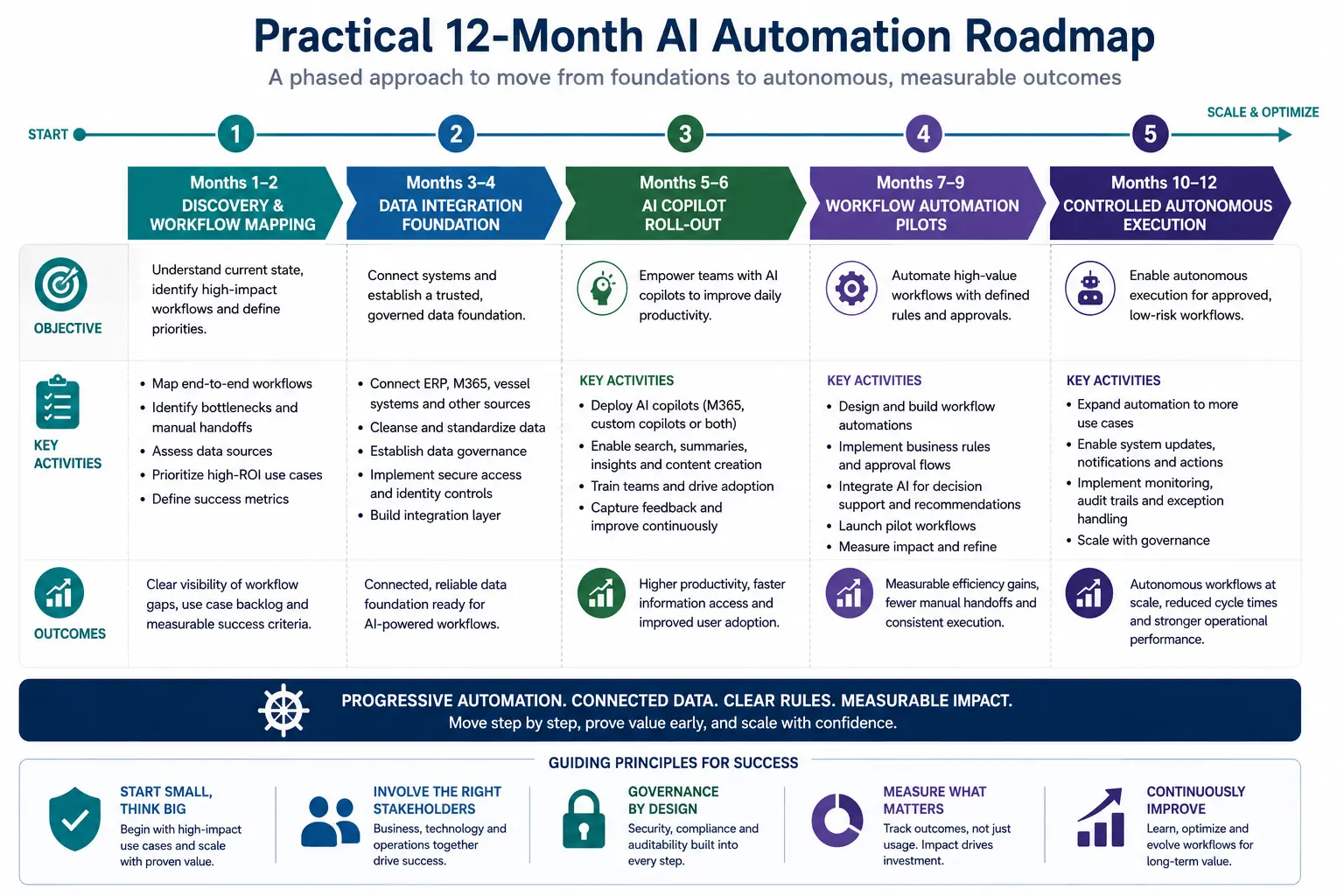
A practical 12-month roadmap for maritime AI automation may look like this:
Months 1–2: Discovery and Workflow Mapping
The first step is to map the current operating environment.
This includes identifying the systems in use, key workflows, manual handoffs, reporting dependencies, compliance risks, and operational bottlenecks.
The goal is to understand where work actually slows down.
This stage should produce a clear list of automation opportunities ranked by impact and feasibility.
Months 3–4: Data Integration Foundation
The next step is to connect the most important operational data sources.
This may include ERP, Microsoft 365, documents, maintenance records, workforce data, compliance records, and vessel-related information.
The goal is to create a connected information layer that AI can safely use.
Months 5–6: AI Copilot Rollout
Once the data foundation is in place, the company can roll out copilots for selected teams.
These copilots should focus on practical use cases such as information retrieval, document summarization, report drafting, email support, and internal operational Q&A.
The goal is to create early productivity gains and build user confidence.
Months 7–9: Workflow Automation Pilots
The next stage is to automate selected high-value workflows.
These pilots should be narrow, measurable, and controlled.
Examples may include compliance alerts, customer reporting, incident escalation, workforce time exceptions, or maintenance reminders.
The goal is to prove that AI automation can reduce manual work and improve operational visibility.
Months 10–12: Controlled Autonomous Execution
The final stage of the first year is to introduce controlled autonomous actions.
These may include automatic notifications, task creation, report generation, routine system updates, escalation workflows, and audit log creation.
The goal is to move from assistance to execution while maintaining approval controls and auditability.
Measuring Success
AI automation should be measured through operational outcomes, not only technology adoption.
Executives should track metrics such as:
- Reduction in manual follow-ups
- Faster response times
- Fewer missed deadlines
- Reduction in reporting effort
- Improved compliance readiness
- Faster issue escalation
- Better workforce utilization
- Reduced operational delays
- Improved customer communication
- Reduction in duplicated work
- Increase in process visibility
- Lower dependency on manual coordination
The key question is not:
“How many people are using AI?”
The better question is:
“How much manual workflow effort has been removed?”
That is the real measure of AI automation maturity.
The Executive Perspective
For maritime leaders, building an AI automation roadmap is not about chasing the latest tool.
It is about creating a practical path toward better operational control.
The roadmap should begin with data connection, move through employee assistance, then automate high-value workflows, and finally introduce controlled autonomous actions.
Each phase should create measurable value.
Each phase should reduce operational friction.
Each phase should increase trust in the system.
The companies that succeed will not be the ones that attempt full autonomy from day one. They will be the ones that move step by step, connect their systems, define their rules, prove value through targeted workflows, and expand automation with discipline.
AI automation is not a technology shortcut.
It is an operating model upgrade.
7. Common Mistakes Maritime Leaders Should Avoid
AI automation can create significant value for maritime companies, but only when it is implemented with the right strategy, controls, and operational understanding.
The risk is not that maritime leaders will ignore AI.
The bigger risk is that they will adopt AI in a fragmented way.
A company may buy an AI tool, launch a chatbot, connect a few documents, automate a few reports, and assume it is moving toward transformation. But without workflow clarity, integration, business rules, governance, and change management, AI can easily become another disconnected layer on top of an already fragmented operating environment.
For maritime companies, the cost of poor implementation can be high.
AI can create confusion if employees do not trust the output.
Automation can create risk if business rules are not defined properly.
Disconnected tools can increase complexity instead of reducing it.
Poor governance can create compliance and audit concerns.
Unclear ownership can cause projects to lose momentum.
This is why leaders should approach AI automation with discipline.
The following mistakes are common, avoidable, and important to address early.
Mistake #1: Buying Another AI Tool Instead of Solving the Workflow Problem
The most common mistake is treating AI automation as a software purchase.
Many companies start by asking:
“Which AI tool should we buy?”
But this is the wrong starting point.
The better question is:
“Which workflow is slowing down the business, and why?”
If the workflow problem is not clearly understood, a new AI tool may only add another interface for employees to manage. It may improve isolated tasks, but it will not fix the underlying operational friction.
For example, if customer reporting is slow because data is scattered across ERP, email, vessel systems, and service records, then buying an AI writing assistant will not solve the root issue.
The assistant may help draft a message, but someone still needs to collect the data, validate the status, approve the communication, send the update, and log the action.
The real solution is not only AI-generated text.
The real solution is a connected workflow that can pull the right data, apply business rules, prepare the update, route it for approval if needed, send it through the right channel, and record the action.
AI tools are useful only when they are connected to a clear operational purpose.
Without that purpose, AI becomes another technology layer rather than a transformation engine.
Mistake #2: Automating Before Mapping Processes
Another major mistake is trying to automate workflows before understanding how they actually work.
On paper, many processes look simple.
A service request is received.
A task is assigned.
A technician performs the work.
A report is generated.
A customer is updated.
The record is closed.
But in reality, the workflow may involve many informal steps.
Someone checks an email thread.
Someone calls a vessel manager.
Someone confirms availability in a spreadsheet.
Someone verifies a compliance requirement.
Someone waits for approval from operations.
Someone manually updates the ERP.
Someone prepares a separate customer update.
If these hidden steps are not mapped, automation will be incomplete.
The system may automate the visible process but fail at the real process.
This is why workflow mapping is essential before automation begins.
Leaders should identify:
- Where the workflow starts
- Which systems are involved
- Which people touch the process
- Which decisions are rule-based
- Which decisions require judgment
- Which approvals are required
- Which exceptions occur frequently
- Which data is needed at each step
- Which actions can be automated safely
- Which points require audit trails
A process that is not understood cannot be automated reliably.
Automation should follow process clarity, not replace it.
Mistake #3: Allowing AI to Make Deterministic Decisions
AI is powerful, but it should not be responsible for every type of decision.
In maritime operations, many decisions must be deterministic. They must follow fixed rules because they affect compliance, safety, contracts, approvals, billing, workforce obligations, or auditability.
Examples include:
- Compliance deadlines
- Safety requirements
- SLA breach rules
- Contractual obligations
- Approval thresholds
- Payroll rules
- Certification validity
- Audit documentation requirements
- Access permissions
- Escalation policies
These decisions should not depend on AI interpretation alone.
AI may assist by identifying context, summarizing documents, detecting anomalies, or recommending actions. But the final logic for deterministic decisions should be rule-based, testable, and auditable.
For example, if a compliance certificate expires within a defined period, the escalation should follow a fixed rule.
If a work order exceeds a financial approval limit, the approval workflow should follow a fixed rule.
If a customer SLA is breached, the notification and escalation path should follow a fixed rule.
The principle is simple:
AI should interpret complexity.
Rules should control certainty.
This distinction protects the business from inconsistent decisions and improves trust in the system.
Mistake #4: Ignoring Change Management
AI automation changes how people work.
It changes who receives information.
It changes who approves actions.
It changes how exceptions are escalated.
It changes how reports are produced.
It changes how employees interact with systems.
It changes how managers supervise operations.
If this change is not managed properly, employees may resist the system or work around it.
This resistance is not always because people dislike technology. Often, it happens because they do not understand the purpose, do not trust the output, or fear that automation will reduce their role.
Leaders must communicate clearly that AI automation is not only about replacing manual effort. It is about reducing repetitive coordination so employees can focus on judgment, service quality, exception handling, and higher-value work.
Change management should include:
- Clear explanation of business goals
- Training for each user group
- Transparent workflow changes
- Human approval points
- Feedback channels
- Gradual rollout
- Visible leadership support
- Clear ownership of exceptions
- Measurement of improvements
- Continuous refinement
The goal is to create trust.
Employees should understand when the system is assisting, when it is recommending, when it is executing, and when human review is required.
Without trust, even a technically strong AI automation system will fail to deliver full value.
Mistake #5: Chasing Full Autonomy Too Early
Many leaders are attracted to the idea of autonomous operations.
The vision is compelling: systems that monitor activity, detect issues, make decisions, update records, notify stakeholders, and keep operations moving with minimal human intervention.
But full autonomy should not be the starting point.
It should be the result of maturity.
If a company moves too quickly into autonomy without connected data, clear rules, reliable workflows, audit controls, and user trust, the risk increases significantly.
Autonomy should begin with low-risk, well-defined actions.
For example:
- Sending internal reminders
- Creating routine tasks
- Updating non-critical status fields
- Generating scheduled reports
- Escalating overdue items
- Logging completed steps
- Preparing draft communications
- Triggering approval workflows
Higher-risk actions should remain human-reviewed until the system has proven reliability.
For example:
- Sending sensitive customer communication
- Closing critical incidents
- Making financial decisions
- Approving compliance exceptions
- Changing contractual records
- Assigning high-risk operational responsibility
The right approach is progressive autonomy.
Start with assistance.
Move to recommendations.
Introduce workflow automation.
Then allow controlled autonomous actions.
This protects the business while still moving toward meaningful transformation.
Mistake #6: Treating AI as an IT Project Only
AI automation is not only an IT initiative.
It is an operating model initiative.
Technology teams are essential, but they cannot define business workflows alone. Operations, compliance, finance, customer service, maintenance, HR, and leadership must all be involved because AI automation touches how work actually happens.
If AI automation is owned only by IT, the project may become technically sound but operationally weak.
The system may connect data but miss real workflow nuances.
It may automate steps that employees do not actually follow.
It may produce dashboards that leaders do not use.
It may overlook compliance obligations.
It may fail to address customer communication realities.
A strong AI automation program needs cross-functional ownership.
Business teams define the workflow.
Compliance teams define control requirements.
Operations teams define exceptions and escalation paths.
Technology teams define architecture and integrations.
Leadership defines priorities and success metrics.
This shared ownership ensures the system solves real business problems, not just technical problems.
Mistake #7: Measuring AI Success Through Usage Instead of Business Outcomes
Many organizations measure AI success by adoption metrics.
How many employees logged in?
How many prompts were submitted?
How many summaries were generated?
How many reports were drafted?
These numbers may be useful, but they do not prove business impact.
A maritime AI automation program should be measured by operational outcomes.
Better questions include:
- How many manual follow-ups were eliminated?
- How much reporting time was reduced?
- How many compliance gaps were detected earlier?
- How many overdue tasks were escalated automatically?
- How much faster did customer updates go out?
- How many duplicate data entries were removed?
- How much faster were incidents triaged?
- How much better is leadership visibility?
- How much operational capacity was created without adding headcount?
AI success should be measured by workflow improvement, not tool activity.
The goal is not more AI usage.
The goal is less manual dependency.
The Executive Perspective
For maritime leaders, avoiding these mistakes is just as important as choosing the right technology.
AI automation should begin with workflow clarity, not tool selection.
It should be governed by business rules, not AI interpretation alone.
It should be rolled out with employee trust, not forced adoption.
It should be measured through operational outcomes, not usage statistics.
And it should move toward autonomy gradually, not recklessly.
The companies that succeed with maritime AI will not be the companies that move the fastest. They will be the companies that move with the right discipline.
They will connect systems before automating decisions.
They will map processes before introducing workflows.
They will keep deterministic rules under control.
They will involve business teams from the beginning.
They will measure what matters.
They will build trust before scaling autonomy.
AI automation is powerful, but only when it is implemented as part of a controlled operating model.
That is what separates short-term experimentation from long-term transformation.
8. The Future of Maritime Operations
The future of maritime operations will not be defined by companies that simply use more software.
It will be defined by companies that can turn fragmented operational data into intelligent, connected, and executable workflows.
For many years, maritime digital transformation focused on system adoption. Companies implemented ERP platforms, vessel tracking tools, maintenance systems, compliance software, workforce tools, reporting dashboards, and communication platforms.
These systems improved parts of the business. But they did not always change the operating model.
Work still depended heavily on people checking systems, interpreting updates, coordinating between departments, preparing reports, following up manually, and escalating issues through emails or calls.
The next phase will be different.
The next phase is not software-centric operations.
It is AI-centric operations.
This does not mean AI replaces core business systems. ERP, compliance systems, vessel platforms, maintenance tools, and communication systems will continue to remain important. But AI will increasingly sit above and across these systems as an operational intelligence layer.
This layer will help maritime companies understand what is happening, what needs attention, what action should be taken, and which workflow should move forward.
That is the future direction of maritime operations.
From Software-Centric Operations to AI-Centric Operations
In a software-centric operating model, people use systems to complete work.
A manager opens a dashboard.
A coordinator checks an email.
A compliance officer reviews a document.
A technician updates a work order.
A customer success team prepares a report.
An executive asks for a weekly summary.
The software stores information, but people still drive the workflow.
In an AI-centric operating model, the system becomes more proactive.
It monitors operational activity.
It detects exceptions.
It identifies missing information.
It recommends action.
It prepares communication.
It escalates risks.
It updates records.
It creates visibility for leadership.
The difference is significant.
Software-centric operations require people to search for what matters.
AI-centric operations bring what matters to the right person at the right time.
This shift will change how maritime teams work. Instead of spending a large part of the day collecting and moving information, employees will spend more time reviewing exceptions, making judgment-based decisions, improving service quality, and managing complex operational issues.
The role of people will not disappear.
But their work will move higher up the value chain.
The Rise of Operational Intelligence Layers
The most important technology shift in maritime operations will be the rise of operational intelligence layers.
An operational intelligence layer sits across existing business systems and connects data, rules, AI, workflows, and actions.
It does not replace the ERP.
It does not replace vessel systems.
It does not replace maintenance tools.
It does not replace compliance systems.
Instead, it makes them work together.
This layer can understand that a customer email is linked to a vessel schedule, a service request, a maintenance task, a compliance requirement, a technician assignment, and a billing event.
That connected understanding is what makes AI automation valuable.
Without this layer, each system remains isolated.
With this layer, the organization can begin to operate with real-time context.
For maritime leaders, this becomes a strategic capability. The company no longer depends only on manual reporting cycles to understand what is happening. It can create live operational visibility across vessels, teams, customers, assets, risks, and financial impact.
This is where AI moves from being a productivity tool to becoming part of the management system.
Human-in-the-Loop vs Autonomous Workflows
The future of maritime operations will not be fully autonomous overnight.
The better model is a controlled balance between human-in-the-loop workflows and autonomous execution.
Some workflows should keep humans involved because they require judgment, accountability, relationship management, commercial sensitivity, or safety consideration.
Examples include:
- High-risk compliance exceptions
- Sensitive customer communication
- Major operational incidents
- Contractual disputes
- Financial approvals
- Safety-related decisions
- Critical crew or workforce decisions
- Strategic management decisions
In these areas, AI should assist, recommend, summarize, and prepare action — but humans should review and approve.
Other workflows can become increasingly autonomous because they are repetitive, rules-based, low-risk, and easy to audit.
Examples include:
- Internal reminders
- Routine task creation
- Status updates
- Escalation notifications
- Report generation
- Dashboard updates
- Compliance log updates
- Follow-up scheduling
- Document gap alerts
- Basic workflow routing
The future will not be about choosing between humans and AI.
It will be about deciding where human judgment is essential and where automation can safely remove repetitive operational work.
This distinction will become a core leadership responsibility.
What Maritime Leaders Should Do Over the Next 12 Months
Maritime leaders do not need to wait for perfect AI maturity before taking action.
The next 12 months should be used to build the foundation for AI-enabled operations.
The first priority should be workflow visibility.
Leaders should identify where manual handoffs, duplicated work, delayed reporting, compliance exposure, and operational bottlenecks are most visible. These areas usually contain the strongest automation opportunities.
The second priority should be system connection.
AI cannot create meaningful value if it is disconnected from the systems where operational reality lives. ERP, Microsoft 365, vessel systems, maintenance records, compliance documents, workforce data, and customer communication should gradually become part of a connected operational layer.
The third priority should be rule definition.
Before automation can scale, leaders must define which decisions are deterministic, which require approval, which can be automated, and which must remain human-led.
The fourth priority should be pilot selection.
The best pilots are not the most futuristic ones. They are the workflows where manual effort is high, rules are clear, risk is manageable, and business impact can be measured.
The fifth priority should be adoption and trust.
Employees must understand how AI will help them, where human approval remains required, and how the system will improve operational consistency. Without trust, even the best automation system will struggle.
The companies that use the next 12 months wisely will not merely experiment with AI. They will build the foundation for a different operating model.
The Executive Perspective
For maritime CEOs, COOs, CIOs, and operations leaders, the future is not about adding AI to the business as another tool.
It is about redesigning operations so that intelligence, rules, workflows, and execution are connected.
The future maritime organization will be able to see operational reality faster, respond to exceptions earlier, coordinate teams with less manual effort, reduce compliance exposure, and serve customers with greater transparency.
This does not require replacing every system.
It requires connecting the systems that already exist and building intelligent automation around them.
The winners in maritime AI will not be the companies with the most AI tools.
They will be the companies that successfully connect their operational systems, embed intelligence into workflows, and automate decision execution at scale.
The future is not AI-powered chat.
The future is AI-powered operations.
Conclusion
Maritime operations are entering a new era.
For years, digital transformation in the maritime industry has focused on adopting systems: ERP platforms, communication tools, vessel monitoring systems, maintenance platforms, compliance software, reporting dashboards, and document management solutions.
These systems were necessary.
But they were not enough.
The next level of transformation will not come from adding more software. It will come from connecting existing systems, reducing manual handoffs, embedding intelligence into workflows, and allowing routine operational actions to move forward with greater speed, consistency, and control.
This is where AI automation becomes strategically important.
The real value of AI in maritime operations is not simply faster search, better summaries, or automated email drafts. These are useful starting points, but they do not change the operating model.
The real value begins when AI becomes part of the workflow itself.
When AI can monitor operational events.
When it can detect exceptions.
When it can understand business context.
When it can apply predefined rules.
When it can recommend the next action.
When it can trigger workflows.
When it can update systems.
When it can create visibility for leadership.
That is when maritime companies move from manual copilots to autonomous workflows.
This shift should be approached carefully. Maritime operations involve compliance, safety, customer commitments, financial controls, workforce responsibilities, and operational risk. AI should not be given uncontrolled authority over critical decisions.
The right approach is controlled automation.
Deterministic rules should remain deterministic.
Human judgment should remain where judgment is required.
AI should support complexity, context, prioritization, communication, and pattern recognition.
Automation should execute approved workflows where the rules are clear and the risk is manageable.
This balance is what will define successful maritime AI adoption.
For executive leaders, the message is simple: AI automation is not an IT experiment. It is an operating model upgrade.
It requires leadership alignment.
It requires workflow clarity.
It requires connected data.
It requires governance.
It requires business rules.
It requires employee trust.
It requires measurable outcomes.
The companies that succeed will not be the ones that chase the most advanced AI tools. They will be the ones that identify their workflow bottlenecks, connect their operational systems, define clear rules, automate high-value processes, and scale gradually with discipline.
The opportunity is significant.
Maritime companies can reduce manual coordination, improve compliance readiness, accelerate decision-making, strengthen customer communication, improve asset reliability, optimize workforce utilization, and create better executive visibility.
But the companies that wait too long may find themselves operating with the same manual workflows while competitors build faster, smarter, and more scalable operations.
The future of maritime AI is not about replacing people.
It is about removing the repetitive operational burden that prevents people from focusing on higher-value work.
It is about giving managers better visibility.
It is about giving teams better coordination.
It is about giving customers better transparency.
It is about giving leadership better control.
It is about helping the organization scale without increasing complexity at the same price.
The future is not AI-powered chat.
The future is AI-powered operations.
And for maritime companies ready to modernize their workflows, that future can begin now.