When healthcare organizations made the shift from traditional local data centres to cloud‑native healthcare systems, this shift attracted hackers’ attention.
Unlike finance, where certain details may lose relevance over time, healthcare data such as genetic markers and chronic diagnoses, must be permanently protected because it directly influences critical decisions in patient care. This is the reason that health organizations cannot rely on generic cloud providers without specialized security.
To safeguard patient data, they must partner with trusted security providers that demonstrate real‑world operational maturity rather than offering only bare‑minimum protections.
Modern EHR software platforms, which store sensitive patient records, highlight why this level of protection is non‑negotiable.
Why Healthcare Remains a Primary Boardroom Concern?
According to HIPAA Journal, the Change Healthcare ransomware attack exposed the protected health information of an estimated 192.7 million individuals, making it the largest healthcare data breach ever recorded.
This raises the question: why is healthcare such a prime target?
The High Value and Permanence of Health Data
Healthcare records are far more valuable on underground markets than financial credentials.
While a compromised credit card can be cancelled and a password reset, medical histories like chronic diagnoses, genetic markers, and insurance identifiers cannot simply be reissued.
This permanence makes healthcare data a high‑stakes target. Once exposed, it remains vulnerable forever, giving threat actors access to an asset that can be used for long term exploitation.
For organizations who work on a global level, let’s say in Germany, it becomes more than important to partner with a DevOps consulting company in Germany who can help integrate strict GDPR rules and regional sovereignty requirements.
The Operational Crisis of Clinical Breaches
In healthcare, security is measured on the CIA triad that is confidentiality, integrity, and availability. If any of these pillars fail, the impact is not just reputational but also operational in nature.
Ransomware can lock diagnostic platforms and patient records which can easily delay surgeries and re-route the emergency ambulances. This is why protection of sensitive EHR systems and electronic health records is something that no healthcare organization can ignore.
Modern Healthcare’s Dependence on Data Exchange
Since healthcare relies on constant data exchange across multiple platforms from scheduling to billing to lab systems, a single compromise can disturb the whole chain or cut access to critical information at the point of care.
All these reasons are why the demand for AWS Cloud DevOps Engineering Services in Healthcare is increasing as these experts help healthcare organizations to apply encryption, IAM, and monitoring controls that lowers the risk of failures.
Securing Patient Data: 5 Steps to Choosing the Right Cloud Partner
Now that the question of “why healthcare data is a prime target” is clear, the next challenge is about keeping patient information actually secure in the cloud. Here partnering with the right technology expert to maintain privacy, compliance, and operational resilience comes out as the top solution. But, again, finding the right cloud partner comes with its own set of challenges so here are five steps that will guide you through this process.
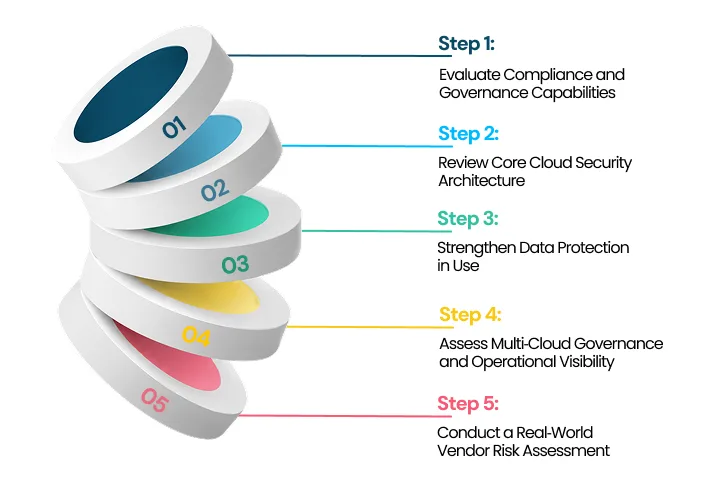
Step 1: Evaluate Compliance and Governance Capabilities
Healthcare security begins with governance. A trusted partner must clearly define responsibilities under the shared responsibility model where the provider secures infrastructure, but the healthcare enterprise protects the data within it.
This should be made formal in a Business Associate Agreement or BAA that guides:
- who manages encryption keys
- who oversees backups
- who leads incident response
Mature partners use compliance automation and continuous monitoring tools like CSPM platforms to find misconfigurations in real time. It delivers standards such as HITRUST and SOC 2 Type II continuously in place of just during annual audits.
For global operations, partners must also show expertise in regional privacy laws like GDPR in Europe to manage cross‑border data transfers without compromising patient privacy. For example, if you are a business running in Germany you shall partner with DevOps consulting company in Germany to bring that local expertise for strict European data sovereignty requirements.
Step 2: Review Core Cloud Security Architecture
Security must be built into the foundation.
Strong Encryption Standards Knowledge
A reliable partner applies strong robust encryption standards that are AES‑256 for data at rest and TLS 1.2/1.3 for data in transit. Identity and Access Management or IAM is equally critical, as it applies the principle of least privilege, multi‑factor authentication or MFAa, and role-based access controls.
Automation of security across systems
All these controls, when applied directly into DevOps pipelines, your organization can automate secure configurations across deployments. This ensures that every workload right from diagnostic applications to pharmacy networks inherits strong security baselines by default.
Here utilizing AWS Cloud DevOps Engineering Services in Healthcare lets organizations embed these baselines into their CI/CD pipelines, so that encryption and IAM policies are consistently applied across every environment.
Step 3: Strengthen Data Protection in Use
Beyond storage and transmission, patient data must remain secure during active processing.
A mature partner:
- Makes use of encryption in use through isolated memory environments, keeping PHI encrypted even while being processed.
- They use Zero Trust enforcement that lets no user or device give implicit access.
- Apply Micro Segmentation to limit deeper movement in the network so that a breach cannot spread to other sensitive databases.
This layered defence is very powerful to limit attackers from affecting more than one system as loose ends can give them free movement across the network to compromise patient records.
For healthcare enterprises running mission‑critical EHR software, this approach remains a life saviour as it guarantees patient data safety at every stage of its lifecycle.
Step 4: Assess Multi‑Cloud Governance and Operational Visibility
Most healthcare enterprises operate across multiple providers like AWS, Azure, Google Cloud, and private systems. Without unified oversight, small misconfigurations can take the form of major breaches that are harder to control later.
A trusted partner should be able to give you that unified governance with
- consistent policies across all environments,
- centralized monitoring to remove any blind spots
- An AI‑driven threat detection system that flags unusual API traffic or fast data movement in real time
This visibility creates an ecosystem where compliance is maintained continuously and clinicians can rely on uninterrupted access to patient data.
Region-specific partnerships are again helpful as many organizations, let’s say from Germany, would turn to a DevOps consulting company in Germany or similar regional experts to align their multi‑cloud governance with local compliance.
Step 5: Conduct a Real‑World Vendor Risk Assessment
Deciding on a cloud partner is a high‑stakes decision that goes deeper than just polished sales presentations. Healthcare enterprises should evaluate how vendors perform under real operational pressure at the time of incidents, audits, and migrations.
Clear Answers
A reliable partner gives clear answers to complex questions like how quickly workloads can be isolated during a breach or who owns encryption keys in a failover scenario. Their credibility is also tested with their transparent incident disclosure protocols, regular penetration testing, and red team exercises.
Exit strategy
Just like that, a vendor’s exit strategy is important as it should have clear termination clauses and data portability options that prevent lock‑in and make sure that patient records remain accessible if the partnership ends.
Overall summary
In a nutshell, if you go with AWS Cloud DevOps Engineering Services in Healthcare, you should aim for portability across hybrid environments while maintaining encryption and compliance standards. A partner who shows this resilience under scrutiny, in place of relying on generic compliance claims, is the one healthcare organizations can trust with their most sensitive data.
Before you sign on watch for these warning signs
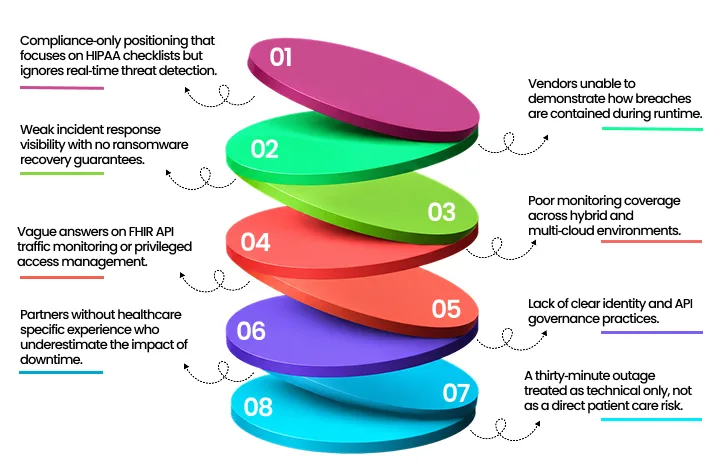
- Compliance‑only positioning that focuses on HIPAA checklists but ignores real‑time threat detection.
- Vendors unable to demonstrate how breaches are contained during runtime.
- Weak incident response visibility with no ransomware recovery guarantees.
- Poor monitoring coverage across hybrid and multi‑cloud environments.
- Vague answers on FHIR API traffic monitoring or privileged access management.
- Lack of clear identity and API governance practices.
- Partners without healthcare‑specific experience who underestimate the impact of downtime.
- A thirty‑minute outage treated as technical only, not as a direct patient care risk.
The Final Words
When we talk about modern healthcare, data security isn’t just a technical checkbox, it’s the backbone of patient trust and care continuity. This five‑step framework we discussed will set a strong foundation for healthcare enterprises when they pick a trusted healthcare partner.
Genuine Cloud Security Partners like NetSet Software will always ensure to keep clinical systems steady, patient records intact, and leadership ready for whatever tomorrow’s ransomware landscape brings.
FAQs
Is HIPAA compliance enough when choosing a cloud provider?
While HIPAA is a legal requirement, a vendor can pass an audit and still have key gaps in runtime threat detection, incident response, or backup isolation hence operational maturity is what actually prevents breaches.
What is the “Shared Responsibility Model” in healthcare?
It is a framework where the cloud provider secures the infrastructure, but the healthcare enterprise is responsible for configuring security, managing access, and protecting the PHI within that infrastructure.
Why is Zero Trust vital for patient data safety?
Traditional perimeters are already on the verge of extinction which is why new methods like Zero Trust exist. It limits lateral movement by verifying every request continuously, which is important for protecting sensitive systems like EHR software from credential theft.
How do cloud partners secure PHI in a multi-cloud environment?
Security teams shall protect PHI with centralized identity policies, end-to-end encryption, and unified logging which collects the telemetry from all providers like AWS, Azure, etc. to prepare a single detailed view for constant review.
What are the most common security “red flags” in a vendor?
The most dangerous red flags are compliance-only positioning, weak API governance, and a lack of regular ransomware recovery testing.