Who thought people would have an online platform where they would predict real-world events and gain tradable outcomes? And, one level deeper, Polymarket has come out as a leading decentralized solution that gives transparency and accessibility using blockchain technology.
With the success of the platform, their demand for prediction market software solutions is increasing but one key confusion remains how Polymarket actually generates revenue with their unique monetization strategies and that is what you will find in this blog.
But, before we jump into the strategies, let us learn a little bit more about Polymarket.
What is Polymarket (in easy terms)?
Understand Polymarket has a platform that is not controlled by any centralized entity and lets users trade on the outcomes of real-world events. It is not like traditional betting systems because it uses blockchain technology for the best security, transparency, and accessibility. In it, users can buy and sell “shares,” which are tied to specific outcomes with prices, collective sentiment, and probability.
The main aim
It was found to democratize forecasting and has quickly gained traction in the USA as well as on the global level. The appeal lies in simplicity, where anyone can participate, markets are easy to create and trades are executed using smart contracts. This decentralized structure lowers the reliance on mediators, which makes the platform cost efficient and trustworthy.
What does it mean for businesses?
For businesses and innovators, Polymarket is more than a trading hub, as it shows how prediction market software solutions are used in industries from finance and healthcare to gather collective intelligence about events.
In the USA, prediction market software development companies are in high demand because businesses want collective insights about the events that have an impact on their operations.
[Prefer Reading: How To Build A Custom Prediction Market Platform Like Kalshi
Polymarket’s revenue streams
The success of Polymarket as a prediction platform comes from a clear and scalable revenue platform, which is not like old betting systems using odd manipulation or house margins. It earns using a transparent mechanism built into its prediction market software solution.
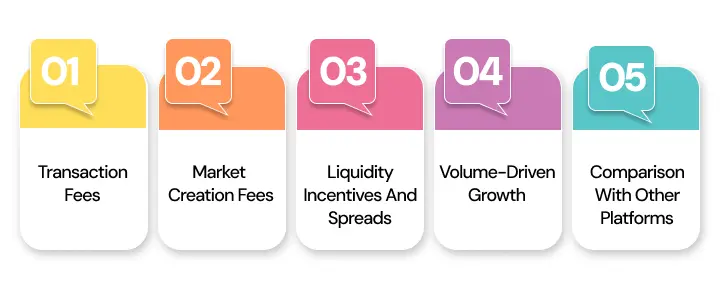
Stream 1: Transaction Fees
Every time a user buys or sells shares connected to an event outcome, Polymarket charges a small transaction fee. This fee is normally a percentage of the trade value. Since prediction markets make big on high activity, even modest fees generate notable revenue when multiplied across thousands of trades. As more participants join and engage in a possibility, the more Polymarket earns.
Stream 2: Market creation fees
Polymarket lets users create a new market around real-world events and to prevent spam and ensure quality, it charges a fee for market creation. This not only filters serious creators but also adds a steady revenue stream. For example, if someone wants to launch a market predicting the outcome of a sports championship or political event, they pay a setup fee that goes directly to Polymarket.
Steam 3: Liquidity incentives and spreads
Liquidity is important when it comes to prediction markets because without it, users cannot easily buy or sell shares. Polymarket incentivizes liquidity providers but it also benefits from spreads (the difference between buy and sell prices). These spreads give indirect revenue other than the platform capturing value from the trading activity itself.
Stream 4: Volume-Driven Growth
Polymarket works amazingly when it is on scale so the more users participate, the more trades occur and the higher the fee revenue. This creates a self-reinforcing cycle where popular markets attract more traders, which in turn boosts Polymarket’s earnings. It is not like fixed subscription models but more of an approach that makes sure revenue grows organically with user engagement.
Stream 5: Comparison with other platforms
Other prediction market platforms may rely on advertising, premium subscriptions, or sponsorships, but Polymarket’s focus was always on the transaction based monetization which affects consumers really little. This also makes this revenue model very transparent and aligned with user activity.
For businesses that want to study prediction market software solutions, Polymarket gives a blueprint, builds trust, inspires participation, and monetizes using activity in place of the hidden margins.
User incentives vs. platform profitability
The main strength of Polymarket lies in bringing user benefits and its own revenue model to a similar level. For prediction market platforms, profitability depends on sustained participation and that only happens when users feel rewarded and trust the system.
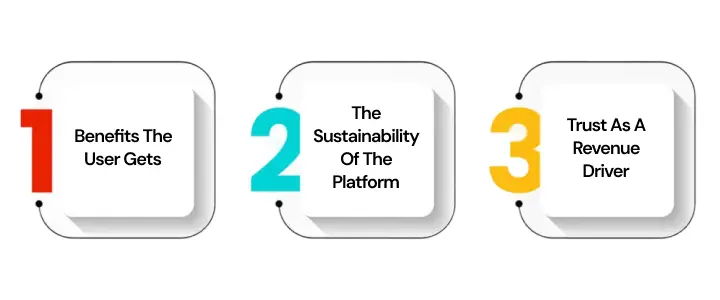
Benefits the user gets
There are ample benefits that users gain starting from accurate forecasting rewards, where users profit when their predictions are correct, thus creating a strong incentive to participate. Further, users get transparency, as Polymarket uses blockchain so that outcomes are verifiable and contain no skepticism. With low barriers to entry, people also get the best accessibility, which means that anyone can start trading and expand the user base.
The sustainability of the platform
Polymarket earns using transaction and market creation fees, but it must balance this with user satisfaction. So, if they charge excessive fees, it would discourage participation; that’s why the platform has to keep charges modest while also relying on high trading volume for profitability.
Trust as a revenue driver
Credibility is central so when users believe markets are fair and outcomes are transparent, they constantly return to the platform and increase the volume of their trade. This repeat activity fuels Polymarket’s revenue without any aggressive monetization tactics. Due to trust, Polymarket has been achieving symbiotic growth and has become an ideal standard for the businesses that are looking to deploy such a solution.
Future outlook
Prediction market platforms like Polymarket are in constant rise because consumers want decentralized platforms that support forecasting of events. The rising interest in blockchain-based solutions will cause Polymarket to expand its monetization over the transaction and market creation fees. Some potential models here can be premium features for advanced traders, enterprise partnerships, and integration with the financial institutions.
Future for the builders
For a prediction market software development company USA, this trend signals opportunity. Businesses will recognize the value of collective intelligence and software solutions that replicate Polymarket’s model with the solutions customized for the finance, healthcare, and education sectors. Further, as the adoption grows, prediction markets may come out as mainstream tools for decision making which consists of both profitability as well as societal impact.
[Prefer Reading: The Ultimate Guide to Prediction Market Platform Software
Final Words
Polymarket shows how prediction market platforms can monetize while remaining transparent and user-centric. With transaction fees, market creation charges, and liquidity incentives, it sustains profitability without making any compromises on user trust.
Such balance between user rewards and platform growth highlights the strength of decentralized prediction market software solutions. For businesses and innovators, NetSet Software Solutions will deliver a clear blueprint for scalable and transparent systems that align with the digital economy.
FAQs
What is the main factor that makes Polymarket different from traditional betting platforms?
The decentralized nature of the Prediction market platform (meaning no one entity handles it) using blockchain technology, for forecasting and transparency, is one major separator because betting sites were using odds manipulation + centralized approach.
What are the main ways Polymarket makes money?
Polymarket earns with transaction fees on trades, market creation fees, and liquidity spreads, plus their revenue notably grows as user participation increases.
What is the reason behind the huge popularity of the prediction market platforms?
They allow users to trade on real‑world outcomes so that it is possible to achieve collective intelligence into actionable insights and it is very important for forecasting politics, sports, finance, and global events.
Can prediction market software solutions be customized for businesses?
Yes, a prediction market software development company USA can build custom platforms for industries like finance, healthcare, and education so that organizations can harness collective intelligence.
Is Polymarket legal in the USA?
Polymarket operates within regulatory frameworks, but prediction markets face changing compliance challenges but with businesses exploring prediction market software solutions, experts ease things up.