It is quite interesting to know that the backbone of the modern capital market is tokenization, something that people have never imagined will exist. When you convert real-world assets like real estate, private equity, and treasuries into digital tokens, you get due liquidity, transparency, and accessibility on a global level. But despite this much popularity, it is still not that easy to build a successful tokenization MVP because the thing is that mvp development solutions are actually complex.
And, in the situation when custodians are already at 63% live offerings and tokenized assets are projected to reach $10 to $16 trillion before 2030, there is no doubt that stakes are really super high. The choice of a right roadmap can decide whether a project will scale or stall so here are the six strategic decisions every business must make to build a growth-ready MVP.
How is the adoption of tokenization in the market?
Tokenization has already made the shift from being in pilot projects for viability testing to being the operational reality and as evidence, here are some numbers that you must see.
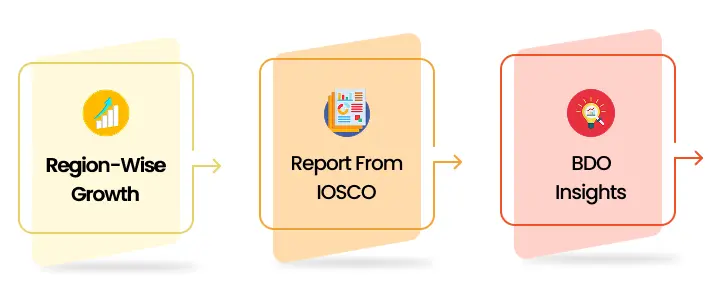
- Region-wise growth says that the Middle East and Africa are going to have the highest CAGR of 26% from 2026 to 2030, whereas North America and Asia Pacific will see growth rates of 24% and 26%, respectively.
- There was a report from IOSCO that clearly showcased that tokenization is breaking into fixed income, repos, and money market funds where custodians are connecting tokenized services right into their infrastructure.
- As per BDO insights, mainstream tokenization is breaking through fast, where it has democratized investment opportunities and brought liquidity across real estate, private equity, and other RWAs.
These figures are just like an overview to show that tokenization has completely made a shift from experiments to a structural shift in global finance and other industries.
[Prefer Reading: Create Your Token in Minutes: How NetSet’s No-Code Crypto Token Platform Works
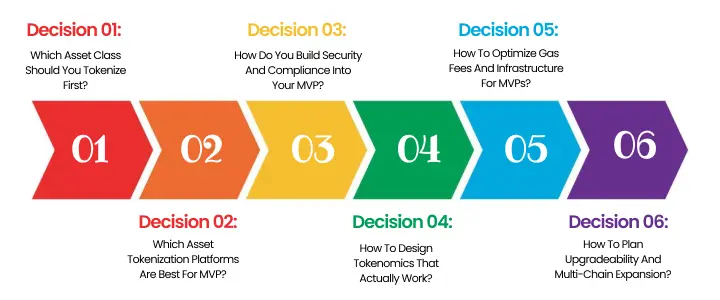
Six strategic decisions for tokenization MVP success
So, what are all the decisions that really contribute to the success of an MVP of a tokenization? Well, there can be a large number of them but we have compiled the summary of all those decisions into these six strategic ones.
Decision 1: Which asset class should you tokenize first?
The choice of the right starting point is always the main confusion for every tokenization MVP, as not all asset classes carry the same level of adoption potential, liquidity profile, and regulatory clarity.
Well, let’s perform a little bit of research to actually have a takeaway answer here. If you see the stats, the tokenized real-world assets are already crossing $34 billion in value, with real estate and private equity leading the charge. These sectors are attractive because they suffer from illiquidity and high entry barriers, which makes fractional ownership a game changer.
Now looking at the diversification of asset types, tokenization is expanding more than just property and equity, as it has reached commodities, debt instruments, art, royalties, and carbon credits, which means you are flexible to build an MVP for just what your investors demand.
And then there is the rising interest in tokenized private debt, infrastructure, and hedge funds along with traditional fixed income. It further signals that MVPs target alternative assets, which further signals that MVPs who target alternative assets will get traction faster than those who are focused alone on the mainstream securities.
The Takeaway
For most of the firms, the MVP should start with real estate or private equity given their strong demand and clear inefficiencies. But forward-looking teams may also find private debts, commodities, or carbon credits to differentiate the offerings and capture the niche investor segments.
Decision 2: Which asset tokenization platforms are best for MVP?
The very next key decision should be the choice of platform, which is again an important choice in building a tokenization MVP, as it plays a key role in terms of scalability, compliance, and investor trust.
In just the previous year, the tokens coming from treasuries, funds, and property on public chains were worth $24 billion, which is a 380% jump in the last three years. This is the reason why banks and fintech carefully studied the tokenization platforms for 2026 launches.
All the leading providers, like Polymesh, Securitize, Tokeny, and Hedera, deliver different strengths. Polymesh focuses on regulatory compliance, whereas securitize is great for institutional onboarding followed by interoperability, which is better in Tokeny and speed and scalability, which are better in Hedera.
Now if we try to fetch out key decision factors, then firms should focus on:
- Compliance ready platform (ones who align with KYC/AML, and other security regulations)
- Interoperable platforms (the ones who support cross-chain communication and connect with legacy systems)
- Scalability and fees (gas optimization and transaction throughput)
- Security (audit frameworks, smart contract flexibility)
- Customization (white label tokenization platform options for branding and custom workflows)
The Takeaway
For MVPs the best choice mostly depends on whether they need institutional-grade compliance or flexibility and speed because there is a dedicated platform choice for both of them. Any firm looking for quick entry into the market shall prefer white-label tokenization platforms and the ones who want to target a regulated market shall focus on compliance-centric providers.
Decision 3: How do you build security and compliance into your MVP?
Security and compliance are two pillars that play a major role in deciding if a tokenization MVP would scale or collapse and many blockchain projects fail just because they treat these aspects loosely.
If you see the security risks, then crypto thefts have already crossed $3.4 billion with smart contract risks costing over $3.1 billion in losses. The most common risks include reentrancy attacks, unchecked external calls, and poor access control.
Then the need for clarity in compliance is also emerging as the EU’s MiCA framework now governs digital assets all across Europe, while the US GENIUS Act sets guardrails for stablecoins. These frameworks are shaping how tokenized assets must be issued, traded, and reported.
The Takeaway
Now to achieve a successful MVP, you must integrate security architecture and compliance frameworks right from the start (not treat them as something to do later). This not only will protect your investors but will also build institutional trust, which is the basis of scaling into regulated markets.
Decision 4: How to design Tokenomics that actually work?
Tokenomics is the economic backbone of any tokenization MVP because a poorly designed token model is the main reason blockchain projects fail. If you look at the research, most new tokens lost over 70% of their value in the last year + a percentage of tokens launched between 2021 and 2023 lost over 90% of their value within a year. The issue is not just market volatility but a weak utility and misaligned incentives.
All of the tokens that promise future use cases like governance coming later have higher chances of collapsing because investors lose interest before utility comes. The successful MVPs make sure that tokens have immediate, tangible functions like transaction fees, access rights, or yield distribution.
Further liquidity management is important too, as vesting cliffs that release large amounts of tokens at once can disturb markets. With modern events where ETH or BTC prices drop 30 to 50%, we can understand the Tokenomics design can act as a prevention to token failure.
The Takeaway
A strong MVP requires tokens that are useful from day one, distributed fairly, and resilient under stress. Without this, even the most innovative tokenization platform has the risk of losing credibility and investor confidence.
Decision 5: How to optimize gas fees and infrastructure for MVPs?
Unlike traditional systems, every blockchain operation carries a cost and poor optimization can easily erode user adoption. For example, Ethereum mainnet transactions averaged $3.78 in 2025, which is down from $5.90 in 2024 due to layer 2 scaling improvements. But even with the transaction fees going down, the smart contracts optimization does push costs into the $5 to $20 range, which makes MVPs costly.
All the networks like Arbitrum, Optimism, and zkSync have lowered transaction fees to $.20 to $.50 while still maintaining security through Ethereum settlement. This makes them attractive starting points for MVPs that focus on user experience. Further, projects that deploy across multiple chains too early often face fragmented liquidity and higher audit costs.
The Takeaway
Optimizing gas fees is not just a technical detail; it is a competitive moat. All the MVPs that design contracts with cost efficiency in mind and utilize scalable infrastructure will deliver smoother user experiences and stand out in a crowded market.
Decision 6: How to plan upgradeability and multi-chain expansion?
The final strategic decision for building a successful tokenization MVP stays with planning for what happens after the launch. As smart contracts are immutable once they are deployed, which means that bugs or inefficiencies can become permanent if upgradability is not designed from the start.
When the upgrade paths are not defined nicely, the teams without proxy or modular architecture do face permanent risks and costly migrations to new versions. Then with expansion, multi-chain launches often lead to fragmented liquidity and tripled audit costs. Also, when the module contract design and role-based access control go missing, the entire system will demand redeployment on the entire system.
The Takeaway
The main takeaway to have a great MVP is don’t keep upgradability and multichain expansion as optional extras that can be taken care of later. A well-planned MVP builds in flexibility to evolve while also removing the liquidity fragmentation and technical debt that detail many tokenization projects.
Don’t compromise on your tokenization MVP success? Partner with NetSet Software
The above strategies might sound easy to understand but come with their own implementation challenges. That is where our experts can help you, right from planning to deployment of your MVP.
As an RWA tokenization development company, we can simplify compliance, deliver the best security and accelerate your go-to-market timelines. We ensure that your MVP is built to scale and not just launched, no matter if you want real world asset tokenization development services for real estate, private equity, or alternative assets.
FAQs
What is the actual definition of tokenization MVP?
A tokenization MVP is a simple version of the platform that converts real-world assets into digital tokens, which businesses use to test viability, investor demand, and functionalities.
What are some industries where tokenization MVPs remain a hit?
With the right approach and expert support, tokenization is possible in real estate, private equity, private credit, and a lot more industries. It is just that you have to find out how you can divide ownership into fractions for faster operations.
How do asset tokenization platforms differ from each other?
Platforms vary with their focus, as some focus on compliance and regulatory alignment while others focus on speed and interoperability so the right choice depends on your MVP targets.
Why should a business go for a white label tokenization platform instead of full custom platform development?
With a white label solution, a business can launch (ready to deploy) products under their own brand (as per their customization) with pre-built infrastructure. It lowers development time and cost, thus making it easier to test market fit quickly.
How can MVP development solutions boost tokenization projects?
When you go with MVP development solutions, you get expert guidance and support right from asset selection and Tokenomics design to security and scalability.