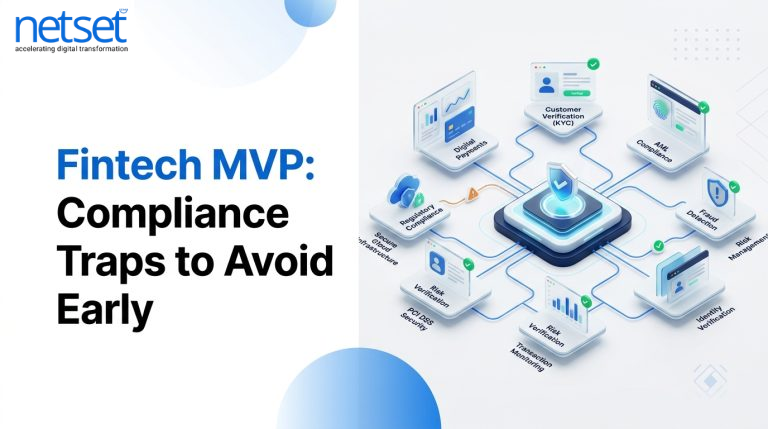
Building a fintech MVP is often a race against runway. You are trying to validate demand, ship features, and win early customers before a better-funded competitor arrives. The problem is that fintech is not a typical “move fast” category. A single compliance miss can block partnerships, freeze payouts, trigger bank offboarding, or force a costly rebuild of your core architecture.
The good news: you do not need an enterprise-grade compliance program on day one. You do need a compliance-aware MVP that avoids the early traps that create technical debt, legal exposure, and commercial friction.
This guide breaks down the most common fintech MVP compliance pitfalls, how to design around them, and how to build an MVP that is fast, partner-ready, and scalable through 2026–2030.

Why compliance mistakes hit fintech MVPs harder than other startups
In fintech, compliance is not just policy. It is product behavior plus data handling plus partner requirements.
A few realities founders learn quickly:
- Banks, card networks, and payment processors enforce their own rules and can terminate you faster than regulators.
- Compliance gaps create platform risk, which makes it hard to close enterprise customers and strategic partnerships.
- Many “quick MVP shortcuts” become hard-to-undo architecture decisions (identity, ledgering, audit logs, data retention).
Industry signal to take seriously: Global regulators have increased enforcement intensity across payments, crypto, lending, and AML over the past few years. Meanwhile, fraud continues to rise as onboarding becomes more digital and AI-driven. Decision-makers now expect compliance-by-design even for early-stage products, especially where funds movement is involved.
Quick definition: What “compliance” means for a fintech MVP
A fintech MVP typically touches several compliance domains at once:
- KYC/KYB: Know Your Customer / Business identity verification.
- AML/CTF: Anti-Money Laundering and Counter-Terrorist Financing controls.
- Sanctions screening: OFAC and other lists depending on regions.
- PCI DSS: If you store, process, or transmit card data.
- Data privacy & security: GDPR, CCPA/CPRA, GLBA, SOC 2 expectations from buyers.
- Consumer protection: Disclosures, fees, adverse action (lending), complaint handling.
- Licensing: Money transmitter, lending licenses, crypto registrations (varies by geography).
- Recordkeeping & auditability: Evidence for disputes, investigations, and partner audits.
An MVP can be small, but it still needs the right control points.
The 12 most common compliance traps (and how to avoid them)
1) Treating “we use Stripe” as your compliance strategy
Using a payment processor, BaaS provider, or card issuer helps, but it does not outsource everything. You still own:
- Customer experience and disclosures
- Risk decisions you embed in product flows
- Data privacy obligations
- Fraud outcomes and chargebacks
- Marketing compliance and claims
Practical fix: Create a simple RACI early (Responsible, Accountable, Consulted, Informed) for compliance tasks split across your company and vendors. Make it part of onboarding for engineers and product managers.
2) Choosing the wrong MVP model: “fake it until you make it” licensing
Many teams ship before they understand whether they are:
- A program manager under a sponsor bank
- A money transmitter
- A lender/broker
- A marketplace versus a principal
- A custodian or merely a software provider
That classification determines licensing, disclosures, and how contracts must be written.
Practical fix: Do a one-page regulatory classification memo before you write production code. This is the fastest high-leverage step you can take. It guides architecture and vendor selection.
Real-world example: A payroll-linked earned wage access MVP can drift into “credit” depending on fees, repayment mechanics, and marketing language. Teams that validate this late often have to rework contracts, flows, and state-by-state rollouts.
3) Poor KYC/KYB design: verifying identity but not proving it
Fintech MVPs often implement identity checks but fail to store adequate evidence:
- What signals were checked (document, selfie, watchlists, address, device)
- When checks happened
- What the outcome was and why
- Who approved manual overrides
- How often re-verification occurs
Practical fix: Design an identity verification ledger (not a funds ledger, an evidence ledger). Store vendor reference IDs, timestamps, risk scores, and decision reasons. Make it queryable for audits.

4) Not screening sanctions continuously (not just at signup)
Many MVPs screen only during onboarding. But sanctions lists update frequently, and risk can change. For some products, you also need transaction monitoring triggers.
Practical fix:
- Screen at onboarding and on material events (name change, payout destination change).
- Schedule periodic re-screening based on risk tier.
- Log screening version and list sources.
5) Building a “wallet” without a real ledger and reconciliation model
If your MVP touches balances, credits, rewards, cashbacks, stored value, or internal transfers, you need a clear approach to:
- Double-entry ledgering (or an equivalent auditable model)
- Idempotent transaction processing
- Reconciliation to external processors/banks
- Dispute and chargeback traceability
Trap: Teams build balances as a single “users.balance” field. This breaks audits, refunds, and chargebacks. It also creates unexplainable discrepancies.
Practical fix: Use an append-only transaction journal with strong idempotency keys, immutable entries, and derived balances. Even if you do not build a full accounting system, build your core like one.
6) Storing card data or secrets in ways that accidentally trigger PCI scope
A fintech MVP can fall into PCI scope by accident, for example:
- Logging PAN data in server logs
- Storing card details in analytics tools
- Capturing screenshots with card data in support tickets
- Allowing front-end forms to touch your servers before tokenization
Practical fix:
- Use hosted fields or tokenization from processors.
- Add automated log scanning for PAN patterns.
- Ensure support tooling redacts sensitive data.
- Implement secrets management from day one (vault/KMS).
Comparison: Hosted fields vs direct card capture
- Hosted fields/tokenization: Faster compliance path, smaller PCI scope, easier audits.
- Direct capture (you touch PAN): More control, heavier compliance cost, higher breach impact. Usually not worth it for an MVP.
7) Privacy compliance bolted on after analytics and growth tooling
MVPs commonly add:
- Session replay
- Event analytics
- Attribution SDKs
- Customer support chat widgets
These tools can collect PII, financial behavior, or even document images. If you later need to comply with GDPR/CCPA/GLBA expectations, you may be forced to rip out tooling.
Practical fix: Privacy-by-design in 5 steps
- Classify data: PII, sensitive PII, financial data, credentials.
- Minimize: collect only what the MVP requires.
- Tag events: ensure analytics does not ingest regulated fields.
- Centralize consent: one consent record per user, versioned.
- Implement deletion: real deletion workflows, not “soft delete only.”
8) Weak audit trails: you cannot prove who did what, when, and why
Auditors, partners, and enterprise buyers care about traceability. Your MVP should be able to answer:
- Who approved a manual KYC override?
- Who changed bank account details?
- Who initiated a payout?
- What was the risk score and policy version at decision time?
Practical fix: Implement an immutable audit log for privileged actions:
- Admin actions
- Risk engine decisions
- Payout changes
- Refunds and reversals
- Permission changes
Use write-once storage patterns where possible, and ship logs to a secure central store.
9) Manual operations without controls (support becomes a compliance risk)
Early fintech products rely on humans:
- Manual KYC review
- Manual refunds
- Manual limit changes
- Exception approvals
This is normal. The trap is doing it without:
- Role-based access control (RBAC)
- Dual control for high-risk actions
- Case management evidence
- Time-bound access
Practical fix: Add a lightweight ops console with:
- RBAC (Admin, Reviewer, Support, Finance)
- Reason codes and mandatory notes
- Approval workflows for risky actions
- Downloadable case history for audits
10) Cross-border complexity ignored until expansion
A US-first MVP often breaks when expanding to:
- UK/EU (PSD2/SCA expectations, GDPR rigor)
- APAC (local data residency, licensing, ID norms)
- MENA (KYC variations and document types)
Practical fix: Design “region as configuration,” not “region as code fork”:
- Region-based policy rules
- Pluggable identity providers
- Localized disclosure templates
- Data residency options (cloud region separation)
Future trend (2026–2030): Expect more real-time payments, tighter fraud controls, and stronger digital identity frameworks. Your architecture should support dynamic policy updates without redeploying core services.
11) Overpromising in marketing and onboarding disclosures
Compliance failures are not always technical. They often start with:
- “No fees” claims with exceptions
- Ambiguous APR and repayment language
- Misleading turnaround times
- Confusing “insured” statements for stored value
Practical fix: Maintain a disclosure registry:
- Every claim mapped to a product rule or contract clause
- Versioned copy across web, app, and emails
- Legal review workflow (lightweight, but consistent)
12) Shipping AI features without governance and explainability
By 2026–2030, fintech MVPs increasingly include:
- AI underwriting
- Fraud scoring
- Support automation
- Transaction categorization
- Personalized financial advice
AI adds compliance risks:
- Bias and disparate impact (especially in lending)
- Explainability requirements for adverse actions
- Model drift and monitoring
- Data provenance and consent
Practical fix: Implement “minimum viable AI governance”:
- Document model purpose, inputs, and limitations
- Keep training data lineage
- Monitor drift and key fairness metrics
- Provide human override paths
- Log model version used per decision
Business example: A retail lender using ML to pre-approve offers must ensure adverse action reasons can be surfaced in a consumer-friendly way. If you cannot explain decisions, enterprise partnerships and regulators will push back.

A practical compliance-first MVP blueprint (fast, not heavy)
Step 1: Map your money flow and data flow
Document:
- Where funds originate, move, and settle
- Who holds custody
- Which vendors touch funds
- What sensitive data you store and where
This becomes the foundation for scope: licensing, AML, PCI, privacy, and SOC 2 readiness.
Step 2: Define policies as configuration
Avoid hardcoding rules in UI logic. Put policies behind:
- A rules service
- Feature flags
- Region-based configs
- Versioned decision tables
This prevents rewrites when partners or regulators require changes.
Step 3: Build the “compliance spine”
At minimum:
- Centralized audit log
- Identity evidence store
- Transaction journal (append-only)
- RBAC for internal tools
- Secure secrets management
- Data retention and deletion workflows
Step 4: Choose vendors based on compliance interoperability
When selecting KYC, AML, BaaS, card issuing, or fraud tooling, evaluate:
- Webhooks and event completeness
- Evidence and reporting exports
- SLA and incident processes
- Regional coverage and data residency
- Pricing at scale (not just MVP)
Step 5: Run a partner-readiness checklist before launch
If you plan to partner with a bank, issuer, or enterprise:
- Document your controls
- Test incident response
- Validate logging and reconciliation
- Validate disclosures and customer support workflows
Common technology choices: what works best for fintech MVPs
KYC/KYB and AML tooling
- Best for MVP speed: Vendor-led verification with strong APIs and evidence export.
- Best for long-term control: Modular design where you can swap vendors without rewriting onboarding.
Ledgering
- MVP-friendly: Append-only journal + derived balances + daily reconciliation.
- Scale-friendly: Dedicated ledger service, event sourcing patterns, and robust idempotency.
Cloud and security
- Use cloud-native services for encryption, key management, WAF, DDoS protection, and audit logging.
- Implement least-privilege IAM from day one.
Where custom software helps most: The winning pattern is to buy compliance primitives (KYC, screening, tokenization) and build the differentiating layer (risk policies, UX, decisioning, ops workflows, ledger design). This is where NetSet Software typically supports fintech teams: architecting a scalable MVP that does not collapse during audits or partnerships.
Benefits of getting compliance right early (without overbuilding)
- Faster partnerships: Banks and processors approve you faster when your controls are clear.
- Lower rebuild cost: Correct early architecture prevents expensive refactors.
- Reduced fraud and chargebacks: Strong onboarding and monitoring reduce loss.
- Better enterprise sales: SOC 2 and privacy readiness shorten procurement cycles.
- Easier geographic expansion: Regional policy configuration prevents forks.
Challenges and trade-offs to expect
- More upfront design time: You will spend more time on architecture, less on “just shipping.”
- Vendor complexity: Managing multiple providers adds operational overhead.
- False positives: Early AML and fraud rules may block good users until tuned.
- Cost: Compliance tooling can be expensive. But rebuilding later is usually worse.
Future trends (2026–2030) that will shape fintech MVP compliance
- Real-time payments everywhere: Faster settlement raises fraud pressure and makes monitoring near real-time.
- Digital identity maturation: More reusable identity frameworks, plus higher expectations for strong authentication.
- AI regulation and auditability: More scrutiny on automated decisions, especially credit and fraud.
- Privacy enforcement and data localization: Multi-region data strategy becomes standard.
- Continuous controls monitoring: Enterprises will expect always-on evidence, not quarterly snapshots.
A fintech MVP built with configurable policies, clean audit trails, and modular vendor integrations will be better positioned for this environment.
Actionable recommendations (what to do this week)
- Write a one-page classification memo: what you are, what you are not, and why.
- Draw money and data flow diagrams and validate them with a compliance advisor.
- Implement append-only journaling for financial events, even in MVP form.
- Add immutable audit logs for admin and high-risk user actions.
- Ensure KYC and sanctions evidence is stored with timestamps and decision reasons.
- Reduce PCI scope with tokenization and log redaction.
- Put privacy controls in front of analytics and support tooling.
- Make policies configurable and versioned to avoid rewrites.
Frequently Asked Questions (FAQ)
What compliance do I need for a fintech MVP?
Most fintech MVPs need some combination of KYC/KYB, AML/sanctions screening, data privacy/security controls, audit trails, and possibly PCI DSS. Exact requirements depend on whether you move money, extend credit, or custody assets.
Can I launch a fintech MVP without licenses?
Sometimes, yes, if you operate under a sponsor bank or a regulated partner. But you still need compliance controls and partner-required policies. Misclassification is a common early mistake.
What is the biggest compliance trap for fintech startups?
Building money movement and balances without a real ledger and audit trail. This causes reconciliation failures, partner escalations, and expensive refactors.
Do I need SOC 2 for an MVP?
Not always. But many B2B fintech buyers and partners expect SOC 2-aligned controls early. Implementing audit logs, access control, encryption, and incident response basics from day one reduces future effort significantly.
How do AI features change fintech compliance?
AI introduces governance needs: explainability, fairness, drift monitoring, and model versioning. Even for an MVP, you should log model decisions and keep human override paths.
Conclusion: Build a compliance-aware MVP that can scale
A fintech MVP should be fast, but not fragile. The goal is not to build a heavyweight compliance organization. The goal is to avoid architectural and operational traps that block partnerships, amplify fraud, and force rewrites right when you need momentum.
If you are building a fintech product and want an MVP that is partner-ready, audit-friendly, and designed for scale, NetSet Software can help. We support founders and CTOs with fintech architecture, secure cloud implementations, AI integration, scalable ledgering, and compliance-aware engineering workflows.
If you want a quick technical review of your onboarding, ledger design, data flows, and compliance control points, contact NetSet Software for a consultation.
FAQs (Frequently Asked Questions)
Why do compliance mistakes impact fintech MVPs more severely than other startups?
In fintech, compliance encompasses product behavior, data handling, and partner requirements. Banks, card networks, and payment processors enforce strict rules and can terminate partnerships quickly. Compliance gaps create platform risk that hinders closing enterprise customers and strategic partnerships. Many quick MVP shortcuts result in hard-to-undo architecture decisions affecting identity verification, ledgering, audit logs, and data retention.
What does ‘compliance’ mean for a fintech Minimum Viable Product (MVP)?
Compliance for a fintech MVP involves adhering to multiple domains simultaneously including KYC/KYB (customer/business identity verification), AML/CTF (anti-money laundering and counter-terrorist financing), sanctions screening, PCI DSS standards for card data handling, data privacy laws like GDPR and CCPA, consumer protection regulations, licensing requirements depending on geography, and recordkeeping for audits and disputes. Even a small MVP needs the right control points to manage these areas effectively.
Is using Stripe or similar payment processors sufficient as a compliance strategy for a fintech MVP?
No. While payment processors like Stripe help with certain aspects, they do not cover everything. Your company remains responsible for customer experience and disclosures, embedded risk decisions in product flows, data privacy obligations, fraud outcomes including chargebacks, as well as marketing compliance and claims. A practical approach is to create a simple RACI matrix early on to assign compliance responsibilities across your company and vendors.
How should fintech teams choose the right MVP model to avoid licensing pitfalls?
Teams must understand their regulatory classification before shipping code—whether they are program managers under sponsor banks, money transmitters, lenders/brokers, marketplaces versus principals, custodians or software providers. This classification determines necessary licenses, disclosures, and contract structures. Conducting a one-page regulatory classification memo early guides architecture and vendor selection and prevents costly rework later.
What are common KYC/KYB design mistakes in fintech MVPs and how can they be avoided?
A frequent mistake is verifying identity without adequately proving it by failing to store evidence such as signals checked (documents, selfies), timestamps of checks, outcomes with reasoning, manual override approvals, and re-verification frequency. The fix is designing an identity verification ledger that stores vendor reference IDs, risk scores, decision reasons in a queryable format suitable for audits.
Why is continuous sanctions screening important beyond initial onboarding in fintech MVPs?
Sanctions lists update frequently so screening only at signup leaves risk exposure over time. Continuous screening on material events like name changes or payouts helps detect new risks promptly. For some products, transaction monitoring triggers are also necessary to comply fully with sanctions regulations and reduce legal exposure.