The healthcare industry is going digital very fast, and together with this, health and wellness app development is no longer just another layer to it. Every system dealing with patients’ data has to be secure and comply with the regulations, since otherwise, it may face severe consequences. Thus, having knowledge of HIPAA compliance becomes necessary for building any kind of application related to the healthcare field.
Being a healthcare provider, a startup founder, or an engineer responsible for developing regulated products, one has to have an understanding of what PHI security involves. This guide includes choosing the correct architecture for HIPAA compliance and implementing suitable measures to secure data.
It is important to note that a product based on HIPAA-compliant application development is not only about adding some security measures to a product. It is about building such a product in which the entire process is aimed at ensuring data protection, especially when it comes to health and wellness applications.
What HIPAA Compliance Means in Real Systems?
HIPAA defines how protected health information (PHI) must be stored, accessed, and transmitted. In a production system, that translates into enforceable technical controls.
PHI is any information that can be used to identify a patient and relates to their health, treatment or payment for health care. This includes obvious information like name and diagnosis, and also non-obvious information like device ID, date and time of appointment and location information when paired with medical record information.
From a system perspective, compliance requires:
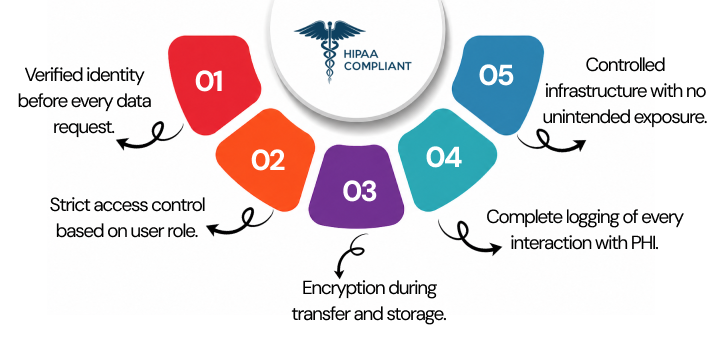
- Verified identity before every data request.
- Strict access control based on user role.
- Encryption during transfer and storage.
- Complete logging of every interaction with PHI.
- Controlled infrastructure with no unintended exposure.
These controls must be implemented in code, infrastructure, and operational workflows. Documentation alone does not create compliance.
Data Flow Design Comes First
Before writing application logic, define how data moves through your system. This step prevents hidden exposure points later.
Map the following:
- Entry points such as mobile apps, web portals, and APIs.
- Processing layers, including backend services and queues.
- Storage systems such as relational databases and object storage.
- External services that receive or process data.
Clear data flow mapping allows you to define where encryption is required, where access must be validated, and where logs must be controlled.
Infrastructure Configuration Defines Your Security Baseline
Using a cloud provider that supports compliance is necessary, but it does not secure your system by default.
You need to configure:
- Private networking for internal services.
- Restricted access using identity and access management.
- Multi-factor authentication for administrative accounts.
- Storage systems with public access disabled.
- Centralized secret management for credentials.
A frequent issue in HIPAA compliance application development is misconfigured storage. Teams deploy quickly, leave default settings unchanged, and expose sensitive data unintentionally. This is preventable with proper configuration reviews.
Every deployed service should be evaluated for external exposure before it reaches production.
Encryption Must Be Applied Without Exceptions
Encryption prevents unauthorized access to PHI and needs to be applied in the entire system. For data in transit, TLS needs to be used in all endpoints for the secure exchange of information between clients and servers. HTTP requests that are not secure must be filtered out by the gateway, and services must communicate using secure connections.
All data in any state must be encrypted everywhere, starting from databases to backups. The use of strong encryption technologies such as AES-256 is essential because it ensures that none of the PHI information can be decrypted without proper authorization.
Key management requires being kept separate from the application code using dedicated key management systems. Proper access control and regular rotation of keys should be implemented to ensure proper handling of encryption keys.
Access Control Must Be Enforced in Backend Logic
Role-Based Access Control is used to determine who has access to what data. It should be enforced on the backend, not merely through the UI.
Typical roles include:
- Patients accessing their own records.
- Doctors accessing assigned patients.
- Administrative staff with limited operational access.
First of all, the request has to be validated for the information to be obtained. For example, where the doctor requests the information about a patient’s access, there has to be validation of the request to confirm whether the patient is really under that doctor.
OAuth 2.0 should be used for authentication purposes. All token-based systems should have an expiration and refresh process implemented.
Logging and Monitoring Are Required for Traceability
Every interaction with PHI must be recorded.
A complete log entry includes:
- User identity.
- Action performed.
- Timestamp.
- Resource accessed.
- Source IP address.
Logs should be maintained in an environment that does not allow any alteration to their contents once they have been created.
API Security Must Be Strictly Controlled
APIs are the primary interface between users and your system. Poor API design leads to data exposure.
Each API must enforce:
- Authentication on every request.
- Input validation for all parameters.
- Output filtering to limit returned data.
- Rate limiting to prevent abuse.
Avoid returning full datasets when only partial data is required. This reduces exposure and improves performance.
Centralized API gateways can assist in ensuring uniform security standards for applications.
Data Minimization Reduces Risk
Store only the data you need.
Do not collect any identifiers that you do not need. Where feasible, use hashing and tokenization in place of retaining sensitive information.
Logins should never contain PHI. During development, teams often log full request payloads for debugging. This practice must be restricted in production environments.
The backups should be as secure as the main storage medium since unprotected backups lead to many data breaches.
Third-Party Services Must Meet Compliance Requirements
The services that manage the PHIs need to abide by HIPAA guidelines since the security perimeter gets extended beyond your internal infrastructure. You will have an extended regulated environment that needs to comply with the security controls for confidentiality, integrity, and availability.
A Business Associate Agreement is needed before you integrate third-party services so that the service provider becomes a legal obligation to adhere to HIPAA. It is essential to gain insight into the security policies of the vendor in relation to encryption, access control, and monitoring.
Emails, analytics, and messaging systems pose high risks, and hence require particular attention to ensure that there are no leaks of PHI.
Security Must Be Part of the Development Process
Security checks should be integrated into daily development workflows.
This includes:
- Code reviews that include security validation.
- Automated scans for dependency vulnerabilities.
- Static analysis tools to detect insecure patterns.
- Penetration testing before release.
Continuous integration pipelines can enforce these checks automatically. This reduces the chance of deploying insecure code.
Cost Structure of HIPAA Compliant Systems
Building compliant systems increases cost, but these costs are predictable.
Expect:
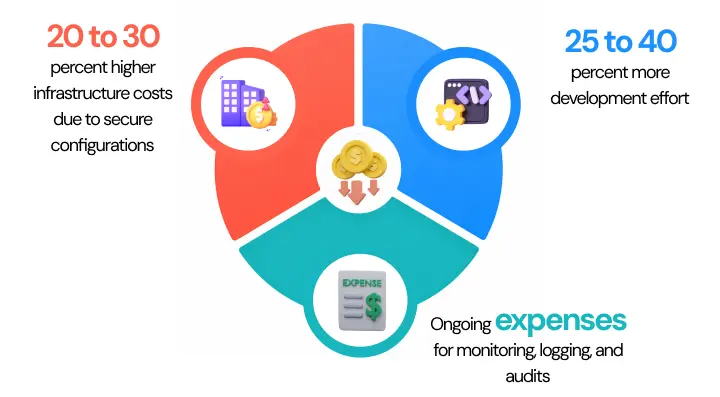
- 20 to 30 percent higher infrastructure costs due to secure configurations.
- 25 to 40 percent more development effort.
- Ongoing expenses for monitoring, logging, and audits.
These costs reflect the additional controls required to protect sensitive data. Skipping them creates far higher financial and legal risk.
NetSet: Practical Execution in HIPAA Compliant Software Development
The NetSet Software framework provides solutions to companies developing regulated systems via HIPAA-compliant software development services. The emphasis is on developing secure system architectures that are compliant with regulatory guidelines without compromising on development timelines.
When developing apps for health and wellness applications, execution tends to fail at the backend and infrastructure levels. NetSet Software addresses this by handling data flow design, encryption implementation, access control systems, and compliance documentation required for audits.
Organizations building or evaluating best HIPAA-compliant management software benefit from working with teams experienced in HIPAA compliance application development, especially when internal resources lack deep security expertise.
Conclusion
HIPAA compliance development is enforced through engineering decisions. This needs consistent management of data access, storage, and transmission within the system.
In case you are developing applications in the healthcare sector, it is necessary to have each and every layer secure. This will ensure that there are no security issues.
With proper implementation, the system gains reliability, stability, and protection of user information to build upon in the future.
Prefer Reading: AI-Driven Healthcare Companion for Advanced Patient Care & Diagnosis Case Study

FAQs
What makes software HIPAA compliant in real production use?
The HIPAA-compliant software comes equipped with functionalities like encryption, controlled access, security of application programming interfaces, auditing, and security infrastructure that ensure all PHI data is handled properly.
Why does backend enforcement matter so much in HIPAA-compliant applications?
Back-end validation helps in providing protection against any sort of bypassing. If the front-end fails, the back-end will validate whether the person accessing protected health information is authorized or not.
Where do APIs create risk in health and wellness apps?
APIs become risky when they are not tightly controlled. If authentication is weak or input checks are missing, sensitive patient data can slip out through simple requests. In many healthcare systems, API misconfiguration is one of the first places where data exposure happens.
How does infrastructure affect HIPAA compliance?
Infrastructure determines the way data is stored and retrieved. Poor configuration of the cloud service, exposure of storage, or inadequate identity management can render any application layer security mechanism ineffective.
Why is data minimization important in HIPAA-compliant software?
Data minimization minimizes exposure risks through minimal storage of sensitive data. The collection of necessary data minimizes the effects of data breach attacks and streamlines compliance by minimizing the handling of protected health information.