We cannot deny the fact that there are a lot of transformations going on in the digital-savvy world, like shifting from a model of piracy of assets to verifiable and executive ownership. This change is made possible with the help of Non-Fungible Tokens or NFTs, or digital collectibles, which are fast becoming the preferred method for proof and transactions.
It was once seen as just digital art, but now it has grown into a foundational Web3 infrastructure layer. This revolution now demands immediate attention from business leaders, investors, and entrepreneurs who see that digital assets are the future of consumer engagement. The global market of digital collectibles is already set to reach $211.72 billion by 2030, and the shift you are planning shall come now.
But how to get started and what all should you know about digital collectible development software to create a high-performing collectible marketplace? Well, keep up with this blog, and you will eventually find everything out.
The Fundamentals of Digital Collectibles
To get the full potential of this market, it is important to understand the technical architecture behind digital collectibles. This journey begins with the concept of fungibility, so let us just understand a few things.
Understanding the Non-Fungible Token (NFT)
When we look at fungible assets, they can smoothly be exchanged for another unit of the same type without any loss of value, like swapping one $10 bill for any other $10 bill. The bitcoin and standard fiat currencies are fungible and work like it, due to their identical, interchangeable, and divisible nature.
Non-fungible tokens or digital collectibles are the opposite. They are unique and indivisible and represent specific verifiable ownership of a digital or physical asset. An NFT is more importantly a digital certificate of authenticity and ownership, which is encoded in blockchain via technical standards like Ethereum’s ERC 721 or ERC 1155. Whether the asset is digital art, a rare music track, virtual land, or an in-game item, the NFT itself is the proof of title, giving the owner the exclusive rights over that specific, tokenized asset.
How do NFTs work with blockchain and smart contracts?
The ability to prove scarcity in a world of easily copied fields is enabled by two core Web3 technologies: blockchain and smart contracts. Here, blockchains work as an immutable, decentralized public ledger. When a digital collectible is built, a process known as minting, which is its unique metadata, where details like the creator, transaction history, and link to the digital file are permanently recorded and verified on this ledger.
The real engine is for sure the smart contract, which is written in code and deployed on the blockchain, and it is a self-executing agreement with all the rules of the NFT. It automatically assigns initial ownership to the creator, governs how the token is transferred to a new buyer, and critically applies predefined rules such as creator royalties. Also, smart contracts make sure that every time the NFT is resold on a secondary market, the original creator does receive a fixed percentage of the sale price, thus transforming how digital creators monetize their work.
The Digital Collectibles Market Ecosystem in 2025
The digital collective market has really matured after evolving from a novelty to just a basic need, driving a large portion of the Web3 economy. We have to understand the scale and direction of this market before actually planning to launch or invest in a digital asset development idea.
Market Growth and Projections
The market has of collectibles is not just a hype anymore as it now shows powerful, utility-driven growth, and some strong numbers:
- Valuation: The global collectibles market will reach $211.72 billion by 2030 with 30% CAGR. This trend confirms the market’s stabilization and shift toward practical long-term application.
- Demographics: Millennials who are born between 1981 to 1996 represent the largest segment of active NFT users and investors, thus valuing the digital assets for both investment and strong community affiliation.
- Geographical Dominance: While North America leads in transaction dollar volume, the Asia-Pacific region is already dominating global user adoption and transaction count, largely driven by high engagement in mobile-first blockchain gaming environments.
Key use cases that go beyond art
While digital art remains quite a big visible segment, the true engine of market volume still is innovation in utility-driven apps. The single largest category by transaction volume is gaming, as NFTs give players true ownership of in-game assets like skins, weapons, virtual land, and characters, so that a fair play to earn model is built.
More than gaming, utility, and membership NFTs are also coming out as the future of tokenization identity, as these assets function as digital access passes giving exclusive entry into online and physical communities (token gating). And, not only this, you also get loyalty rewards and verifiable event tickets, making the shift of NFT from a static image into an active one. At the end, the concept of tokenized real-world assets is also gaining too much traction, as complex smart contracts allow for fractionalized or full ownership of high-value physical goods like real estate or luxury collectibles, covering the gap between digital and traditional finance.
Building the Digital Collectible Ecosystem
The success of any NFT project connects with its technology, so businesses mainly have to focus on two core areas, i.e., choosing the right blockchain and making use of specialized development services to deliver speed, security, and scalability.
Understanding Infrastructure Choice and Why High Throughput Chains Dominate
While Ethereum and its layer 2 solutions remain important for liquidity and blue-chip collections, the high-volume, utility-driven market is very much migrating to high-throughput and low-cost layer 1 chains.
Solana- the go-to for mass adoption
Solana has come out as the premier choice for NFT development when it comes to gaming and large-scale membership projects due to its architecture and economic advantages. It has a unique proof of history consensus, which lets it process thousands of transactions per section with sub-second finality. This high speed is important for responsive gaming experiences and large-scale, high-frequency minting events.
Then, low transaction costs, averaging only a fraction of a cent, which is around $0.00025 per transaction, remove the barrier of high gas fees, which are often seen on other chains, thus making microtransactions, bulk minting, and trading easily accessible to everyone. The platform also boasts a strong development ecosystem where it utilizes the Rust SDK for secure and efficient smart contract creation, which again attracts top-tier technical talent.
Core Development Services to understand for a robust platform
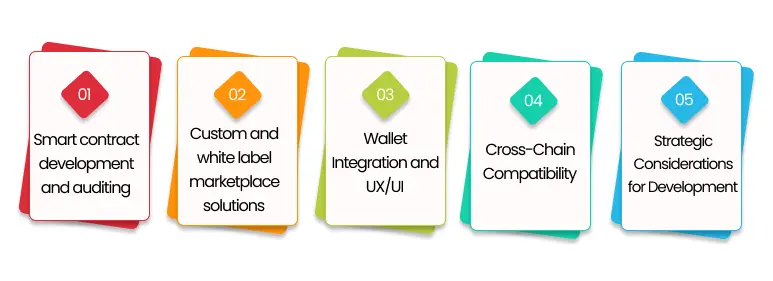 Now, developing a professional, secure, and scalable NFT platform requires specialized expertise across multiple domains. Most enterprises pick partners with a dedicated NFT development company to manage this complexity and normally look for the below important services:
Smart contract development and auditing
It is about writing secure, efficient, and audited smart contracts like Metaplex on Solana or ERC 721/1155 variants on EVM chains, which is the foundation. There can be audits by third-party security firms, which are mandatory to protect user assets and prevent important risks.
Custom and white label marketplace solutions
Custom development is building a unique trading platform from scratch, where a business decides everything.
White label solutions use prebuilt, tested, and custom software frameworks to launch a branded marketplace quickly within weeks, thus lowering time to market and costs, which suits startups.
Wallet Integration and UX/UI
This includes integrating multiple popular wallets like Phantom and MetaMask, and also designing a user-friendly interface that not only looks good but is also simple to use. The users who find the user interface easy to use are more likely to be on board with a platform as compared to users who get confused with the layout of Web3 technology.
Cross-Chain Compatibility
Adding solutions to allow the transfer and trading of assets on multiple blockchains, like moving an NFT from Ethereum to Solana or vice versa. This maximizes the liquidity and market reach of a platform, thus driving success in the short as well as long run.
Strategic Considerations for Development
Moving from concept to a successful, enterprise-grade digital collectibles platform requires making strategic, forward-looking decisions about technology and proper risk management. With these decisions, your idea goes towards the right scalability, security, and market reach.
Choice of the right technology stack
Selecting the foundation blockchain is without any second thought, the most important technical decision, as it determines the project’s performance, costs, and developer ecosystem. This one starts with the choice of blockchain, which should be done only after aligning the project’s goal.
For example, Ethereum remains the standard for blue-chip collections and gives maximum liquidity by making use of layer 2 solutions like Arbitrum for cost efficiency. Then, Polygon is used mostly by large brands due to its EVM compatibility and proven scaling solutions. For high-volume projects like those involving tokenization of real-world assets or rapid-fire gaming mechanics, Solana continues to deliver unmatched speed and near-zero cost necessary for mainstream adoption.
Now, after blockchain, there comes the choice of development tools, starting with the front-end development, which uses frameworks like React, while backend services often rely on Node.js. However, due to the secure nature of smart contracts, languages like Rust are popular for Solana infrastructure. The necessity of strong digital collectibles development software cannot be overstated, as it streamlines deployment, automates metadata structure, and manages the complexity of cross-chain compatibility solutions.
Security, Royalties, and IP Management
Other than the tech stack, three core areas also govern the long-term viability and trust of an NFT platform.
- Smart contract audits are due to the immutable nature of blockchain code.
- Creator royalties because smart contracts are powerful for managing IP rights and automatically distribute creator royalties on every sale.
- IP rights and RWA, because the creators usually retain the core IP unless they wish to transfer it to some other party.
Ready to build your NFT infrastructure? Collaborate with NetSet Software.
Going through the complexities of smart contract auditing, multi-chain integration, and white label NFT marketplace development requires a seasoned technical partner. We NetSet Software, are a premier blockchain development service provider having key specialization in custom web3 solutions, so whether you want to build a high-speed Solana NFT marketplace development package or a tokenization physical assets or any other solution, our team will deliver you the quality you require for success.
FAQs
What separates crypto tokens like Bitcoin from a digital collective NFT?
It is just about the fungibility difference, so crypto tokens like Bitcoin are fungible means their every unit is identical and interchangeable, whereas a digital collectible is non-fungible.
Is the NFT market just a bubble this year, or will it keep on growing in the coming years?
The market has stabilized and shifted its focus. While trading of simple images has cooled down, the market for utility-driven NFTs like gaming assets, properties, and digital identity is growing and will keep growing at a really fast rate.
What will be the best blockchain for an NFT project?
The best depends on your specific needs because all are the best ones. But still, Solana is the top choice for gaming and high-volume collections, and Ethereum is used for high-value art and luxury projects.
What is a white label NFT marketplace, and is it different from a custom one?
Yes, a white label NFT marketplace is a prebuilt and ready-made product that you can use to make a few tweaks and launch in the market, whereas custom ones are the ones that you design from scratch.
How can I earn royalties on my digital collectibles?
You can program royalties into the smart contract during the development phase so whenever an NFT is traded, you will get a revenue share.