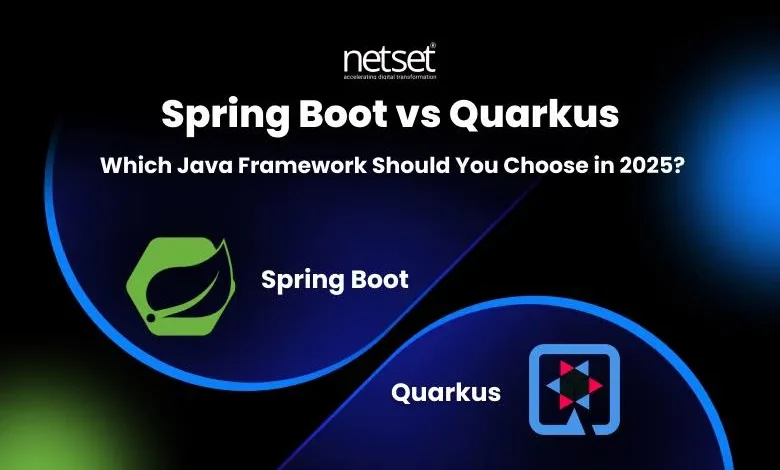
Java remains a powerhouse for building everything from enterprise web portals to modern microservices in 2025. As organizations face new challenges in performance, cloud deployments, and developer productivity, the choice of framework matters more than ever. When talking about frameworks, it seems that the confusion between these two leading contenders stays in high debate- the Spring Boot and Quarkus. We cannot doubt that both are shaping the ecosystem of businesses in creating fast, reliable, as well as scalable apps, but which is the best fit for your needs?
Well, this is what we are going to talk about today, and this guide will help international businesses, CTOs, and developers to explore the similarities, differences, and real-world considerations for selecting Spring Boot or Quarkus for the present as well as the future.
Understanding Spring Boot and its major strengths
Spring Boot is a mature, stable, and quite popular framework which is born out of the Spring ecosystem. It streamlines Java web app development by removing boilerplate (repetitive) configuration and providing building blocks that are always ready to use.
Some of Spring Boot’s strengths are:
- Auto-configuration, which automatically sets up your application based on present dependencies.
- Embedded server, as it bundles Tomcat, Jetty, or Undertow, so apps run standalone.
- Conventions over configuration because smart defaults speed up new projects.
- Full ecosystem as there are features modules meeting the security, data access, messaging, web services, and monitoring requirements of businesses.
- Flexibility in scalability because there is support for both monolithic and microservice architectures that easily connect with Spring Cloud tools for resilience and distributed systems.
Businesses rely on Spring Boot for enterprise web portals, e-commerce platforms, banking systems, and mission-critical backend processing.
Understanding Quarkus with its major qualities
Quarkus is a rising star in the Java world, which is built for the age of cloud, containers, and Kubernetes, or meeting the most modern DevOps requirements. Some of the key qualities of Quarkus are:
- Native to Kubernetes as it is tweaked for seamless operation in containerized environments.
- Fast startup and low memory achieve near-instant boot times and minimal resource usage, which is perfect for microservices, serverless, and reactive applications.
- Native compilation of code due to the deep integration with GraalVM for creating native binaries that start up in milliseconds.
- Dual programming models as it supports both imperative and reactive development.
- Ease for developers because its features, like live reload, streamlined configs, and modern tooling, speed up feedback and delivery.
Quarkus is intended for teams determined to maximize efficiency, scale, and readiness for next-generation cloud deployments.
The Common Similarities Between Both
While different in philosophy and technical focus, Spring Boot and Quarkus share some important traits that you must know to properly make the differentiation:
Well, first of all, both frameworks are open source and support full Java standards, so you do not have to worry about planning a commercial budget to use these frameworks. Then you have powerful dependency injection with RESTful web service creation and architecture patterns that stay in proper layers. Not to forget that both have enterprise-grade security, where they easily deliver authentication and authorization features. And, if you are curious about plugins or extensions, then you must know that both have vibrant support for extensions and plugins, meeting the requirements of different ecosystems.
Differences in the Features Between the Two
Now, let us break down some of the most important differences related to the features between the two.
| Feature | Spring Boot | Quarkus |
| Boot-up time taken | Slow since it takes about 1 to 4 seconds on the JVM | Quite fast since it takes just 10 to 100ms right in the native mode |
| Average Memory Use | Higher since it takes about 200 to 500MB generally | Low since the memory usage is only 35 to 100MB in the native mode |
| Native execution support | Does not come default, supports Spring AOT + GraalVM | Comes with GraalVM native support right out of the box |
| Developer Tools | Quite Mature, stable, vast documentation | Modern CLI, live reload, interactive Dev UI |
| Cloud Integration | Mature with Spring Cloud, Netflix stack | Built-in OpenShift, Kubernetes, serverless |
| Programming Model | Mostly imperative, with WebFlux for reactive | Equally strong imperative & reactive support |
| Learning Curve | Gentler, more docs, huge community | Steeper, newer APIs, smaller community |
Quarkus is preferred for speed, lightness, and innovation, and Spring Boot wins when it comes to familiarity, modules, and right stability.
How is the Community Support different in both?
Community support is very helpful because there are a lot of times when the problem is too complex and the development team requires support from people who have also faced a similar problem. When we look at Spring Boot, it has one of the largest Java communities in the world, where thousands of tutorials, sample projects, and Stack Overflow answers are available for the user. All the major enterprises and cloud vendors deliver proper and regular support and updates for the framework. There is also a continuous contribution from Pivotal/VMware and the whole Java ecosystem, which remains a key reason behind this thriving framework.
Now for Quarkus, it is also one of the rapidly growing frameworks, which is backed by none other than Red Hat and IBM, which are big names in the tech market. There is a strong focus on open-source collaboration but the knowledge base remains smaller due to the fact that only more youth are inclined towards this framework. Also, you can find plenty of GitHub repositories and Discord/Slack channels for fast learning or clearing confusions while working with Quarkus.
Drawing a comparison of the scalability potential between Spring Boot and Quarkus
While determining a technology, an important factor for the decision is the stability potential, and why not? Scalability is important for modern businesses like those in SaaS, logistics, finance, and e-commerce. When we consider Spring Boot, it is a proven winner for scaling traditional enterprise solutions. It supports both vertical and horizontal scaling, plus you can easily integrate it with Spring Cloud for microservices, distributed configuration, API gateways, load balancing, and circuit breaking. It is also ideal for strong, resilient systems, like handling heavy and consistent traffic without any issues.
On the other hand, Quarkus shines for cloud-native, event-driven systems due to its ultra-lightweight startup for rapid containerized scaling up and down. It is also a perfect match for Kubernetes auto scaling, FaaS/serverless platforms, and edge computing. You will also appreciate the reactive architecture of this framework, which enhances performance for real-time and highly parallelized workloads.
Differences in the Use Cases Between Both
Spring Boot is often the default for:
- Enterprise web applications
- Banking and insurance portals
- Long-lived internal applications
- Apps requiring complex security or stable integrations
Quarkus is the framework of choice for:
- Microservices architectures need lightning-fast scale
- Serverless and FaaS deployments
- Projects focused on low latency (IoT, streaming, edge)
- SaaS start-ups and innovation labs wanting speed
Do Both Technologies Integrate Well with Existing and Modern Systems?
Instead of keeping the integration part in difference, we kept it together because both frameworks are not behind each other when it comes to ease of integration; however, there is a difference in strengths. Just for example, Spring Boot connects with legacy Java or JEE systems, data sources, enterprise message buses, and ERP/CRM software right in the native mode with its deep ecosystem, giving plug and play mode.
On the other hand, Quarkus is created for integration with cloud platforms, REST APIs, and async/reactive stacks. Its numerous extensions deliver direct bridges to legacy platforms, Kafka, NoSQL databases, and more. Docker and Kubernetes support stays at high priority, so it fits perfectly in modern DevOps pipelines.
Top apps built using Spring Boot vs Quarkus
For reference, you must be wondering what some of the apps that are created using the power of Spring Boot vs. the apps built with Quarkus are. So, starting with Spring Boot, Netflix’s back microservices and Alibaba’s many bank core APIs are using none other than Spring Boot. Some other applications include Zalando’s e-commerce backends and Spring Petclinic and Piggymetrics (top GitHub learning projects). Coming to Quarkus, it is popular at Red Hat OpenShift products, IBM hybrid cloud solutions, and Lufthansa systems’ microservices. Also, most of the modern SaaS tools and edge/cloud-native apps for finance, logistics, and IoT use Quarkus as their preferred technology.
These companies utilize their chosen framework’s unique attributes to build fast, reliable, and scalable services at scale.
Still Confused? NetSet Software Might Help You
If you’re unsure whether Spring Boot or Quarkus is right for your project, NetSet Software can help you navigate the choice. Our team offers full-stack Java development services, including Spring Web App Development, Spring Boot Development Services, and high-performance Quarkus web development.
Whether you’re looking to modernize legacy systems, launch a cloud-native SaaS, or simply want to hire Spring Boot Developers in India for cost-effective and expert solutions, we provide end-to-end guidance, architecture advice, and delivery. From early project planning to the audits related to scalability and the handson builds, NetSet Software’s Java engineers deliver your business a solution that is robust, efficient, and future-ready in every way.
Conclusion
When you choose between Spring Boot and Quarkus, you must be clear about your business goals, the tech ecosystem you are in, and your plans. For Spring Boot, you get great enterprise stability, while Quarkus is the modern tool of choice for new cloud or microservice ventures. There is no denial that both have their strengths, massive ecosystems, and integration capabilities with support from vibrant communities. You can always go for expert help from a trusted development company like NetSet Software, and get clear direction.
FAQs
Should I use Spring Boot or settle with Quarkus for my web app in 2025 and also after that?
If your focus is on enterprise integration, a large number of ready modules, and stable documentation, then frankly speaking, Spring Boot is best. If you need ultra-fast startup, small memory usage, and easy cloud scaling, Quarkus is worth trying for the same.
Is it easy to find developers for both frameworks?
Spring Boot developers (like those you can hire in India) are widely available. Quarkus is newer but gaining fast; the talent pool is still growing but robust.
How do costs compare for Spring Boot vs Quarkus web development?
You can expect development costs to be nearly similar because both are Java frameworks, but operational (hosting, cloud) costs are often low as compared to Quarkus due to higher efficiency when you are in containerized environments.
Can I switch from Spring Boot to Quarkus later?
It’s possible since both use Java standards. But switching can require significant rework, especially for complex architectures. Plan or consult with experts like NetSet Software.
Do both integrate with modern DevOps tooling like Docker, Kubernetes, CI/CD, etc?
Yes, expect both frameworks to deliver you excellent integration and plenty of resources right out of the box for modern deployment pipelines.