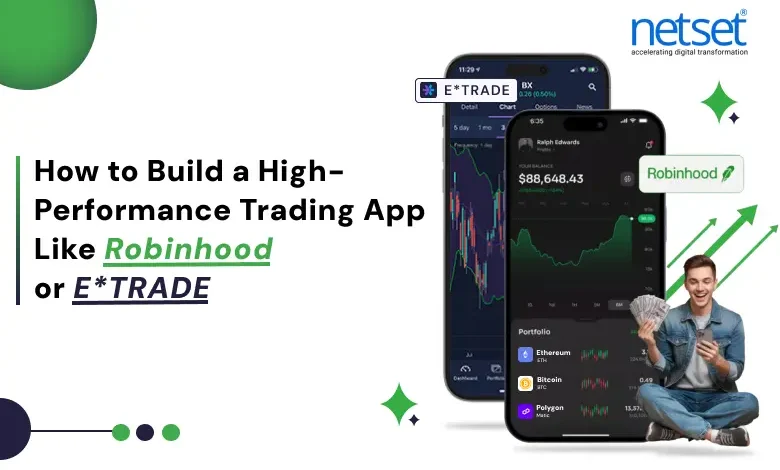
Just in these recent years, trading apps like Robinhood and E*TRADE has brought a revolution to the investment industry by making stock and cryptocurrency trading accessible to millions of investors. Their high-performance platforms do empower users with real-time data and smooth trading within a user-friendly interface.
And now, as the blockchain technology matures further, there are so many businesses that are planning to combine traditional trading functionalities with Ethereum and Solana to launch the next trading app.
If you are also in the same boat, understanding the key elements behind successful trading app development is really important. We will understand everything in this blog in order to create an app like Robinhood or E*TRADE, right from features, development lifecycle, budgeting, and a lot more.
Market stats with respect to Robinhood and E*Trade
The best possible way to start this guide will be discussing the current market because the investment ecosystems bring some shocking numbers to anyone planning to create an app like Robinhood and E*Trade.
These companies did not just digitize trading; they actually have democratized it by building a zero-commission model in the industry. This trend is solely bringing the retail investor segment to invest more, as their investment has already reached around 70% of the entire e-brokerage market.
- Robinhood reported an increase of total platform assets of 119% year-over-year, which is $333 billion.
- The Android app of Robinhood alone has crossed 10 million downloads on the Google Play Store, showing their dominating user acquisition.
- Emerging economies like India are also seeing a boost in investments as account numbers skyrocketed to over 150 million.
- The E*TRADE app has more than 1 million downloads on the Play Store and maintains a consistent rating of 4.2 stars, which is again a solid number for any investment app.
All these numbers show that the opportunities in trading app development are vast and solid when it comes to building an app like Robinhood or E*Trade.
Core features that make Robinhood and E*Trade stand out
When an app balances simplicity for retail investors with powerful, advanced tooling, the chances to achieve market success go up for them. Here are the five core pillars of functionality.
Smooth, high-speed execution and real-time data
The foundation of a successful platform is speed because instant trade execution and a true commission-free trading model are foundational for any trading and investment app, which does demand a robust, proprietary order routing system. A few functionalities like real-time quotes, dynamic level 1/level 2 data feeds, and advanced and responsive charting are some important ones that you cannot ignore. Platforms like E*Trade deliver deep analytical tools and research integration, while Robinhood focuses on a sleek, mobile-first dashboard that removes the complexities of using such an app without sacrificing data integrity.
Solid Portfolio Management
Users expect complete, cross-platform control over diverse assets like stocks, ETFs, options, and cryptocurrencies. Here, fractional share trading is now standard, notably lowering the barrier to entry. The app must provide clear, actionable visualizations of realized and unrealized gain, historical performance, dividend history, and an accurate, dynamic cost basis calculator. The goal is to turn complex financial tracking into a really easy-to-use interface with a consumer-grade experience.
Strong Risk Management and Security
As the trading environment becomes more complex, robust tools like managing risk are important. This includes support for diverse order types beyond simple market and limit orders, like stop loss, take profit, and trailing stops. Here, security stays important, needing multi-factor authentication, biometric login, and transparent regulatory compliance information to create user trust.
Integrated Research and Education
Modern traders use the app as their primary financial information source. The platform should give seamless integration of relevant financial news, company fundamentals like earnings and balance sheets, and solid analysis ratings directly within the stock profile. Furthermore, giving structure and gamified educational modules will help users quickly understand complex products like options or margin, thus making more responsive investing habits.
Engagement and onboarding
Simple, rapid onboarding like KYC/AML is important for user acquisition. The customizable, timely push notifications are important, alerting users to price movements, order fills, or breaking news. Then gamification elements like immediate visual trade confirmations, like the famous confetti effect, and progress tracking keep engagement high and make the financial world less intimidating when it comes to younger demographics. The key is a low-friction entry combined with high value and constant interaction.
What can we learn from Robinhood’s tech stack and blockchain use cases?
When we talk about a successful new platform, there is a team standing strong with blockchain development services who will also agree that the backbone is the technology platform. The decision between creating traditional centralized cloud infrastructure and connecting decentralized ledgers (blockchain) is an important strategic choice that maintains the scalability, latency, and cost in a platform.
Comparing the architectures of Robinhood and E*Trade
Early players like Robinhood built their systems to be cloud native from day one, where they made use of public cloud providers like AWS. This choice focused on microservices, which, if we analyse are mostly written in Python or Django and Go, Postgres databases, and data streaming using Kafka for horizontal scalability. From such architecture, the platforms handle big, unpredictable boosts in retail user volume and deliver a low-friction mobile-first experience.
In comparison, set brokers like E*Trade (now part of Morgan Stanley) have historically relied on more traditional, purpose-built systems. While really fast evolving to adopt cloud components, their architecture must manage decades of legacy accounts, comply with extensive regulatory requirements, and support highly complex features for professional and active traders, like advanced charting and desktop platforms. The tradeoff is clear: Robinhood optimizes for simplicity and retail scale, while E*TRADE optimizes for features and legacy integration.
Blockchain use cases and platform selection
Modern trading apps must also take care of blockchain because for crypto current and future asset tokenization, this becomes important.
- Ethereum brings high trust but also high cost and is most suitable for complex operations like asset tokenization.
- Solana blockchain app development brings high speed at low cost because it’s designed for speed and volume, suits best for real-time in-app payments (Solana Pay) or fractional stock trading on-chain.
[Prefer Reading: Blockchain Use Cases and Applications Industry]
The Trade-offs in Decentralization
When selecting a technology platform, the important decision is the degree of centralization:
- Centralized cloud, also Robinhood’s core model, delivers maximum performance, lower operational overhead, and full control over security and regulatory compliance.
- Decentralized blockchain (crypto/DeFi integration) gives immutable record keeping and transparency and removes single points of failure, but comes with complexity, regulatory elements, and bottlenecks as per the chain choice.
However, a good suggestion is also a hybrid architecture because the industry is setting on fast, centralized cloud platforms for core trading experience and user data, but also using secure, decentralized ledgers for functions like asset ownership and custody.
Building your development team
Building a high-performance trading app requires a specialized, multidisciplinary team structure. The focus must be on mixing high-speed system engineers with deep financial and regulatory knowledge.
Phase 1 Team
Normally, the team can be seen in 3 structures. The first one is your front-end and back-end structure, where front-end developers will be important for creating your mobile and web experience from the looks and design part. They might create a button, but when you click on it, it won’t be working unless the backend developers create the code behind it. All your elements, like ultra-low latency trading systems, distributed streaming, and sharded databases, are created and managed by the backend developers.
Phase 2 Team
For phase 2, you have blockchain developers (either working on the Ethereum or Solana blockchain platform) who are important for integrating cryptocurrency, custodial solutions, and future asset tokenization in your application. Then the DevOps engineers make sure about automation, system performance, and microservices architecture on the cloud.
Phase 3 Team
Finally, in phase 3, there go quality analysts (with, of course, security engineers and compliance experts) and marketers (if you hire any). But do remember that all these team roles are managed by one or more project managers who will be in contact with you with the right reports of the whole team.
In-House vs. Agency Approach
When sourcing this talent, the key decision stays between a dedicated in-house team and external specialized agencies. The in-house teams deliver you maximum long-term control, solid institutional knowledge, and a deeper commitment to the company’s culture. But they are expensive and may be slow to scale in the future.
However, a specialized app development agency has rapid access to vetted, niche expertise, giving you a faster time to market and less burden, making them ideal for thousands of the biggest project launches.
What does the development lifecycle from MVP to full-scale launch look like?
Now that you know the features and team members, it is also important to have an understanding about the development phase. It might look small and quick in reading, but there is a lot happening when you actually head into development.
- Phase 1 is market research and feasibility, where you define the target user, identify key competitive gaps, and lay down the technical feasibility of achieving sub-second trade execution speeds.
- Phase 2 is MVP definition, where you strip the product down to its core trading and user features. This MVP must include secure sign-up, real-time quotes, viewing, and basic buy/sell order placement functions with KYC/AML integrations.
- Phase 3 is development and iteration, which consists of planning, development, testing, and reviews on consistent sprints.
- Phase 4 is private beta testing, which focuses on security penetration testing, load testing for trade volume, and ensuring a smooth and bug-free user experience.
- Phase 5 is the full rollout, which takes place gradually and consists of releasing the fully tested app to the public, adding final regulatory sign-offs, and planning a long-term monitoring and maintenance strategy.
Cost and timeframe in building a trading app like Robinhood or E*Trade
The final costing part is always highly variable because your scope of project, location of your development team, and technical requirements matter a lot.
MVP cost and development time frame
For a minimum viable product or MVP, you can expect around 2-4 months of work because trading app development falls under some of the most complex projects. The costing part again varies but you can expect anything from $25,000 to $100k, depending on the features and functionalities you want to add to your MVP.
Full-scale platform cost and development time frame
Now, for reaching the scale and performance of major players like Robinhood and E*Trade, the investment can be large because these are dominating players who have invested millions in their platforms. But, on average, you can make a budget for around $100k to $500k if you really plan to build a complex yet great platform like the major players in the trading and investment industry.
Partner with NetSet Software and transform your trading app vision into a successful reality
The journey from a trading app concept to a successful, compliant, and scalable platform is not easy due to the technical and regulatory challenges.
Here, you need an expert team that understands not just mobile or web development but also has experience building low-latency architecture, immutable financial ledgers, and global compliance mandates.
So do not let the complexities of fintech development slow your time to market, and partner with NetSet Software, a leading blockchain app development company, to onboard the best hybrid architecture engineers and launch your dream vision.
FAQs
What are the key features to add if I want to create a high-performing trading app?
There are a few options that you cannot ignore, like instant buy and sell orders, real-time market data, secure authentication, portfolio management, and support for stocks. Then, advanced features can be AI-based recommendations, and social trading and risk management tools will further add value to your platform.
How much will it cost me to create a trading app like Robinhood or E*Trade?
The development cost can be a few hundred dollars because the complexities in such a global-level app are greater as compared to a smaller level and basic trading app.
What is the time frame within which I can create a trading app from start to end?
Your app will take at least 6 months if you are looking for a fully functional one and with more complexities, the timeframe can even cross a year.
While building a trading app, what things should I keep in mind for compliance and security?
Although the list can be big but ensure know your customer, AML, SEC, and FINRA requirements, and GDPR for data privacy with strong encryption, secure payment gateways, and regulatory security to protect user data and avoid legal issues.
Is it better to create an app in-house or hire a blockchain development agency for my project?
Agencies with experience in trading app development and blockchain integration can boost your timelines with the best of compliance, whereas an in-house team is more permanent but a very costly and effortful process.