We can clearly see the fast evolution in the digital finance space which has made FinTech wallet applications a main center of modern payment ecosystems. From businesses to consumers, all demand limitless, secure, and scalable solutions that get them instant transactions across borders.
Here, Flutter, an open source framework from Google, has come out as an underlying technology behind the organizations wanting speed-to-market and cost efficiency in the fintech space, with no performance compromises.
But, with all the Flutter’s cross-platform capabilities, where companies can deliver consistent user experiences across iOS and Android, how to really build a successful fintech wallet app with Flutter? Well let us discuss everything related to it right from the essential features, security architecture, to cost considerations that define successful wallet apps with the help of Flutter app development company.
Global FinTech Wallet Market Context and Business Case
The global FinTech wallet market has for sure seen some massive growth where the mobile wallet market is already crossing $300 million due to quick digital adoption, government agendas for cashless economies, and offcourse consumer demand for fast transactions. For business leaders, the opportunity stays not only in stepping into new revenue streams but also in making their customer loyalty better with digital experiences. Here the role of Flutter in this transformation is quite notable offcourse due to its cross platform app development capabilities across iOS and Android at the same time.
From a strategic perspective, Flutter allows for measurable ROI as it reduces duplicate development efforts and boosts product launches. The companies that are using Flutter report faster iteration cycles, better scalability, and lower maintenance burden. For executives planning wallet solutions, the business case further goes more than technical efficiency as it is about competitive advantage. A well-built FinTech wallet app can make a difference as a brand in crowded markets, manage risks with advanced security, and step into new monetization models.
With all this, the leaders looking to hire Flutter developers can make sure that wallet development is not just a technical project but a strategic investment in long-term growth within the fintech industry.
Core Features necessary for every successful aspiring FinTech Wallet App
Building a FinTech wallet app needs more than just a great design because it also asks for a strong set of necessary features that makes a balance between usability, compliance, and scalability. The businesses planning their own wallet solutions must focus on capabilities that directly drop an impact on the customer trust and long-term ROI.
[Prefer Reading: How to Launch a Successful Fintech App]
User Onboarding and KYC
Seamless onboarding with connected Know Your Customer or KYC verification delivers regulatory compliance while reducing complexity for new users. There can be automated identity checks and document uploads which further makes this process easy, ending drop-offs.
Multi-Currency and Cross-Border Support
Modern wallets must handle multiple currencies and allow for cross-border transactions. This feature not only expands market reach but also brings the app to a global level solution for diverse user bases.
Transaction History and Analytics
Delivering users with key transaction logs, spending insights, and predictive analytics which easily boosts transparency and engagement. For businesses, these analytics bring more opportunities for customer offers and monetization.
Security First Features
Biometric authentication, two-factor verification, and tokenized transactions are important to safeguard sensitive financial data. These features help businesses to manage the fraud risks and build user confidence right in the platform because the mobile payment data protection market is going to rise with 11% CAGR in the coming years.
Bank and Payment Gateway Integration
Direct integration with banks, credit cards, and third-party payment gateways promises fund transfers without any limits. This interoperability is a must-have if you want to target scaling adoption and keeping a competitive advantage.
Scalability and Performance Optimization
As user bases grow, the wallet must scale without making any compromises in speed or reliability. Here Flutter devs play a key role by helping businesses to utilise the Flutter’s architecture for consistent performance across platforms.
All the market features, when implemented strategically, gives businesses a way to make their wallet apps unique in crowded markets. For sure, each capability contributes to ROI which might be using compliance efficiency, customer retention, or new revenue streams. For executives, the takeaway gets clear that a feature-rich wallet app is not just a technical product, but a strategic asset that brings them growth for a long term.
Security as a Strategic Focus for FinTech Wallets
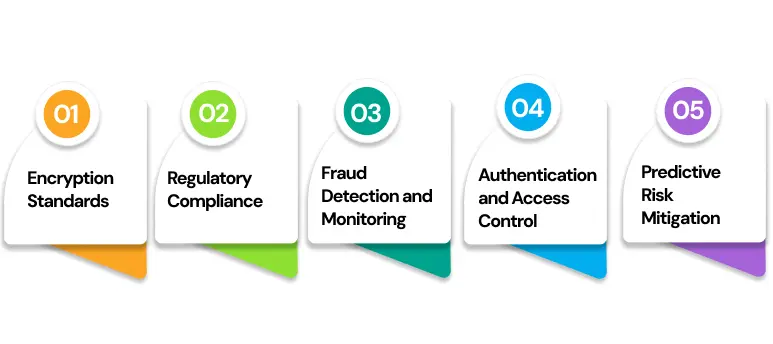 In the FinTech domain, security is not optional because of the fact that it is the foundation upon which trust and adoption are built. A wallet app must be built with a security-first mindset, so that every transaction, data exchange, and user interaction is protected against constantly changing threats.
Encryption Standards
Advanced encryption protocols directly contributes to making sensitive financial data both in transit and at rest. As per the AES-256 and SSL/TLS implementations, the whole fintech industry benchmarks to deliver data integrity and confidentiality as their key elements.
Regulatory Compliance
Compliance with frameworks like PCI DSS, GDPR, and local financial regulations is again important as these standards not only protect users but also creates a shield around businesses from legal and reputational risks.
Fraud Detection and Monitoring
Real-time anomaly detection is powered by machine learning which can identify suspicious activities before they even escalate. With the help of predictive monitoring, businesses can easily reduce fraud exposure and enhance customer confidence for their fintech wallet apps.
Authentication and Access Control
With the help of multi-factor authentication, biometric verification, and role-based access controls, businesses can make sure that only authorized users go to initiate transactions. These measures help them mitigate insider threats and external breaches in the best possible manner.
Predictive Risk Mitigation
More than reactive defences, predictive analytics help organizations to react to the possible vulnerabilities and proactively make their systems stronger. This forward-looking approach aligns with executive priorities around risk management thus making the security of a fintech wallet app much stronger.
Now to have such a strong security, partnering with the right team is crucial because when businesses hire expert flutter programmers, they gain access to developers who understand both Flutter’s technical ecosystem and of course the security requirements of FinTech. This form of expertise makes sure that wallet apps are not only functional but also resilient against cyber threats. For business leaders making an investment in safe architecture is a strategic decision that protects ROI, brand reputation, and customer trust.
Cost Analysis of Building a FinTech Wallet App
For executives, understanding the financial elements of wallet development is as critical as working for the features and security. The cost of building a FinTech wallet app with Flutter or the cost of hiring a Flutter developer in 2026 typically depends on several key components:
Key components affecting cost
- Design Prototype: For good user interfaces and seamless experiences, you need to make an investment in UX/UI design and this stage sets the foundation for customer adoption as well as your unique brand awareness.
- Development and Testing: Core coding, API integration, and constant testing falls here where Flutter’s efficiency lowers duplication across iOS and Android, thus less overall development costs.
- Compliance and Security: Meeting standards like PCI DSS and GDPR adds to the budget but these investments mitigate risk and protect ROI by avoiding penalties or breaches.
- Maintenance and Scaling: Post-launch updates, bug fixes, and scaling infrastructure makes way for ongoing costs but thanks for Flutter’s single codebase which makes maintenance smooth.
Regional variations
Regional variations again play a role as the best example here can be that going with Flutter devs company in India does provide cost effective solutions with no compromise in quality. Whereas mobile app development company in Australia may align better with local compliance and market insights but can have cost differences. For global enterprises, it is important to actually balance the regional expertise with budget efficiency.
But again, when you hire Flutter developers, you gain access to cost optimization by default for your fintech wallet app.
Choosing the Right Development Partner
You must know that a right development partner is one big decisive factor in whether a FinTech wallet app succeeds or struggles. It is something more than just technical execution, as a partner must align with business goals, compliance, and long-term growth.
Going with global agency
Working with a seasoned Flutter app development company delivers you access to a big pool of experts in building secure, high-performance applications. These firms bring proven methodologies, industry insights, and the ability to deliver within strict timelines, something businesses seek when they want ROI and speed to market.
Going with local agency
Regional expertise is also a way to go here meaning that if you are in Australia, you might go with Flutter devs company in India to bring your development costs down without compromising quality. But partnering with a mobile app development company in Australia can offer local compliance knowledge and market-specific insights, which is more valuable.
The final decision
The decision ultimately comes down to alignment and your budget offcourse. You should evaluate partners not only on technical credentials but also on their ability to act as strategic collaborators. It is like hiring someone who actually anticipates risks, helps you optimize costs better, and promises you a scalable fintech wallet app solution.
A Clear Process Roadmap for Building a FinTech Wallet App
Now developing a FinTech wallet app with Flutter will require you a structured roadmap with a balance of speed, compliance, and scalability because of course it is one of the most dominating cross platform frameworks in the market. You must view this process not just as a technical checklist but as a pathway to ROI and market uniqueness if your ultimate goal is to do big in the fintech space.
- Step 1: Define business objectives, compliance needs, and target audience and consider this stage as alignment between technical execution and strategic goals.
- Step 2: Creation of wireframes and interactive prototypes to validate user flows because early design changes with fixations reduce risk and boosts stakeholder buy-in.
- Step 3: Developing the final version of the app with Flutter’s single codebase for iOS and Android passing solid testing like functional, security, and compliance for ensuring reliability and trust.
- Step 4: Launch a wallet with strong monitoring tools and know that post-deployment, scaling infrastructure and optimizing performance stays key to sustaining growth.
Accelerate Your FinTech Wallet App Vision with NetSet Software
If you want to build a secure, scalable FinTech wallet app with Flutter and want someone who comes out as a strategic investment in ROI, brings speed-to-market, and has worked on some exceptional Flutter projects, then you can partner with NetSet Software. Our team will help you accelerate your digital transformation growth and deliver you a competitive edge with all the most advanced and modern features. You can take a look at our portfolio, talk to our team members, and just quickly schedule a discovery call for your fintech wallet app idea.
FAQs
What is the average ballpark cost of building a FinTech wallet app using Flutter?
Costs can vary massively as per your scope and region, so it is not possible to make a ballpark; however, you can book a call with one of our experts to get a detailed quote specific to your project.
How long does development usually take?
A secure, feature-rich wallet app typically requires 4 to 6 months of constant and focused working.
Is Flutter safe enough for financial applications?
Yes, with proper encryption and compliance, Flutter apps meet industry-grade security standards- something that even the biggest of tech giants use it for.
Can the app scale as user demand grows?
Without any doubt, because the architecture of Flutter lets you scale in the most flexible manner.
Why should I go with Flutter over native development?
When you go with Flutter, it saves cost, is faster to build and launch, and maintains flexible scalability, which is complex when it comes to native development.