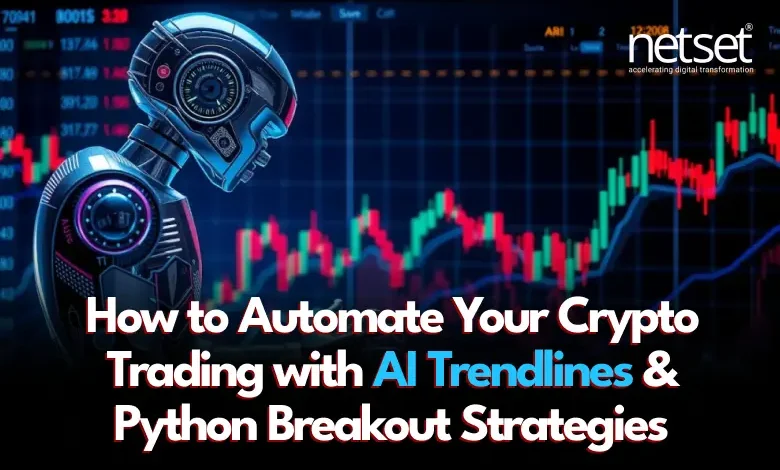
In this high-stakes cryptocurrency trading world, profit margins are no longer determined by market standards anymore, but by latency and intelligence. The relentless 24/7 nature and high volatility of the crypto markets demand an automation strategy that far surpasses what human traders will be capable of.
For businesses that are already working in the trading space, they know that if they do not act as per the market and bring automation, they won’t be able to stand strong in the market. But do not worry, if you are also standing in the same confusion, then this guide will give you a strategic blueprint for upgrading your existing infrastructure with respect to AI trendlines and Python breakout strategies.
You can use this understanding and implement the same with crypto trading software development, and stand strong again in the competitive world.
Why is AI your platform’s next revenue driver?
To fully appreciate the scope of the shift that is going on in technology, business leaders must first understand that automation has undergone a strong evolution, fundamentally changing the competitive dynamics of proprietary crypto trading.
From reactive indicator to predictive intelligence
Historically, automation in finance just relied on basic technical indicators that were simple moving averages, relative strength indexes, or fixed architecture opportunities. These systems were purely reactive and predictable, and any benefit they delivered was quickly removed as other market participants adopted similar logic. Now the integration of machine learning marks the shift from reactive to predictive trading.
The ML models, like those utilizing deep neural networks, are capable of consuming diverse, massive datasets like market data, social sentiment, macroeconomic indicators, and even network activity to generate probabilities for future price movements. This approach is widely studied in the academic community, with numerous surveys confirming the shift from traditional models to deep learning models (like CNNs and RNNs) for advanced price prediction in cryptocurrency research.
That is how the foundation of the modern AI trendline began and kept on booming.
The nonnegotiable 24/7 automation and latency
When you connect AI capabilities, you are not just technically upgrading things; rather, you are starting an important business strategy that influences the profitability and scalability of the platform.
Sustained Alpha Generation
AI-driven models can identify profitable patterns that are too subtle or too high-dimensional for human or traditional algorithmic analysis to detect. This proprietary intelligence leads to the generation of “alpha,” or excess returns above the market benchmark, thus delivering a notable competitive benefit. This requires special AI development services to also correctly structure the data pipelines and train strong models.
Always on Trading
The crypto market never sleeps so legacy systems requiring human supervision or downtime are mostly disadvantaged. A fully automated AI system will make sure that the right trading opportunities, like rapid, high volatility events, are acted upon immediately irrespective of the time zone.
Execution Speed
The entire system, from prediction that is AI to execution that is Python strategy, must be engineered for ultra low latency. When you invest in specialized artificial intelligence development services, make sure that models are not only intelligent but also optimized for real time inference directly feeding into the execution engine to maintain an important time advantage over competitors.
How does AI trendiness deliver your predictive edge?
The true power of AI in trading is its ability to move further than simple correlation and linear prediction. For crypto platforms that are popular, this means building a custom solution that can detect non obvious market structures and what we call the AI trendline.
Deep Learning’s secret weapon for linear market forecasting
Traditional trend analysis relies on standard deviation, linear regression, or simple polynomial fitting. But cryptocurrency price action is nonstationary in nature and holds complex and chaotic dependencies. So to capture this complexity, platforms should make use of deep learning architectures:
Recurrent Neural Networks and Long Short-Term Memory
These models are inherently designed to process sequences of data, which makes them perfect for financial time series. Research has shown that LSTM networks can effectively capture the complex, non-linear dependencies in volatile cryptocurrency price data, achieving high accuracy scores such as an R² Score of 0.9486 in some forecasting models.
Unlike traditional models, LSTMs can remember or forget past information, letting them capture long-term dependencies like the effect of a major exchange hack from weeks ago while also focusing on short-term noise. This is how the model can identify a true, high-conviction trend instead of just a momentary price spike.
Feature Engineering- The key to insight
The model’s intelligence is limited only by the quality of its inputs. While price and volume are standard, a good system must add diverse features to gain a real edge.
- Market Microstructure: Order book depth bid, ask spread changes, and order submission rates.
- Blockchain Data: Network utilization, transaction fee levels, and active wallet counts.
- Sentiment: Real-time sentiment analysis from social media like X, Telegram, and Reddit, and relevant news feeds often makes use of specialized natural language processing models built through advanced AI development services.
Hence, by applying these features, the model learns the nonlinear relationship between market inputs and future price direction, delivering a vastly superior prediction compared to relying on a simple technical indicator.
Quantifying Conviction Using AI Confidence Scores as a Risk Filter
A prediction without a measure of certainty is worthless in high-frequency trading. An AI trendline is not just a directional forecast (up or down); it is a directional forecast mixed with confidence scores.
Defining the score, strategic application, and case study example
The confidence score, which you can also see as a probability metric, stays between 0 and 1 and reflects the model’s statistical possibility if the predicted trend will hold over or not. This score acts as the primary risk filter for the execution strategy.
For example, a platform might only permit a high leverage breakout trade if the AI trendline model returns a confidence score between 0.60 and 0.85; the platform might limit the trade to spot buying only. If it falls below 0.60, the strategy should stand down or may only be executed at a hedge. This allows the system to trade in aggressive mode at the time of high certainty regimes and preserve capital during market uncertainty.
For the case study, let’s just imagine that the AI identifies a strong, 0.92 confidence continuation trend for ETH/USD on a 15-minute chart, a prediction based primarily on low order book volatility mixed with rising network activity. A human trader watching the chart consolidate might hesitate, but the automated system identifies the high statistical probability of a move, validating the signal for the subsequent Python execution module.
This layered approach, using deep learning for prediction and a confidence score for risk management, is the strategic core that separates a high-performance proprietary platform from standard retail bots.
The right execution- Python’s role in speed breakout capture
Once the AI trendline module delivers a high conviction signal, the system must shift gears into high-speed execution. This is where Python breakout strategies come into play. While Python is mainly known for its ML capabilities, its extensive libraries and active community make it the optimal choice for rapid strategy development, backtesting, and production execution logic, mostly integrating with faster languages for the ultimate trading speed.
Strategy design to build your breakout core with Python
 Breakout strategies capitalize on moments when price action violently moves outside a predefined trading range, mostly notifying the beginning of a major trend move that is exactly what the AI trendlines predict. The Python’s scientific stack (Pandas, NumPy, SciPy) allows for the faster development and testing of complex breakout logic:
Diverse range definition
Unlike manual trading, where support and resistance are visually marked, the Python strategy must richly calculate these boundaries. This can involve using:
- Volatility-based channels that are automatically calculated channels, like Keltner channels, where breakout is defined
- Consolidation Boxes, which identify specific periods of low average true range and narrow price movement over the last N bars
Filter Integration
The Python script acts as the final gatekeeper as it checks the technical breakout conditions and, importantly, cross-references the AI trendline’s confidence score. No action is taken without a high conviction model from both the technical indicator and the predictive model. Here, businesses can hire Python development company expertise to ensure complex filters are coded for maximum efficiency and minimal execution lag.
The ultra-low latency pipeline signal to the execution architecture
Now the important challenge is translating the Python signal into a market order without delay. Even a few milliseconds can mean the difference between capturing a move and including slippage, so the process must follow an optimized signal to execution pipeline like below:
- Data feed where the system receives real-time, low-latency market data through a consistent connection like WebSocket
- Strategic login in Python because this module listens to the data feed.
- Execution Engine (mostly in Rust or Go), as it is responsible for minimal processing and wire-speed order transmission.
- Risk parameters are all orders that should be hard-coded with immediate stop-loss and take-profit parameters made to manage risk instantly upon execution.
Hence, compartmentalizing the system means using AI for intelligent prediction, Python for strong strategy and filtering, and a compiled language for high-speed execution. Businesses can know they are equipped with an architecture built for speed and sustained profitability.
Production readiness with a bulletproof infrastructure
Moving the AI trendline and Python breakout strategies into live production requires a bulletproof, enterprise-grade infrastructure. This operational core requires a dedicated tech stack, which is optimized for ultra-low latency, and Python remains key for ML and strategy, but final execution must be handled by a compiled language like Rust or Go using a time series database.
If you go for a successful deployment, it will hinge on diverse risk mitigation to avoid catastrophic curve fitting, as this mandates advanced validation techniques like walk-forward optimization and Monte Carlo simulations that accurately model real-world factors like fees and slippages.
Of course, a crypto trading software development or cryptocurrency development services provider can accelerate time to market and deliver the best security and resilience.
Accelerate your Alpha generation with NetSet Software
In the end, applying a bulletproof and high-speed trading architecture, which requires Rust and Go execution engineers, securing complex smart contracts, and managing advanced risk models, is for sure a special challenge. Do not let your competitive edge stall while your team struggles with the right infrastructure development.
NetSet Software is a premier provider of crypto trading software development, offering diverse cryptocurrency development services. When you partner with us, you get a secure, scalable, and market-ready system just customized to your firm’s requirements. This is the right time to partner with an experienced firm for a strategic AI Python upgrade and lead in the competition.
FAQ
What fundamental business benefit do I get with the AI trendline over legacy traditional indicators?
Legacy indicators like MAs are purely reactive, whereas the AI trendline delivers a predictive edge with the help of deep learning.
How will AI ensure the stable generation of “alpha,” or excess returns?
It first identifies profitable, nonlinear patterns that are invisible to human traders, and then it integrates a confidence score, which acts as a dynamic risk management filter.
What are the main performance requirements for ultra-low latency execution?
To remain competitive, the end-to-end execution latency must be sub-10 milliseconds, so it requires a dual-stack approach, which you can achieve with Python and Rust or Go together.
Why is a hybrid Python/Rust tech stack important for best performance?
Python is always better for intelligence later, and Rust/GO stays there for the speed layer, and together they deliver top-class Rust/Go intelligence at microsecond-level execution speed.
How can I protect my system from curve fitting and catastrophic risk in live trading?
Protection relies on advanced risk validation and not just simple backtesting, so you have to use walk-forward optimization and Monte Carlo simulations. Don’t worry, a right cryptocurrency development services provider will ease your work here.