The mantra to success in this modern world has become one: deliver a superior, high-performance experience across every device with maximum efficiency. This escalating demand for cross-platform capability, mixed with the need for native grade speed, has driven Flutter from a promising framework in 2025 to an enterprise-level necessity for 2026. And why not?
This is the framework that is backed by Google and delivers the decisive strategic advantage of compiling to native code for mobile, web, desktop, and applied systems from a single codebase written in Dart. Not only does it lower development and maintenance time by 30-40% but also makes UX across all platforms standard. Due to this efficiency, Flutter has now become a strategic choice for global firms trying to partner with a mobile app development company India.
As we approach the next year, the main challenge is no longer adaptability but about the cost. So whether you want to hire Flutter developers on a freelance basis or a Flutter mobile app development firm for a complex project, this blog will help you to shape your budget.
The strategic value of the Flutter developer
The high demand for the cost of skilled Flutter talent in 2026 is not driven by the hype; it is driven by tangible, measurable business value. For firms planning scalability and efficiency, the framework delivers architectural benefits that directly translate into a superior return on investment (ROI).
Technical and Business Benefits of the Framework
Do note that the primary draw of Flutter is its ability to radically make the development lifecycle simple while also boosting the end user experience.
Single codebase efficiency
If we look at the most notable benefit of Flutter, then it is the “write once, deploy everywhere” principle (as supported by nearly 46% developers). When you want to make use of a single codebase, a Flutter app development company aims for iOS, Android, web, and desktop ecosystems, all at the same time.
With this there is no need to maintain separate development teams (like Swift/Kotlin, React, etc.), which cuts down time to market as well as the development and maintenance costs. The resulting savings can later be used in business for better strategic investment.
Native performance with superior UX
Not like the older cross-platform solutions that relied on JavaScript bridges, Flutter compiles Dart code directly to native ARM code (for mobile) and highly optimized JavaScript (for web). This compiled nature delivers near-native speeds , resulting in fluid animations and fast application responsiveness, which is again an important factor for user retention in competitive markets like FinTech and eCommerce. Then Flutter’s use of its own rendering engine known as Skia also delivers pixel-perfect consistency across all platforms, promising a standardized high-quality user experience, which was missing in older hybrid apps. All thanks to the Flutter devs, who are key in bringing visions to reality with a near-native optimization where even while comparing Flutter vs React Native, Flutter takes edge.
Why will demand continue to spike in 2026?
The market for Flutter professionals is entering a mature expansion phase, ensuring demand that will only accelerate in the coming years.
Multi-platform expansion (more than mobile)
While Flutter did gain ground in mobile, the future of it is far bigger. The commitment from Google to Flutter as the UI layer for Fuchsia OS makes the framework’s long-term viability much stronger. Then, the official stable releases for desktop (Windows, macOS, and Linux) and web development mean enterprises are now utilizing Flutter to consolidate their entire software ecosystem onto one single technology, needing a wider array of specialized talent.
Maturity and Community Confidence
The framework has moved past its early adoption phase and now brings third-party libraries, extensive documentation, and a massive and active global community. This maturity lowers technical debt and mitigates the risk that is mostly associated with newer technologies, thus making it an easy choice for major enterprises and large corporations looking for proven stability.
Global Pay Benchmark in 2026 for Flutter Devs
The cost to hire Flutter developers changes by location, based on living costs and how rare the skill is. If we see the market trends and anticipated 2025 to 2026 wage inflation in the tech sector, it’s possible to project distinct salary benchmarks across three primary global zones. These benchmarks are important for any business planning to optimize its development budget, as Framework choice directly impacts cost models, making React Native, Xamarin, and Flutter comparison more common.
North America (US and Canada): High cost and specialized talent
North America shows the highest compensation bracket, which is driven by competitive market dynamics, high CoL, and a demand for deep domain expertise (FinTech, HealthTech, etc.). The companies that look to hire Flutter experts in these regions are generally paying a premium for local control and immediate physical access to senior staff.
- The annual salary of a senior Flutter developer is from $140,000 to $195,000+ USD.
- The hourly rate range will be $80 to $130 USD (for contractors).
Analysis
The high end of this range is reserved for architects and principal developers with more than 5 years of experience and who can actually integrate complex native APIs, handle performance profiling, and lead agile teams. The expectation is not just coding but full lifecycle architectural ownership.
Western Europe (UK, Germany, Netherlands) Quality-focused midrange costs
Western European markets generally have a strong balance of high engineering quality and cultural alignment, often at a lower cost compared to Silicon Valley, though still higher than offshore models. The salaries here have a strong influence on regulatory requirements like GDPR compliance and a strong focus on security standards also.
- The average annual salary for a senior Flutter developer here can be seen in the range from €95,000 to €145,000 EUR (that is $105,000 to $155,000 USD).
- The hourly rate range is $65 to $100 USD.
Analysis
This cost reflects a mature labor market where development is mostly unionized and benefit packages contribute notably to total compensation. Mostly from here, firms prefer developers with experience in banking and industrial applications.
The strategic advantage of India and emerging markets
For businesses focusing on scalability, speed to market, and exceptional value, the outsourcing model centers on high talent pools like India, as it offers the most compelling cost advantage without sacrificing technical quality. India has become a global hub for Flutter mobile app development due to its vast supply of English-speaking and really skilled engineering graduates.
- The projected 2026 average annual salary of a senior Flutter developer here is $25,000 to $50,000 USD.
- The hourly rate range if outsourced through a firm goes from $25 to $50 USD.
Analysis
The hourly rate achieved by working with a dedicated Flutter devs company in India or a larger mobile app development company India is notably low. This is not due to lower quality but to the lower cost of labor (CoL) and the efficiency of the outsourcing firm managing the infrastructure, recruitment, and attrition risk. This model lets businesses deploy entire expert teams for the cost of one mid level developer in North America.
The variables that drive hiring costs
While geography provides the base rate, the final cost and overall value of a Flutter developer are shaped by twoFlutter devs company in india key variables, which are their seniority (experience) and their technical specialization (non core skills).
Seniority and Skill Level- the experience multiplier
The difference in cost between a junior and a senior Flutter developer is for sure notable because it is not just about coding speed but also the quality of decision-making and risk mitigation they do.
Junior developers with 0 to 2 years mainly focus on speed, applying features based on clear specifications and learning the framework. They also require close supervision and are important for high-volume and lower complexity tasks.
Then Mid level developers with 3 to 5 years of experience are capable of working autonomously and contribute to architecture, integrate APIs, and manage state effectively. They are the backbone of most development teams.
Senior Flutter Developers capable of more than 5 years of experience are architectural owners whose values lie in designing scalable systems to make sure about security compliance, mentoring junior staff, and profiling performance to handle high traffic or high security applications like Fintech. They also mitigate technical debt, which is far more costly than their higher salary.
- A junior-level person charges $45 to $70 for feature implementation, bug fixes, and learning.
- Mid-level personnel charge $75 to $110 for autonomous work, API integration, and state management.
- Senior/Expert charges $110 to $150+ for system architecture, security, performance profiling, and team leadership.
Technical Specialization and Scope
A developer who knows Dart and Flutter will cost less than one who can also handle complex infrastructure and native integrations. These non-core skills have a notable cost but also exponentially increase the scope of work one developer can handle.
Non-core skills that drive up cost
If you go for a CI/CD setup to save operational time and reduce human error, then your costs will increase. Then backend integration, native bridge development, and Rust integration are a few more elements that affect the prices depending on the mid to advance level you are targeting.
Project Complexity
Large-scale, enterprise-level projects like banking apps and large eCommerce platforms with millions of users require higher costs. These projects demand key knowledge in data encryption, advanced caching, and completing specific regulatory standards like HIPAA or PCI compliance.
The need to hire Flutter experts (what defines expert)
When a project demands mission-related performance or bespoke customization, a business needs to hire Flutter experts– the developers who function at the very peak of their technical ability. But wait, what defines an expert?
They are able to perform advanced performance profiling with their deep skills in using tools like Dart DevTools to identify and resolve subtle junk or memory leaks. Also, the experts can modify or contribute to the underlying Flutter engine, like Skia for best rendering performance. You can also expect experts with architecture pattern mastery, meaning they are great in complex state management patterns and designing scalable architectures so that when the app grows, everything is easy to change.
Strategic Hiring Models Comparison
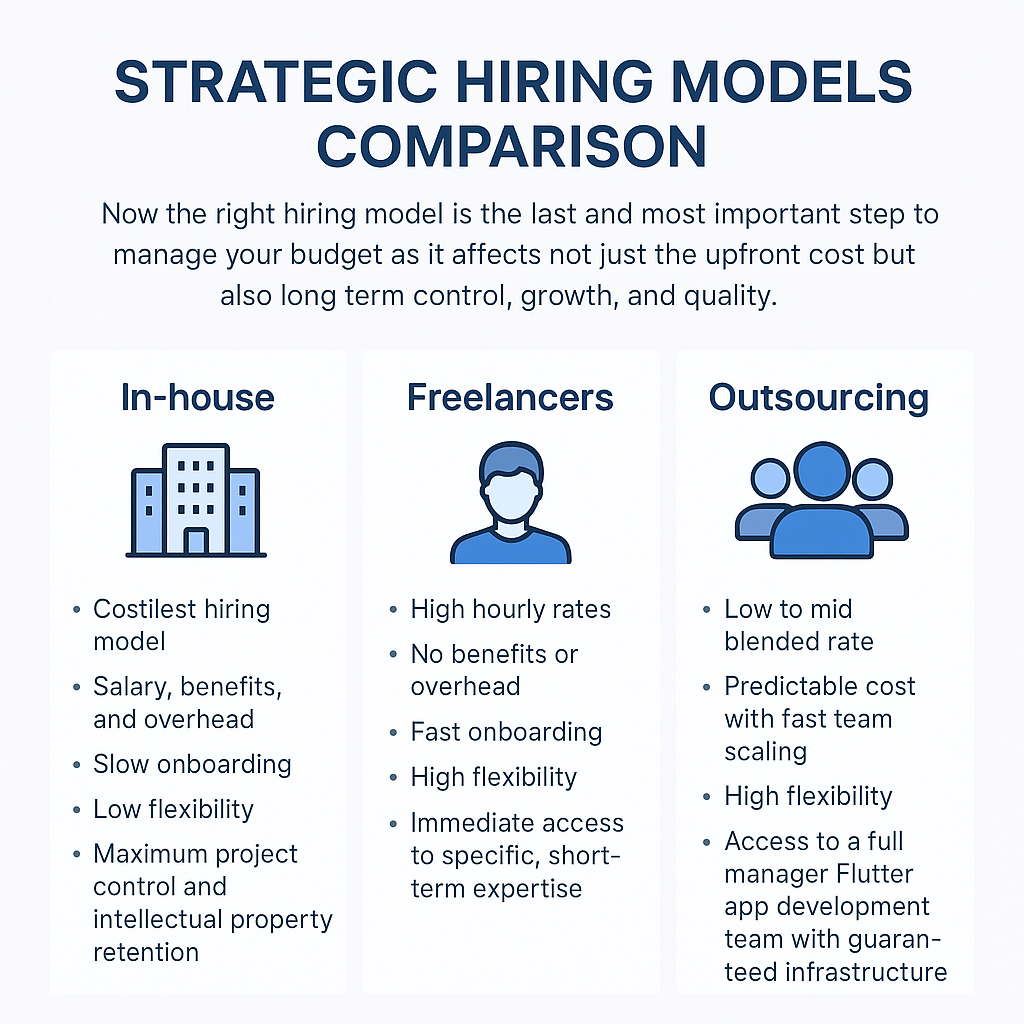
Now the right hiring model is the last and most important step to manage your budget as it affects not just the upfront cost but also long term control, growth, and quality. Here businesses should aim to balance overall costs with the flexibility and speed given by each of the below options.
In house
The in-house hiring model is the costliest because you have to deliver salary, benefits, and overhead, followed by slow onboarding and low flexibility, but it delivers maximum project control and intellectual property retention.
Freelancers
Freelancers (contractors) may have high hourly rates that vary from individual to individual but come without any benefits or overhead costs, followed by fast onboarding, high flexibility, and immediate access to highly specific and short-term expertise.
Outsourcing
Outsourcing (dedicated team) has a low to mid blended rate, predictable cost with fast team scaling, and high flexibility; that is, you get access to a full manager Flutter app development team with guaranteed infrastructure.
Ready to maximize your Flutter ROI? Partner with NetSet Software
So if you are ready to maximize your 2026 ROI with a talented team in Flutter development, then you can collaborate with us too. We are a dedicated Flutter app development company with experience of nearly 2 decades in the market. You can expect immediate access to pre-vetted senior Flutter architecture with deep expertise in even the most competitive fields like fintech and AI. You can request a detailed quote right now and forget about any hiring risks involved.
FAQs
What is the estimated Flutter ROI in 2026?
Due to a single codebase, development and maintenance costs are reduced by 30 to 40%, delivering long-term ROI.
How much are the estimated savings I make by not going with in-house staff?
You can expect an additional 25 to 40% cost if you go in-house, so this complete cost is saved.
What should I go with, the US or India?
US senior devs cost $140k to $195k as compared to $25k to $50k for India, without any compromise in the communication as well as the skills.
Can you tell me an ideal team structure?
1 senior architect or leader, 2 mid-level developers, 1 UI/UX designer, and 1 backend resource are suitable for a basic project, but of course the team expands quickly if requirements become complex.
How much time does it take to outsource a team?
Outsourcing is fastest with firms like NetSet Software, who are ready to onboard on your project as soon as possible, within 48 hours.