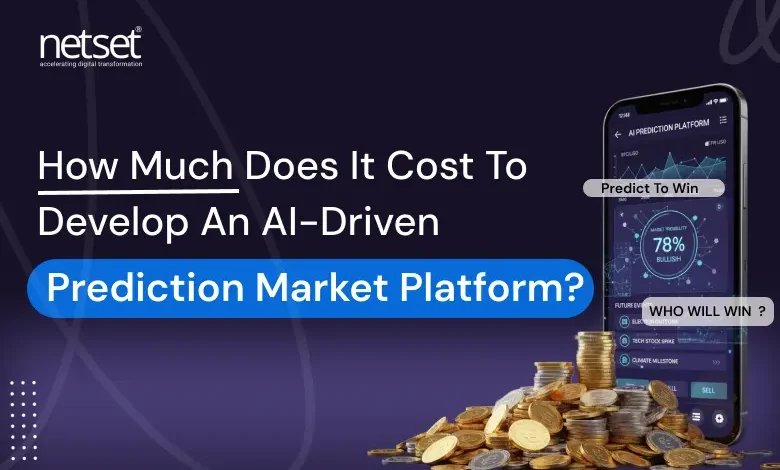
Today we are looking at a market opportunity that is quickly transforming how the world predicts the future. The traditional forecasting models are giving way to sophisticated platforms that utilize the power of crowdsourced insight and artificial intelligence. When you mix the dynamisms of financial exchange with the accuracy of advanced AI, you create the ultimate product in the market, known as an AI driven prediction market platform.
This is not just another betting application because it is complex prediction market software that uses algorithms to identify the trends, manage risk, and deliver the kind of analytical certainty that attracts serious users.
To put the scale of this opportunity into perspective, the decentralized prediction market alone was valued at $1.4 billion in 2024 and is projected to skyrocket to $95.5 billion by 2035, showing a massive CAGR of 46.8%.
But such monumental growth begs the question you are here to answer: what is the real cost of creating such a disruptive technology in the market? Well, this guide will give you a detailed business plan breaking down the financial investment requirement to move from concept to launching best prediction market apps in the industry.
Budget unpacking- What actually drives the cost of your platform?
The final price tag on your prediction market platform is not a single number but a sum of three major variables. You can think of this as the fundamental equation of software development, and understanding these factors lets you control the budget before a single line of code is written.
Complexity and Feature Scope
The biggest cost driver is complexity because creating a simple prediction platform for in-house use is really different from creating a consumer-facing production market app that handles millions of real-time transactions. The more complex your logic (like automatic settlement and complex order types) and the more systems you integrate, the higher the required investment goes. A system with high security standards, complex architecture, and advanced AI features can be seen as a large enterprise project.
Technology Stack and Performance
Now the tools you choose also matter, like will your platform run natively on iOS and Android or use a cross-platform solution? More than that, the core trading engine and database must be architected for speed and high availability, which again requires solid expertise and server-side technologies that are for sure not cheap to get. Now, creating for scalability from day one prevents costly rebuilds later.
Team expertise and geography
This is for sure the most variable cost factor due to the fact that the skill of an AI developer is not cheap, but the location of talent does change the rate notably.
- In the high-cost regions like the US and Western Europe, rates can range from $80 to $180+ per hour.
- There are high-quality AI app development service in India or other Asian outsourcing partners who will deliver you cost-effective service, where rates typically range from $25 to $70 per hour without even a single compromise on technical excellence.
As per the standard, the effective hourly rate for an outsourced AI development services partner in the Asia Pacific region can be as low as $25 per hour. This is again four to five times less than senior talent in high-cost regions, so geographical elements are key to maintaining a competitive budget.
The non-negotiable core features and their price tags
When you create a budget for the important framework of your platform, you are going to invest in the engine, housing, and security systems. These components represent the bulk of the starting development time as they evolve complex security and transactional logic.
User module and compliance
While this module seems simple, it handles everything from onboarding to user asset management and requires strict protocols.
- Registration and Profile help you secure multi-factor authentication and profile creation.
- KYC/AML integration integrates with third-party identity verification services to meet regulatory demands, which again is an important cost factor.
- Wallet/Asset Management is a secure system that handles user funds, whether they are fiat, stablecoins, or platform tokens, and it often includes multi-signature or custodial wallet logic.
Trading Engine and Market Logic
This is the central nervous system of your platform and is responsible for real-time order matching and calculating probabilities.
- Real-time order matching is the component that instantly processes buy and sell orders, and it must be highly performant and scalable.
- Market creation and resolution are tools for administrators to define an event, set outcomes in yes or no or multiple outcomes, and securely resolve the market once the real-world event takes place.
- Data feeds and oracles are mechanisms to reliably import external and real-world data to settle markets.
Robust backend and security
This category is mostly invisible to the user but consumes a good portion of the budget already.
- Admin Panel is a detailed dashboard for you and your team to manage markets, oversee transactions, handle disputes, and maintain user support.
- API-first architecture is for building a flexible foundation that easily connects to your mobile app and future AI/analytics tools.
These are some of the basic features that are nonnegotiable when you plan to create prediction market software with the help of a financial and blockchain software development company. Now again, these core features generally represent the largest segment of the pre-launch investment and can even range from $50,000 to $150,000, even in MVPs, because these are some features you cannot launch an MVP without.
The AI-driven edge features that again multiply your value and cost
 This is the section where your prediction market platform earns the AI-driven title and separates itself from standard exchanges. Here, integrating artificial intelligence is the key cost multiplier, but it is also the source of your platform’s competitive advantage.
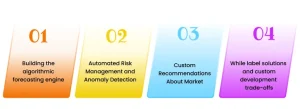
Building the algorithmic forecasting engine
This will be the brain of your platform. A dedicated AI forecasting engine pulls in massive streams of external data like news sentiment, social media trends, political polling data, and historical market volatility. It uses machine learning models like recurrent neural networks or advanced regression models for processing this unstructured data and outputting the probability scores. Again, creating such features requires a specialized AI development services provider who will actually convert your investment into the best ROI.
Automated Risk Management and Anomaly Detection
In any market, integrity is everything, and AI is your best defense when it comes to defense against manipulation and fraud. Your platform needs an engine that constantly monitors user behavior and transaction patterns in real time. When a user suddenly places large orders with multiple markets or if trading activity spikes, the AI can flag the behavior as a risk.
Custom Recommendations About the Market
To maximize the user engagement, your platform should feel custom to each individual. Here the AI engine can analyze a user’s past market participation, trading volume, and successful forecasts to suggest new, relevant markets. If a user frequently participates in political markets, the platform will use predictive models to push new political events to their dashboard first. This customization is what turns a good platform into a user-retaining prediction market app.
While label solutions and custom development trade-offs
When you consider AI integration, you face a key build or buy decision. Building a bespoke AI suite from the ground up, custom to your exact market niche, gives maximum competitive advantage but comes with a high cost. Alternatively, some companies may offer a white-label artificial intelligence solution, which is a prebuilt, reusable AI component designed for prediction markets. While this path can notably lower upfront development time and cost, it limits your ability to customize the core AI algorithms, thus making the platform less unique in the long run.
Although the AI-driven costs can see a hefty addon, I know that it will reduce 20% to 35% prediction errors as compared to traditional models, so it makes the investment worth it.
Calculating the final estimated platform cost
Now that we have understood the factors affecting the cost and features in detail, it’s time that we can put a final breakdown so that you have an accurate idea while looking for AI app development services in India or any other region you are planning to.
- Minimum Viable Product: For your prediction market software‘s MVP, you can estimate the range of $30000 to $50000 and a time frame of 3 to 5 months.
- Advanced and scalable platform: As you are done with your MVP and collect feedback, you can now go for the final prediction market app development phase with an estimated cost range of $100k to $150k and a time frame of 6 to 9 months or 1 year if your project is complex.
- Full customization and deep learning AI features: If you partner with a blockchain app development company for complex deep learning models and other AI addons then you can prepare a budget range of $300k to $400k and this kind of project will surely take more than a year.
- Maintenance and Support: For this part you can keep 10 to 20% of the overall cost aside.
[Prefer Reading: Cost to Build a Prediction Market Platform Like Polymarket or Augur]
Want a detailed quote for your next best prediction market app? Consult NetSet Software.
While the blog outlines everything you need to know, if you want to get a detailed quote about your prediction app idea, then you can collaborate with NetSet Software. We are specialists in providing custom, scalable, and secure AI development services that promise you the success that you are envisioning. All you have to do is schedule a consultation call with our AI solutions architect, share your project requirements, and get a detailed cost with a budget optimization roadmap.
[Prefer Reading: How to Create a Prediction Market Platform like Polymarket]
FAQs
How does AI specifically reduce the risk in prediction market software?
AI models like the ones that focus on anomaly detection do monitor trading patterns for signs of market manipulation or fraud in real time. This automated supervision is what provides far stronger security and lowers operational risk.
Is it budget-friendly to use white-label artificial intelligence for forecasting?
Yes, using a white label artificial intelligence solution is normally cheaper and faster for initial deployment because it uses tried and tested algorithms that are prebuilt. But it comes at the expense of limited customization.
Why is a blockchain software development company important for a prediction market app?
If you want to create simple or basic apps, then it is possible to do it by hiring a few freelancers, but a prediction market app is a very complex one. This is why you require someone who is an expert at it and can handle the final product with the best of transparency and trust.
Are there any post-launch costs with AI development services?
It solely depends on you because some businesses invest heavily in the marketing part, whereas some have a solid working strategy to reach audiences without investing heavily. So, the post-launch costs are mostly related to marketing of your product.
What is the normal timeframe for launching a basic prediction market software MVP?
You can keep a ballpark of around 3 months to launch an MVP of your prediction market software.