How Much Does It Cost to Build a Prediction Market Platform Like Polymarket or Augur?

If you research the most fascinating apps in blockchain technology, then you are going to find prediction markets at the top of the list.
It lets users bet on real-world outcomes, which can be election results or sports or crypto trends, bringing crowd wisdom into decentralized finance. For this, there are a bunch of platforms where Polymarket and Augur have shown how on-chain markets can really be transparent and borderless as well as proof.
In case you are planning to build something similar to these platforms, you might want to find out the cost structures, technologies, and also challenges. No matter if you are thinking of a niche betting website development project or blockchain prediction market software for your web3 startup, this blog will give you a real overview of everything required.
Understanding Prediction Markets and How They Work
Let us keep it simple; you can see a prediction market as just a decentralized exchange where users buy and sell shares on the basis of the outcomes of future events. The prices of these shares reflect the collective probability for an outcome, like there can be a prediction about Bitcoin crossing a specific target by the end of December.
For these bets, there are platforms like Polymarket, which uses blockchain technology to remove mediators and make all transactions auditable. Just like that, we have Augur, which was an early decentralized prediction system that built its framework on Ethereum’s prediction market smart contract logic. With the help of these contracts, these platforms ensure trades, payouts, and settlements take place automatically as soon as an event finishes and results are verified.
Now, for the developers, such systems mean that they have to connect blockchain networks, oracles, user interfaces, and some solid security mechanisms. That is where prediction market software development gets both exciting and resource-intensive and becomes a key factor in driving growth for the entrepreneurs planning such an idea.
Why is blockchain the key success driver in ideas like Polymarket and Augur?
The key reason here is that blockchain acts as a backbone when it comes to decentralization and trust, whereas without blockchain, users would have to rely on a central book market or a broker to manage the trades. The on-chain systems instead use smart contracts that are publicly visible and self-executing in themselves so they do not require any mediator to handle the trade.
Modern blockchain application development services let developers apply oracles that are able to fetch real-world data, which is most important in a few fields like sports or election outcomes. With that, decentralized identity systems and crypto wallets can give users the required privacy while also delivering transparency and traceable financial flows, which were the two key elements that the traditional betting system was missing. When we combine them all, such transparency is the biggest reason why prediction market platform development continues to grow this year and will keep on growing in the coming years.
[Prefer Reading: How to Create a Prediction Market Platform like Polymarket]
Factors that drive the cost to build a prediction market platform
The cost to build prediction market platform really depends on a few things, like scope, features, and tech stack. There are basic MVP versions, which cost much less than large-scale, cross-chain platforms like Augur or Polymarket. Anyways, coming to the point back, here are the key factors that influence your overall cost:
- Choice of blockchain network matters because each network like Ethereum, Polygon, and Arbitrum, comes with its own set of costs and complexities.
- Writing, testing, and auditing prediction market smart contract logic for trade execution, settlement, and reward distribution also affects the cost.
- A user-friendly dashboard that helps the visualization of live markets and prices in real time also affects the final cost.
- If you go for secure data feeds for result validation with Oracle integration, then your cost might go up.
- Wallet and token support influence the cost because some projects demand multi-chain wallet connectivity with the support of ERC20 or stablecoins, which again impacts the cost.
- If you go for external code audits, then your budget is affected by 15 to 25% of the total budget.
- Local betting and gambling laws are different in countries, and you may need compliance consultation or geofencing features, which again affects the cost.
Before you make any decisions, know that the above elements surely affect the cost, but nearly all of them are important if you really want to create a successful application.
Cost breakdown from MVP for full platform
Here we reach the most important part, which is the costing part, but we will keep it very simple to understand.
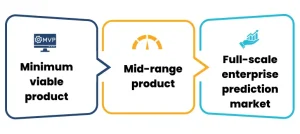 Minimum viable product
This is a basic version of any app and, with the basic version, is mostly used for testing the viability of the idea with features like trading, event creation, wallet integration, and payouts. In this phase you can expect an investment of $40,000 to $70,000 because of a simple interface and limited blockchain integrations.
Mid-range product
For platforms that are similar to early Polymarket clone development cost or smaller decentralized exchanges, the budget ranges in between $80,000 and $150,000. Here you will have a better user experience than an MVP, some oracle systems, and expanded asset support.
Full-scale enterprise prediction market
If you want to go all the way big with a high-performing decentralized platform with features like staking, governance, multichain support, and liquidity pools, then the cost will increase further. This can even go more than $200,000 when you build with the advanced oracles and custom backend analytics, where every part in your application is just unbeatable in the competition.
Choosing the right technology stack for your idea
Other than cost, it is also important for you to make your tech foundation matter and we are not saying that you should be an expert at tech but that you should know a few concepts. A lot of developers prefer frameworks that are easygoing with Ethereum because of its stability, security, and big library. But newer chains like Polygon, BNB Smart Chain, and Solana are becoming popular due to their lower transaction costs.
To give you an idea, here is the core tech stack that goes into blockchain prediction market software:
- For frontend, React.js, Vue.js, and Next.js are some popular ones, and for backend, Node.js and Python with Flask and FastAPI are popular.
- For smart contracts you can go with Solidity (Ethereum), Rust (Solana), or Vyper and connect a database like IPFS for decentralized storage or a MongoDB or PostgreSQL database for your off-chain data handling.
- For oracles, you have Chainlink, API3, or custom oracle layers as per your choice and requirements.
- For wallet integration, you have MetaMask and WalletConnect (the popular ones), and for hosting you can pick from AWS, Infura, or decentralized storage options like Filecoin.
Know that projects that use advanced decentralizing features most of the time choose to hire smart contract developer teams that are experienced in multi-chain interoperability. The right blockchain app development company will promise you smooth integration of oracles, smart contracts, and UI without any compromises in performance.
What about the key features to have in a prediction market platform?
While designs make a difference, there are some must-have features that, by today’s standard, are necessary to have in every prediction market platform, so make sure that you do not miss them.
Core Features
For the core features part, you must have user registration with crypto wallets (non-custodial), a market creation and participation function where users can create or join prediction pools, smart contract-driven escrow and payout mechanisms, and more. Then you shall also have price charts and liquidity tracking and multi-token payment and payout support features.
Advanced features
The advanced features can be diverse but you must be looking to at least have governance tokens and staking, layer 2 or multi-chain interoperability and custom event verification using decentralized oracles. Then you can also plan an analytics dashboard with trade volumes and probabilities and liquidity mining with market-making incentives.
Know that when you go for advanced features, then it will increase your Web3 betting platform cost estimate, where staking systems or DAO-based governance stays in the top complex feature list.
What about the development timeline?
When we are clear about cost, its factors, and tech, there is one more related query that stays in the mind, and it is the timeframe. There is no one-word answer to it because there are so many phases or what we call milestones, in such prediction market platform development. When your app is in the discovery and planning phase, you can expect 2 to 3 weeks, followed by smart contract development services, which will take like 6 to 8 weeks.
Further, you are seeing frontend and backend development, which will take around 8 to 10 weeks and then comes your oracle and wallet integration, which will take 8 to 10 weeks. You will then finally head to testing and auditing, which will take 4 to 6 weeks and the deployment phase, which is again a 1- to 2-week operation.
So, for a standard prediction markets platform, you can plan around 4 to 6 months for an MVP and 6 to 9 months for a full-scale version. For the complex projects that have advanced features like DAO systems or multi-chain support, you are going to see an extended 10- to 12-month timeline. However, if you choose to hire smart contract developer teams with strong DeFi experience, the process will become smooth as well as faster.
Key challenges that break user experience
Even with a solid blockchain backend, the success of a prediction market falls on how easy it is for users to interact with it. There are platforms like Augur, which in the beginning struggled with complexity and slow interfaces as compared to new solutions that have a strong focus on UI/UX and mobile responsiveness.
The cost of creating front-end dashboards, data visualization, and live charts can make up 20 to 30% of your cost to build a prediction market platform where smooth onboarding, wallet connections, and transaction confirmation still stay key for user adoption.
Then developers are mostly using cross-platform app development frameworks like React Native to make mobile access free and if your audience consists of mainstream users, you must simplify wallet usage and gas fee management, which can really improve retention.
Get a detailed quote with NetSet Software and start your journey
Without any second thought, the next wave of decentralized apps will have a massive increase in the demand prediction market smart contract systems. It will continue to push the boundaries about how we trade information, not just assets, and a reliable blockchain software development company like NetSet Software can help you plan your prediction market software development budget.
And not only the accurate cost, but also the team can help you to create the digital solution, whether you want to create a simple data-driven marketplace or a global Web3 betting ecosystem.
FAQs
How much is it going to cost me to create a prediction market platform like Polymarket or Augur?
The cost differs depending on how complex your project is, but still for a basic version, you can set aside around $40,000 to $70,000, whereas a full, large app will cost you much more so it is best to take an idea from a technology partner.
What are key components that affect the Web3 betting platform development cost?
Key cost drivers are smart contract design, oracle integration, user interface, and cross-platform development, but you can also deliver the best security audits and compliance features.
Is there any ideal tech stack that works as the best one for creating blockchain/crypto prediction market software?
Honestly, the choice of technology depends on your project and preferences, but if you want a ballpark, then React is famous for the front end, Python for the backend, Solidity for smart contracts, and MetaMask for wallet integration.
How long will it take to create a prediction market platform from scratch?
If you want to test the viability of your idea, then expect somewhere around 1 or 1.5 months, followed by a full platform within 6 to 9 months.
Is it legal to create a prediction market, and how do the regulations affect cost?
Regulations alter by jurisdiction because prediction markets can also be seen as betting and gambling so it is best to research local regulations and acquire the required licenses to smoothly run your business.