Saudi Arabia is making some remarkable growth when it comes to the healthcare system under their Vision 2030 with a strong push toward digital health and modern patient services. There, the mobile apps play a key role in making access, efficiency, and patient experience better across the region.
Most of the businesses and healthcare providers are actively turning to a trusted mobile app development company in Saudi Arabia as their technology partners to create reliable digital solutions. This shift has shown new opportunities for innovation, better care delivery, and smarter health management for entrepreneurs planning to bring revolution.
The Healthcare App Ecosystem in Saudi Arabia
The great thing about Saudi Arabia is that the government here actively supports the digital transformation for which they have introduced Vision 2030 where the country is investing heavily in telemedicine, mobile health, and AI‑driven healthcare care models. This shift is not just strategic but also measurable. The overall Saudi’s digital health market was valued at USD 2.37 billion in 2024, and projections are that it will grow much faster in the coming years, driven by government backing and rising demand for mobile‑first healthcare solutions.
Telehealth
Telehealthcare is one of the dominant forces that has the largest share of digital health usage in this region. It aligns very well with the growing adoption of remote consultations, chronic disease management tools, and mobile health apps among patients. With this as more citizens rely on digital platforms for everyday healthcare needs, businesses look forward to partnering with a mobile app development company in Saudi Arabia.
Government initiatives
Government initiatives further boost this growth with vision 2030’s health sector transformative program, which focuses on digital records, virtual care, and integrated health systems. There are news and reports that prove Saudi Arabia’s focus on telemedicine, AI diagnostics, and remote monitoring. With this aim, the region is able to create a strong ecosystem of innovation with startups and enterprises building apps for wellness tracking, appointment booking, teleconsultations, and custom care.
The market’s momentum is also fueled by rising chronic diseases and increased patient comfort with mobile health apps, which remain important tools for long‑term care and lifestyle management. With a techy population and strong regulatory support, Saudi Arabia does have a promising opportunity when it comes to healthcare app development in the Middle East.
Some Features that most Successful Healthcare Apps Embed
To build a healthcare app in Saudi Arabia, you need a balance of trust, usability, and compliance because patients want smooth experiences, while healthcare providers want secure and reliable systems. With strong custom healthcare software development, you can make sure that every feature supports real medical workflows and meets national standards.
For the features, here are the key ones that you should add at least.
Secure Patient Records and Medical History
A successful healthcare app must allow users to access their medical records, prescriptions, lab results, and visit history, and like that doctors should be able to review patient information quickly, thus having the best communication and no delays in care.
Booking and Scheduling Appointments
The users in Saudi Arabia prefer digital booking for convenience, so a good app must deliver real-time availability, reminders, cancellation options, and smooth coordination functionalities between clinics and patients.
Remote Consultations and Telemedicine
Virtual care is no doubt a big part of Saudi Arabia’s healthcare system, so features like video calls, chat consultations, and digital prescriptions are a must for patients as they want to receive care without visiting a clinic in the dense traffic.
Wearables and IoT Devices Integration
A lot of patients use smartwatches and health trackers, so when apps sync with these devices, doctors gain deeper-level insights about heart rate, activity levels, sleep patterns, and glucose readings, thus giving the best personalized care.
Strong Security and Compliance
Healthcare apps must follow Saudi Arabia’s data protection rules, which include encrypted communication, secure login, and strict access control. With this, patients get confidence that their medical data is protected at all times.
Arabic‑First, Bilingual User Experience
A healthcare app in Saudi Arabia must focus on Arabic as the primary language, with English as an optional interface, so that the solution delivers accessibility for both citizens and foreigners.
Factors that affects Costs of Building a Healthcare App in Saudi Arabia
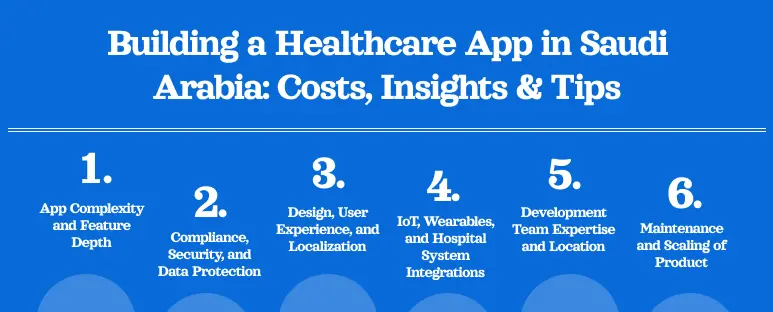 Building a healthcare app in Saudi Arabia consists of several moving parts right from compliance and security to design, integrations, and long‑term maintenance. There can be different budget numbers as per the complexity of the app, its features, and the development approach you choose. It is a good idea to go for custom mobile app development services in Saudi Arabia so that you can customize your app budget just as you need. Here are the factors affecting the cost of healthcare app development.
App Complexity and Feature Depth
The cost of healthcare app development in Saudi Arabia heavily depends on the type of app being built. There are apps with basic features like appointment booking and medical records that fall on the lower end. Then there are advanced apps like telemedicine platforms or apps similar to Sehhaty that require more investment due to video consultations, AI‑based recommendations, and secure data handling.
Compliance, Security, and Data Protection
Healthcare apps in Saudi Arabia must follow strict data protection rules, like compliance with national digital health standards, secure authentication, encryption, and audit trails, all add to the development cost. And, know that security and regulatory alignment are major cost drivers in the region’s healthcare app ecosystem.
Design, User Experience, and Localization
Saudi Arabia’s healthcare users expect clean interfaces, Arabic‑first design, and smooth navigation, so creating bilingual interfaces, culturally aligned layouts, and accessible UI elements increases design effort, thus costs also.
IoT, Wearables, and Hospital System Integrations
Apps that sync with smartwatches, glucose monitors, or hospital EMR systems require more development time as compared to the ones that do not use it. The Integrations with IoT devices and third-party APIs for chronic care and remote monitoring apps notably affects the final cost.
Development Team Expertise and Location
Hiring local experts over partnering with an Indian based development company delivers you compliance and cultural fit, but may come at a higher cost. If you go with outsourcing your project to countries like India, the overall expenses go low without any compromises in quality because it’s a developing economy.
Maintenance and Scaling of Product
After launch, apps need constant updates, bug fixes, security patches, and new features and when it comes to healthcare apps, they require long-term support to stay compliant with changing regulations and patient expectations. And, such long-term investment and planning does add up to the budget.
A few important Insights for Developers and Executives
To build a healthcare app in Saudi Arabia requires a clear understanding of both the technical elements as well as the business expectations that are shaped by Vision 2030. The developers and executives usually approach the project from different angles, but both share the same goal that is to create the best healthcare solution.
Developer Insights
The Developers working on healthcare app projects in Saudi Arabia must focus on security, performance, and compliance because healthcare data is always sensitive, so apps must follow strict national guidelines. Also, know that the right tech stack, like Flutter, React Native, or other native development ones, depends on the complexity of the app and its long-term scalability, hence decide accordingly.
Then, developers also need to plan for integrations with hospital systems, IoT devices, and wearables. Such integrations require clean APIs, stable backend architecture, and strong testing practices. Finally, performance testing, load testing, and security audits also go important so that the app can handle real‑world usage.
Many organizations prefer to hire Mobile App Developers in Saudi Arabia on freelance models, too which can be better than offshore teams if you understand the requirements clearly.
Executive Insights
Executives focus on outcomes, which means faster delivery, lower costs, and long‑term value, and a healthcare app must not only function well but also meet Saudi Arabia’s digital health goals. This includes supporting telemedicine, improving patient access, and reducing operational pressure on clinics and hospitals. Executives also look at ROI from multiple angles:
- How quickly can the app launch
- How well it engages patients
- How easily it can scale across regions or specialties
- How effectively it reduces manual workload
A well‑designed healthcare app can improve patient satisfaction, lower administrative burden, and boost a provider’s digital presence. With Saudi Arabia’s growing digital health market, businesses that invest early gain a competitive advantage.
Bridging Both Perspectives
The most successful healthcare apps are built when developers and executives collaborate closely. It is because developers bring technical clarity, while executives bring strategic direction, and together, they create apps that are secure, scalable, and aligned with Saudi Arabia’s healthcare vision.
Tips for Building a Future‑Ready Healthcare App
You need more than just good development skills to build a healthcare app, as it requires planning, cultural understanding, and a strong focus on long-term scalability also. The below tips will help businesses and developers create apps that stay relevant, secure, and aligned with the region’s digital health goals.
[Prefer Reading: How to Build a Scalable and Secure Wellness App in 2025?]
Step 1- Focus on User Experience and Accessibility
To start with, healthcare apps must be easy to use for patients of all ages, so clear navigation, readable text, and simple workflow will make a big difference. Then Arabic should always be the primary language, with English available as an option, and don’t forget a clean, friendly interface that promises you trust.
Step 2- Focus on Security and Compliance
Saudi Arabia has strict rules for medical data management so apps must use encrypted communication, secure login methods, and strong access control. Then regular security audits help with compliance like national digital health standards which is important for protecting patient information and maintaining credibility.
Step 3- Partner With Healthcare and Tech Experts
Working with experienced consultants, medical professionals, and Saudi‑based developers makes sure that the app fits real healthcare workflows. The experienced teams understand cultural expectations, patient behavior, and regulatory requirements much better than new teams in the market.
Step 4- Plan Scalability with Future Technologies
Healthcare does advance quickly, so your app should be built with a flexible architecture in mind, which shall support new features like AI recommendations, remote monitoring, and integration with other or future hospital systems.
Step 5- Test Across Devices and Regions
Saudi Arabia has a diverse user base so testing the app on different devices, network conditions, and user groups gives smooth performance everywhere right from major cities to remote regions.
Build your Healthcare App in Saudi Arabia with NetSet Software
The right partner like NetSet Software, is your key when it comes to healthcare apps in Saudi Arabia so working with a trusted mobile app development company in Saudi Arabia will boost your success chances with great numbers.
If you wonder why it matters? To answer that, companies like NetSet Software know Saudi healthcare workflows, cultural expectations, and compliance requirements. This then lowers risks, speeds up development, and makes sure that your app fits real user needs.
The team of NetSet Software supports you beyond launch with updates, security improvements, and new features, thus becoming your go-to technology partner for Kingdom’s fast‑growing digital health market.
FAQs
How much will it cost me to create a healthcare app in Saudi Arabia?
There are no fixed numbers because the cost is decided by features, security requirements, and integrations. Just know that basic apps cost less, while telemedicine or IoT apps demand higher investment.
What is the timeframe that goes into developing a healthcare app?
Most healthcare apps take a few months, but some might even take more than a year as per their complexity, design requirements, features, and compliance requirements.
Do healthcare apps need special approvals in Saudi Arabia?
Yes, because these apps handle medical data and must follow national digital health guidelines + strong data protection rules.
Can my app support Arabic and English users?
Absolutely, as most healthcare apps in Saudi Arabia have Arabic as the primary language with English as an optional interface.
Can a new app connect with wearables and my old hospital systems?
Yes, it will connect with smartwatches as well as glucose monitors, and EMR systems in your hospital to support the best possible patient monitoring and care.