For decades, the Saudi property market was defined by rigid paper deeds and high capital barriers that limited entry to institutional giants. But now the digital aspect has completely changed where assets are changed into flexible and liquid shares.
With the help of the power of real estate tokenization blockchain, the Kingdom is not just upgrading its tech; it is rewriting the institutional logic of asset governance. This shift promises that the smart investor of tomorrow focuses on liquidity and security above all else.
How did Vision 2030 build the digital foundation?
The transformation of Saudi real estate is basically a pillar of Vision 2030 that aims at making national assets more transparent and resilient. At the heart of this evolution is the transition from a cash-heavy economy, where 70% of bill payments were once made physically, to a sovereign digital infrastructure.
The architect of the digital pipeline
Faisal Monai, a key architect of the kingdom’s payment systems, has moved from digitalizing cash to reprogramming the national asset base. Through platforms like droppRWA, he has secured mandates worth around $12.5 billion to bring real-world assets or RWAs, onto the blockchain.
Key institutional milestones
- Regulatory Leadership: The real estate general authority or REGA has established a global regulatory standard linking technology directly to legal assets.
- The single source of truth: The Real Estate Registry or RER, serves as the conclusive record so that no digital token is issued without a given registered deed.
- National Integration: Systems like Yakeen (identity) and Sadad (payments) are integrated directly into the tokenization rails.
As the kingdom builds this multi-rail financial system, specialized real estate tokenization development services are becoming the important bridge for developers to align their projects with these national standards.
The Alchemist’s Journey that turns physical towers into programmable tokens
The process of converting a skyscraper into a digital share is a meticulous mix of legal engineering and technical accuracy. It begins with property valuation and the creation of a Special Purpose Vehicle (SPC) to hold the title deed.
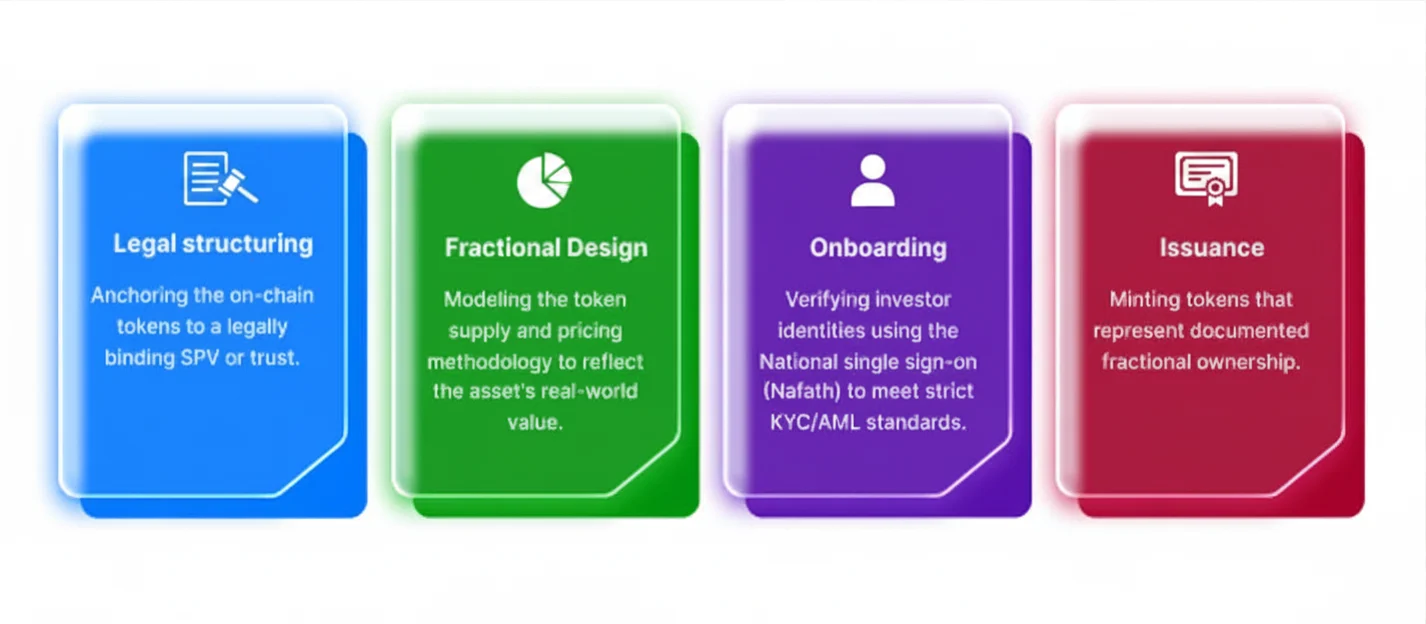
The steps of digital transformation
- Legal structuring: Anchoring the on-chain tokens to a legally binding SPV or trust.
- Fractional Design: Modeling the token supply and pricing methodology to reflect the asset’s real-world value.
- Onboarding: Verifying investor identities using the National single sign-on (Nafath) to meet strict KYC/AML standards.
- Issuance: Minting tokens that represent documented fractional ownership.
| Aspect | Traditional Investment | Tokenized Real Estate |
| Minimum Capital | Hundreds of thousands or millions | Starting from 1,000 SAR |
| Liquidity | Low (months to sell) | High (instant trading via platform) |
| Ownership Proof | Physical/Electronic Paper Deed | Encrypted digital token |
| Distribution | Manual Rental Collection | Automated via Smart Contracts |
For developers, achieving this level of accuracy requires custom blockchain software development for real estate that can handle the whole asset lifecycle from issuance to automated dividend distribution.
The Pillars of Absolute Certainty: Why Saudi Arabia is not just a pilot
Unlike isolated experiments elsewhere, Saudi Arabia’s initiative is a national-scale infrastructure program. The kingdom is not just testing blockchain; it is deploying it to protect national wealth from global economic shocks.
Speed as a competitive benefit
Traditionally, property settlement involved length verification and administrative lag. The new blockchain-based infrastructure has already shown that property settlement times can be lowered from several days to mere seconds.
The roadmap to 2026 and beyond
- Stablecoin integration: By late 2026, regulated stablecoin-based settlement is expected to go live, letting developers receive global capital in minutes.
- Interoperability: The focus is on creating “regulator-portable” rights that remain applicable even when assets cross jurisdictional boundaries.
- Sovereign Resilience: As you reach 2030, the kingdom expects to prove that sovereign-grade tokenization can function as core financial infrastructure.
The goal is to provide absolute certainty in ownership and transfer that makes asset tokenization platform development an important focus for both the public and private sectors.
Breaking the Gates with 1000 SAR of investor empowerment
Real estate ownership in the kingdom is no longer a privilege of the ultra-wealthy. Tokenization has actually lowered the barriers to entry that let a 1000 SAR investor take part in the growth of Riyadh’s skyline.
The Rise of PropTech Leaders
Several platforms are already working under REGA’s regulatory sandbox that provides a safe environment for retail investors.
- Sahl: Pioneers in the fractional ownership model that focuses on making property investment accessible and simple.
- Madak: The first authorized application to give partial ownership opportunities that generate monthly income.
- Jozo: A private platform that lets users build a property portfolio part by part with target annual returns of around 8.2%.
Real estate tokenization is shifting the narrative from speculative crypto to legally anchored digital deeds. Investors can now check residential, commercial, or logistic opportunities; study the prospectus; and buy tokens straight from their phones.
The architect’s vision: an always-on, interoperable future
The future of Saudi real estate is always on. Industry experts note that aggressive mobilization of state capital is validating the tokenization thesis globally. But the real challenge lies in the oracle problem that makes sure that physical data ingestion remains accurate and verifiable.
Building a multi-rail ecosystem
The kingdom is not looking to replace traditional banking but to add a faster, more sovereign digital layer along with it. This multi-rail approach lets traditional currencies and regulated banks coexist with tokenized assets.
Future capabilities include the following:
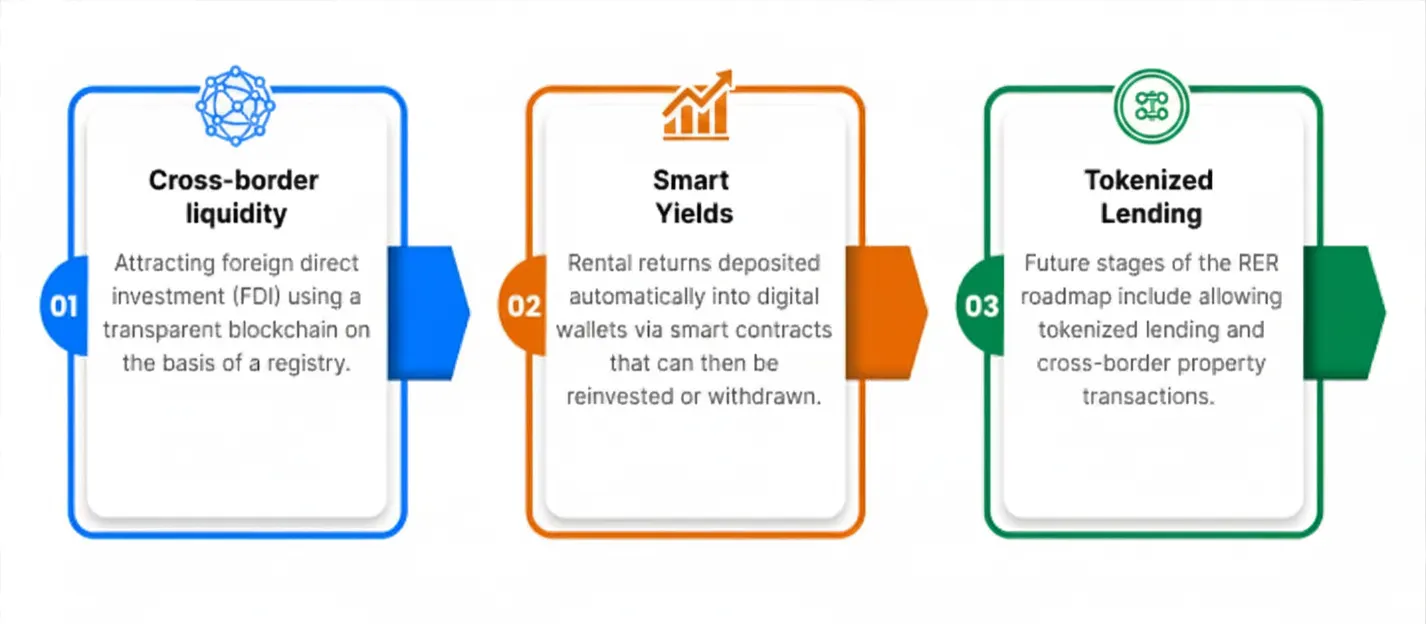
- Cross-border liquidity: Attracting foreign direct investment (FDI) using a transparent blockchain on the basis of a registry.
- Smart Yields: Rental returns deposited automatically into digital wallets via smart contracts that can then be reinvested or withdrawn.
- Tokenized Lending: Future stages of the RER roadmap include allowing tokenized lending and cross-border property transactions.
This high-speed transition demands the most robust blockchain software development solutions for the real estate sector to make sure that every transaction is auditable and institutionally reliable.
Build your digital oasis with NetSet Software
As the kingdom accelerates to a fully integrated digital real estate ecosystem, the opportunity for early entry is unmatchable.
The team of NetSet Software provides end-to-end real estate tokenization platform development services that can help you navigate the complex intersection of REGA regulations and Shariah-compliant technical structures.
Our mission is to help governments, enterprises, and mid-scale startups to transform physical assets into high-velocity digital shares so that projects are ready for the sovereign-grade financial infrastructure of the next century.
FAQs
Is real estate tokenization legal in Saudi Arabia?
Yes, operations are conducted under the strict supervision of the Real Estate General Authority, which is REGA, and within a monitored legislative environment to make sure investors’ rights are protected.
What is the minimum investment required?
While regulators are finalizing given thresholds, tokenization is designed for accessibility, with opportunities generally starting between 500 and 1000 Saudi riyals.
How do I receive my rental returns?
Thanks to smart contracts, rental returns are deposited automatically into your digital wallet on the platform. You can then reinvest these funds or withdraw them to your bank account.
Can foreigners and residents invest in Saudi tokenized real estate?
Yes, new regulations let residents and foreign investors own shares in tokenized real estate within given controls, making the kingdom’s investment circle wide.
How do I sell my tokens if I need liquidity?
Investors can give their tokens for sale in a secondary market available within the licensed platform. Ownership is transferred to the buyers instantly as the transaction completes.